
Bezpłatny fragment - Voynich Manuscript (2)
Treasure of Knowledge
Introduction
The Voynich Manuscript has, for over a hundred years, constituted one of the most intriguing and enigmatic works in the history of humankind. Countless generations of researchers, cryptologists, and enthusiasts of mysteries have undertaken attempts to decipher its text, treating it as a complex linguistic cipher. These efforts, despite the enormous amount of work invested and the application of modern scientific methods, have not led to a definitive solution to the mystery. In my conviction, this is not a coincidence.
The starting point for this book is the assumption that the principal carrier of information in the Voynich Manuscript is not the text, but the image. It is the illustrations — their structure, composition, and symbolism — that constitute the proper key to understanding the intentions of its creators.
The text, by contrast, performs the function of a veil, a kind of mystification, and at the same time a labyrinth in which seekers of meaning have wandered for many years, often losing time and energy on attempts to decipher that which — perhaps — from the very beginning was not intended to be read in the classical sense.
In my previous book, I presented a detailed interpretation of two fundamental parts of the Manuscript. First, I discussed and interpreted the section previously referred to as the herbal section, which I proposed to call the historical section, indicating that the illustrations contained within it constitute a symbolic compendium of the history of our civilization — from the earliest prehistoric events to contemporary history.
Second, I undertook an attempt to read the meaning of the section referred to as the biological section, which I named the anatomical section, indicating that the scenes depicted within it symbolically describe the structure and functioning of the human organism, as well as the processes occurring within it.
Those analyses constituted the first stage of a broader research project, the aim of which is the systematic interpretation of the entire Voynich Manuscript as a coherent system of signs and ideograms. The results of these studies led me to the conclusion that the illustrations of the manuscript should be considered primarily in semiotic terms, that is, as signs carrying specific meaning, rather than merely as decorative representations of plants, figures, or structures.
From the perspective of semiotics, every element of an illustration — shape, proportion, spatial arrangement, the relationship between parts of the image — may perform the function of a sign. The root of a plant may signify the beginning of a process or the source of events; the stem — development or continuity; the leaves — the branching of ideas or events; and the flower — their result or culmination. In this way, the illustration ceases to be an image in the aesthetic sense and becomes a message — a kind of ideogram written in the language of symbols.
For this very reason, in the present book I consciously resign from the analysis of the textual part of the manuscript. Not because it is devoid of meaning, but because its function may be primarily instrumental — to constitute a structure that diverts attention from the actual message. The text, in this perspective, acts like a labyrinth: it draws the researcher into a process of endless searching, multiplies hypotheses and interpretations, and at the same time effectively separates him from the most important source of information, which is the illustrations.
The history of research on the Voynich Manuscript shows that for decades it was precisely the text that constituted the main object of scholarly interest. Successive linguistic, cryptographic, and mathematical theories were developed; however, none of them brought a final solution to the mystery.
One may therefore pose the question whether this is not evidence that answers were sought in the wrong place — that the key to understanding the manuscript from the very beginning lay not in the letters, but in the images.
The present book constitutes a continuation of previously initiated research and focuses exclusively on the analysis of the illustrations of the remaining parts of the manuscript, in particular the astronomical, cosmological, and pharmaceutical sections. I adopt the assumption that each page of the manuscript was designed as an autonomous unit of meaning, and at the same time as a fragment of a larger narrative describing the development of the world, nature, and humankind.
Did the authors of the manuscript intend to transmit knowledge in a form resistant to the passage of time and changes of language? Did they create a system of signs capable of surviving centuries, even when the original language ceased to exist? Or perhaps their aim was to conceal knowledge in a form accessible only to those who are able to read symbols and perceive meaning in the structure of the image?
The analysis of the illustrations, conducted with consideration of their semiotic function and the logical structure of visual communication, makes it possible to perceive in the Voynich Manuscript a system of meanings far more ordered and purposeful than might appear at first glance.
I therefore invite the reader to continue this shared journey through the successive pages of this extraordinary work. It will be a journey requiring patience, imagination, and readiness to look at an illustration not as an image, but as a sign — a sign that may lead to an understanding of knowledge hidden in symbols.
The illustrations used in this book originate from the website of the Beinecke Rare Book and Manuscript Library of Yale University: link — https://collections.library.yale.edu/catalog/2002046
Folios 85R2 and 86V3
85R2 — The Life of Man
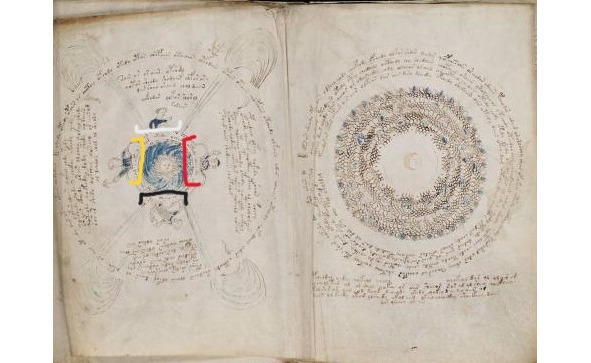
Folio 85R2 constitutes an encoded message about the life of Man — his days and nights. The fact that this has been presented in such a synthetically symbolic manner leads to the conclusion about the genius of the semiotic message of the creators of the Manuscript. But to the point.
Human life consists of successive days and nights that create the rhythm of existence. Particularly significant in this context are the ideograms of the Sun and the Moon, placed at the center of each graphic. They symbolize these two times of day that make up the everyday reality of each of us. Days are the time of activity and exploration of the world. During the day, a person acquires knowledge, experiences new situations, develops abilities, and pursues goals.
He meets people, experiences joys and difficulties, works, creates, and makes decisions that influence his future. Days also bring achievements, discoveries, and the possibility of transmitting life and values to subsequent generations.
Nights, in turn, are the time of rest and renewal of strength. At night, a person calms down, falls asleep, and undergoes regeneration. The body regains energy, and the mind organizes memories and experiences of the past day. Sleep restores the balance between effort and rest.
One may therefore say that: the day symbolizes action, development, and experience, while the night symbolizes rest, renewal, and preparation for further life.
Left Side
Developmental Periods of Human Life
White color
Childhood is the time of discovering the world and building the first foundations of life. A person learns to speak, think, recognize good and evil, and discovers the surrounding reality through play and curiosity. It is a period of growth, dependence on others, and the formation of character.
Yellow color
Adolescence is a time of transformation — both physical and psychological. A person begins to search for their own identity and learns independence and responsibility. The first serious decisions appear, new emotions arise, and the need to define one’s place in the world emerges.
Red color
Adulthood is a period of action and creation. A person undertakes work, develops skills, builds social and family relationships. It is a time of realizing plans, assuming responsibilities, and transmitting life and experience to the next generations.
Black color
Old age constitutes a stage of reflection and summary of the years lived. A person gathers wisdom resulting from experience, shares knowledge with the younger generations, and gradually withdraws from activity. It is a time of peace, memory, and preparation for the end of the earthly journey.
Each of these periods is necessary, because together they create the fullness of human life — from birth to its end.
Right Side
Sleep
Sleep is a natural rhythm of human life, just as necessary as work or learning. During sleep, the body rests, and the mind regains balance. Sleep enables a person to maintain health, strength, and the ability to continue acting.
86V3 — The Evolution of Life on Earth
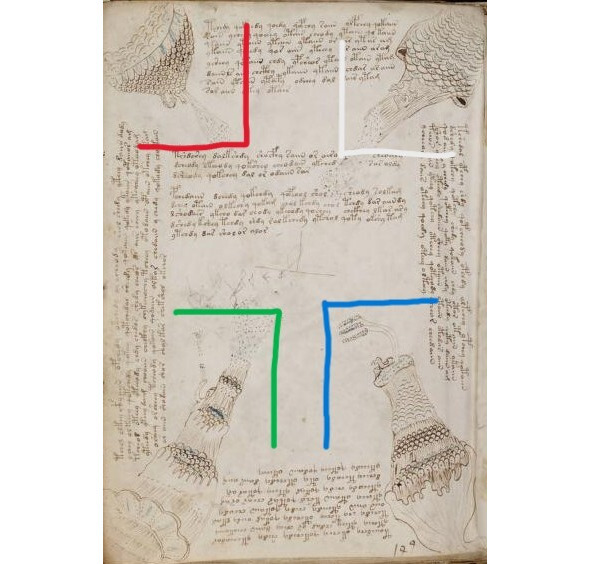
Cycle of Life on Earth can be symbolically presented through the four elements: fire, water, earth, and air, which reflect successive stages of the development of life. They show the transition from the formation of conditions for life, through its birth and development, to increasingly advanced forms of organisms.
Red color
Fire
Stage of the formation of the Earth and conditions for life. The creation of the Earth’s crust, intense volcanic activity, and the shaping of the atmosphere. During this time, cyanobacteria appear, which through photosynthesis begin to enrich the atmosphere with oxygen.
In this part of the graphic, its most important element is erupting lava.
White color
Air
Symbol of the evolution of organisms adapted to life in the atmosphere. Development from reptiles (scales), through intermediate forms, to birds capable of flight. This is the stage associated with mastering space and full adaptation to the aerial environment.
Here it is impossible not to notice a bird in flight.
Blue color
Water
Place of the birth of life. In the oceans, the first bacteria appear; later eukaryotes and multicellular organisms develop. In the aquatic environment, the main evolution takes place until the moment when life begins to emerge onto land — first plants, then animals.
Another clue — a duck swimming on water.
Green color
Earth
Stage of the development of terrestrial life and the evolution of man. From hominids through intermediate forms to Homo sapiens.
This is the time of the development of tools, consciousness, speech, and culture — that is, the full formation of the human being.
And the quintessence of this part of the graphic — the emerging silhouette of a human.
Summary
Elements represent successive stages of the evolution of Life:
Fire — the formation of the Earth and conditions for life
Water — the birth of life
Earth — the development of man
Air — the advanced adaptation of organisms and the mastery of space
Folio 86V
A Map of the World as an Ideogram of the History of Humankind
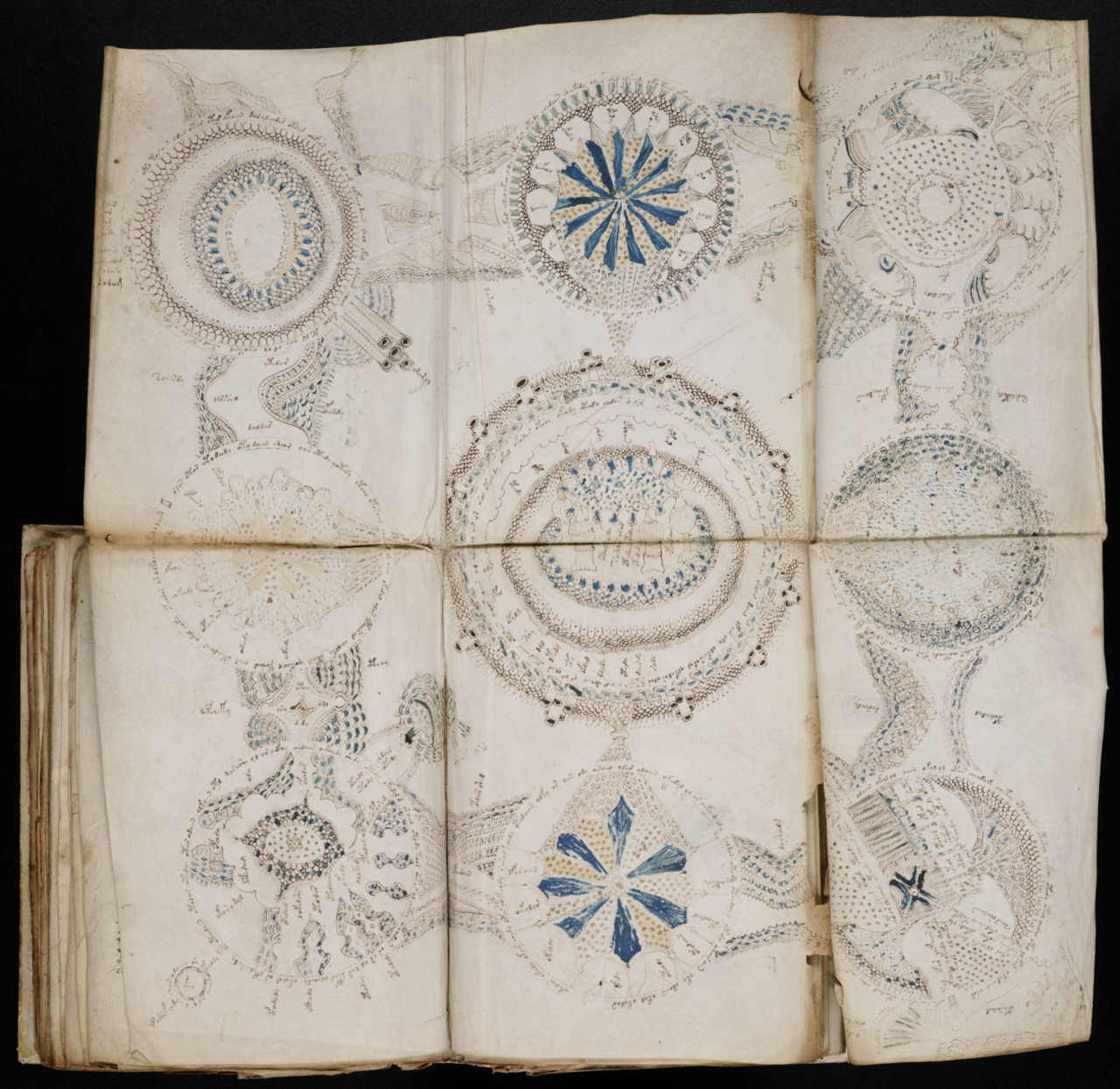
Among all the pages contained in the Voynich Manuscript, a special place is occupied by the folio marked with the number 86V.
It is a graphic exceptional both in terms of composition and the scope of the message that — in my conviction — has been encoded within it. While earlier parts of the manuscript focused on specific aspects of knowledge: history, anatomy, or biological processes, folio 86V constitutes an attempt at a synthetic presentation of the entirety of the history of man and his presence on Earth.
It is not a map in the cartographic sense, but rather an ideographic map, in which geographic space has been presented through symbols and signs carrying specific historical, cultural, and civilizational meaning. For this very reason, the analysis of this graphic requires a semiotic approach — treating individual elements not as realistic representations of lands or cities, but as messages encoded in visual form.
The arrangement of nine interconnected structures, resembling islands or regions of the world, is not accidental. They create a kind of network of relationships that symbolically reflects the processes of migration of peoples, the emergence of civilizations, armed conflicts, the expansion of religions, and technological development.
Connections between particular areas may be interpreted as routes of contact, cultural exchange, or paths of expansion, while clusters of human figures, stars, or buildings constitute a condensed record of events that shaped the history of the world.
In this sense, folio 86V may be perceived as the culmination of the narrative contained in the manuscript — an attempt to present the history of humankind in a single synthetic image. It is a visual chronicle of the world, in which continents are not merely geographic areas, but scenes of historical and civilizational events. Each fragment of this graphic tells a different story: about migrations, discoveries, conquests, conflicts, beliefs, and the development of knowledge.
For this reason, folio 86V should be treated not as a single illustration, but as the central interpretative point of the entire work. If earlier parts of the manuscript can be compared to chapters describing particular fields of knowledge, then the map from folio 86V is their synthesis — an attempt to show the world as a whole, in which all historical and cultural processes remain closely interconnected.
In this part of the book, I undertake an attempt at a detailed reading of the meaning of individual elements of this extraordinary graphic. This analysis is based on the assumption that the authors of the manuscript used the language of symbols, and that every detail — even one seemingly decorative — was placed deliberately and performs a specific informational function.
If one assumes that the Voynich Manuscript is a treasure of knowledge encoded in the form of images, then folio 86V appears as its map — not only a map of the world, but also a map of the history of man, his journeys, achievements, and dramas. It is precisely for this reason that the analysis of this page constitutes one of the most important stages in the attempt to understand the meaning of the entire manuscript.
1. Top Left: North America
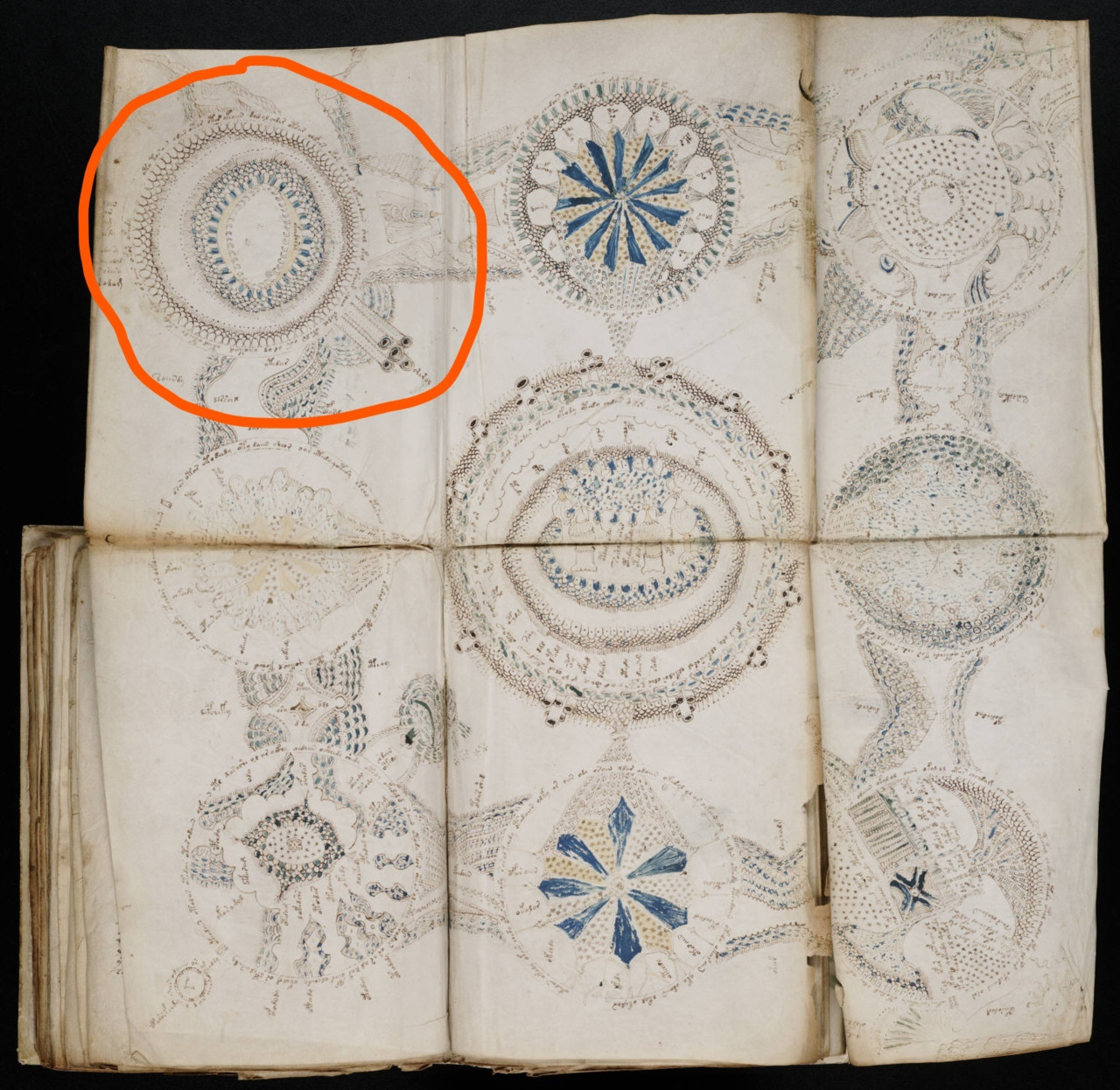
One of the most distinctive fragments of the graphic from folio 86V in the Voynich Manuscript is the area located in the upper left part of the composition, which in my interpretation represents the continent of North America.
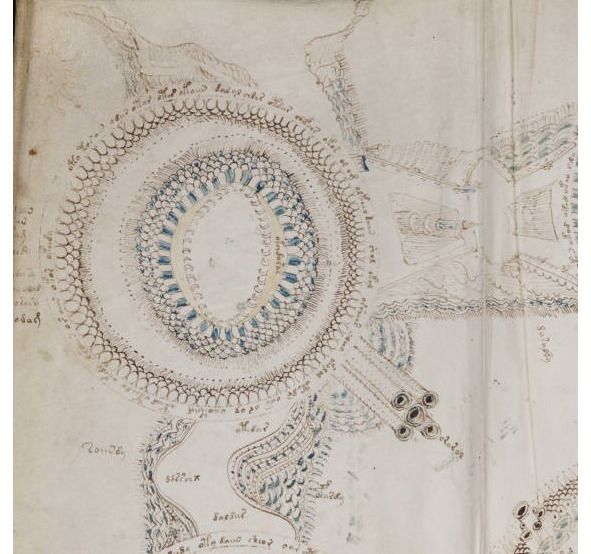
The very arrangement of the coastlines suggests the outline of the northern boundaries of this land: on the right side one can discern a form resembling Greenland, in the center a space corresponding to the Arctic Ocean, and on the left side — an area associated with Alaska.
Further to the west stretches only the vast expanse of the Pacific Ocean, separating America from Asia in the region of the Bering Strait. The symbolic depiction of the setting sun may be read as a metaphor for the end of a certain era and the simultaneous beginning of a new history of humankind on this continent.
Particular significance is attached to the wide connector on the eastern side of this area. In the semiotic sense, it may be interpreted as a route of migration and civilizational contact leading from the Old World to the New. Its size and clear distinction suggest that the process of settling North America was an event of fundamental importance for the history of humanity.
In the upper part of this connector, there is a form which, in symbolic interpretation, may resemble a small object floating in the air. It may be read as a sign of the birth of the aviation era, initiated by pioneers such as Orville Wright and Wilbur Wright, who at the beginning of the twentieth century carried out their first successful flight experiments in the town of Kitty Hawk. In this sense, the symbol does not necessarily represent a specific airplane, but rather the idea of surpassing the limits of human technical capabilities.
Central part of the connector, in which one can discern a shape resembling a vertically rising object, may symbolize another stage in the development of science and technology — the era of space exploration. In this interpretation, the path from the first aviation experiments to the human landing on the Moon becomes a metaphor for civilizational and technological progress. This symbol may be interpreted as a condensed story of the evolution of science — from dreams of flight to the realization of the vision of journeys beyond Earth.
Lower part of the connector, depicting turbulent ocean waves, reinforces the narrative about the hardships of transatlantic travel and the risks associated with discovering new lands. The sea becomes here a symbol both of an obstacle and of a path leading to new worlds.
At the junction of the connectors appears a clear form resembling a tall building. It may be interpreted as a sign of the birth of modern urban architecture, whose symbolic beginning was the nineteenth-century skyscraper known as the Home Insurance Building in Chicago.
In this sense, the skyscraper becomes a symbol of urbanization, industrialization, and the dynamic economic development of the United States.
Continent
The most dramatic message, however, is contained in the continent itself. The outer ring of densely arranged human figures may be read as an image of the pressure of new arrivals, while the cluster of figures in the center symbolizes the indigenous population that was pushed to the margins of its own living space. The lines above the heads of these figures may be interpreted as a sign of conflict, violence, and the struggle for survival.
Graphic presents a symbolic story about one of the most important and at the same time most tragic processes in the history of North America — the gradual extermination of the native population during the period of colonization and territorial expansion, particularly in the times known as the “Wild West.” The visible emptiness in the center of the composition may symbolize the loss of land, culture, and population of the indigenous inhabitants of the continent.
Entire scene may therefore be read as a multidimensional sign of the birth of the modern world — a world of technological progress, dynamic civilizational development, but also dramatic conflicts and profound social transformations. It is precisely this ambivalence — the simultaneous coexistence of achievements and tragedies — that appears to be one of the key motifs of the narrative encoded in the graphic of folio 86V.
2. Top Center: Europe
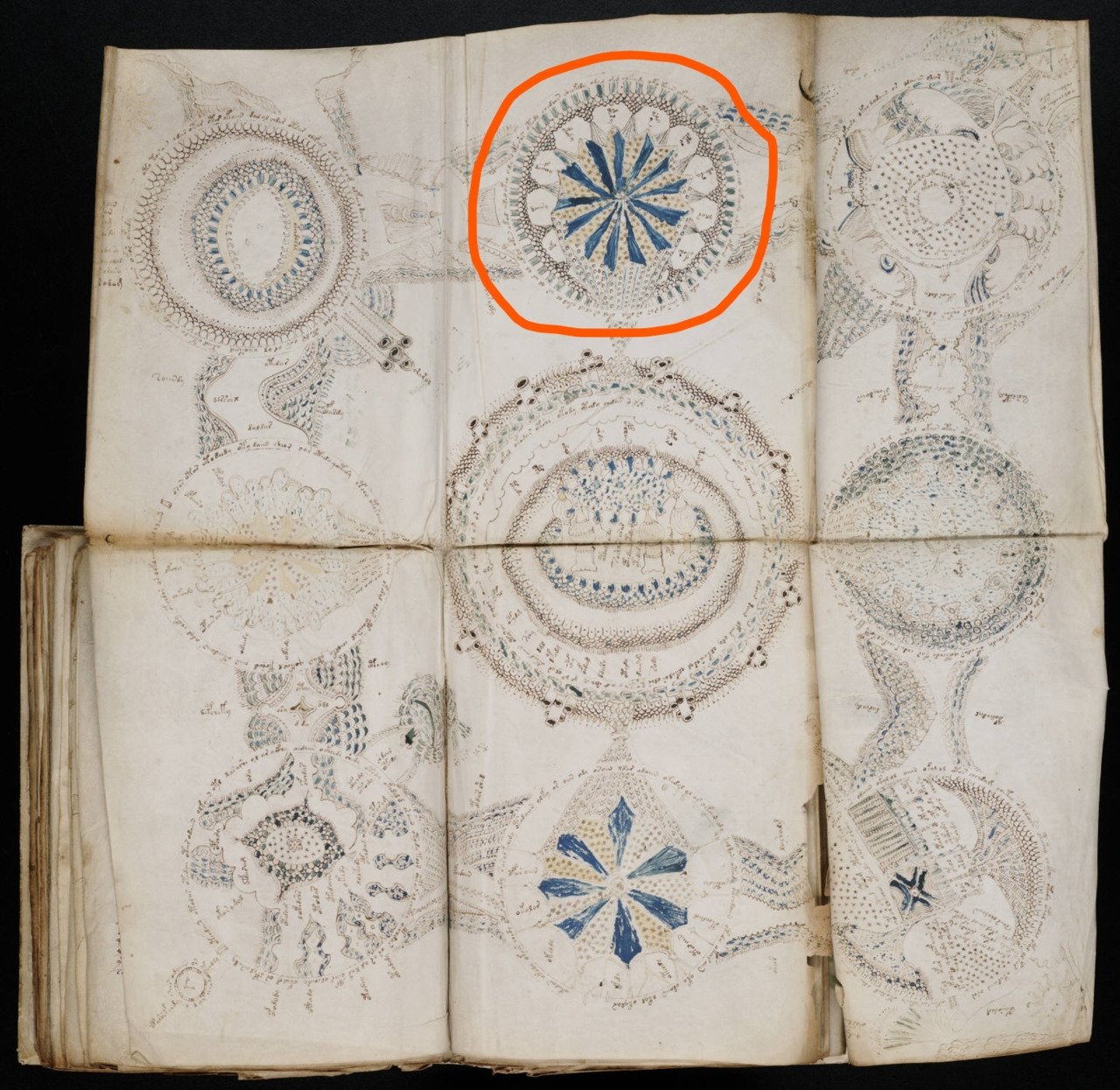
Central upper part of the graphic represents, in my interpretation, the European continent — a space commonly referred to as the Old World. At first glance, an extremely dense concentration of human figures is visible here, clearly grouped into separate clusters. This is not an accidental graphic device.
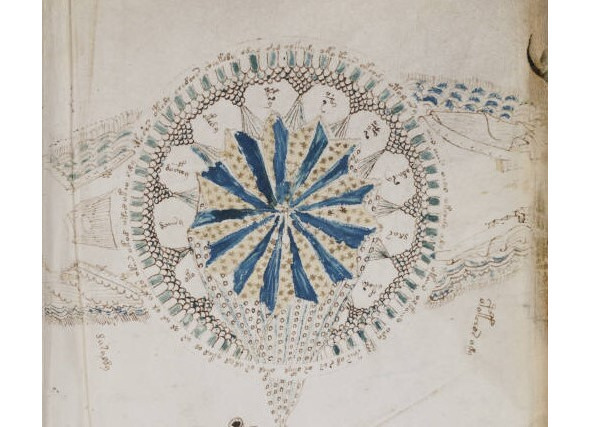
In the semiotic sense, these “bundles” of figures may be read as symbols of nations and states that for centuries co-created the European cultural, political, and religious mosaic.
Europe appears here as a continent of paradoxes — the birthplace of great ideas, philosophical systems, art, and science, but at the same time a space of constant conflict and rivalry. It is from this area that both the values that became the foundation of modern civilization — law, science, state organization, technology — and destructive phenomena such as wars, conquests, and religious persecutions originated.
Density of human figures therefore symbolizes not only population size, but above all the intensity of historical life, which on this continent assumed an exceptionally dynamic character.
Inscriptions visible within the continent — although difficult to read unequivocally — may be interpreted as signs identifying individual states and nations of Europe.
Their number and distribution emphasize the multiplicity of cultures, languages, and traditions that coexisted within a relatively small geographic space. In this sense, the graphic presents Europe as a space of constant dialogue, but also tension between different communities.
Particular attention should be paid to the enormous white-and-blue rosette placed within the continent. In symbolic interpretation, it may be treated as a sign of Europe’s civilizational radiation. Its rays, spreading outward like rays of the sun, may symbolize the process of the spread of European ideas, technologies, and social systems to other parts of the world. It is an image of cultural and political expansion which, during the era of great geographical discoveries and later colonialism, led to the global dominance of patterns developed on this continent.
Connector on the Right Side
Upper part of this connector depicts waves of varying color — on one side blue, on the other almost colorless. In symbolic terms, they may be read as the waters surrounding the northern borders of Europe: the Atlantic Ocean and the Arctic Ocean. Below this is visible a fragment of land with a distinctly jagged coastline resembling the rocky fjords of northern Scandinavia. This element of the graphic may indicate the harsh climate and difficult living conditions in the northern regions of Europe, and at the same time their strategic importance for navigation and trade.
Central part of the connector shows areas of a more regular structure, which may be interpreted as the fertile plains of Central and Eastern Europe. For centuries, this region constituted the agricultural base of the continent and an important area of population migration.
In symbolic terms, this element may signify stability, food production, and continuity of settlement.
Lower part of the connector depicts turbulent waves that may be identified with the waters of the Mediterranean Sea. Since antiquity, this sea has been a space of trade, cultural, and religious exchange, as well as a field of numerous conflicts. In this sense, it symbolizes both contact between civilizations and rivalry for influence.
Southern Connector
A narrowing stream of human heads may be read as an image of great migration movements and military expeditions that swept across the inhabitants of Europe in the Middle Ages. In symbolic terms, this element may refer to the era of the Crusades, military expansion, and religious fervor that prompted entire communities to undertake distant and often tragic expeditions. The narrowing of the stream of figures may signify human losses, exhaustion of forces, and the dramatic consequences of armed conflicts.
Connector on the Left Side
Upper part of this connector depicts undulating green lines above which short strokes are visible, resembling those known from other fragments of the graphic. In symbolic interpretation, they may be read as a sign of migration of populations from island areas, particularly from the region referred to as the “green island.” This motif may refer to mass emigrations caused by religious persecution, economic crises, and famines which in the history of Europe repeatedly forced people to leave their homelands.
Central part of the connector shows terrain with a distinctly rocky structure, which may be interpreted as a symbol of the Iberian Peninsula. For centuries, this region constituted a meeting point of different cultures — Christian, Muslim, and Jewish — as well as the starting point of great maritime expeditions that initiated the Age of Geographical Discoveries.
Lower part of the connector depicts two vertical elements resembling columns, between which sea waves are visible. In symbolic terms, they may be identified with the ancient motif of the Pillars of Hercules — the boundary of the known world. For centuries, this motif signified the transition from the known world into the unknown, and thus the beginning of a journey, risk, and the discovery of new lands.
Continent
Entirety of this part of the graphic presents Europe as a source continent — the birthplace of ideas, conflicts, and transformations that shaped the modern world. It is from here, like from a central hearth, that civilizational impulses spread, gradually encompassing the remaining continents and giving human history a global dimension.
3. Top Right: Asia — Northern Part of the Continent
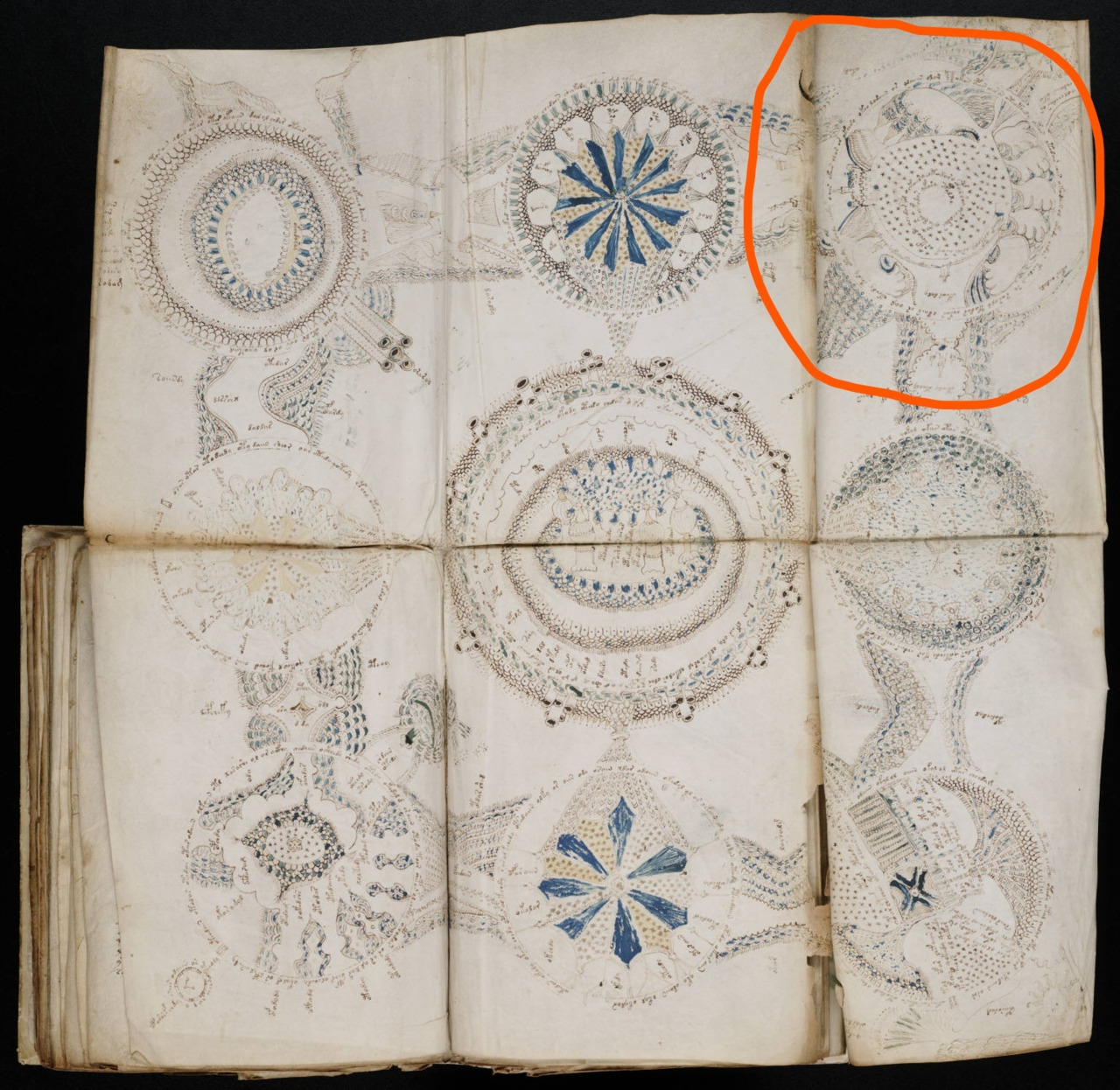
Upper right part of the composition in the graphic of folio 86V in the Voynich Manuscript represents, in my interpretation, the northern part of the Asian continent — a vast space that for millennia has constituted both a geographical barrier and a bridge between different civilizations.
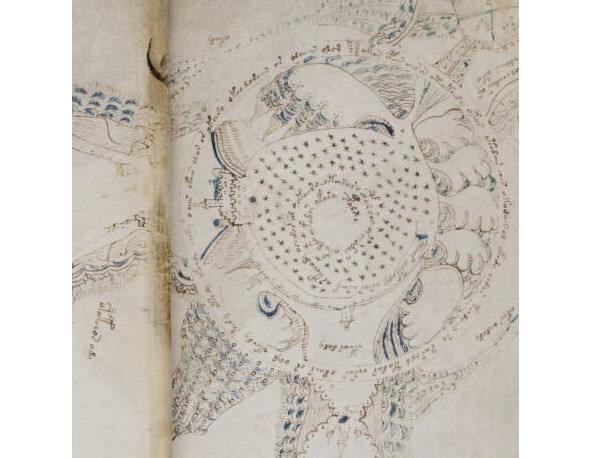
At the very top, the outline of the maritime boundaries of the continent is visible, which may be identified with the waters of the Arctic Sea. The characteristic line separating the water surface from bright, irregular forms may symbolize the boundary of floating ice, and thus the climatic conditions that for centuries limited the possibilities of settlement and communication in these regions.
North-Eastern Connector
In the north-eastern part of the graphic, a narrow isthmus connecting two continents is marked. In symbolic interpretation, it may be read as a reference to the ancient land connection between Asia and North America, existing in times when ocean water levels were significantly lower than today. This isthmus enabled the migration of peoples and the movement of animals between the two continents.
Climate warming and the gradual rise of sea levels led to the formation of a strait separating these areas, which in symbolic terms meant the end of a certain era in the history of human migration.
Southern Connector
Creators of the manuscript, recognizing the enormous cultural and civilizational diversity of Asia, in my interpretation decided to symbolically divide the continent into separate narrative parts. The northern part includes vast areas of northern Eurasia, while a separate graphic was devoted to Chinese civilization. The southern connector may therefore be treated as a sign of contacts between the northern regions of the continent and the developed civilizational centers of East Asia.
Right Side of the Connector
Fragment running in an arc toward the north resembles a chain of islands formed as a result of tectonic plate movements and volcanic activity. In symbolic terms, it may be identified with the belt of islands stretching from the Japanese archipelago through the Kuril Islands to the Kamchatka Peninsula. This element of the graphic may indicate the dynamic nature of geological processes occurring in this part of the world and the natural boundaries separating the continent from the ocean.
Center of the Connector
Form visible here, resembling a defensive structure — a castle or fortress — may symbolize a cultural and political boundary between different civilizational models. In historical terms, it may be interpreted as a sign of the distinctiveness of East Asian and northern Eurasian traditions, as well as a metaphor for systems of authority that for centuries shaped the social life of the inhabitants of these regions.
Area Between the Connectors
Between the southern and western connectors, a fragment is visible depicting an area with the characteristic shape of a peninsula. In symbolic interpretation, it may be identified with the region of the Indian subcontinent, whose significance in world history was exceptionally great both demographically and culturally. The large number of human figures concentrated in this place may symbolize high population density and the dynamic development of the societies inhabiting this area.
Western Connector
Particularly striking element of this part of the graphic is a monumental gate with widely opened doors. In symbolic terms, it may be read as a sign of the boundary between East and West — a space in which political, religious, and economic influences clashed for centuries. The defensive structure placed near this gate may symbolize a system of control and isolation that in history repeatedly separated the inhabitants of this part of the world from other regions. The battlements of the walls in this structure have a clearly swallow-tail shape.
Taking the historical and geographical context as the basis for specifying the final conclusion as to what structure is meant, only one possibility suggests itself — that it refers to the Moscow Kremlin. In historical interpretation, this element may be identified with the idea of closed borders and limited external contacts — a phenomenon that in different eras took various forms, from policies of isolationism to the creation of spheres of influence and political blocs.
Continent
Significant part of the surface of the continent is covered with small signs resembling stars. In symbolic terms, they may signify vast expanses of coniferous forests and hard-to-access territories of northern Asia.
Eastern part of the continent is presented as an area dominated by bright, irregular forms resembling clouds. In symbolic interpretation, they may represent a land of perpetual snow and frost — a region with an exceptionally harsh climate, where low temperatures and long winters constitute the fundamental characteristics of the natural environment.
Northern part of the continent contains an architectural element with characteristic dome-shaped forms. In symbolic terms, it may be read as a sign of central state authority and a decision-making center that for centuries played a key role in organizing the political life of this region.
Southern part of the continent presents a scene of distinctly dynamic character. The small predatory animal form visible here may symbolize successive waves of invasions by nomadic peoples, which in the history of this part of the world played a significant role. The small structures accompanying it may signify centers of power that arose as a result of these events — states and political structures that for a certain time dominated the region.
Centrally placed spiral inscription may be interpreted as a sign of complex and multi-layered historical processes that led to the formation of durable state structures. In symbolic terms, the spiral signifies a path of gradual development — a long-lasting process full of tensions and changes, leading from dispersion and dependence toward independence and consolidation of authority.
Entirety of this part of the graphic presents northern Asia as a vast space, difficult to control, yet strategically important for world history. It is an area in which nature, migrations of peoples, and political conflicts for centuries co-created a unique and complex civilizational reality.
4. Middle, left: Central America
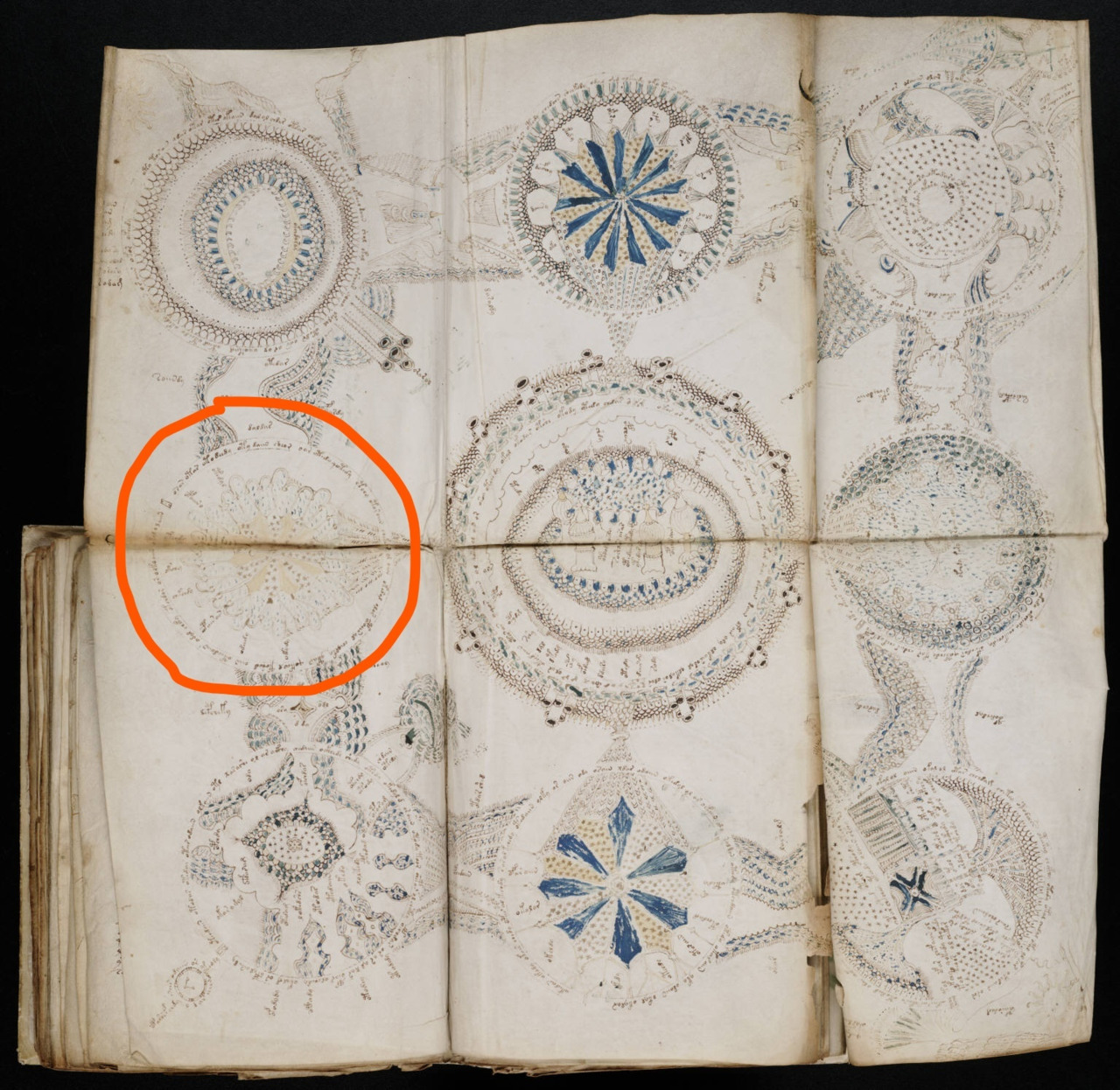
Mddle-left part of the composition in folio 86V of the Voynich Manuscript, in my interpretation, depicts the region of Central America and the area of the Caribbean Sea islands. It is a space of exceptional historical significance, because it was here that for the first time a direct encounter took place between European
civilization and the indigenous inhabitants of the New World, which initiated an era of profound demographic, cultural, and economic transformations.
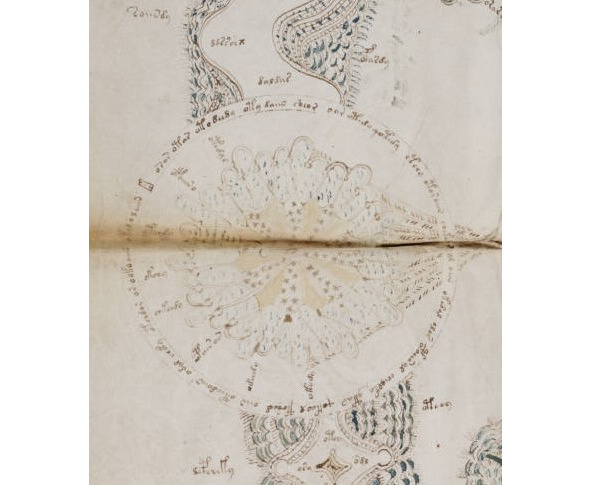
Northern connector
Northern connector of this part of the graphic can be interpreted as a symbol of an event that became one of the turning points in world history — the expedition of 1492, during which the sailor Christopher Columbus reached the islands later called the West Indies. In a symbolic sense, this connector marks the beginning of a new era in human history — the era of geographical discoveries, colonization, and intense intercontinental contacts. Of particular importance here is the reference to the island of Hispaniola, which became one of the first centers of European presence in this region.
It was from the conquest of this island that the process of colonial expansion began, which in the following decades encompassed almost the entire Caribbean area and the American continents.
Eastern connector
Narrowing lines resembling long, tense cords — shown as white bands with black markings — can be interpreted as a symbol of the transatlantic system of transporting enslaved people. In a semiotic sense, this element indicates the direction from which forced labor was brought in to replace the indigenous population, whose numbers drastically declined due to disease, forced labor, and armed conflicts.
This symbolism refers to one of the most tragic phenomena in modern history — the trade in human beings and forced migrations from the African continent to America. The narrowing nature of the lines may represent both the transport route and the loss of freedom, as well as the suffering of individuals deprived of identity and rights.
Southern connector
Southern connector depicts a narrow strip of land surrounded on both sides by blue waves. Symbolically, it can be associated with the isthmus connecting two great oceans — the Atlantic and the Pacific. In the central part of this element, a clear dark mark cutting across the land can be interpreted as a symbol of an artificial shipping canal connecting both bodies of water.
This motif refers to the construction of the Panama Canal — one of the most important engineering projects in world history, which radically shortened maritime routes and transformed the global trade system. Symbolically, this element represents the triumph of technology over nature and humanity’s ability to reshape the environment to facilitate intercontinental communication.
Continent
Central part of this graphic depicts a region whose history is marked by rapid demographic and social transformations. The spreading small star-shaped marks can be interpreted as a symbol of the expansion of settlement and the development of colonial structures that gradually covered successive islands and land areas.
Semicircular blue forms create a layout resembling a map of the Caribbean archipelago. In symbolic interpretation, they may refer to the main islands of the region, such as the Bahamas, Cuba, Jamaica, or the Dominican Republic. Their arrangement highlights the fragmented nature of the geographical space, which fostered both maritime trade and political rivalry between colonial powers.
Overall, this part of the graphic can be read as a symbolic narrative of a region that became a meeting point of different worlds — European, African, and indigenous American cultures. It is a space where economic and technological development went hand in hand with dramatic social and demographic consequences.
Central America thus appears here as a transitional point — a gateway between oceans, cultures, and historical eras. It is here that one can most clearly see how the process of globalization, initiated in the era of great geographical discoveries, changed the face of the world.
5. Middle, center: Jerusalem — Spiritual center of the world
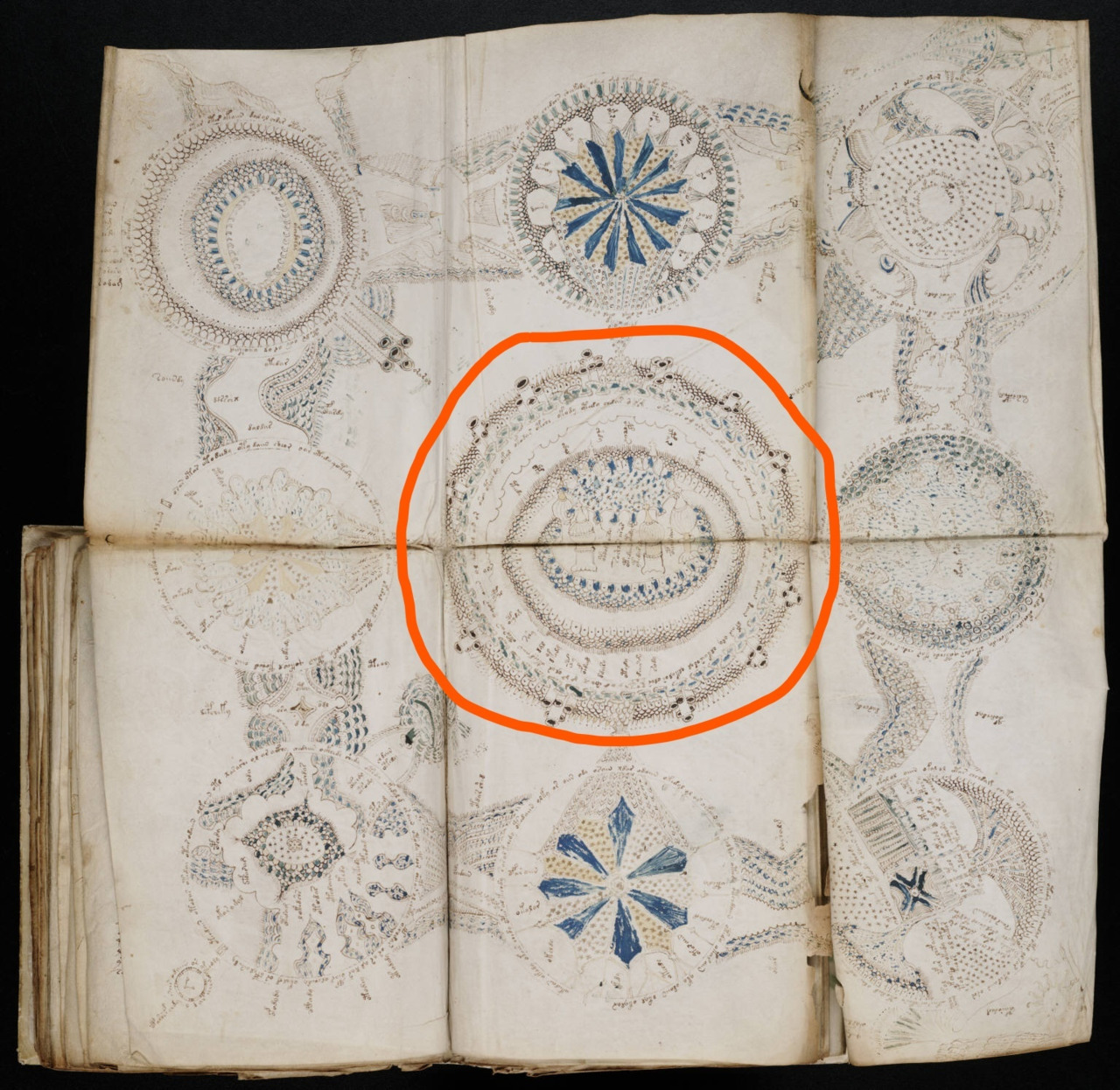
Central part of the composition in folio 86V of the Voynich Manuscript occupies a special place, both in terms of position and symbolic meaning. Unlike the three upper and three lower graphics, which in my interpretation represent continents, the three central graphics refer to universal themes. If the “Central America” graphic tells the story of slavery and intercontinental contacts, then the central scene is devoted to the spiritual heritage of humanity and the birth of the great monotheistic religions.
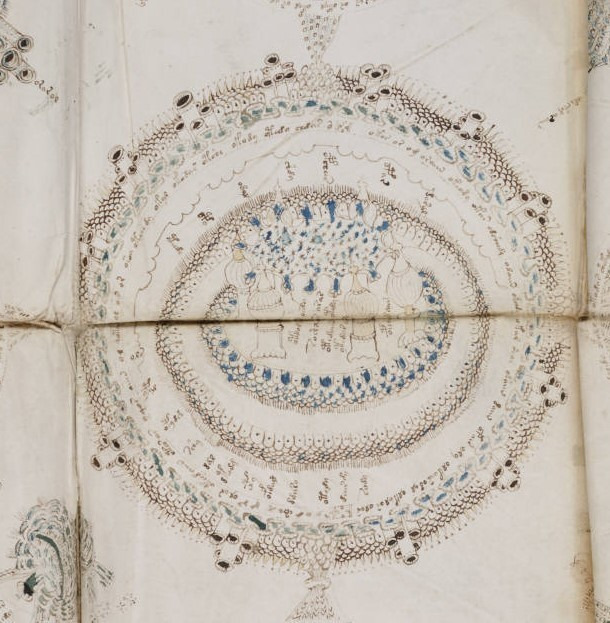
Continent / Region
As is known from archaeological and historical research, the earliest human communities lived a nomadic lifestyle for thousands of years.
Only around nine thousand years before our era, in the area known as the Fertile Crescent, did people begin to develop agriculture and a settled way of life, creating the foundations of the first civilizations. This region included territories of the Middle East, where some of the oldest cities in the world emerged, such as Jericho and Çatalhöyük.
Numerous towers and defensive structures visible along the perimeter of the central graphic can be interpreted as a symbolic representation of successive stages in the development of civilization: from the first urban settlements, through powerful ancient states, to historical empires. In symbolic terms, these elements may refer to cultures and states such as Sumer, Babylon, the Hittite Empire, ancient Egypt, or Persia, and in later eras to political structures such as the Roman Empire or the Byzantine Empire.
Between these “towers,” numerous figures gathered around defensive walls are visible. In symbolic interpretation, they may represent continuous conflicts, sieges, and struggles for control over this strategic region of the world. Since the earliest times, the Middle East has been an area of exceptional economic and religious importance, which caused successive states and empires to strive to dominate it. The history of this region therefore resembles an unending cycle of the rise and fall of successive political powers.
Inner Circle
Particular attention is drawn to the inner circle of densely gathered defenders, which can be interpreted as a reference to the history of the Holy Land. In symbolic terms, it represents a region defended by its inhabitants against successive invasions from outside. This motif particularly clearly refers to the era of the Crusades, when knights of medieval Europe undertook expeditions aimed at capturing and maintaining control over sacred religious sites.
Circle of figures marked in blue can be interpreted as a symbol of the city of Jerusalem itself — a place regarded as holy by three great monotheistic religions: Judaism, Christianity, and Islam. In religious terms, this city occupies a unique place in world history.
For followers of Judaism, it is the capital of the ancient State of Israel and the site of the most important temple. For Christians, it is the setting of events connected with the crucifixion and resurrection of Jesus Christ. For Muslims, it is the place from which the Prophet Muhammad began his Night Journey.
Analyzing the details of this graphic, one may gain the impression that it presents a panorama of the city viewed from the vicinity of the Mount of Olives. Among the characteristic buildings, one can recognize symbols of important sacred sites, such as the Dome of the Rock or the Church of the Holy Sepulchre. The fragment of wall marked above can be interpreted as a reference to the Western Wall — the only preserved part of the ancient Jewish temple.
Northern Connector
Enormous, narrowing stream of human heads running from Europe toward the central graphic can be interpreted as a symbol of the Crusades. It particularly refers to the First Crusade of 1096–1099, proclaimed by Pope Urban II. In symbolic terms, this element represents the influx of numerous warriors who set out eastward to capture and maintain control over the Holy Land.
Narrowing shape of the stream may signify both the enormous number of participants in these expeditions and the dramatic human losses suffered during the long and difficult journey.
Eastern Connector
Eastern connector is depicted in a relatively modest manner and lacks clear symbols.
In symbolic interpretation, this may indicate a limited scope of contacts between Middle Eastern civilizations and Far Eastern cultural centers in certain historical periods. The absence of elaborate symbolism in this place may therefore be read as a sign of lower intensity of political and trade relations compared with other directions of communication.
Southern Connector
Southern connector can be interpreted as a symbol of ancient migration routes leading from the African continent to Asia and Europe. In anthropological terms, the Middle East region constituted a natural migration corridor for early human populations leaving Africa. Successive waves of migration by peoples adapting to changing environmental conditions led to the gradual settlement of new areas of the world.
This element symbolizes not only population movement but also the process of evolutionary adaptation of humans to new living conditions.
Western Connector
Western connector can be interpreted as the result of a necessary compositional simplification arising from the limited graphic space of the map. The symbolic connection of this region with the area of Central America does not necessarily indicate a direct historical source of population migration, but rather points to the general idea of global flows of people and goods.
In symbolic terms, this element reminds us that world history is a network of intercontinental connections, in which events occurring in one region may produce consequences in distant parts of the globe.
Overall Interpretation
Entirety of this central graphic presents the Middle East region as the birthplace of civilization, religions, and great historical transformations. It is precisely here — in the space between deserts, rivers, and trade routes — that the foundations of the world we know today were formed.
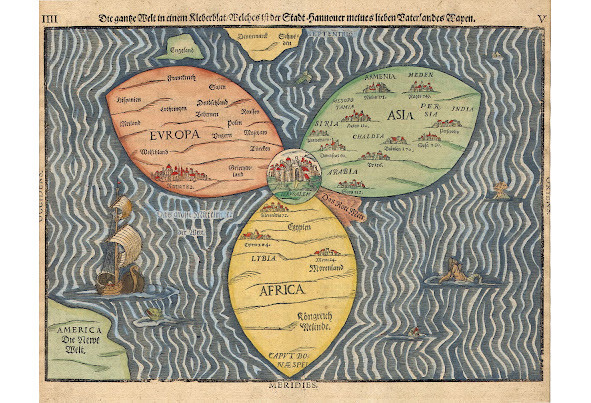
6. Middle, right: China
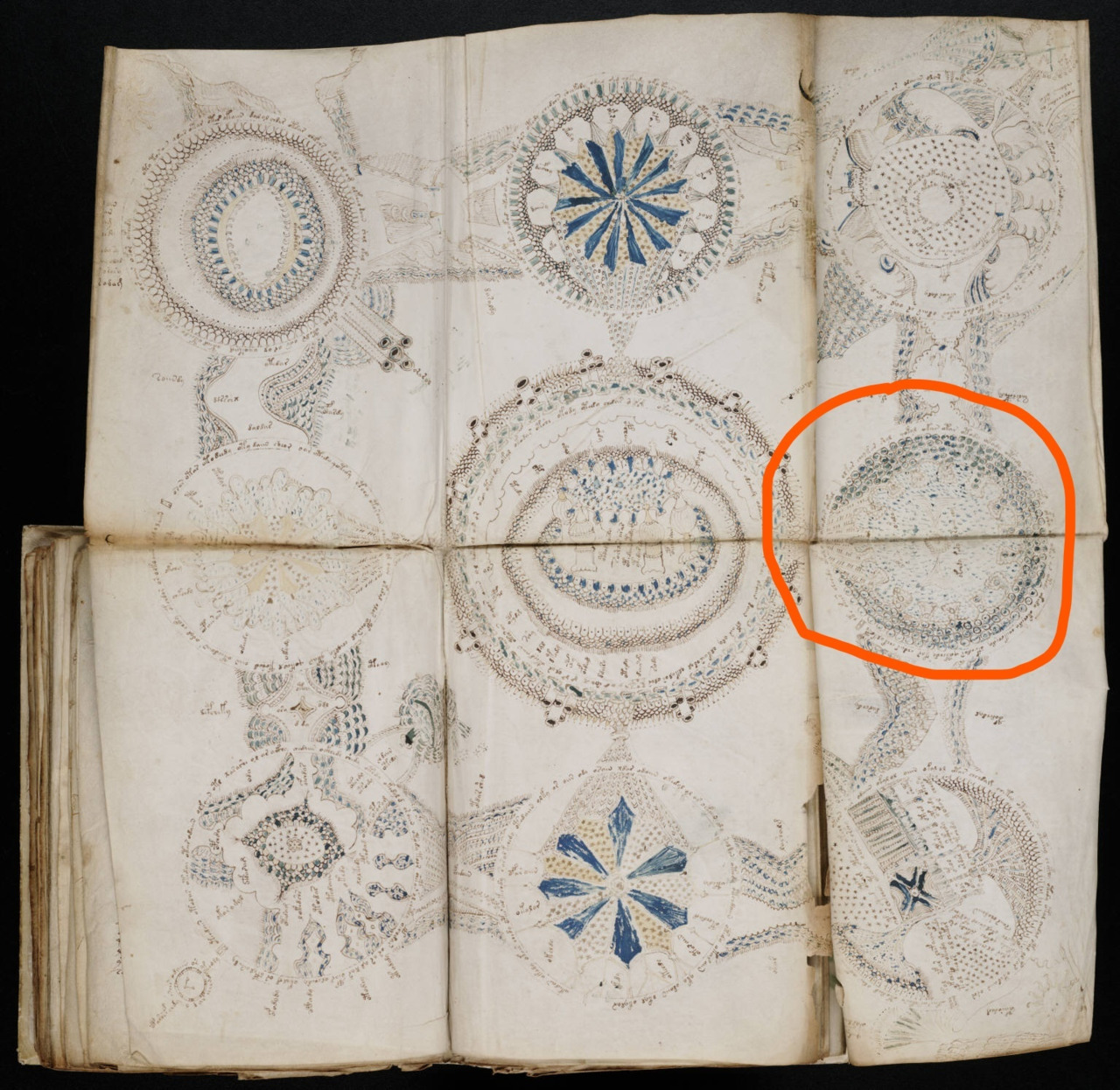
Right central part of folio 86V of the Voynich Manuscript, in my interpretation, depicts Chinese civilization, shown as a clearly separate system both geographically and culturally. Here the motif of closure, isolation, and self-sufficiency is especially strong.
Kup książkę, aby przeczytać do końca.