
Bezpłatny fragment - Voynich Manuscript(1)
Capsule of Eternal Memory
Introduction
In the history of humanity, there are texts that feed us more with questions than with answers. Artifacts which — although created by human hands — seem to elude both reason and intuition. Among them, a special place is occupied by the Voynich Manuscript — a mysterious book that for over a hundred years has successfully resisted all attempts to decipher its content. From the moment it came into the hands of Wilfrid Voynich in 1912, it became an object of fascination for cryptologists, linguists, botanists, historians of science, and even specialists from intelligence agencies. Despite their efforts, the text written in an unknown alphabet, devoid of obvious analogies and linguistic patterns, still remains undeciphered.
The manuscript itself — radiocarbon-dated to the beginning of the 15th century — consists of over two hundred pages richly illustrated with colorful miniatures. We find in it fantastic plants, strange arrangements of stars, astronomical diagrams, structures resembling human organs, as well as the famous scenes of naked figures immersed in networks of pipes and reservoirs. In traditional classification, these illustrations were divided into the herbal, astronomical, biological, cosmological, and pharmacological sections — as if the author were attempting to create an encyclopedia of knowledge about a world we do not know.
The history of attempts to decipher it is as fascinating as the text itself. Over the decades, eminent cryptographers threw themselves at it — including those who, during World War II, were breaking the codes of Enigma. Linguists worked on it, proposing dozens of hypotheses: from an unknown natural language, through a substitution cipher, to glossolalia or a joke by a Renaissance alchemist.
Theories emerged claiming that the manuscript is a medical book, a herbal treatise, an alchemical grimoire, a record of the language of a lost civilization, and even a work by Leonardo da Vinci. And yet, despite hundreds of publications, analyses, and theories, despite the use of the latest statistical, computational, and cryptographic methods — we still remain empty-handed.
It is precisely this helplessness of the traditional method that becomes the starting point of this book. For if for over a hundred years research has concentrated on deciphering the text, then perhaps we have made a fundamental mistake — assuming that the key to understanding the manuscript lies in its written layer. And what if the script is a deliberate smokescreen? What if — like the tangled centuries of Nostradamus — it was created to divert attention, and the true message was hidden elsewhere?
In this book, I propose a perspective different from all previous ones. I treat the Voynich Manuscript not as a textual cipher, but as a symbolic rebus, a cosmic-historical palimpsest encoded in its illustrations. My hypothesis is bold: the herbal section does not depict plants, but the history of life and evolution on Earth — from the birth of the cosmos, through the emergence of humanity, to the historical cycles of civilizations and even contemporary events. In turn, the section traditionally considered biological is, in my view, an anatomical map of the human body, presented as if its creator knew microscopic structures long before the invention of the microscope. Like Albert Barillé in the series “Once Upon a Time… Life,” the author of the manuscript may have used a specific modus operandi, in which scientific content is presented in the form of symbolic scenes.
The Voynich Manuscript is therefore — in this reading — not a mystery to be broken, but a key to knowledge that someone deliberately hid for future generations. Knowledge that transcends the era in which it was created. Perhaps even — the boundary of contemporary understanding.
Voynich Manuscript — (Herbal) Historical Section
Overview
The Voynich Manuscript — especially its herbal section — is, in my view, an exceptional compendium of knowledge about the history of humanity, comparable to the golden plaque of the Pioneer 10 probe, which was meant to convey information to future civilizations. Each page of the manuscript constitutes a separate carrier of content, encoded not in the form of a classical cipher, but through symbols, signs, graphic structures, and ideograms, forming a multilayered language of gnosis.
I assume that the manuscript operates with a semiotic system in which illustrations reflect processes, ideas, and events, and the so-called herbal section depicts not plants, but symbolic images of history and the evolution of life. Roots, stems, and flowers serve here as ideograms describing phenomena, stages, and transformations, often of universal significance.
I treat the Voynich Manuscript as a capsule of knowledge, where each page — from 1R to 52R — is a “window” into the past, the present, and the symbolically understood future, and text and image form a coherent system allowing one to read both chronology and hidden meanings.
The illustrations used in this book come from the website of the Beinecke Rare Book & Manuscript Library of Yale University:
link — https://collections.library.yale.edu/catalog/2002046
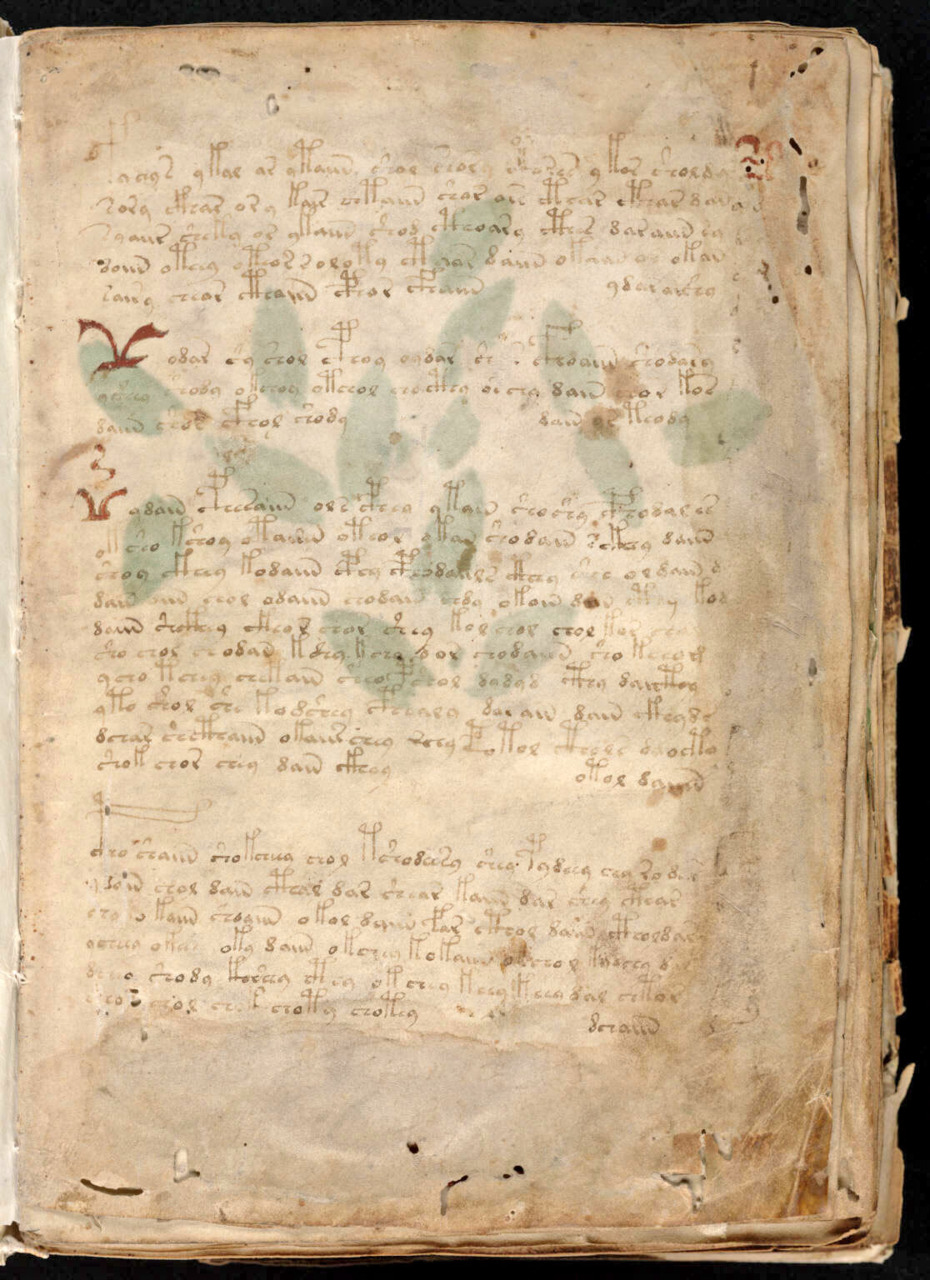
1R — Cyclicality of the Universe
The letters beginning the second and third paragraph of the first page of the Voynich Manuscript: large and quite unusual in their shape, in their idea refer to the cyclicality of the Universe — the Big Bang and Collapse. In my interpretation, particular attention should be paid to the shape of these figures.
— The shape of the first drawing is clearly expansive, even explosive — which is confirmed by the inward-bending breaks at the ends.
— Diametrically different in shape is the drawing located below. One can notice more rounded forms in this drawing. The most suggestive element of this ideogram is the spirally undulating line located in the center of this drawing. Its purpose is to visualize the returning phase of the cyclically exploding and collapsing universe.
Two large ideograms on folio 1R symbolize the cosmic cycle: explosion — collapse — rebirth. The spiral line in the center visualizes the repetitive rhythm of the Universe, which will become the guiding motif of subsequent folios. This spiral line in the second ideogram gives the impression as if the author wanted to say: “this has all already been and will be again” — like a rhythm that the Universe never ceases to beat.
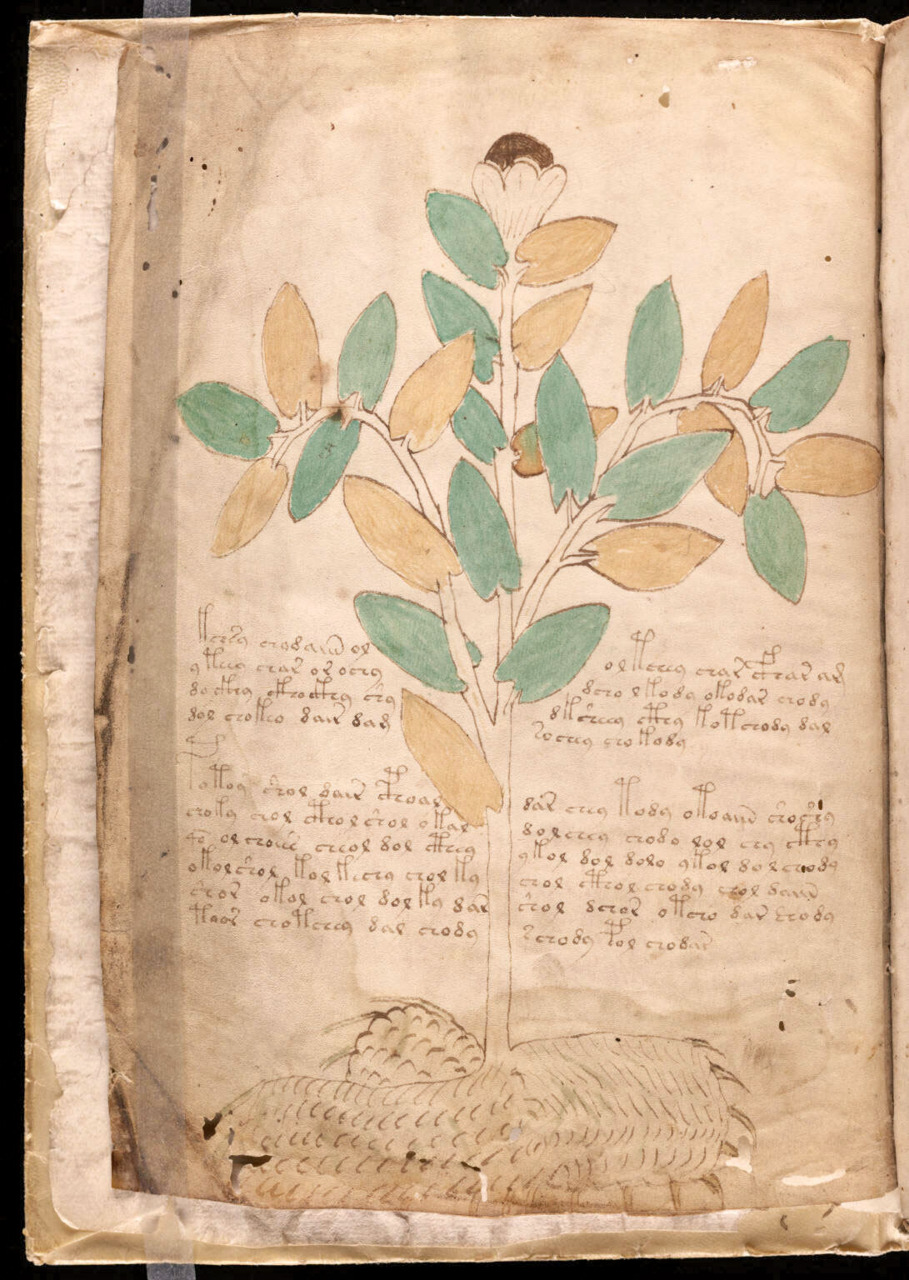
1V — Formation of the Solar System
About 4.5 — 5 billion years ago — the Solar System forms from a gas-dust cloud.
Root: tuberous, numerous twisted lines, as well as straight, short roots resembling claws or fangs in shape.
Leaves: colorful (green-red).
Flower: one — at the top, black in color, round.
— Root: symbolizes the cosmic microwave background radiation, which uniformly filled the Universe.
— Leaves: the extremely dynamic and turbulent beginnings of the Solar System, and also of the Earth — the formation of the Earth’s crust. The red of the leaves likely refers to the redness of lava, while the green is the crust forming from this lava.
— Flower: the fruit of the flower — the already formed and shaped Earth’s crust created as a result of lava cooling.
About 4.5 — 5 billion years ago — the Solar System forms from a gas-dust cloud with the centrally located Sun (over 99 percent of the system’s mass) and the remaining planets, including the Earth. About 4.2 billion years ago — as a result of cooling, the Earth’s crust forms. The root, leaves, and flower of this folio symbolize the beginnings of the Solar System and the formation of the Earth.
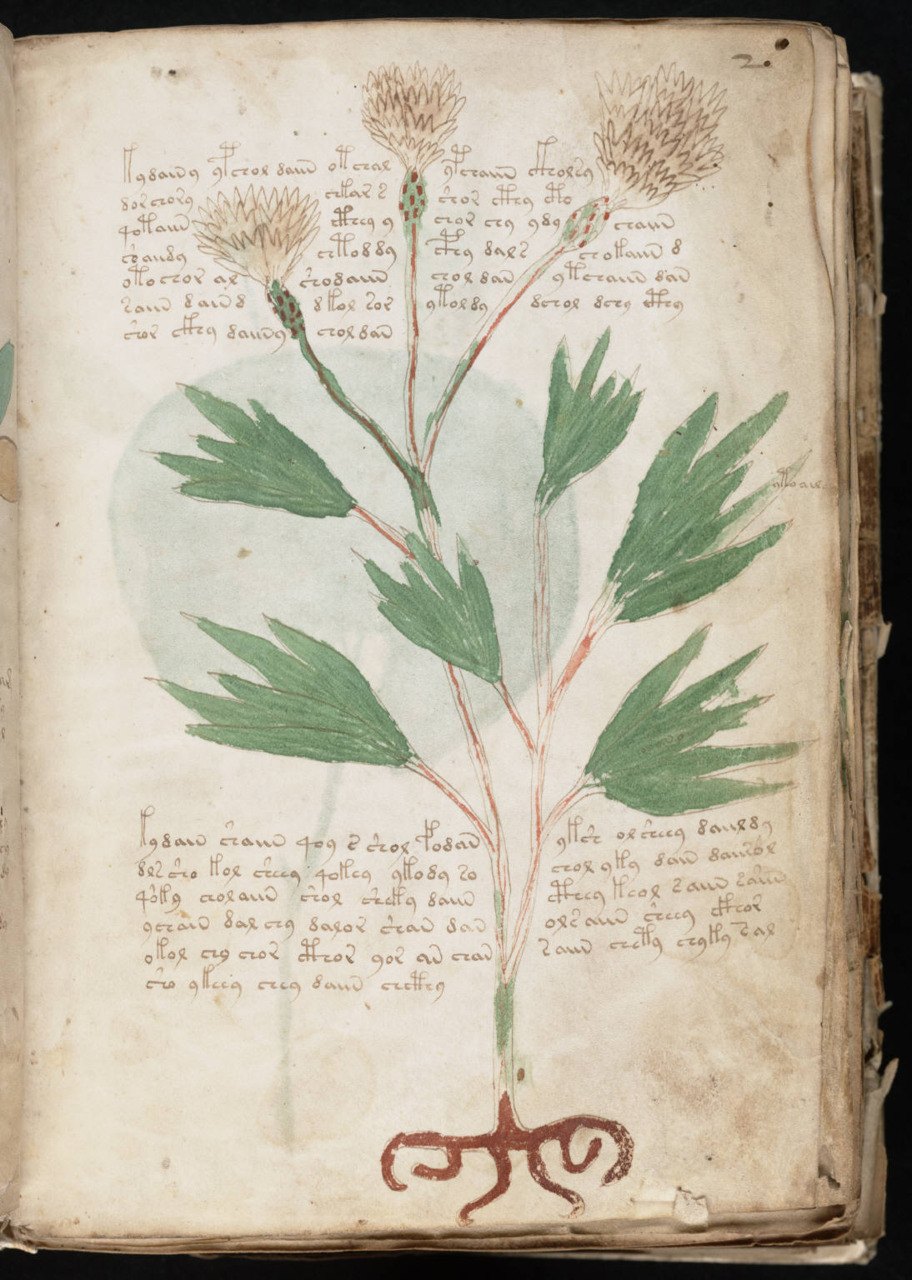
2R — Formation of the First Organisms
About 3.5 billion years ago — the first organisms — bacteria — are formed.
Root: dark red, twisted.
Leaves: green, triangular in shape.
Flowers: light-colored, fluffy, composed of many small petals.
— Root: through its twisted shape and dark color “personifies” the equally twisted DNA strand, which serves to transmit genetic information to descendant cells and organisms and directs protein synthesis, including enzymatic proteins, controlling all processes in the organism.
— Leaves: through their shape and green color symbolize cyanobacteria, which through photosynthesis produce organic compounds and contribute to the formation of an oxygen atmosphere.
— Flowers: through their color and feathery structure imitate life-giving oxygen, essential for the further evolution of life.
About 3.5 billion years ago — the first organisms — bacteria — are formed. Cyanobacteria — among the oldest organisms — through photosynthesis release oxygen, which creates an ozone layer absorbing ultraviolet radiation. The root, leaves, and flower on folio 2R symbolize the beginnings of life and biological evolution.
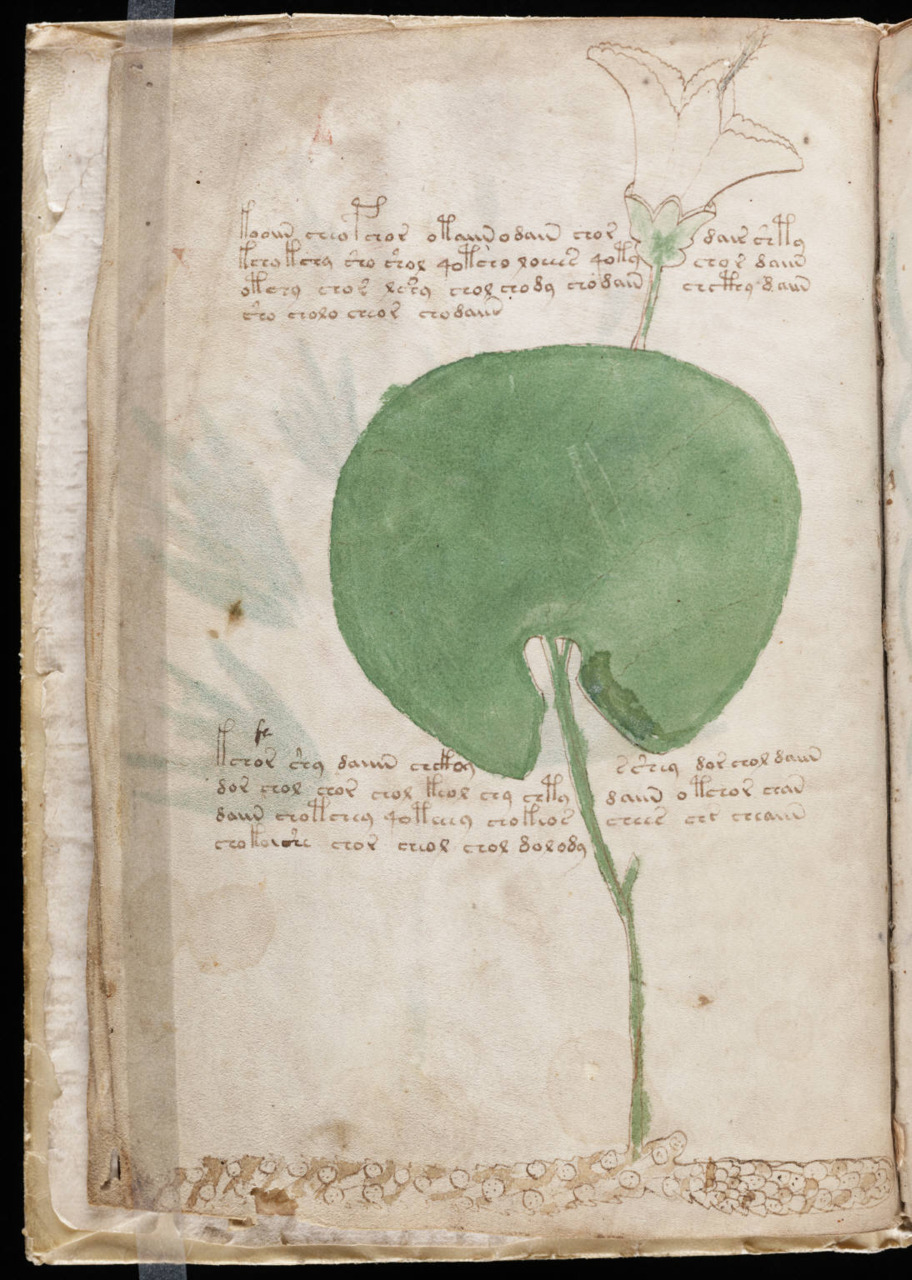
2V — Formation of the First Eukaryotic Organisms
About one billion years ago — the first unicellular organisms (eukaryotes) emerged.
Root: the stem of this plant grows directly from the ground (the root is not visible).
Leaf: one, proportionally large in relation to other leaves in the manuscript, even dominant, overwhelming the entire illustration.
Flower: rather delicate, petals lilac-white.
— Root: or rather its absence, illustrates the fact that these are the first organisms, formed “from nothing,” resembling in their general plan the cells from which all later organisms evolved. The substrate from which this unicellular plant grows resembles grains of sand. On the left side — single — unicellular organisms, on the right — already joining into multicellular structures.
— Leaf: its enormous size symbolizes the dominance of this form of life organization on Earth.
— Flower: all multicellular organisms took their primal beginnings from eukaryotic cells. This little flower is the quintessence of evolution — the beginning of the plant and animal kingdoms.
About one billion years ago — the first unicellular organisms (eukaryotes) emerged. The eukaryotic cell contains many times more genetic material than the prokaryotic one, thanks to which it is able to produce more types of proteins and has potentially unlimited regulatory possibilities. The absence of a root and the enormous leaf symbolize the first eukaryotic organisms and their dominance in the further evolution of life.
3R — Formation of the First Multicellular Organisms
About 900 — 700 million years ago — the first multicellular organisms emerged.
Root: quite solid, numerous branches.
Leaves: their number is also unusual — there are “infinitely many” of them, multicolored: red, white, green.
Flower: not visible.
— Root: numerous branches inform that this is already a large family of multicellular organisms, drawing life-giving juices from the evolutionary specialization of the first eukaryotes.
— Leaves: symbolize the multitude and diversity of species, both plants and animals (e.g. euglena, amoeba, volvox).
— Flower: for understandable reasons it is not present in the illustration. Every representative of flora or fauna consists of cells — the basic building block of all organisms.
The root and leaves on 3R symbolize evolutionary branching and the diversity of multicellular organisms. The absence of a flower emphasizes that every organism arises from a cell as the fundamental building block of life.
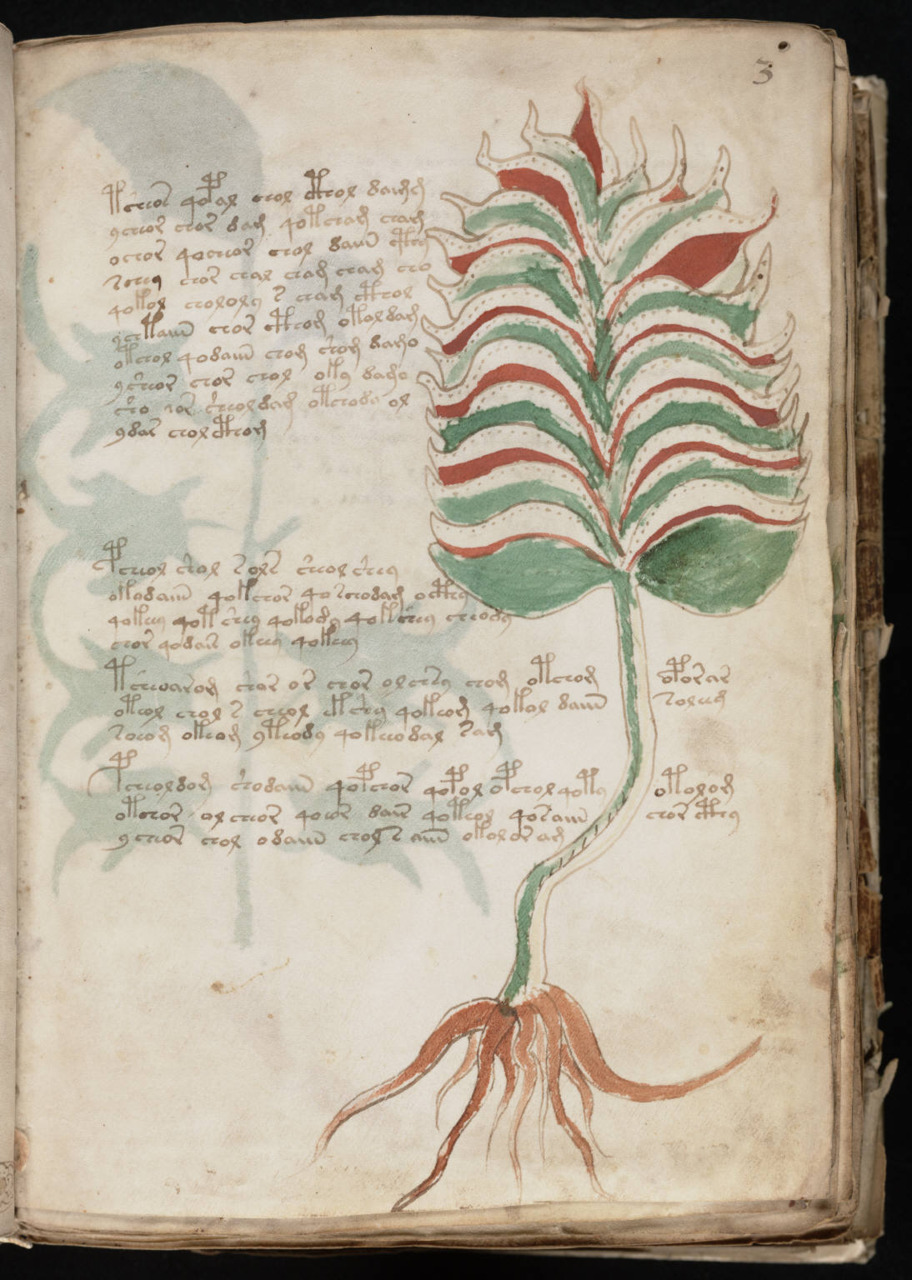
3V — Formation of the First Invertebrates
About 700 — 600 million years ago — the first invertebrates emerged.
Root: one long, as if composed of segments.
Leaves: unusual, hook-shaped.
Flower: two, dark-colored, of unequal size, heavy, swollen. The shape of the flower resembles a fruit or vegetable cut in half, whose edge has dried.
— Root: symbolizes the individual stages of the constantly ongoing evolution of plants and animals.
— Leaves: this is the chaotic and untamed explosion of the appearance and disappearance of various, most bizarre life forms.
— Flower: informs that prey and predators alike adopted protective maneuvers — e.g. the chitinous armor of Anomalocaris — a giant invertebrate about one meter in length.
The root, leaves, and flower symbolize the dynamic explosion of life during the emergence of the first invertebrates. The flower points to evolutionary defense mechanisms such as chitinous armor.
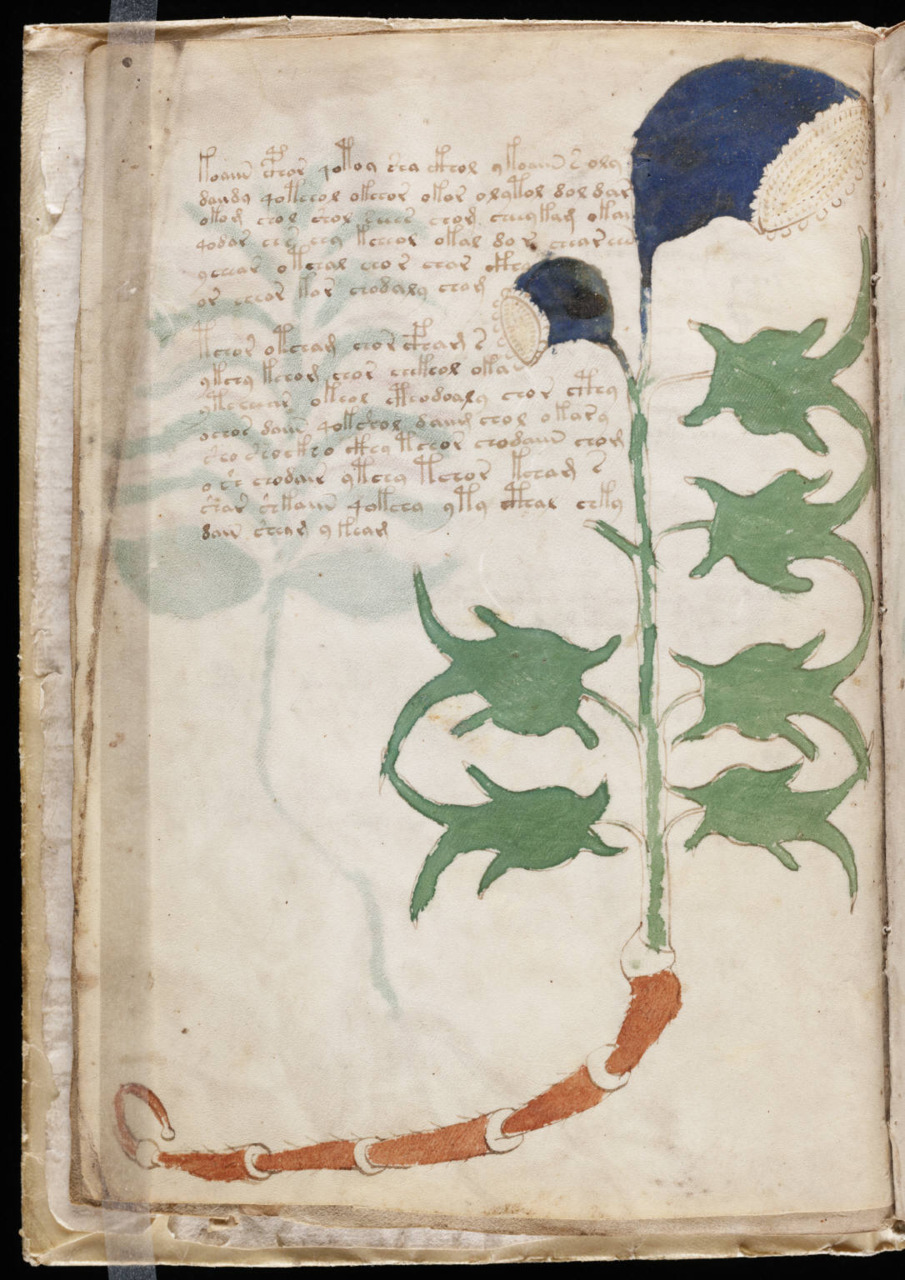
4R — Formation of the First Chordates
About 500 million years ago — the first chordates emerged.
Root: branched.
Leaves: many small, colorful — green and red leaves.
Flower: most branches crowned with a flower.
— Root: symbolizes the widely branched family of chordates, progenitors of all vertebrates.
— Leaves: the number of branches and leaves testifies to the number of types and species of vertebrates.
— Flower: the evolutionary efforts of the chordates (root) did not go to waste — they bore fruit in the emergence of fish, amphibians, reptiles, birds, and mammals.
The root and leaves symbolize the branched family of chordates. The flower illustrates fruitful evolution, that is, the emergence of all major groups of vertebrates.
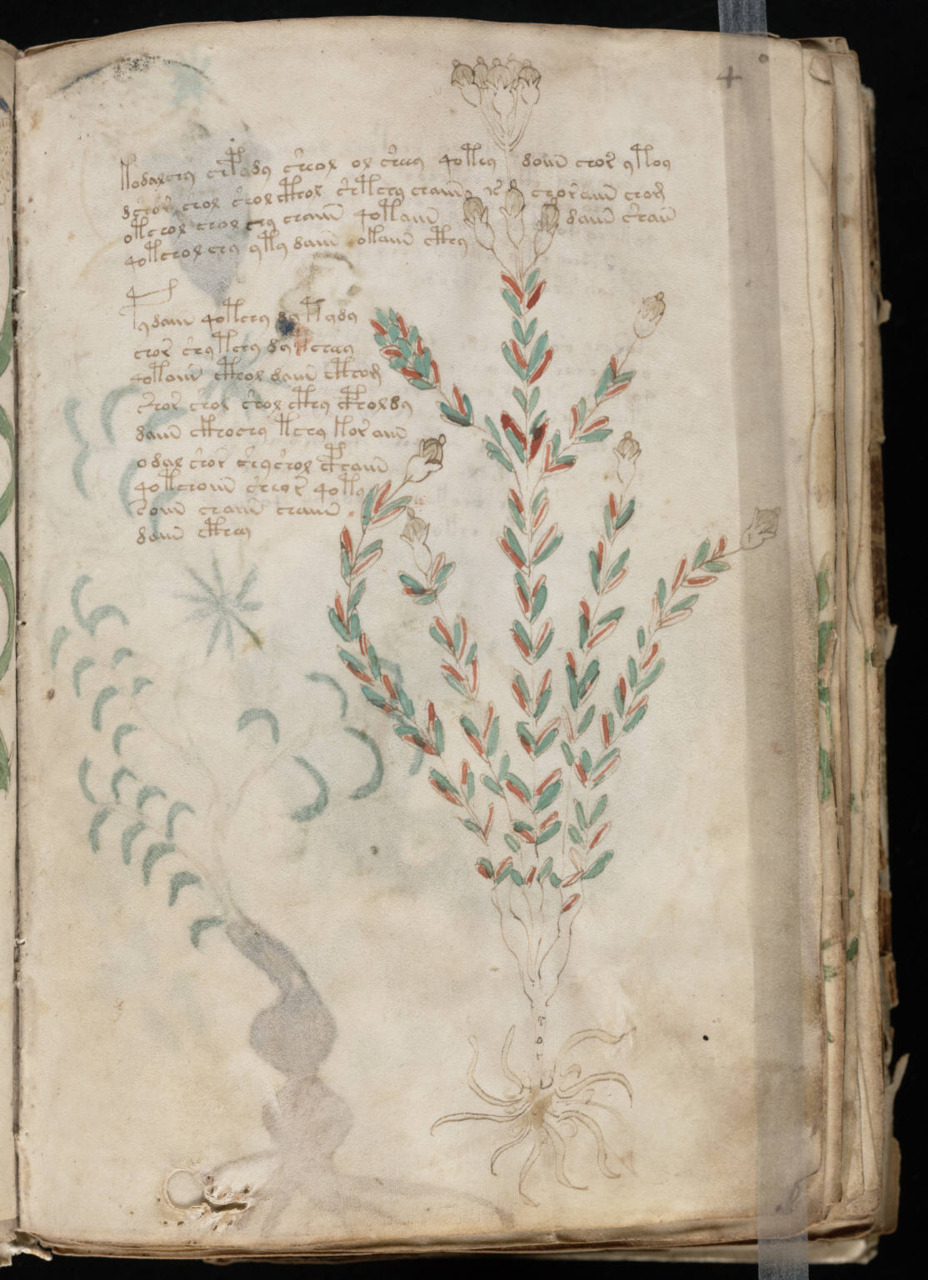
4V — Vertebrates’ Exit onto Land and the Permian Extinction
About 400 million years ago — following plants, vertebrates “came out” literally and figuratively from water.
About 250 million years ago — 80–90 percent of species perish (the Permian mass extinction).
Root: strange shape — numerous offshoots, bulbous in the upper part.
Leaves: small, hook-shaped, also star-like branched.
Flower: dark-colored, above which leaves are visible — specifically one branched one.
— Root: its shape says much. First a classic shape — calm evolution in the familiar aquatic environment, then a sudden change — vertebrates’ exit onto land.
— Leaves: symbolize the initial, difficult stage of vertebrate adaptation to the new environment. The shape of leaves — first hook-shaped (water), later also branched.
— Flower: its “mourning” color symbolizes the Permian catastrophe — the extinction of over 80% of species. Above it, a single, star-like branched leaf informs of the success of vertebrates leaving the water and that the extinction was not total — Life will continue.
The root, leaves, and flower symbolize the adaptation of vertebrates to life on land and the dramatic Permian extinction, which at the same time heralded the further development of life on Earth.
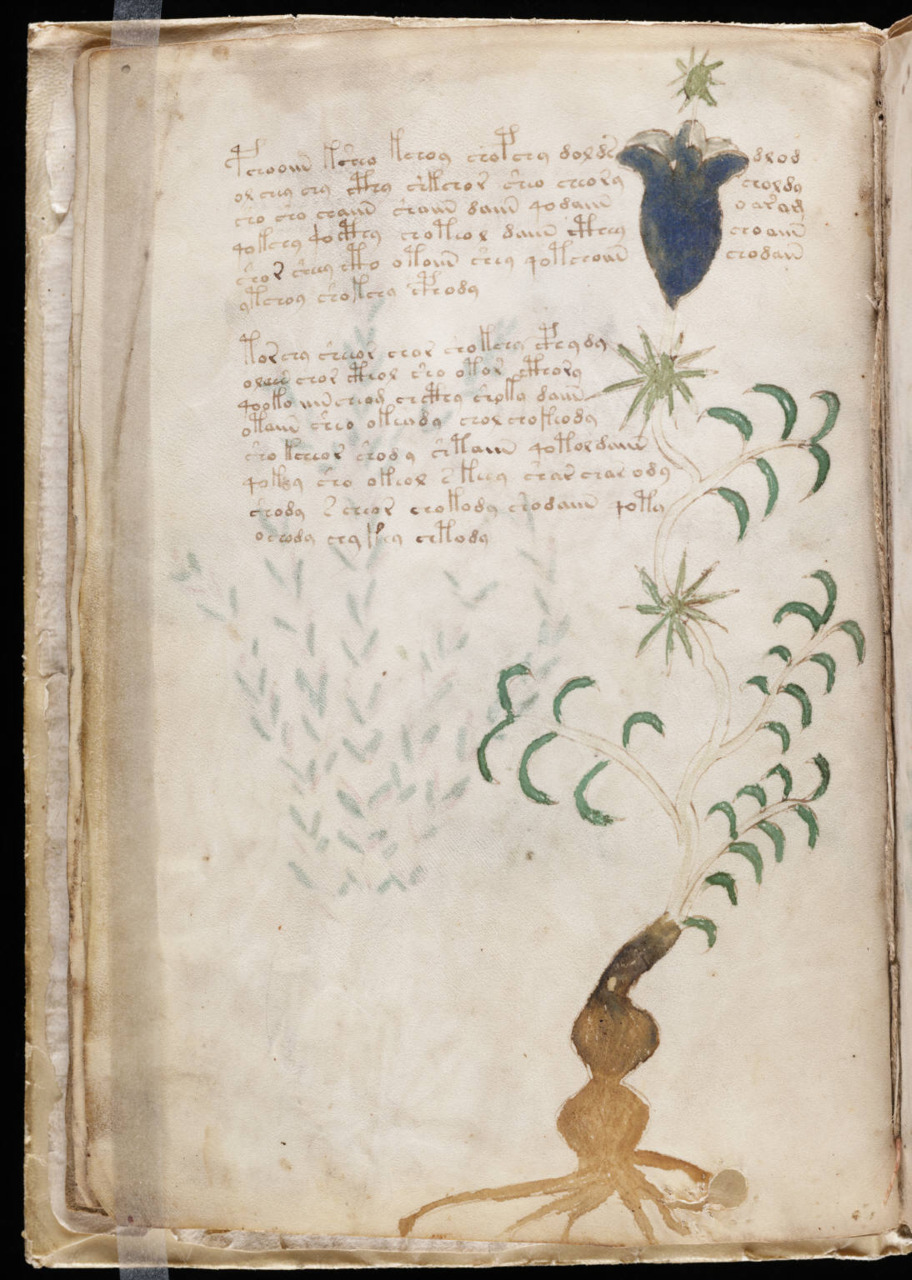
5R — Beginning of the Reign of Dinosaurs
About 220 million years ago — the beginning of the era of dinosaurs.
Root: branched, small, rather meager, colorless (almost transparent).
Leaves: expansive, puffed, giving the plant an impressive, almost monumental appearance.
Flower: in relation to the enormous leaves — surprisingly modest.
— Root: its colorlessness recalls the Permian extinction, from which only a handful of reptiles survived, including Lagosuchus — the progenitor of later dinosaurs.
— Leaves: symbolize the period of dinosaur dominance, which conquered all environments: water, land, and air.
— Flower: represents the modest brain capacities of reptiles; the top of the flower is associated with that organ disproportionately small in relation to their body mass.
The delicate root after the Permian catastrophe contrasts with the power of the leaves, depicting the triumphant flourishing of dinosaurs, which, however, was not balanced by the small neuronal potential of these creatures.
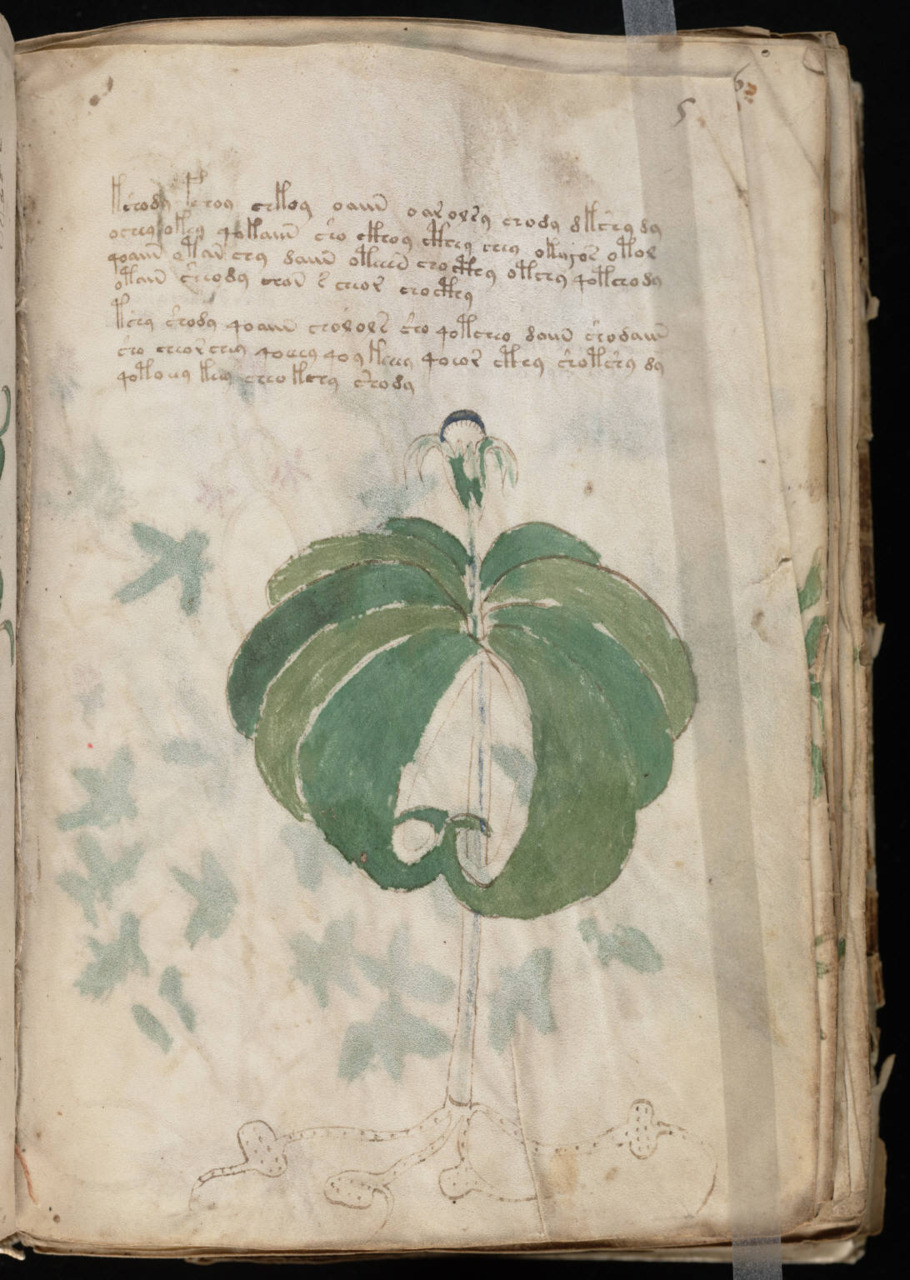
5V — Extinction of Dinosaurs and the Beginning of the Age of Mammals
65 million years ago — after a meteorite impact, a great extinction occurs, which ends the era of dinosaurs and opens the way for the expansion of mammals.
Root: branched, slightly bulbous.
Leaves: small, jagged, evenly distributed on branches; mostly green, some colorless.
Flowers: several, at different heights; red, partially withered.
— Root: its bulbous shape refers to the root from 4V, reminding that mammals descend from mammal-like reptiles (therapsids), which survived both the Permian catastrophe and the one after the meteorite impact.
— Leaves: their even distribution illustrates the genealogy and expansion of mammals, which after the extinction of dinosaurs began to rapidly diversify and colonize successive ecological niches.
— Flowers: symbolize the main evolutionary lines of mammals — monotremes (withered flowers), marsupials, and placentals, which ultimately dominated the planet.
The catastrophe that destroyed the dinosaurs simultaneously became an impulse for the dynamic development of mammals — their “flowers” bloom at all levels of life.
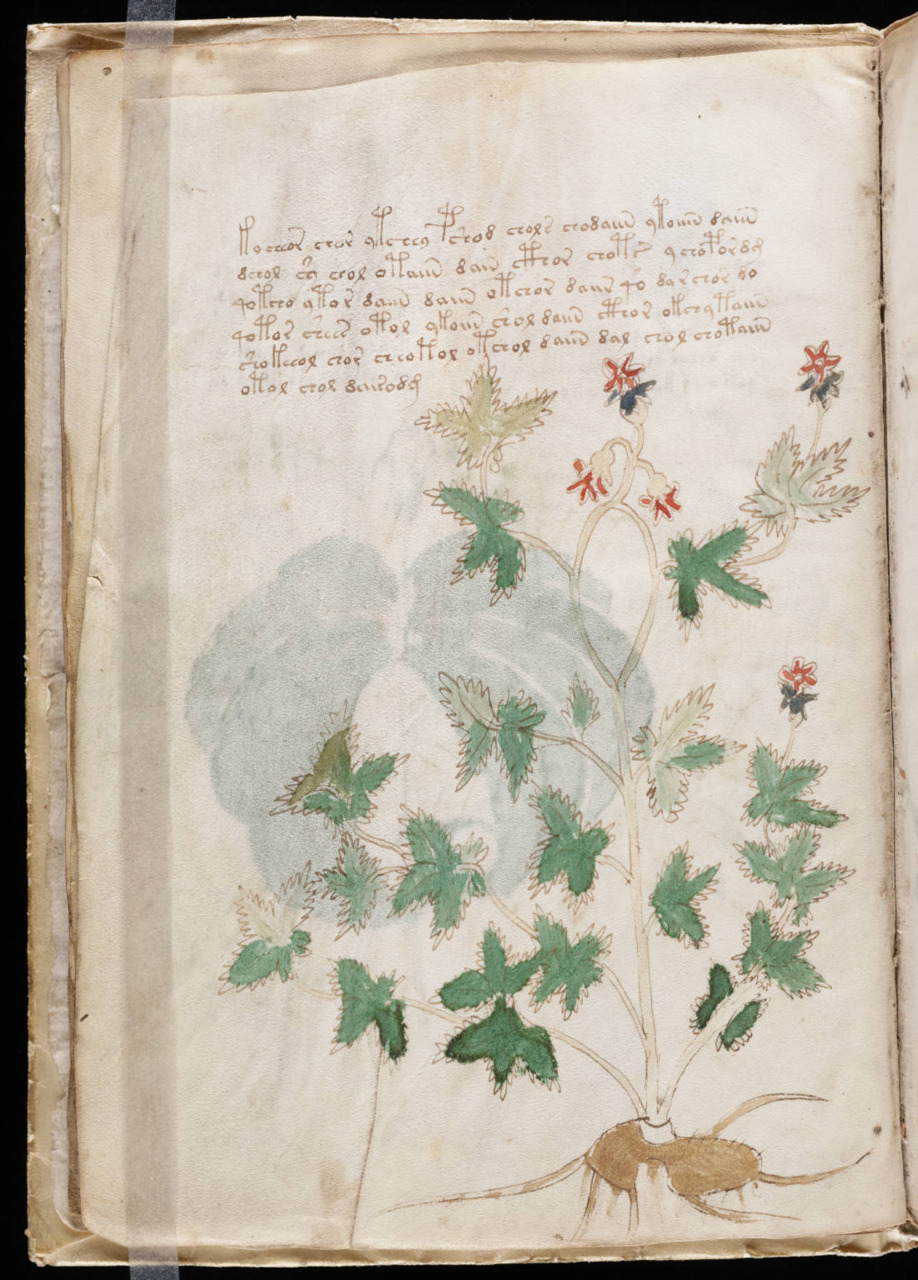
6R — Flourishing and Rapid Turnover of Early Mammals
About 65–30 million years ago — intensive development of herbivorous and carnivorous mammals occupying niches freed after dinosaurs.
Root: colorless, twisted.
Leaves: few, strongly jagged.
Flower: bizarre, as if cut off, covered with “pimples”.
— Root: its colorlessness and twisted shape emphasize the chaotic beginnings of mammals, which were only trying to find themselves in the new ecosystem after the disappearance of the great reptiles.
— Leaves: jagged forms reflect the ugly, raw, inelegant first types of large mammals, such as Brontotherium, Entelodon, or Hyaenodon — massive, misshapen, dominated by brutal struggle for survival.
— Flower: its “pimpled” and cut-off appearance is a symbol of the short-lived nature of these evolutionary lines — these species quickly arose, dominated the environment, and then just as quickly went extinct, leaving room for more advanced forms of mammals.
Folio 6R shows the turbulent and not very “elegant” beginning of the age of mammals: violent evolution of the first large forms, which quickly appeared and disappeared. The plant renders this stage as chaotic, primitive, and transitional — the foundation for later mammalian diversity.
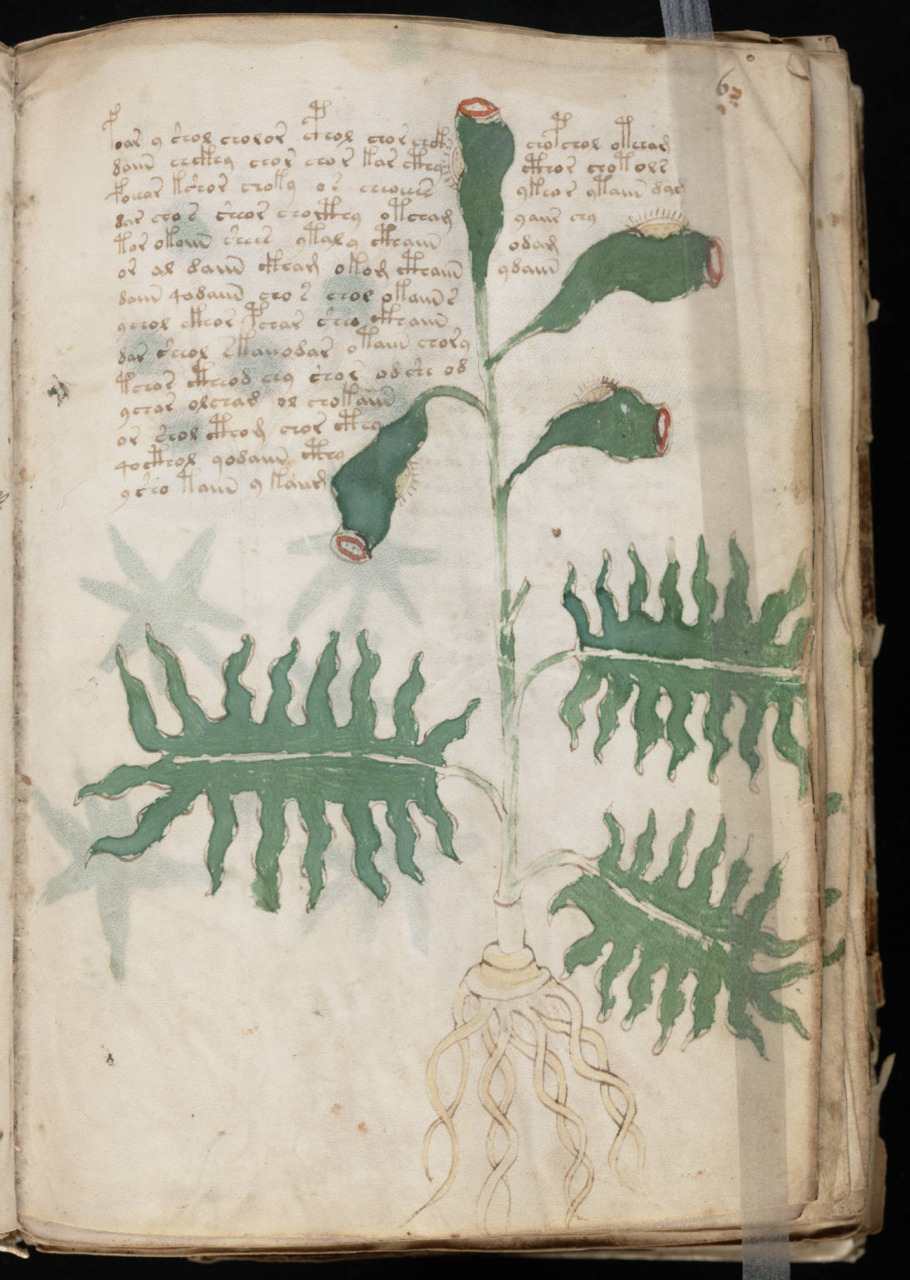
6V — Miocene Epoch (30–7 million years ago)
Formation of most modern plants and animals
Root: also twisted, there are more of them than in 6R, also colorless.
Leaves: most star-like branched.
Flower: spherical, small, jagged petals.
— Root: informs that most plant and animal species of that time constituted only and as much a starting form for other representatives of the ecosystem.
— Leaves: their star-like branched shape announces the fact that these species will spread — e.g. Cranioceras, Alticamelus, Dinoyus.
— Flower: not all lines will survive; some, very peculiar — such as Platybelodon — will disappear from history.
Folio 6V shows the Miocene as a time of dynamic expansions and evolutionary experiments. It is a period of “shaping the palette” from which later ecosystems will arise — some forms flourish, others end their line.
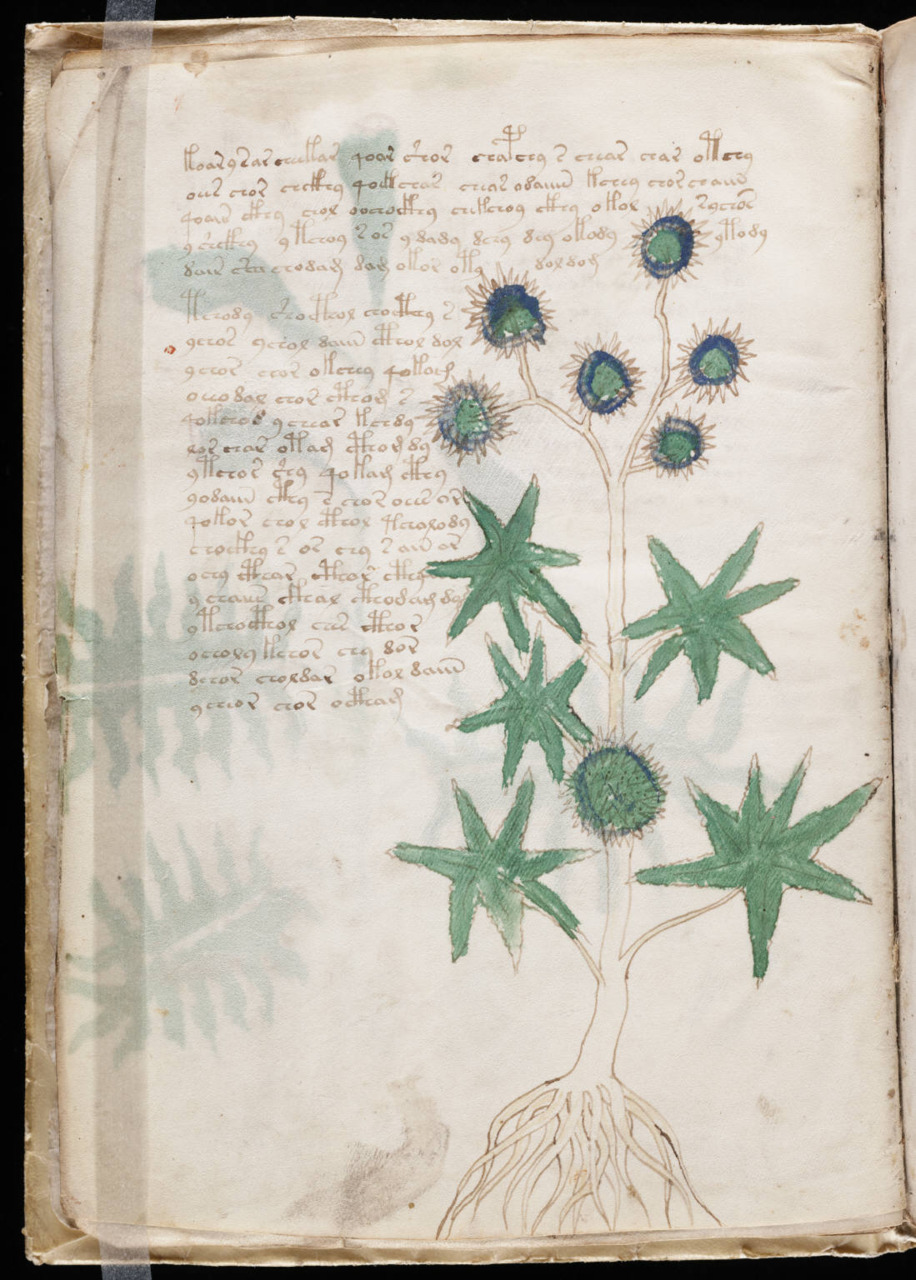
7R — Appearance of the First Hominids (approx. 12 million years ago)
Birth of primate mammals
Root: fairly large, bifurcated.
Leaves: not visible.
Flower: one gigantic, radiating outward.
— Root: its shape, resembling a mountain peak, clearly indicates that primate mammals constitute the pinnacle achievement of evolution — a line developed from the first eukaryotes.
— Leaves: the absence of leaves symbolizes the lightning-fast, almost violent development leading from primitive primates to Homo — compared to the pace of earlier stages of life.
— Flower: the monumental, radiant flower signifies the dominance of primate mammals and their entry to the forefront of Earth’s ecosystem.
Folio 7R presents hominids as the culmination of the evolutionary path of life. The absence of leaves and the powerful flower emphasize the sudden acceleration of development that led to the emergence of humans.
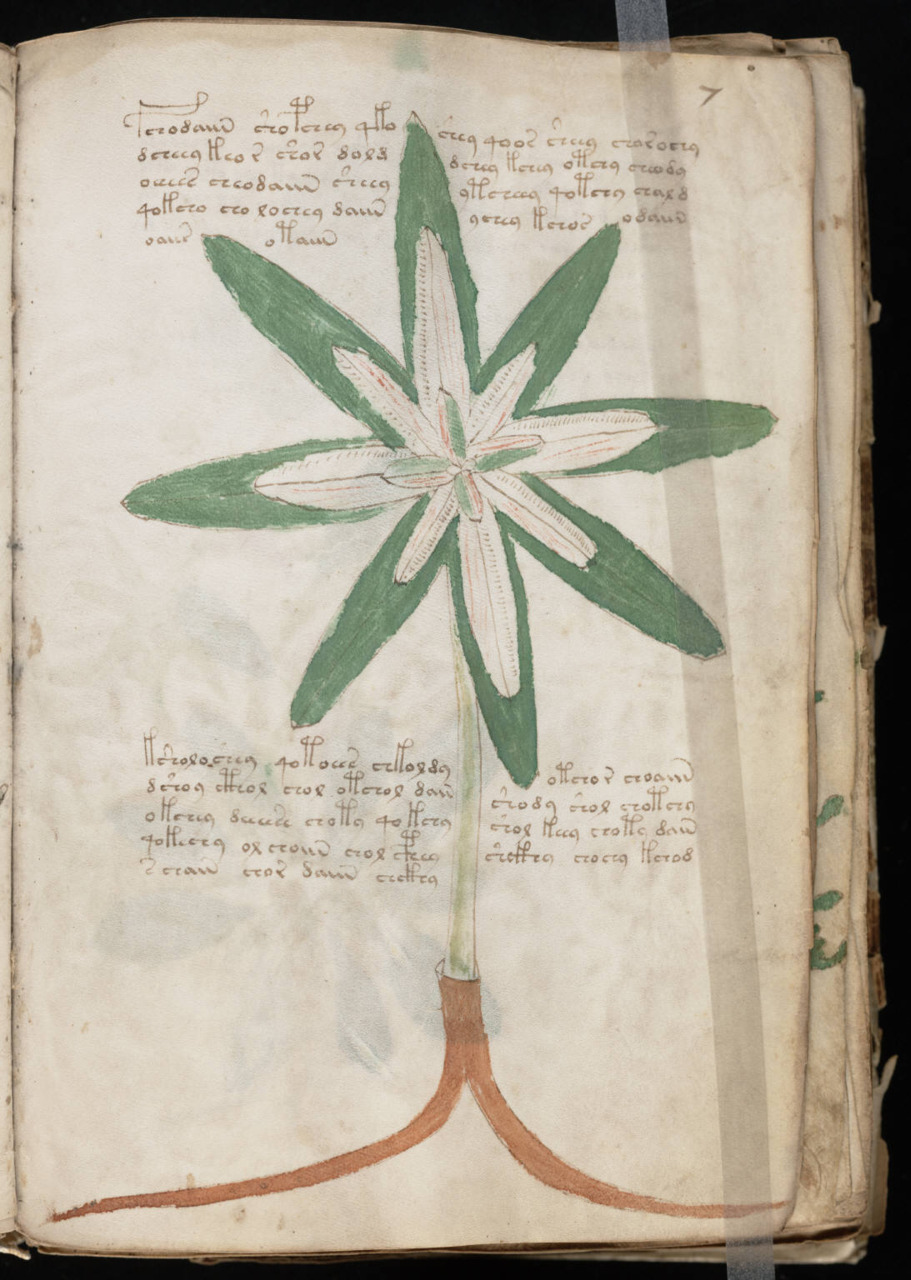
7V — Anthropogenesis (about 7–5 million years ago)
Appearance of man
Root: rather small.
Leaves: many radially spreading leaflets; higher up already classically — two. Some leaflets red, as if burned by the sun, overripe.
Flower: very modest buds, only just beginning to develop.
— Root: the beginnings of man as a species were frail — development took place in conditions full of threats.
— Leaves: the arrangement of the leaflets symbolically corresponds to the genealogical tree of the genus Homo. Withered or red ones mark extinct branches of evolution, while the two highest leaflets represent Neanderthal and modern man.
— Flower: small buds symbolize Homo sapiens, who is only just to fully develop.
Folio 7V shows the birth of man as a fragile, uncertain process, but one leading toward clear flourishing. The buds announce the future possibilities of Homo sapiens.
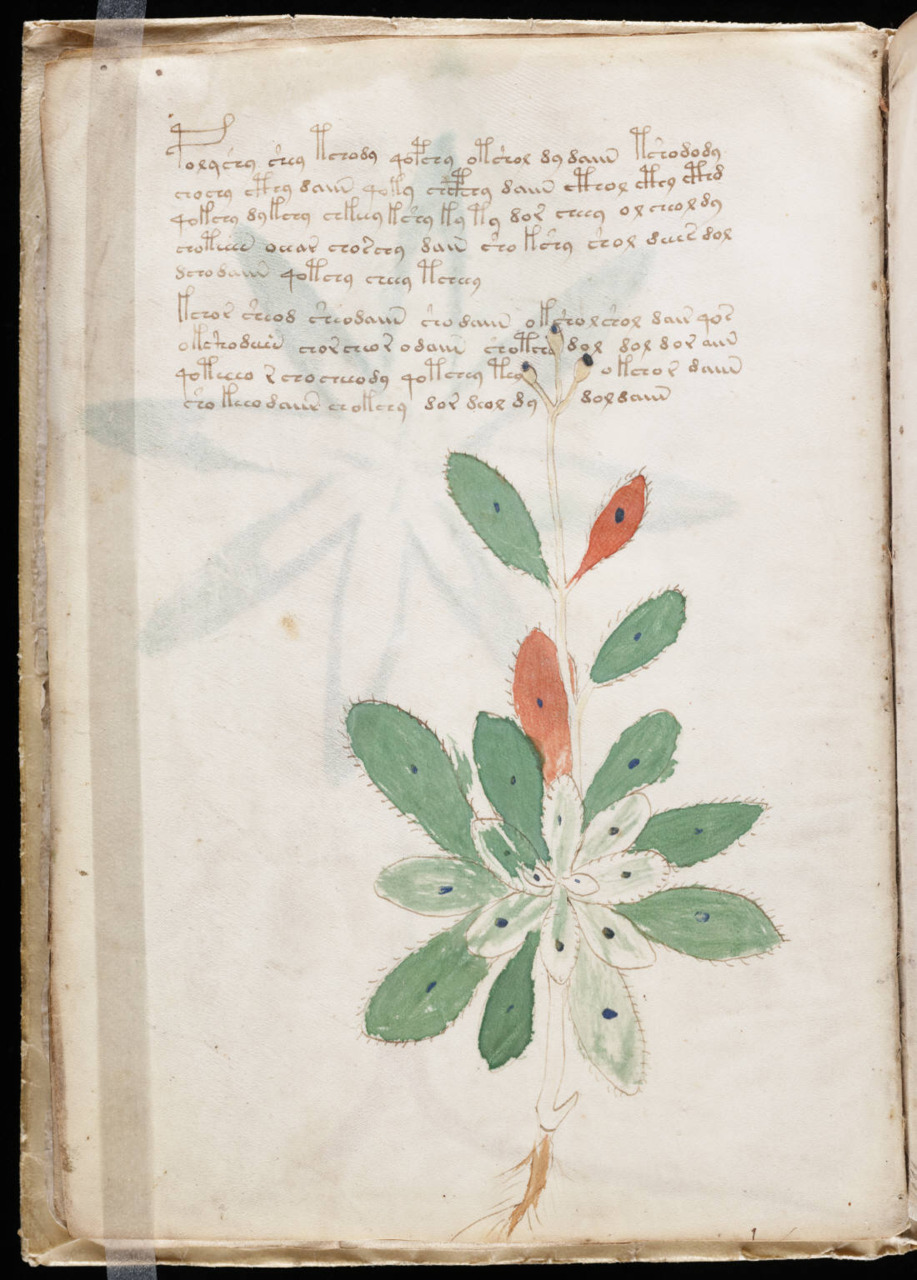
8R — Modern Man (about 100 thousand years ago)
Appearance of Homo sapiens
Root: thin, slightly twisted.
Leaves: one, wrapping around the stem.
Flower: large, leaf-shaped — like an arrow pointing upward.
— Root: reflects the frail, uncertain beginnings of modern man.
— Leaf: marks a key point on the timeline — approx. 43 thousand years ago, when Homo sapiens (Cro-Magnon man) entered the fullness of his historical role.
— Flower: its arrow-like form and intense green color symbolize the demographic explosion at the end of the last glaciation (approx. 11.5 thousand years ago).
Folio 8R presents Homo sapiens as a species that, from an uncertain beginning, quickly transitions into dynamic expansion. The arrow-flower announces humanity’s rapid entry into the era of culture and civilization.
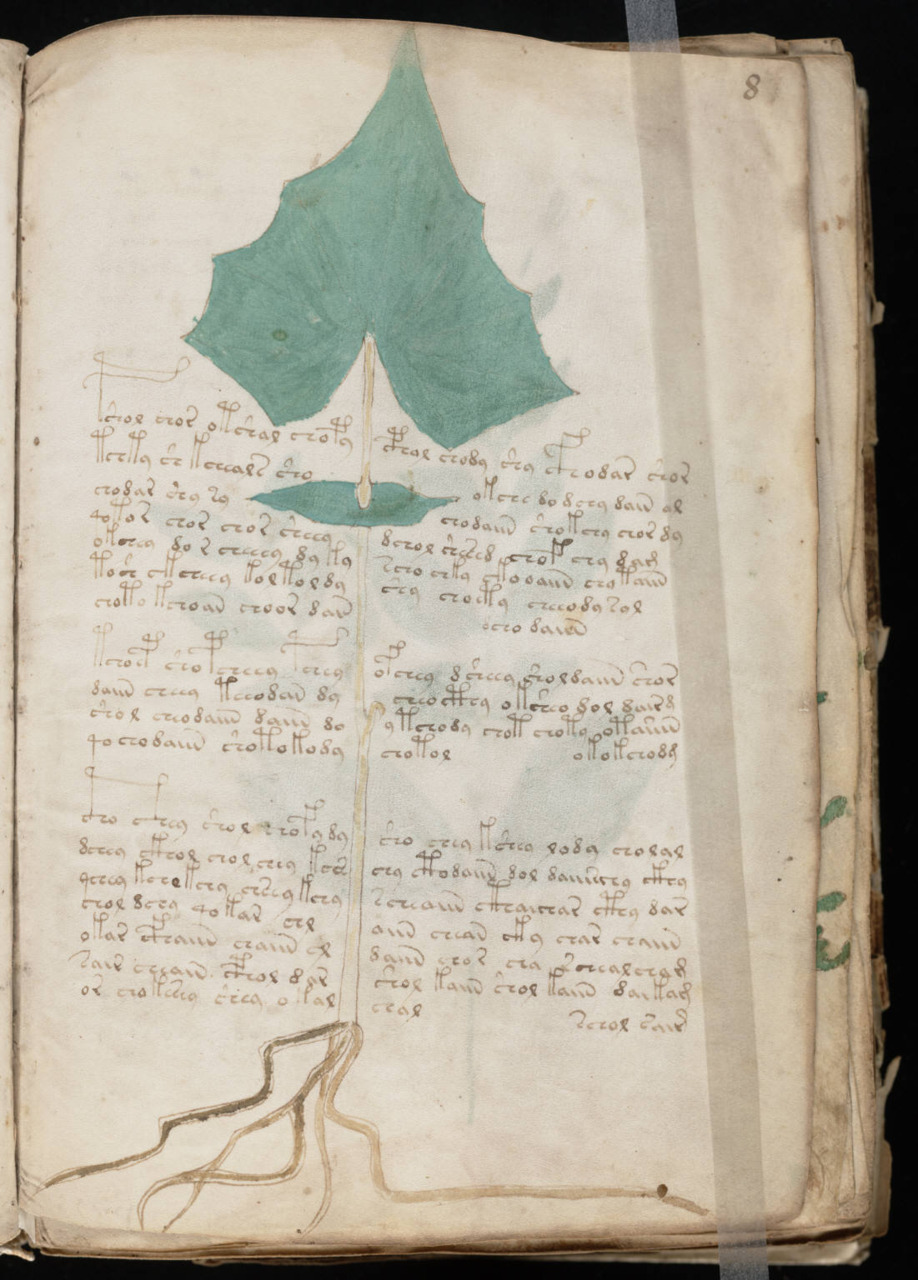
8V — Prehistoric migrations of Homo sapiens (about 15–12 thousand years ago)
Crossing of the Bering land “bridge”
Root: Unusual shape, resembling an ice structure.
Leaves: Two large ones at the base; the higher up, the smaller and more numerous.
Flower: Small, two-colored flowers — blue-red.
— Root: Symbolizes the Ice Age and glaciations that enabled the formation of a land bridge between Siberia and America.
— Leaves: The decreasing size and increasing number of leaves show the expansion of human range across both Americas.
— Flower: The blue-red petals refer to the later colors of the United States, indicating the symbolic “birth” of the first inhabitants of the continent.
Folio 8V presents the key moment of the settlement of both Americas: the migration through Beringia. The flowers in the colors of the USA constitute a subtle yet expressive hint by the author referring to the “first Americans”.
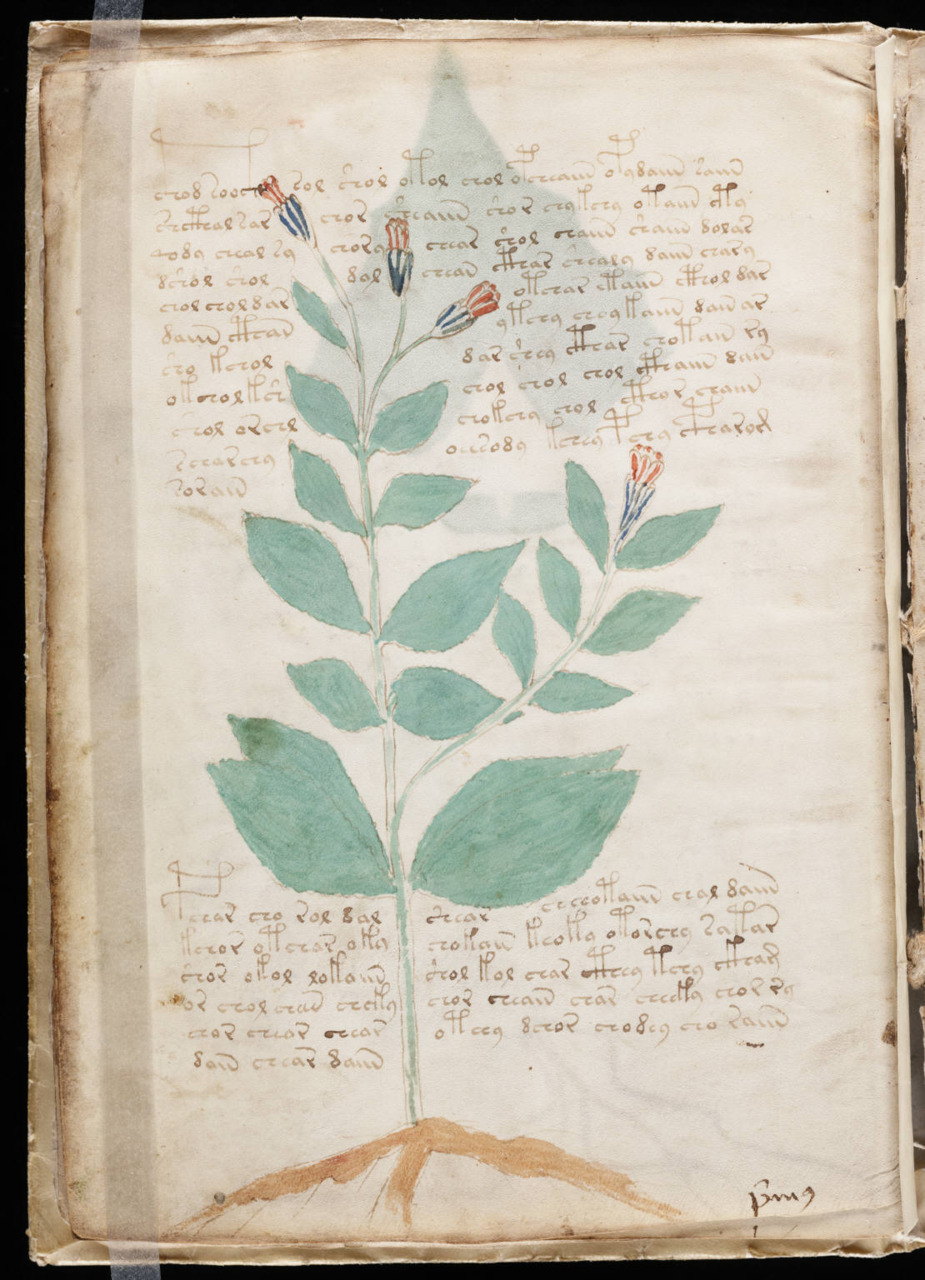
9R — About 11.5 thousand years ago — end of the last glaciation
Root: Solid, twisted offshoots, upper part as if cut off.
Leaves: Numerous, rather unattractive, twisted, growing on many separate stems emerging from the root.
Flower: Speckled petals or small seed-like balls.
— Root: End of the Ice Age — sudden cutting of the upper part. Climate warming, as well as rapid human expansion, as the cause of extinction of many species of giant animals (Mammoths, Smilodon, Titanotylopus).
— Leaves: Equally strangely twisted as those from the end of the reign of dinosaurs — 6R. They symbolize the reign of the giant rulers of the steppes of that time — mammoths, whose end was tragic and irreversible.
— Flower: Seemingly seeds — the extermination of some species is also the beginning of others, better adapted.
Folio 9R shows the dramatic transition of the Ice Age and the extinction of megafauna, while at the same time suggesting the birth of new forms of life. The seed-symbol flower announces that life, despite catastrophes, always finds a path to rebirth.
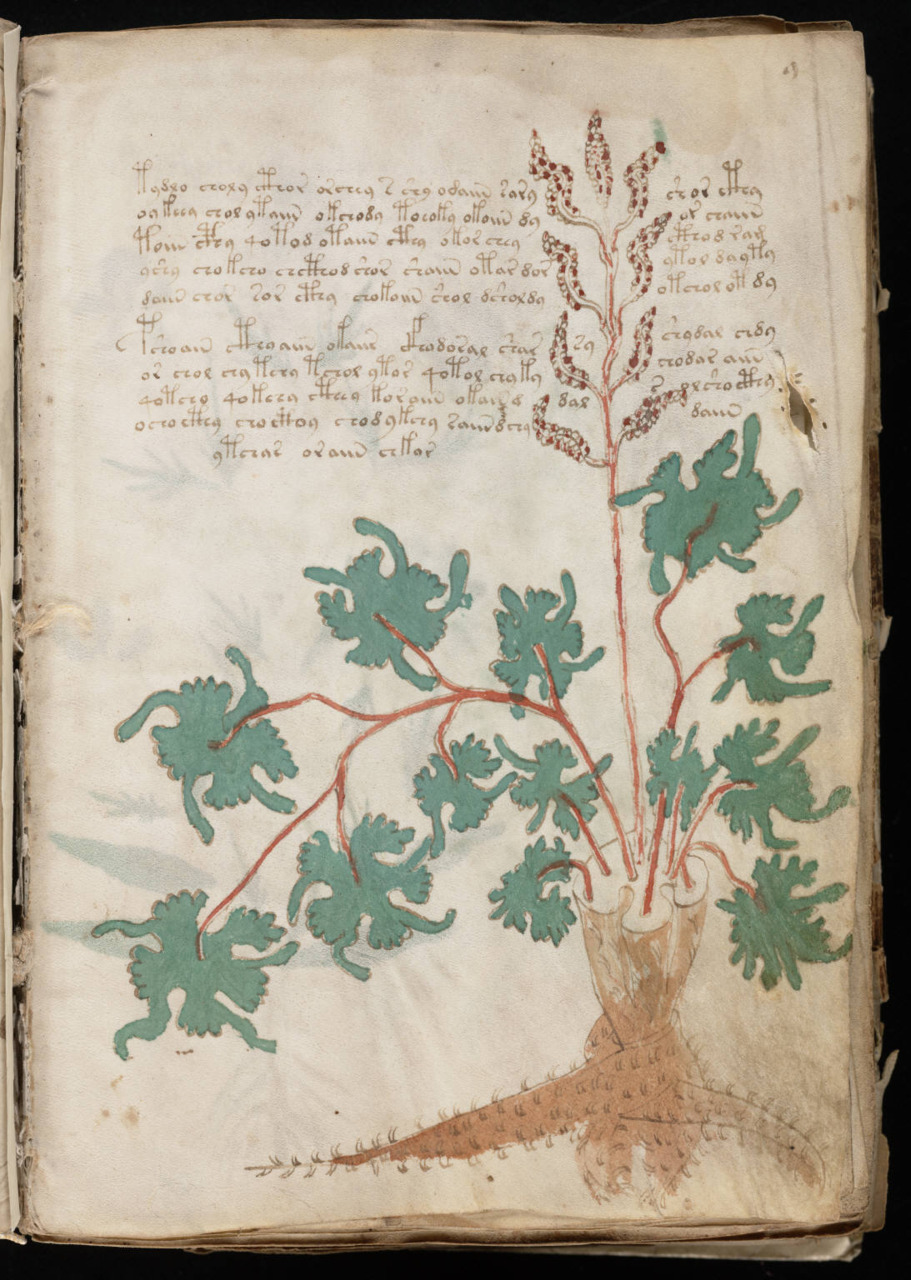
9V — About 10 thousand years ago — hunter-gatherers, birth of agriculture
Root: Small, well branched.
Leaves: Larger at the bottom of the plant, classical in shape; higher up smaller, with split tips.
Flower: Several small ones of bluish color.
— Root: Well-formed, indicating that humans were already physically and mentally ready to manage their environment.
— Leaves: Symbolize the transformation of humans from gatherers into farmers — larger leaves are hunters, smaller split tips are farmers.
— Flower: Reward for effort — decent crops, allowing humans to function independently of nature.
Folio 9V presents the transition of humans from the hunter-gatherer era to the agricultural one, showing both adaptive challenges and the first successes in controlling the natural environment.
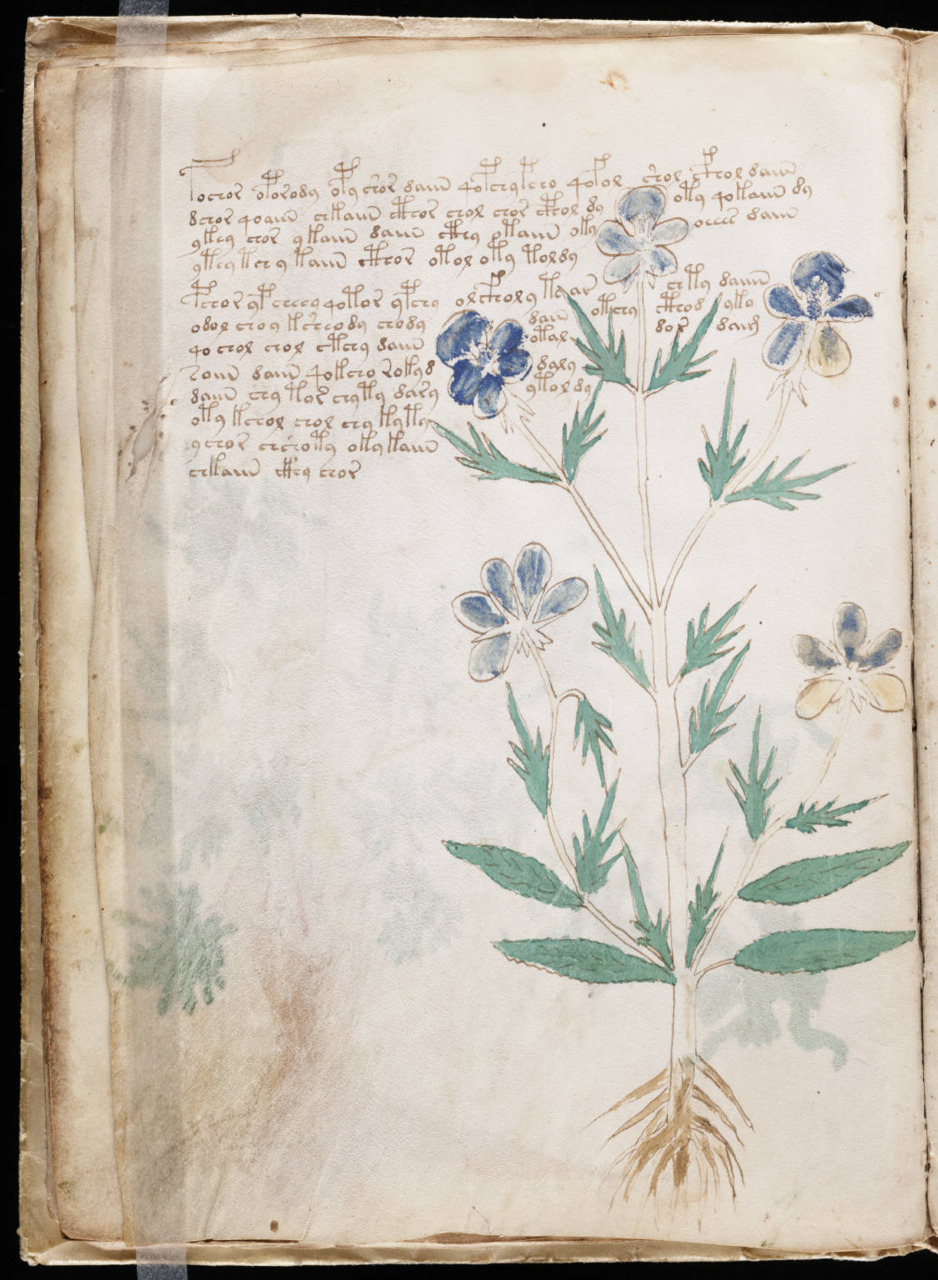
10R — About 4000 BCE — development of urban communities in Mesopotamia
Root: Two tubers located opposite each other (left and right), from which one stem grows.
Leaves: Quite large, near the top of the stem several smaller ones.
Flower: One large one with bluish petals, hanging toward the “ground”, like a ripe sunflower.
— Root: Its shape may resemble the female reproductive system, which in the context of Mesopotamia — “Between the Rivers” (Tigris and Euphrates) — emphasizes the beginnings of civilization and social life.
— Leaves: Symbolize the development of the oldest Mesopotamian cultures (Hassuna, Samarra, Halaf), and the smaller leaves are later phases — Uruk, early Sumerian period.
— Flower: The hanging “sunflower” shows the decline of the civilization’s splendor and the transition from the cult of the Sun to the cult of the Moon, symbolized by the tomb called the Great Death Pit.
Folio 10R illustrates the birth and development of Mesopotamian urban communities, while also pointing to the cycle of rise and fall of civilizations and subtle changes in religion and cultural symbolism.
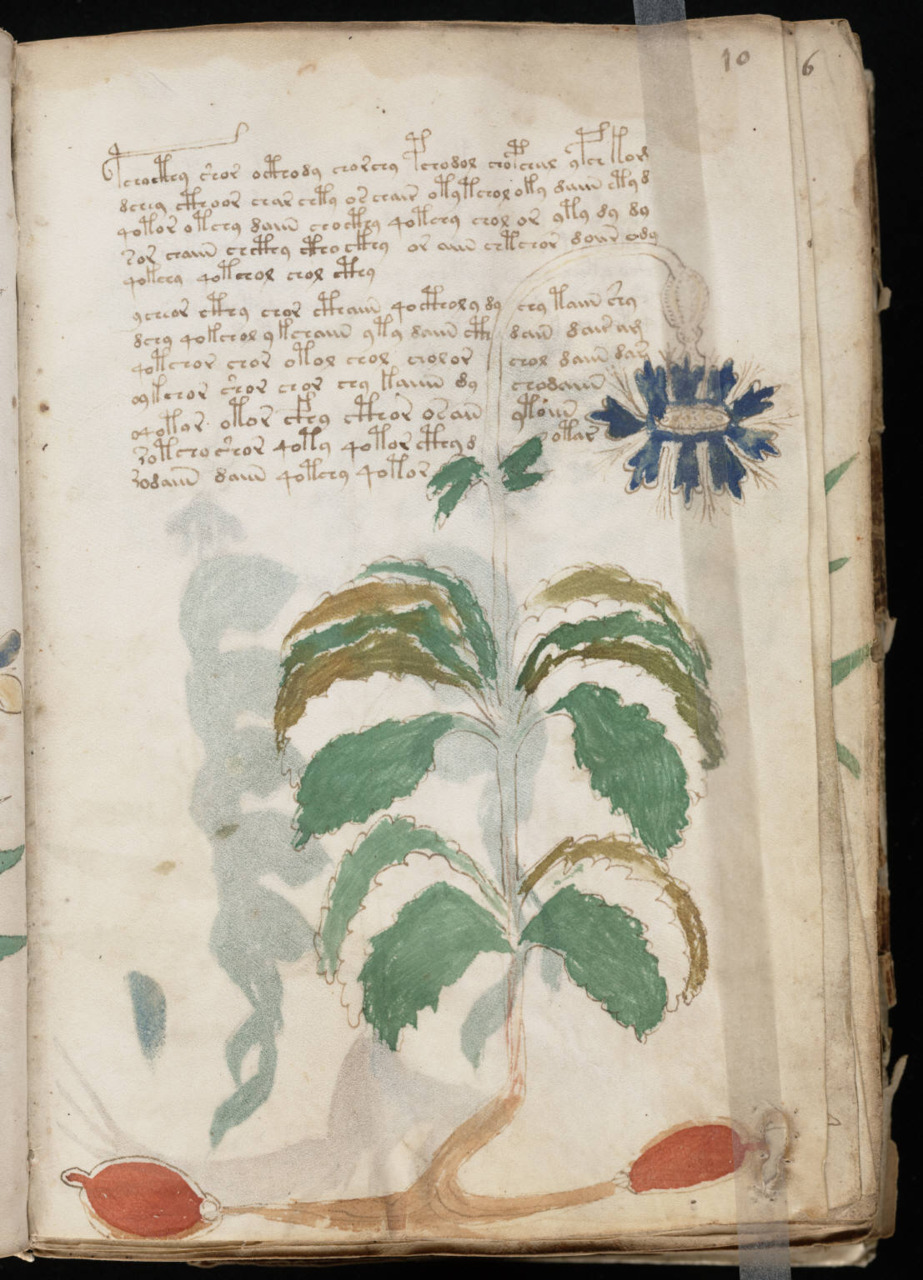
10V — About 3000 BCE — beginnings of ancient Egyptian civilization
Root: Well formed, numerous offshoots.
Leaves: Green, single at the bottom of the plant, further up growing in pairs.
Flower: Two small bluish ones, hanging downward.
— Root: Solid branching symbolizes the stable foundations of Egyptian civilization developing along the Nile.
— Leaves: Single at the bottom — pre- and early-dynastic period; paired leaves — Old, Middle and New Kingdoms; hanging leaves refer to Egyptian ideograms of the lions Shu and Tefnut, as well as to dualism and cyclicity of the universe.
— Flower: Two hanging flowers symbolize the final fall of civilization; the paired arrangement of flowers is an ideogram of dualism.
Folio 10V shows the birth and development of ancient Egypt, emphasizing both the durable foundations of the culture and the cyclical nature of history and dualistic symbolism present throughout the manuscript.
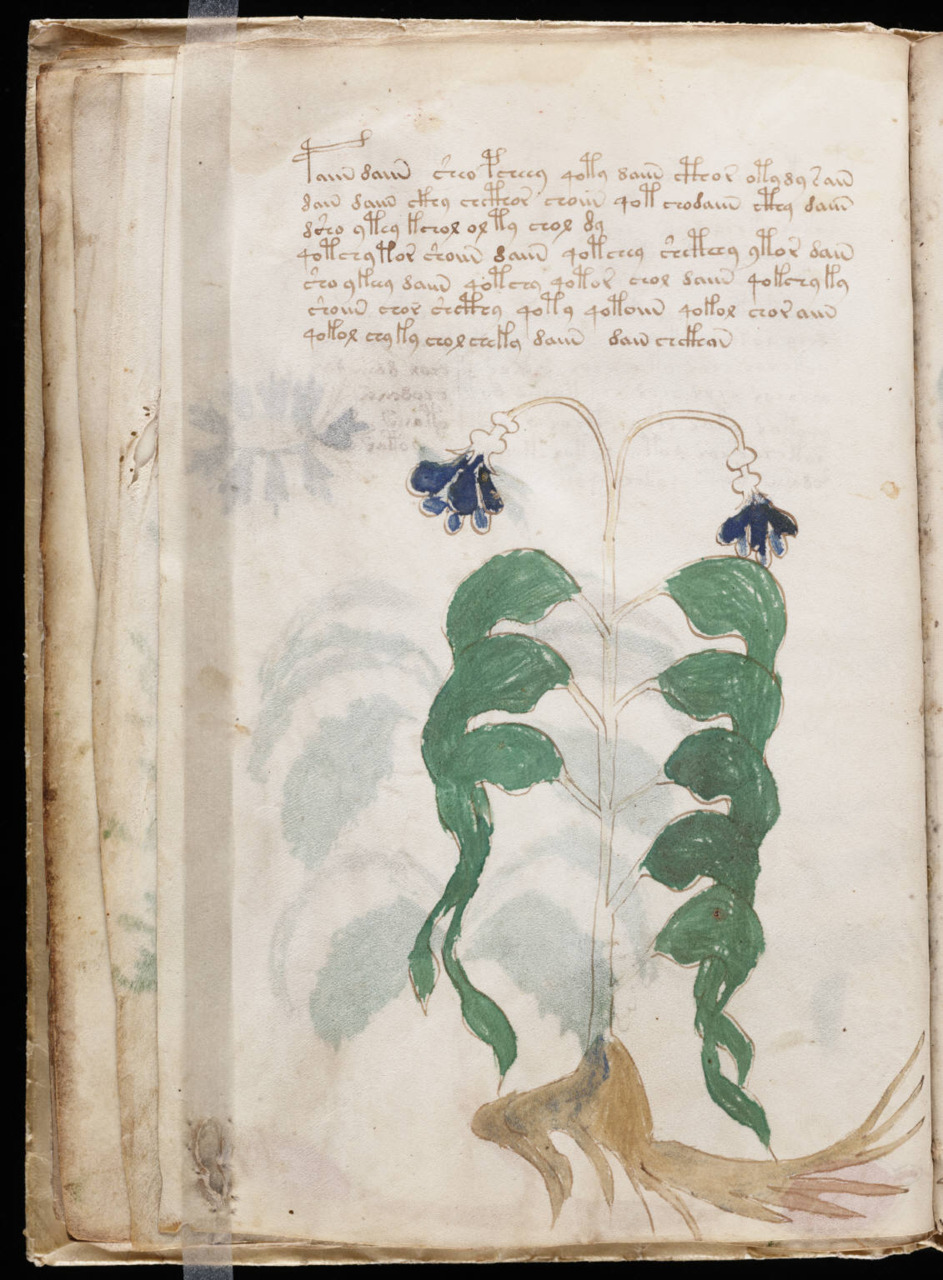
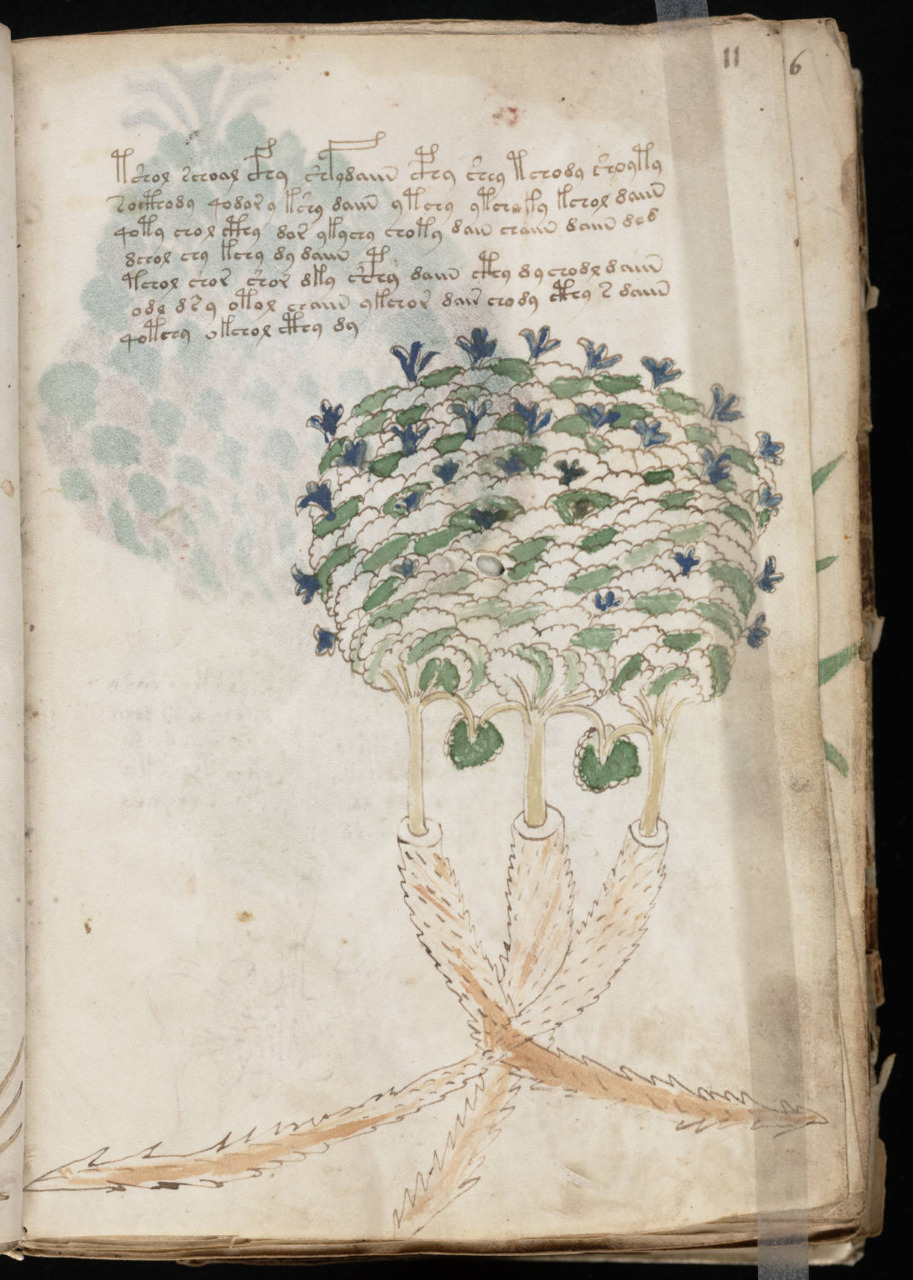
11R — Turn of the 2nd and 1st millennium BCE — Judaism, Jerusalem
Root: Three roots, intertwined with each other, each “coming” and “going” in its own direction. In the upper part as if cut off.
Leaves: Two leaves hanging and at the same time fused at the top of a huge bouquet.
Flowers: One large one, giving the impression of a beautiful and dense inflorescence.
— Root: Firstly: it resembles a menorah — a symbol of Judaism. The cutting of the roots in the upper part says much about the dramatic fate of representatives of this religion — nearly two thousand years of diaspora. Secondly: three “coming” and “going” roots symbolize the three main monotheistic religions: Judaism, Christianity and Islam, which — sometimes in very dramatic ways — intertwined their fates in one city (point) — Jerusalem.
— Leaves: Hanging at the top of the bouquet of flowers, they break the symbolic convention of previous plants (root, leaves, flower). This time, these two leaves constitute the last — final chord of symbolism. It is an announcement of the near future.
— Flower: Since the matter concerns Jerusalem, this magnificent bouquet symbolizes the entire dramatic history of this city over several millennia. The leaves grow directly from the tradition of the “first” religion.
Folio 11R presents the intertwining of the three monotheistic religions in the central point of Jerusalem. The cut roots symbolize diaspora and dramatic history, and the bouquet of flowers emphasizes the durability and richness of the city’s spiritual tradition.
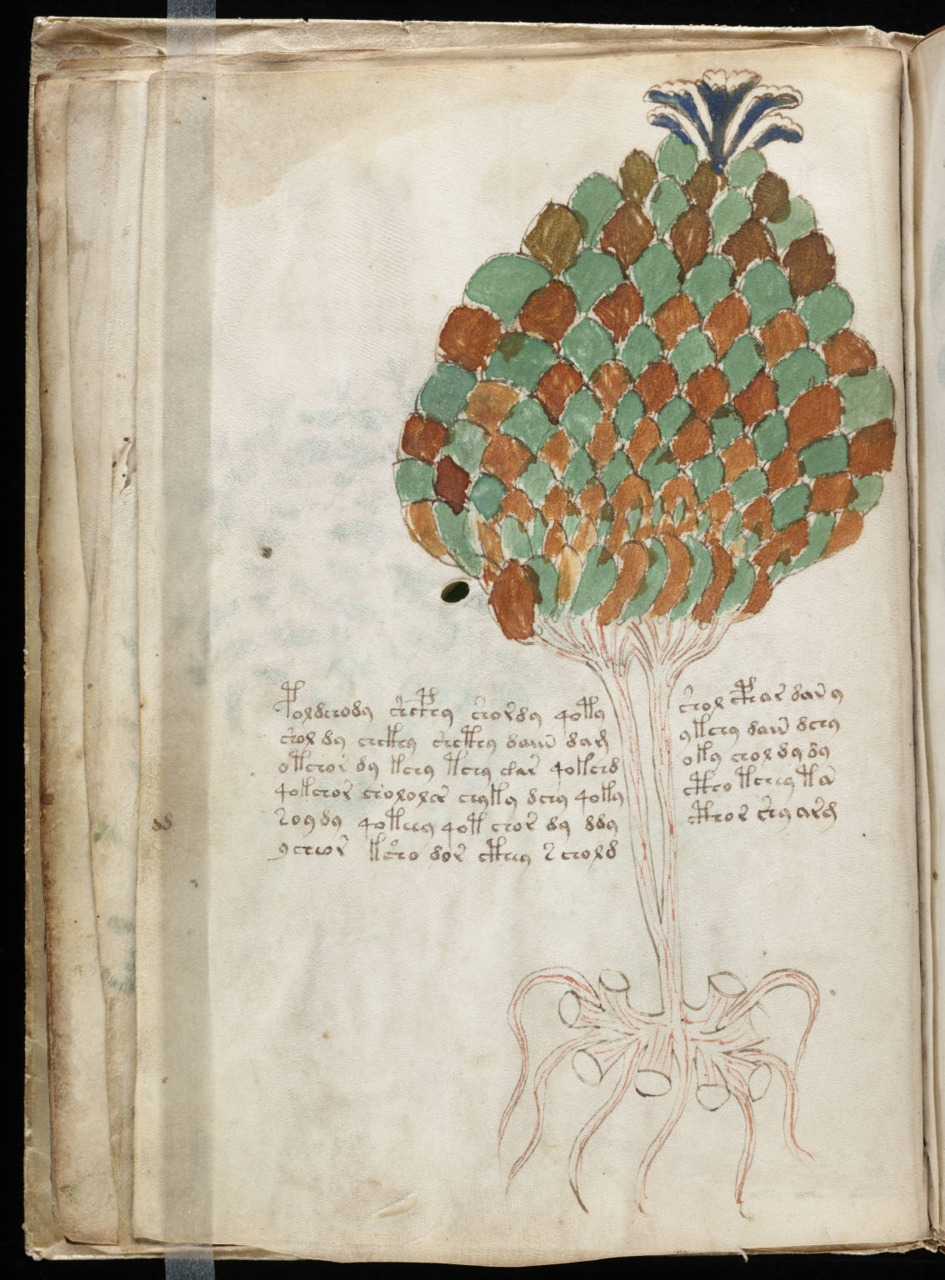
11V — Turn of the eras — Christianity, Rome
Root: Solidly branched, shaped like an octopus, with half of its offshoots, exactly every second one alternately, cut off.
Leaves: Multicolored: green, orange, red, brown, forming a huge thicket shaped like a tiara — the papal crown consisting of three diadems.
Flower: What proves that it is unquestionably a tiara is its top — in the shape of a cross.
— Root: The cut offshoots symbolize the dramatic beginnings of this religion. Two stems growing from one root — this is information about the schism between Orthodoxy and Roman Catholicism.
— Leaves: Their shape and incredible colors speak for themselves.
— Flower: The shape of the cross — the most important symbol of this religion.
Folio 11V shows both the genesis of Christianity and its internal conflicts (the schism). The tiara and cross emphasize the authority and central importance of Rome, and the various colors of the leaves symbolize the richness of tradition and cultural influences.
12R — Ancient Greece
The illustration has been lost, therefore its exact content remains unknown. Maintaining the chronological-historical continuum, it can be assumed that it depicted the civilization of ancient Greece, its cultural, philosophical and political development. Key elements of Hellenistic culture may have been shown — architecture, art, philosophers and the beginnings of democracy, which significantly influenced later civilizations, including Rome.
Folio 12R symbolizes the foundations of European thought and the development of a civilization whose ideas permeate subsequent epochs. The absence of the illustration does not diminish the importance of this stage — Greece remains a key link in the historical continuum.
12V — Empire of Alexander the Great
The illustration is also lost, but historical logic points to the presentation of the empire of Alexander the Great, which in a short time united Greek culture with the territories of Asia and the Middle East. Possible representations included maps of expansion, symbolism of power, and the unification of different cultures under the rule of one ruler.
Folio 12V emphasizes the global reach of Greek influence and the synthesis of cultures in the Hellenistic era. The lost illustration may have served as a bridge between the classical Greek world and the Roman Empire.
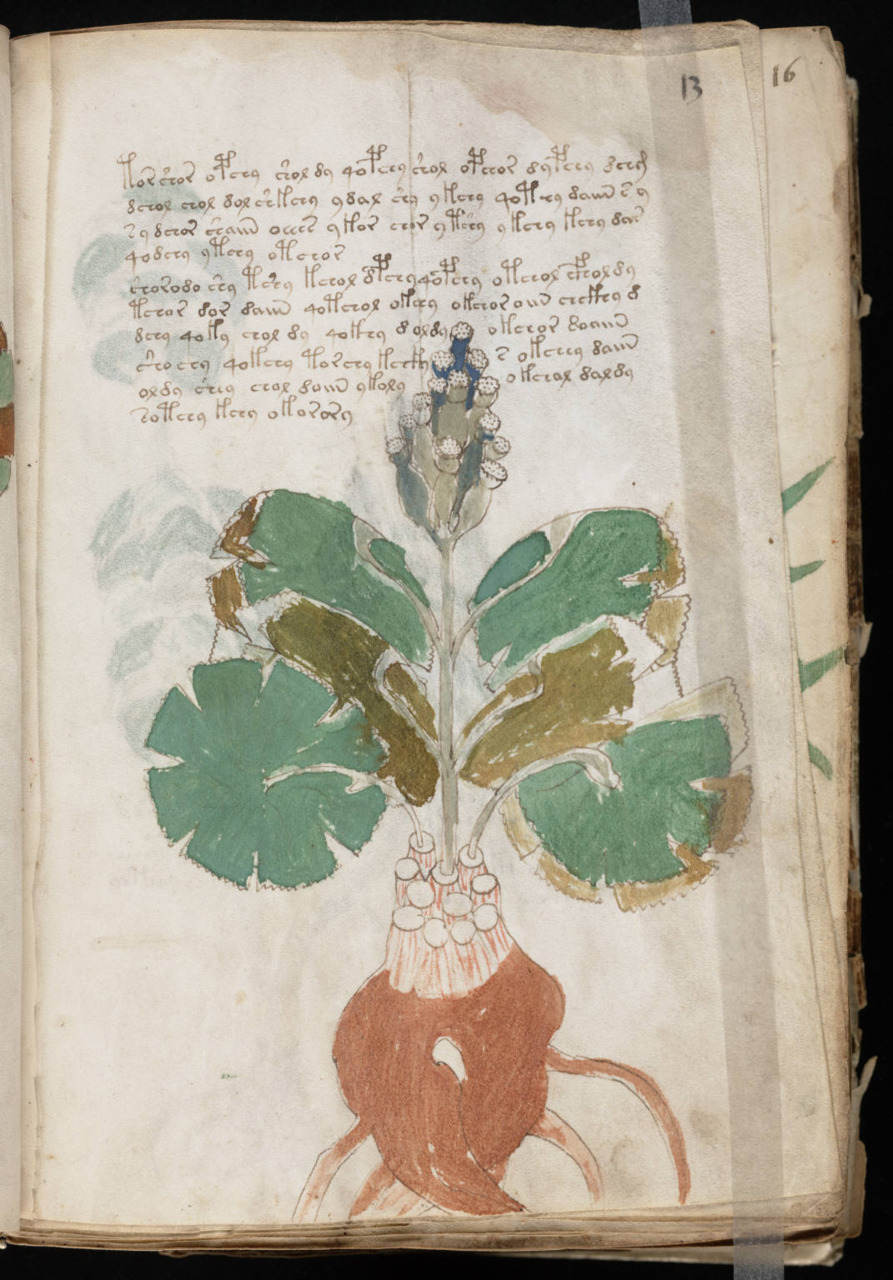
13R — Roman Empire
Root: Enormous in size, squat like a beetroot, in the middle a space formed from the joining of two offshoots, at the top most stems cut off.
Leaves: Rather large, jagged, two-colored.
Flower: Similar in form to the root — as if all offshoots were cut off.
— Root: Its shape symbolizes the furthest reach of the Roman Empire, and the space between the offshoots is Mare Nostrum (the Mediterranean Sea). The cut stems at the top of the root indicate that this empire arose through ruthless conquests, on the ruins of other equally interesting peoples, cultures and civilizations.
— Leaves: Their shape resembles the armor of a Roman soldier — especially the one on the right resembles a centurion’s helmet.
— Flower: The end of this empire was as ruthless as its beginnings.
Folio 13R visually and symbolically presents the power, reach and brutality of the Roman Empire. Every element of the plant — from root to flower — reflects both the rise and the fall of this historical giant.
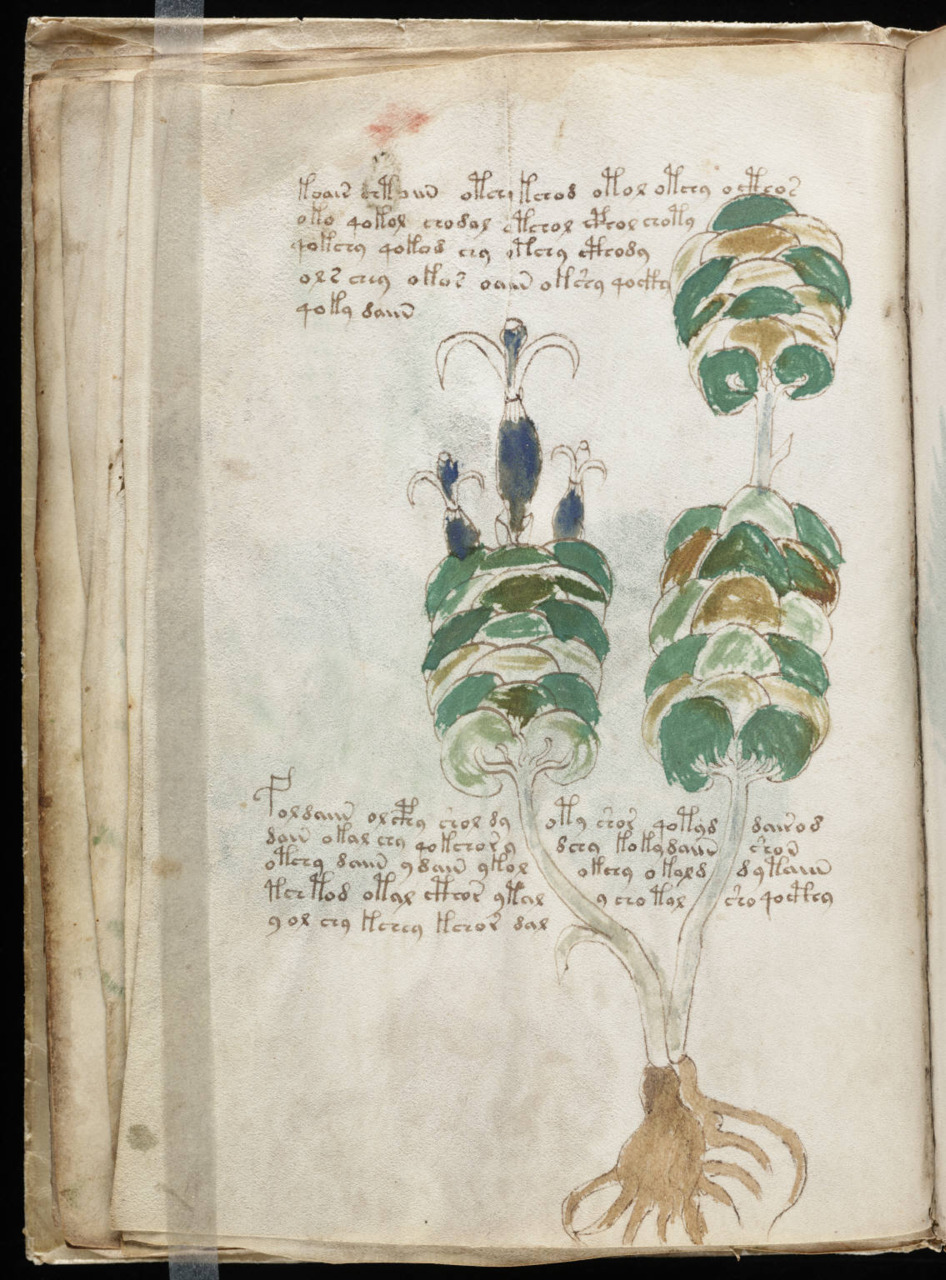
13V — Persian Empire
Root: Quite large, with many offshoots.
Leaves: Two extremely dense and multicolored clusters of leaves growing on two equally enormous stems.
Flower: On the left side hook-ended fruits, on the right similar to the lower located, already smaller cluster of leaves.
— Root: The shape of its hook-like offshoots leaves no doubt that we are dealing with the crescent — a motif frequently occurring in decorative art of Muslim countries, initially under the influence of the Sassanid dynasty (224–651 CE).
— Leaves: The two stems inform about two directions of expansion of this empire: eastern and western — a series of victorious wars with Rome.
— Flower: Those growing on the left side are the western territories of the empire, which in the future (after the fall of the Sassanids) will be taken over by Muhammad — Islam. The flowers on the right side are the eastern Persian part of the empire — the shape and texture of this element are therefore understandable (Iran).
Folio 13V symbolizes the expansion, complexity and heritage of the Persian Empire, both territorially and culturally. The plant pictorially presents the division and evolution of Persian influences in history.
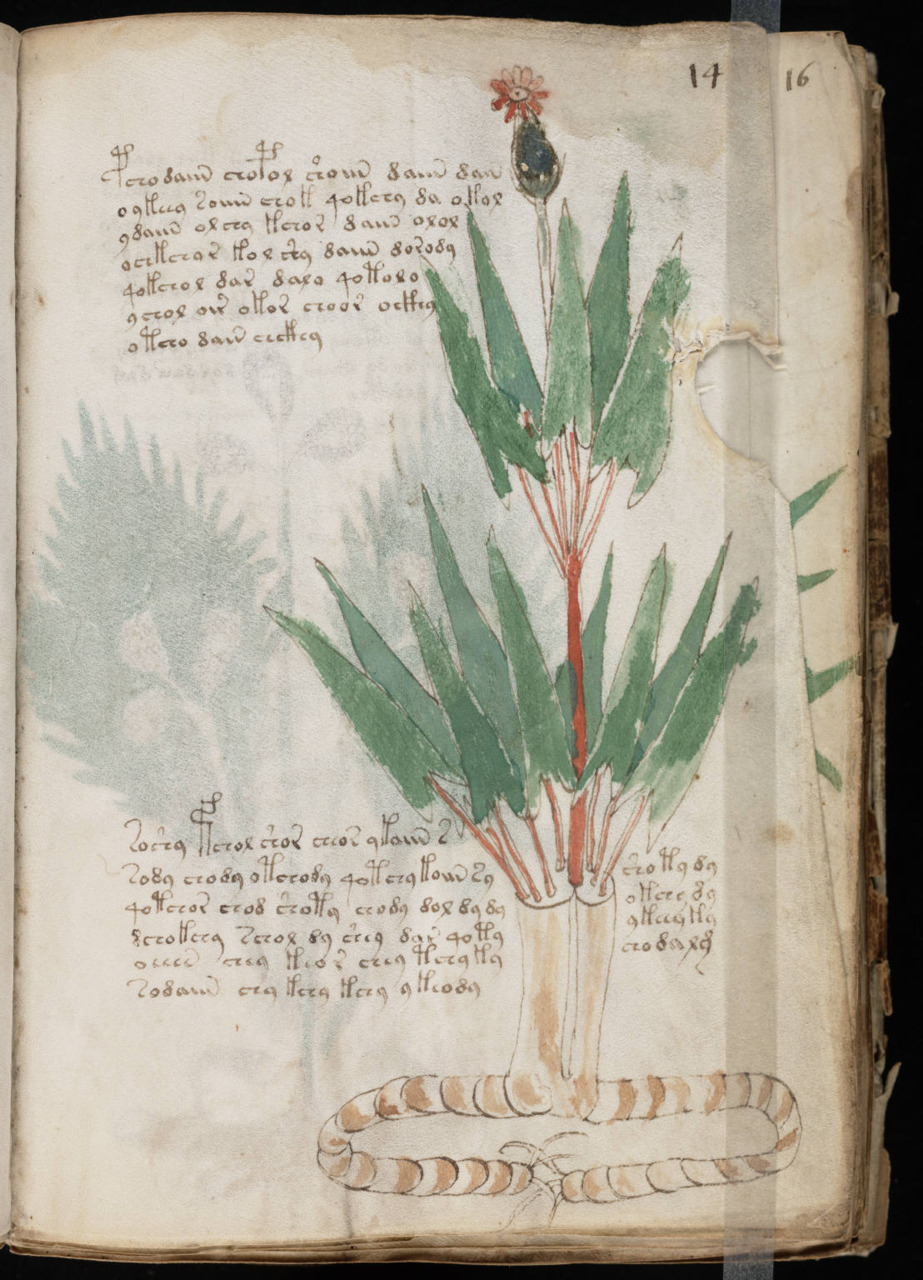
14R — Huns. Mongol Empire
Root: Very unusual, shaped like a snake. The top of the root is cut off.
Leaves: Continuation of unusualness — leaves in the shape of arrows protruding from a quiver — two levels. Below, their number is greater than those at the top.
Flower: In relation to the whole plant very modest — one red flower growing from a black bud.
— Root: Its unusualness is understandable when considering that the matter concerns nomadic tribes inhabiting the steppes of Central Asia — that is, from beneath the Chinese wall. The cut root informs about the “sudden” end of their bloodthirsty ambitions.
— Leaves: The association with a quiver is unquestionable. Two levels of arrows are information about two waves of barbarian invasions. The first — around 370 CE — caused the Great Migration of Peoples, contributing to the fall of the Roman Empire. The second — the empire of Genghis Khan in the 13th century.
— Flower: The black bud is information about Mongolia’s troubles during World War II — the Japanese invasion. The colorful flower — this people, after many centuries being a source of trouble, finally bloomed and became civilized.
Folio 14R shows the expansion, conflicts and evolution of the nomadic tribes of Central Asia, illustrating both historical invasions and the gradual process of civilizational transformation of these societies.
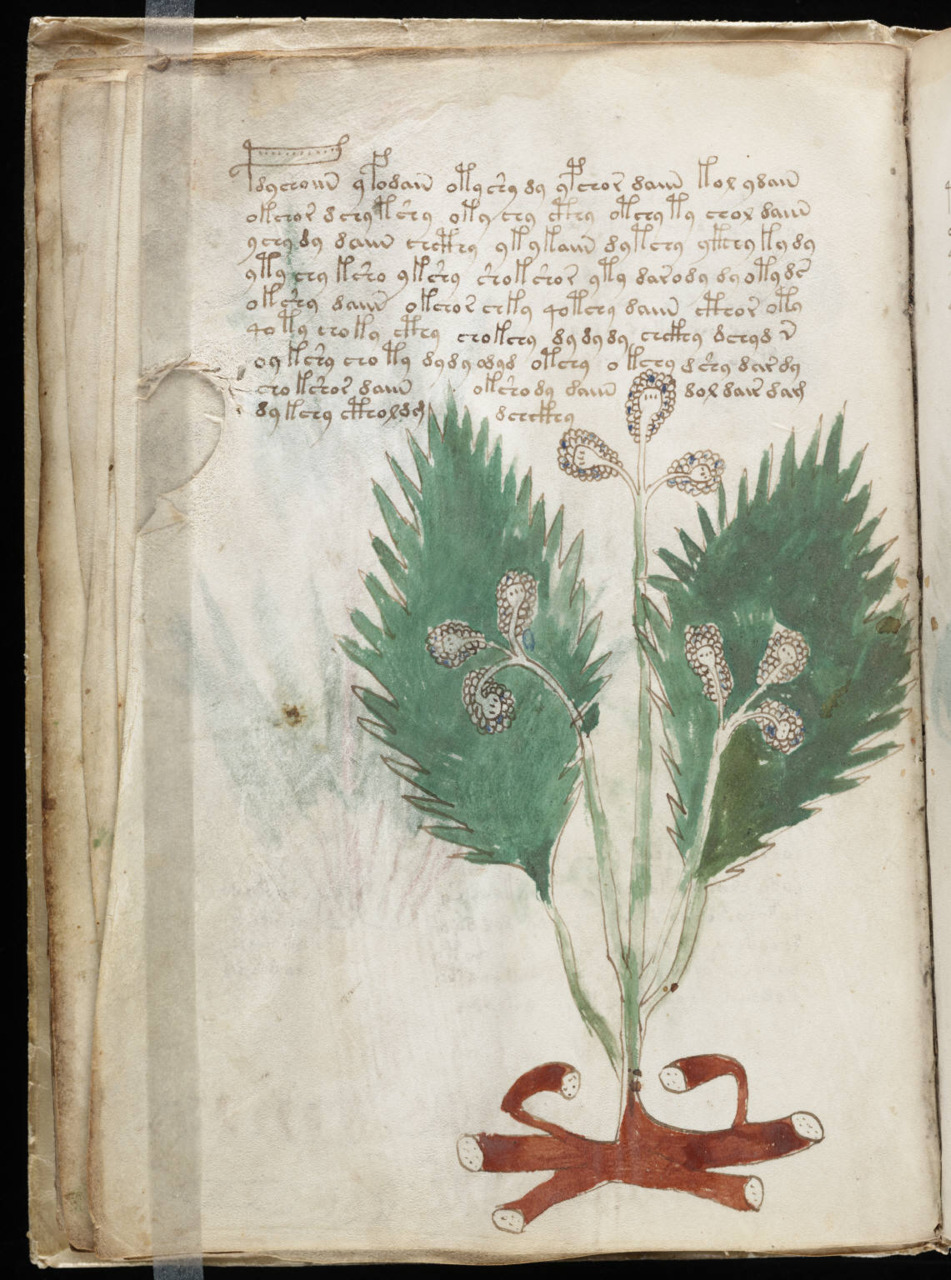
14V — Byzantine Empire
Root: Quite large, red in color, all its offshoots cut off.
Leaves: Two enormous, green and jagged leaves.
Flower: Several, very patterned, almost mosaic-like.
— Root: The shape and color refer to the flag of the Byzantine Empire. The cut offshoots are information that the empire, so vast and relatively long-lasting, did not withstand the test of time (from Constantine I or Theodosius I — 4th century — to 1453).
— Leaves: Two enormous leaves like lungs — the European and Middle Eastern parts of the same organism, whose keystone — capital — was Constantinople.
— Flower: The mosaic motif clearly highlights the main style and decoration of the art of this region.
Folio 14V illustrates both the extent and durability of the Byzantine Empire, as well as its geographical division and artistic heritage, which continues to fascinate historians and art scholars.
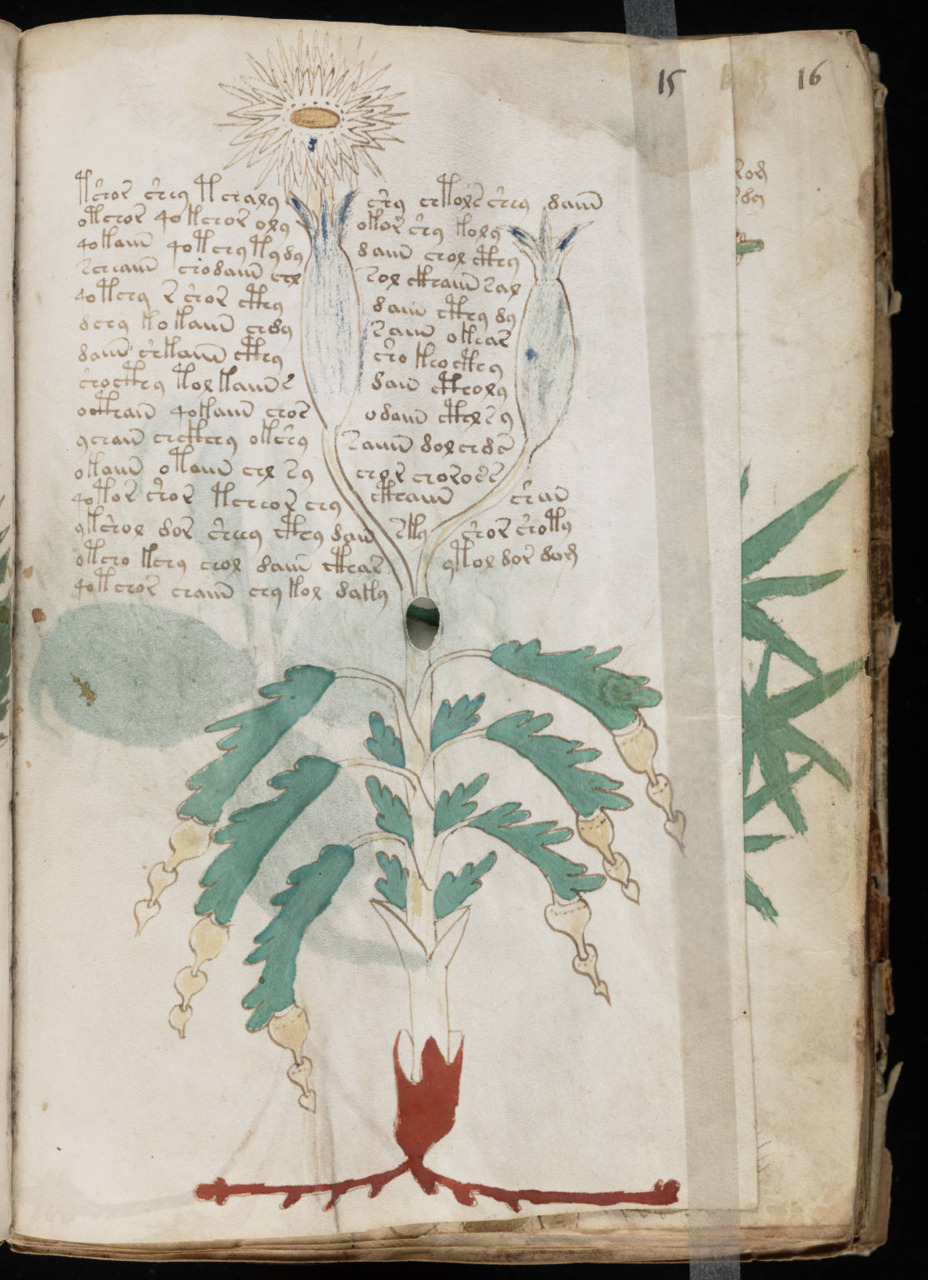
15R — Frankish State. Carolingian Dynasty
Root: Red in color, has two offshoots, directly from it grows the next root segment — white in color.
Leaves: Their shape resembles the leaf of the pedunculate oak. This is confirmed by the hanging fruits at the ends of these leaves in the shape of acorns. The stem is relatively solid with a large number of branches. Further on, the stem divides into two parts — calyxes.
Flower: Although two calyxes grow from the stem, only one produces a fairly large flower, resembling a blooming sunflower.
— Root: The two offshoots symbolize the genesis of the Frankish State, which dates back to the 3rd century CE. They arose from the mixing of smaller Germanic tribes living along the lower Rhine. Another branch of these tribes were the Salian Franks, inhabiting the areas near the North Sea between the Meuse and the Scheldt, from whom the Merovingians descended.
— Leaves: One segment growing directly from the other represents successive dynasties: first the Merovingians, later the Carolingians. The culminating moment of the empire was the death of Charlemagne, after which it split into the western part — France and the eastern part — Germany, exemplified by the two calyxes.
— Flower: Its placement in the left calyx symbolizes France (the western part), evidenced by the sunflower — see Louis XIV — the Sun King.
Folio 15R presents the rise and development of the Frankish State, emphasizing dynasties, their territorial expansion, and the symbolism of power and heritage in medieval Europe.
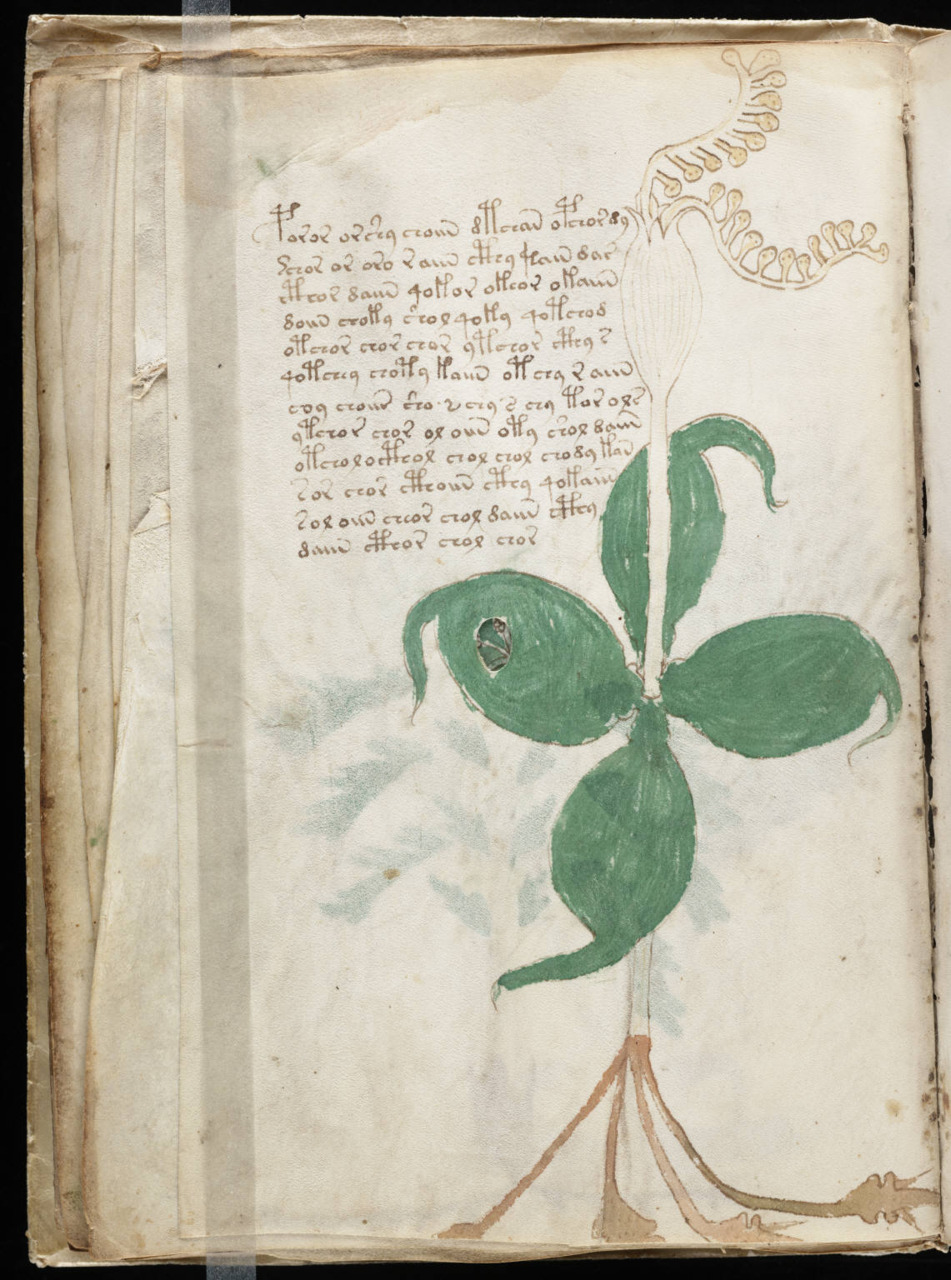
15V — Spread of Islam
Root: Four offshoots.
Leaves: Four enormous, green leaves, growing from one place on a straight, rather long stem.
Flower: From a white calyx protrude two stamens with something resembling beads.
— Root: Indicates that Islam has its roots in Muslim (Sassanid) traditions.
— Leaves: The four enormous leaves symbolize the spread of the religion to the four sides of the then world (Arabian Peninsula, Abbasids, Fatimids, Almoravids, Umayyad Caliphate), and the fact that they grow from one point refers to the knowledge associated with Muhammad and the place where everything began (Mecca).
— Flower: The white color of the calyx is a symbol of the white garments of Muslim pilgrims, referring to the pilgrimage to Mecca. The stamens (bead-like) symbolize the Islamic rosary, consisting of 99 beads.
Folio 15V depicts the genesis and expansion of Islam, showing both its geographical range and religious rituals and traditions deriving from Arabia and Muslim dynasties.
16R — Vikings
Root: Many squat offshoots, top of the root cut off.
Leaves: Many large, green, star-shaped leaves.
Flower: Wavy shape of petals. Colors: white, green, red.
— Root: The number of its offshoots encodes information about the many directions of Viking conquests. Its streamlined form and brownish color symbolize ships, thanks to which they could conquer all of continental Europe. The cut top of the root means that Viking dominance did not last very long.
— Leaves: Their multitude and star-like shape symbolize the aggressiveness of the invaders.
— Flower: The white and red of the waving petals evoke the sails of the Nordic conquerors.
Folio 16R visualizes the expansion and tactics of the Vikings, showing their mobility, aggression and characteristic maritime symbolism in an ideographic way.
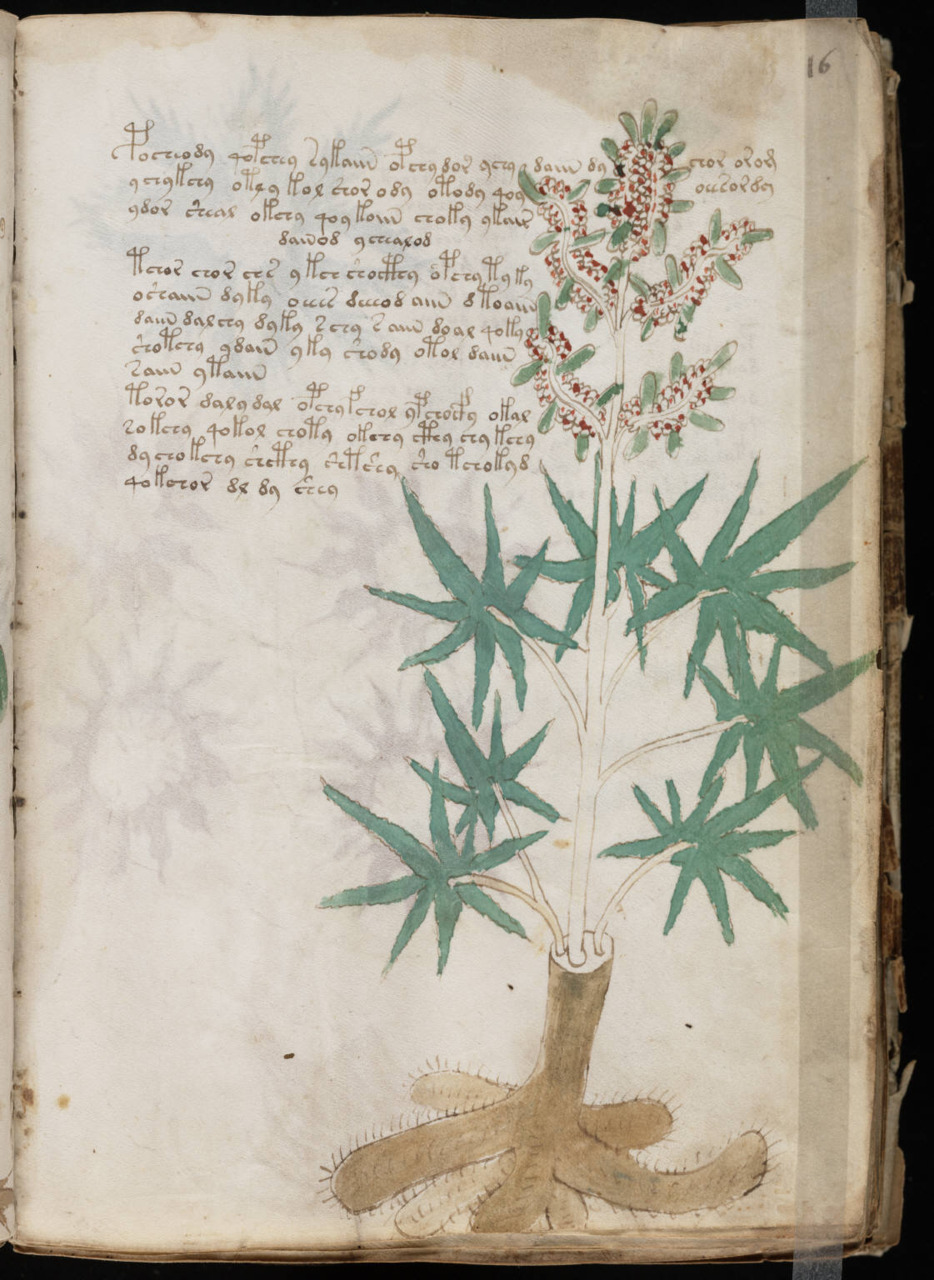
16V — Slavs
Root: One, even quite large, cut at the top.
Kup książkę, aby przeczytać do końca.