
Bezpłatny fragment - Val Karnowski, Boy Revolutionary Part II of II
This book is intellectual property protected by copyright. This means it is a violation of civil or criminal law to make copies for other than personal use without the permission of the author. Permission in other cases will be granted on an individual basis. Authors of intellectual property depend on copyright to protect their work and to allow them to earn income by selling it. Without such protection there would be much less incentive to create such works in the first place. By respecting the author’s rights you can help to create a better environment for all creative endeavors.
Author’s Foreword
This book, and other ones in this series, are works of fiction. I have attempted to make the depiction of history as accurate as possible, but where the facts were scant or non-existent at the time of writing, I invented them. Do not think that because you read something in one of my books it must be true. Check everything I say. Much of my historic data comes from sites that I visited on the Internet, so the data is as accurate as that.
The cover was designed by AI. I did not solicit help from AI in writing the book.
The Angel Zuriel’s Foreword
I am Zuriel, the guardian angel of Valentine Karnowski, whose life is the unifying thread of this, one previous, and subsequent books. As an angel in the presence of the triune God, Who is Truth, I know a lot more than you on earth: I know the truth, rather than commonly-held beliefs about human events. I am a precise kind of being, and that is why I often give times of sunrise, sunset, high- and low- temperatures, wind speeds and other facts of weather, because I know the influence these can have on human events.
Well, why am I writing these books? Valentine Karnowski has led a most unusual life, having lived through many events of historical significance. I want to show the hardships forced on him and the Polish nation, of which he was a part. I want to show the faithfulness of the Poles to Jesus’s Catholic faith.
This book is in the form of a journal, because the life of Man happens day by day. While something is happening in one place, something else is happening in another. The problem with many novels written by chapter is that e.g., in chapter 1 they will deal with the weather over a period of time, then in chapter 2 they will go back to day 1 and deal with geography. Chapter 3 will go back to day one and deal with Mr. X, etc. I tell you about things that are happening simultaneously.
How am I writing them? I give inspiration to Mr. Schmidt, and he types it all out.
It would add to your enjoyment to follow trips from one place to another. You can find the places mentioned in this book on an Internet map of Europe, and on Google Earth. You will get indispensable background that happened prior to this book from Book One, The Possession of Moishe Karnowski.
Part II of II. REVOLUTION across Europe!
Chapter Thirteen: Val’s Journey to Paris
Fri. January 7, 1848. Right after breakfast there was a knock on the door of the palace in Rogóźno Zamek. Stanislav (66) the butler opened it to find a uniformed man standing in the light rain. “Ich hab’ ein Telegram für den GrossHerrn Rogotzinski”, he said, the telegram in one hand, and his horse’s reins in the other. “I have a telegram for Lord Rogoziński.”
“Wait here,” said Stanislav, as he went to a little box holding small change. He took out some coins, returned to the messenger, and handed them to him. “Danke sehr”, he said, and the messenger returned, “Bitte sehr”, and rode away.
Stanislav took the envelope to Lord John (26), who was sitting right up to a fire blazing in the fireplace in his office. He had a bear skin wrapped around his shoulders. “This telegram just arrived, Sir”, he announced, and handed it to the young estate-owner. Walking over to his desk with the fur still around his shoulders, he found a letter-opener and retrieved the telegram. It was from Paris, France, and read:
“Uncle Severin Rogoziński in poor health. Probably just weeks to live. Absolutely essential someone come immediately. — Cousin Szczęsny.”
Severin was the much older brother of John’s late father Romuałd (+7/18/1847 at 52), and had had an even larger estate than Romuałd’s, in what was now the Russian Partition of Poland. He had gotten involved in the abortive November, 1830 Uprising there, and when it failed, he, like many other revolutionaries, had fled to Paris. The lot of them was known as the Great Emigration.
John guessed that the urgency had to do with leaving his considerable money to his next of kin, and John was his next of kin. He correctly guessed that stating that in a telegram would have been madness, as the telegrapher could be trusted to have accomplices who would track the coach and divest the riders of all that they carried. He sat staring into the fire, absently striking the telegram against his chin as he thought what to do. He arose.
In the library Blaise (25) had begun Day 3 of teaching Valentine how to pronounce a combination of more than one big-letter sound. John entered the room without knocking. Interrupting, John said, “I want to see you as soon as this is over, understand?” And Blaise acquiesced.
Blaise went to John’s office where John discussed the import of the telegram. “I want you to take the coach and some strong peasants to go to Paris and see what this is about. I am 99% sure that it entails bringing back an inheritance from our uncle Severin,” John said.
“In this weather?” asked Blaise, incredulously.
“Well, the old boy is dying. God only knows what will happen if he dies and no one of us is there. You can wait a few days for the weather to warm up. You dress accordingly. Two peasants can ride in the coach with you. All that closeness will keep you all warm,” John said snidely.
“It is important to me to continue teaching the boy how to read. I want to take him along”, said Blaise; “Besides, he can act as my valet, and this will help him to get over losing his mother.”
“Do as you like. His presence here reminds me of that wench, his mother.”
John called for Justin (20). When he came John said, “You are going to accompany Lord Blaise to Paris, France. He is bringing back a fortune in money, and you and Hipolit Kwasigroch will act as body guards. My brother will inform you when the time is right”. Then John ordered the sleigh made ready and drove off to Szczepanki, to the Kwasigroch hut. When it began to snow more heavily he whipped the horse.
Not waiting to knock, he entered. The door blew open, and thru it, a gust of snow. Slamming it shut, he came right to the point. “My brother Lord Blaise needs to make a trip to Paris, France, and I want Hipolit to accompany him. Justin Flis is going as well. You two will keep him safe, acting as body-guards. The trip will take about a month, so bring appropriate clothing. Lord Blaise will leave when the weather gets warmer. Is that clear?”
The members of the family looked at each other sheepishly, and the father Witold (53), and son Hipolit (24), each said, “Yes, your Honor.” John marched out, leaving the family members with a pent-up anger that they had to swallow.
*
Blaise had to make a decision. Ordinarily nobles did not want peasants to know how to use a pistol, as one never knew if it would be used against them. Blaise knew that he was not like the average noble: he made an effort to be kind to peasants, and knew that they liked him as a result. Besides, he was sure that there would be no reason in taking the two men along if they could not act as real bodyguards. He decided to begin teaching them how to shoot.
At bedtime Catherine (21) gave Valentine (5) his haircut and bath. She waited for him to dress himself. He then said, “Are you gonna listen to my prayers?” She hadn’t planned on it, but feeling some discomfort she allowed the boy to seat her on a chair. He then knelt before her and placed his folded hands in her lap. Closing his eyes he prayed an Our Father, Hail Mary, and Glory Be. He mouthed a list of people whom he asked God to bless, ending with, “…Lord Blaise, Justin and Catherine”. The servant girl was moved by Val’s lack of vindictiveness at her. She smiled warmly as he got into his cot and pulled up the covers.
*
There was a meeting of Rogala’s Learn-to-Read Group that night. Hipolit Kwasigroch announced that he would be gone for about a month on a trip to Paris, and that Justin Flis would be coming along. Michael said, “You must take the opportunity to teach Justin what you have learned”.
“I’ll do what I can, but I’m no teacher”.
Tonight they would be doing Session 79: Day 1 of f and g. They had done all the capital letters, both vowels and consonants, all the small vowels, and only b, d, c, and ć of small consonants.
After the night’s lesson, Michael said,
“On October 5, 1831, during the November Insurrection in the Russian partition, the last detachments of the Polish armies under the leadership of General Matthew Rybiński, 200,000 men, crossed over the Prussian boundary at Brodnica, 28 miles southeast of Szczepanki.”
Sat. January 8, 1848. Today the temperature reached -19°F — two degrees colder than yesterday, so this was definitely not a day for Blaise to take off. When he entered the library for the lesson he said, “Valuś, before we begin I have a surprise for you. How would you like to take a trip with me to Paris, France?”
“Where’s that?”
“It is many days away. We would travel in a coach with Justin Flis and Hipolit Kwasigroch across the German states. You don’t know Hipolit but he’s a nice man. I know you would like it,” he said, enthusiastically.
The boy liked Justin and Blaise, so said, “Well, if you and Justin are goin’, all right.”
Then they got down to the lesson. Today Blaise began Session 117, connecting a big-letter sound to a small-letter sound. He went thru the entire list of capital consonants before a, then e, etc. e.g., Ba, Ca, Da, Fa… Za; Be, Ce, De, Fe… Ze. He wrote each combo on paper. Then he had Valentine find instances of them in his book and he, Blaise, read the whole word. Valentine found it difficult to concentrate; he was so excited about going away on a trip with his friends, Lord Blaise and Justin.
After the lesson Blaise told Catherine to get Valentine ready for the trip, as they would leave as soon as the weather warmed up. He told the boy that the lessons would be held in the inns where they would stop in the evening. He would continue them, not counting the inconvenience. He went to his own bedroom and packed trunks and suitcases, including all the things needed for the lessons.
Sun. January 9, 1848. After 9:00 Mass at Szczepanki’s St. Laurence church the peasants milled around the churchyard as usual, catching up on news and gossip. Catherine, servant at Rogóźno Zamek told a girlfriend that Lord Blaise, Hipolit Kwasigroch and Justin Flis were going to make a trip to Paris lasting a month.
By nightfall the news of the impending trip reached Łasin and the ears of Lutheran Pastor Irmler (34). “Aha! I knew it! Blaise Rogoziński is in on the plot. They’re going to Paris to team up with all those Polish émigrés there, maybe organize some kind of army. You don’t make a month-long trip in January to sample French cooking! I need a spy!”
“The Plot” was something he was sure that local intellectual Michael Rogala (19) was leading. More of Michael later.
He had to think fast, to devise a plan. Could he kidnap the present coachman from the manor? That would have to be under cover of darkness, but there was moonlight on white snow to contend with. There was the high iron fence to scale, maybe vicious dogs. And he didn’t know where the coachman slept.
What about getting a substitute driver? It would need to be someone local, and someone who spoke fluent Polish, but whose loyalty to Prussia was solid. He’d need a reference from another position, not someone hanging around Nudelman’s inn. He thought of going up to Hauptdetektiv Schuschnig in Kwidzyn and insisting that he send such a spy, but that would certainly raise suspicions, showing up conveniently just when the previous driver disappeared. No, it appeared that he’d have to content himself on finding a spy in Paris.
If he only knew the route that the party would take. Maybe he could plant spies in towns big enough to have a telegraph office who would report to him. Wait a minute: it was a long shot, but worth trying.
Mon. January 10, 1848. At 5:00 am Irmler awoke in Łasin and at 7:45 he was standing before the concierge at Regency Headquarters in Kwidzyn. “Der HauptPolizist has, I believe told you to put me thru ahead of all others if I have evidence of a plot against the government. Well, I have such evidence”, Irmler shot out excitedly. Presently he was sitting on the edge of his chair before Schuschnig.
“I have been listening outside the doors where Rogala and his ruffians meet. He’s teaching them Polish history, trying to whip them into a nationalistic fervor.”
“Yes, I can see that that might lead to a conclusion of conspiracy. And althoughugh the Prussian state frowns on the teaching and learning of Polish history, it isn’t illegal.”
“Blaise Rogoziński and three of them are about to take off for Paris. Something is afoot,” said Irmler.
“To nip this in the bud I’ll notify my spies in Paris to find out just what is going on there”, Schuschnig said out loud. “The émigrés gather at the Hôtel Lambert around Count Czartoryski”, he said to himself.
After Irmler departed Schuschnig went into the telegraph room and sent a coded telegram to Joseph Dobek (24) and Gabriel Hetmański (26). Although these two spies had Polish surnames, they regarded themselves as German — a frequent occurrence in Poland. This ambiguity was useful to Prussia. They lived in Paris, and had become members of the Hôtel Lambert. The telegram said,
“A certain Blaise Rogozinski and three Polish peasants will leave for Paris soon. I want them watched and reports sent back to me. –Udo Schuschnig”.
*
When he got back to Łasin Irmler threw the reins of his carriage into the hands of his servant and immediately trotted over to the Łasin telegrapher, who was German. “May we talk privately?” he asked in solemn tones.
“Yes, pastor, of course”, he replied very respectfully.
“I am on a secret mission for HauptPolizist Schuschnig of the Geheime Staats Polizei in Kwidzyn. Herr Blasius von Rogotzinski is going to make a trip to Paris. We think that he may be up to some kind of plot against our beloved Prussia. I need you to furnish me with a copy of every telegraph he sends from his route. Will you be a patriotic Prussian?” he asked. “Oh, ja, natürlich, Pastor Irmler”, he replied.
“And of course, this must be kept secret between just us two. Agreed?” He agreed, proud to render loyal service to his king.
When Irmler got home he went to his desk and penned this letter to Jerome Boszk (26), a Kashube living in Paris, who was fluent in Polish and German:
“Dear Jerome,
I am calling on you to render a great service to our beloved Fatherland. I want you to infiltrate the Polish émigré group that meets in Count Adam George Czartoryski’s home at Hôtel Lambert, at 1 Quai d’Anjou. I especially want you to keep an eye on a certain Blaise Rogozinski, who is certain to join one of these days. He is about to take off to Paris. Reply by sealed envelope, time permitting. If you must, telegraph me. The telegrapher is a loyal patriot.
Sincerely,
Rev. Waldemar Irmler.”
*
Day 2 of connecting a capital with a small letter for Valentine. Before the lesson Val questioned Blaise about something he had heard at the day’s Mass, that of the Epiphany. “How could a star lead the wise men anywhere? It’s up in the sky”, he said.
“I think that people make a mistake to think of it as an ordinary star. I think it was some kind of bright light that hovered above the ground, say, ten feet up. And it moved. You are asking good questions”, replied Blaise.
At lesson’s end Val took out the picture book of gothic cathedrals and set in to copy the cathedral of Rheims.
Tues. January 11, 1848. King Frederick William IV (52) had Bismarck (32) to dinner at the Berlin StadtSchloss. Bismarck was seated next to Ernest Ludwig von Gerlach (52). Queen Elizabeth Louise said to Bismarck, “It is a pity that your wife could not make it”.
“I believe that she may be with child, your majesty. She has been ill mornings of late, and seems to have developed a ravenous appetite. I thought it best for her to remain in Schönhausen”, he replied.
“Oh, how wonderful if it is true. Of course I will say nothing until I receive confirmation”, the queen said.
The king said to Gerlach, “And so, Gerlach, what have you been up to of late?”
“Well, your majesty, Frederick Julius Stahl and I are getting ready to start publishing a new newspaper. We will call it the Neue Preussische Zeitung. I am quite sure that the views that it will present will coincide exactly with your majesty’s”, he replied, beaming with pride.
Bismarck added, “Happy to hear that. My own views — the views of the old conservatives, the Junkers — also coincide with his majesty’s. I would like to write for the paper”.
At dinner’s end the men withdrew to another salon for cigars and cognac. There was a noticeable sense of relaxation, characterized by lots of belching and farting.
Thurs. January 13, 1848. Blaise got up at 5:30 and knelt down to offer his day to God. He looked out his window, shined a candle at a thermometer mounted there and saw 25°F. “That’s the warmest it has been for a while; it’s bound to get warmer as the day wears on,” he told himself. He attended Mass for the Octave of the Epiphany at 6:00 in the household chapel and ate breakfast. He ordered Justin Flis to get the enclosed coach ready for the trip to Paris.
The coach, to be pulled by four horses, was brought around to the front door and was loaded with all the luggage. Already thinking of possible boredom in their rooms, Hipolit brought a deck of cards and his gęśle (home-made violin); Justin brought his kobza (home-made bagpipe). Blaise brought books for himself and Val, and the latter’s art supplies. All the inhabitants of the house stood by. Sophia and Valentine embraced, both crying. “Now you behave yourself. Please, be a good boy and listen to Lord Blaise,” she cried, and he reassured her that he would.
Blaise, Hipolit, Justin and Valentine all entered the coach and covered themselves with bear- and bison- skins that had been acquired on hunting trips to the primeval Białowieża forest, now in the Russian partition. Up on the driver’s seat the coach driver, Ambrose Marzanek, was himself covered with several such furs. “Brrrrr!” he ordered, rolling the r extra-hard, as he cracked the whip on the horses’ backs.
The entourage took off from Rogóźno Zamek with the household looking thru the windows, waving. It was 7:30; sunrise would not come until 8:11. Excitedly Valentine asked Blaise, “Can I sit next to the window? Huh, can I please?” Blaise traded places. He was most desirous that the boy drink in all the new sights that were sure to present themselves on this trip. He remembered how, as a child, even a trip to the next village seemed a marvelous adventure, full of wonders, and how he would regard a pigeon feather found there as a wonderful souvenir.
Day 1 to Paris. Each of the travelers — Lord Blaise, Justin, Hipolit, Valentine, and the driver — was wearing a ground-length greatcoat made of sheep fleece with the wool on the inside. Lord Blaise’s had a 4” border of black Persian lamb around the base and cuffs, and a thick fur collar of black bear fur; it was fairly new. The peasants’ had painted and embroidered folk art designs, mostly in reds and blues; theirs were weather-beaten and somewhat soiled. They all wore wool scarves over their ears, and large fur hats and gloves. The horses had been shod with special shoes for traction on snow or ice.
In their journey west they passed thru the forestless village of Gruta at 7:44 from whose hill the road descended to the walled city of Grudziądz on the bank of the Vistula. They entered thru a gate at 8:59. In a certain square they came upon a crowd whose eyes were all turned to a platform. On it a man stood with his hands tied behind his back. Beside him was a wood block with straw all around it, and a large man in a black hood. Another man — a court bailiff, perhaps — read in German from a large paper: “For the crime of plotting the overthrow of the Prussian state, Teofil Okoński is condemned to be beheaded. Do you have any last words?” In German, in a confident loud voice, the condemned man shouted, “Prussia occupies Polish land illegally. When Poles managed their own affairs we had freedom. May God restore freedom to Poland. I forgive the king and all who have had a part in this miscarriage of justice”.
At this Blaise realized what was about to happen, so turned them all around. He held Valentine’s head with his hands over his ears so as not to look back or hear. As they all walked away, Hipolit and Justin did keep looking back, and saw the man kneel, and place his head on the block. They heard the thud of the axe. Now they saw why Michael Rogala insisted on keeping their lessons in reading and patriotism secret.
The walk back to the coach was a somber one. To improve the mood Blaise said, “We’ll stay for dinner in Grudziądz”. They left the restaurant and the town at 1:36 pm. Gruta and Grudziądz would be the last two places with which they had the least bit of familiarity. They crossed the Vistula west of Grudziądz and rode with a large forest on their right.
The wide Vistula, whose perimeters were covered with ice, was on their left. It was an ideal setup for highwaymen, and they were on the lookout for them. All four men were armed with pistols.
The road led upward again thru Świecie (thru which they passed at 3:16 pm) and further upward thru Chełmno (3:51 pm). At 4:19 the sun set, and the driver lit the coach lights. The snow that lay all about was a great help in finding the way. At about 6:15 pm they found Pod Białym Smokiem (The White Dragon Inn) in forestless Dobrcz (which the Germans pronounced Dobsch), still in what had been Royal Pomorze. It was dark two hours already when they got there. By pushing the horses they had traveled about 55 miles, which was to be their daily goal.
Blaise rented two rooms on the second floor, a better one for himself and Valentine, a cheaper one for the three servants. Ordinarily the servants of all travelers slept together on the main floor before a huge fireplace, but he wanted no loose talk about the purpose of their trip. All three servants would sleep in one bed. There was some argument about who would sleep in the middle, which Blaise solved by drawing straws.
Blaise ordered food for his party brought up to their rooms. After he and Valentine had eaten he pulled out the reading/writing materials and went into day 3 of getting the boy to connect a big-letter sound to a small-letter sound. Valentine found it hard to concentrate: there were so many new experiences going thru his head, not to mention that he was constantly satisfying his curiosity by looking around the room.
In the other room Hipolit began teaching the 1st day’s lesson of Learn to Read and write to Justin and Ambrose Marzanek, the driver. When that was finished the three asked to go down to hob-nob with the other servants. Valentine begged to go with them. “Remember: you must say nothing about the purpose of our trip!” Blaise ordered before they left.
“Aren’t you comin’ with us?” asked Valentine.
“No, I have brought some books with me, and will take the opportunity to do some reading”, Blaise answered.
“What’s this one about, the one you’re readin’?” Valentine asked.
“That’s a history of our Poland up to the present. It’s called Dates Important to Polish Patriots. After you learn all that I am teaching you, you will be able to read it for yourself.” Valentine couldn’t wait until that day.
The men took their folk instruments and Valentine and went down. “Anyone here wanna make up a kapela (folk band)?” Hipolit asked, and it turned out that one guest had a concertina; another a Kashubian “devil’s violin”. They all set in on lively, happy folk songs, and the guests began to clomp around in the dance. The innkeeper couldn’t have been happier, since the energy expended caused the guests to sweat, and that made them thirsty. When he approached our boys for possible orders, they declined, saying that Lord Blaise held the purse. Valentine sat on the sidelines, very much caught up in the general happiness and good time.
At day’s end Blaise got the boy to kneel down by the side of the bed and say his prayers, then said his own. Valentine studied him as he did so. He observed that Lord Blaise closed his eyes and was intense in his concentration. Blaise moved to begin to undress the boy, who protested, “I can do this myself!” They climbed into the bed and Valentine felt secure with his friend and benefactor under a thick feather tick as the fire burnt low on the hearth.
He fell into a light sleep and dreamed of his mother’s death. In it he felt very abandoned, lonely and sad. Read about it in Part I of II. Lord Blaise appeared and took him up and hugged him tightly. He felt a great affection for Lord Blaise. He dreamed of playing with his real friend Horst, and imaginary one Raymond. In the dream he missed them more intensely than awake.
*
After Blaise’s entourage took off Lord John Rogoziński rode to the home of Atanazy Grzemski in Szczepanki. He knocked on the door and walked in. “One of my servants is away on an errand. I want your son Vitali to serve at the manor. Have him there tomorrow morning”.
*
The diminished Learn-to Read Group met at the Kwasigroch home, Szczepanki. It consisted of Paul and Simon Kwasigroch; Henry, Ignatius and Peter Flis, and Val’s uncle Julian Nering. Rogala gave them Session 81 of 134.
Fri. January 14, 1848. This was Day 2 of Valentine’s trip to Paris. During the night six inches of snow had fallen on the four that was already there. Lord Blaise arose about 5:30 and awoke Valentine. “Come here and I will dress you”, he said.
Valentine answered with much seriousness, “I’m a big boy now. I said I can dress myself!”
“All right, all right”, Blaise said, remembering, and went to the next room and awoke the three men.
While Valentine skipped and jumped in the lead, the men trudged thru the darkness and 10” of snow to get to 6:00 am Mass honoring St. Hilary in the old wooden St. Laurence church, in the village of Dobrcz. They returned to the inn for breakfast, which ended at 7:30 am. They were surrounded by many still-sleeping, hung-over guests. Blaise paid the innkeeper, who was Polish, and they rode off from Dobrcz.
Had they ridden straight thru they would have arrived at 2:30 pm — too early — in the village of Kosztowo, so when passing thru cities with something to see or do, Blaise was determined to teach his peasants something about religion, architecture or history, especially where it concerned Poland. He recalled especially Valentine’s interest in architecture. Besides, walking around on foot was exercise, something they all needed after sitting for such long spells in the coach.
At sunrise — 8:11 — the driver extinguished the coach lamps. The first place they got to was Bydgoszcz — a large city — 14+ miles west of Dobrcz. They arrived at 8:58. He showed them the Old Town, with the baroque former Jesuit College looming over it.
“Why does it no longer belong to the Jesuits?” asked Justin.
“I am not sure. Either the Prussian state took it, or it never was given back to them after their order was suppressed,” answered Blaise.
“I don’t understand,” said Hipolit.
“Well, it’s like this. The Jesuits developed enemies at the Vatican. These enemies convinced the Pope that the Jesuits were bad, and he disbanded them. One thing that meant was that they had to sell their property. That was in 1773. To the south of us, in what was left of Poland, the government used the Jesuits’ property to form the world’s first Commission on National Education,” said Blaise.
“Oh, Michael Rogala told us about that,” said Hipolit.
“Who is Michael Rogala?” inquired the young noble. Hipolit told all about him. “Well, I will help him by adding to what he has told you about our history,” said Blaise.
They stepped into the gothic church of Ss. Martin and Nicholas, and prayed before the famous painting of the “Holy Virgin of Beautiful Love”. Then Blaise took them to what had been the little gothic church of the Poor Clares. “Some time after the Prussians took over our Royal Pomorze they stripped this church of its rich altars, pews and furnishings, and turned it into a warehouse,” explained Blaise; “They couldn’t see that women who prayed for the world all day long were doing anything worthwhile for society, so they disbanded them.”
“Why those blackguards!” exclaimed Hipolit, angrily.
“Now, now, Hipolit. We must not hate our enemies. We must work within law to get back our country,” counseled Blaise. “That is known as ‘Organic Work’”.
“Michael talks like that, too,” said Hipolit.
“I would like to meet this Michael; he sounds like a man after my own heart”, said Blaise.
The peasants were scandalized as they entered the building, and saw how shabbily it had been treated. Plaster had been gouged out by frequent passes of various dollies and small vehicles. There were coal and oil stains. There were graffiti in German, some pornographic. “Ah, but look up,” said Blaise. They all craned their necks in awe of the beautiful paintings on the ceiling that the desecrators had been unable — or too lazy — to touch.
After this Blaise walked them over to Mill Island, in the frozen Brda River, where he showed them the medieval granaries, the footbridges, the red-brick tenement houses and the now leafless avenues of clipped and gnarled chestnut trees. On one such avenue they came upon a squad of Prussian soldiers, splendidly attired in red and blue, the metal parts of their uniforms reflecting the sun. They were goose-stepping in perfect precision. “Many of those men are Poles, forced to defend a despicable government”, Blaise told the men.
“All the townspeople seem to be speakin’ German,” observed Valentine.
“Yes, the king is bent on importing Germans — especially to the bigger cities — to rule us. They have started to change the names of cities, lakes, rivers and so forth. They have re-named Bydgoszcz Bromberg,” replied Blaise.
While on their brief tour Valentine spotted some people who were dressed in blue robes that reached to the ground. They wore stiff white coronets on their heads exposing only their faces and necks — all that could be seen of them. “Who are those people?” he asked, not sure of their sex.
“Those are sisters. Some call them nuns. They do not marry. Instead they dedicate their entire lives to Jesus. We used to have a lot of various kinds of nuns, but as I mentioned before, the Prussians forced most of them out of their convents — that’s what their homes are called. Those are Visitation sisters, one of the very few orders that are allowed. They are allowed because they do corporal, not just spiritual, works of mercy. They work with the poor.”
“Why did they force them out?” inquired Valentine.
“It’s a long story. Before the year 1517 everyone was Catholic, but there were many bad people in our church. A priest named Fr. Martin Luther claimed that he wanted to straighten out the church. Instead, he wound up starting a new religion. Most of his followers hate the Catholic Church. The Prussians are his followers.”
At 2:59 they all got back into the carriage and traveled thru forestless Nakło (4:27 pm) on the Noteć River, just after sunset. By the time they reached equally forestless Wyrzysk (6:10 pm) it was quite dark.
They were in a hilly area on the southern edge of Lake Krajna, in the deep valley of the Łobżonka River. „Lookit the snow”, Valentine said, pointing to the hills and the lake; „The moonlight makes it so bright! It looks nice before people begin tramplin’ it”.
Finally, at about 6:30, they reached little Kosztowo further up the Łobżonka, in a plain. It had 173 inhabitants, all Catholic except for 1 Lutheran, which meant all Polish except for 1 German. They spent night 2 in Pod Czarnym Orłem (The Black Eagle Inn), 2+ miles W. of Kosztowo. The innkeeper, though Polish, shrewdly chose the symbol of the Prussian state for the name of his establishment; as a result there were Germans staying there, and Blaise reminded his servant-companions to be very taciturn.
Today Blaise started Valentine on 3-capital letter combinations. Day 1.
This was the 2nd day for Hipolit teaching Justin and the driver.
After supper and all the lessons, Hipolit took Valentine and Justin and went outside. “We’re gonna make a snowman”, he announced. He began to show the boy how to take a small snowball and roll it in the snow, picking up more snow until a suitable-sized ball was made. “I already know how to do that. I did it with my friend Horst, in Łasin”, said Valentine, who then took over. When the first two balls got too big for him to roll, the men finished the job. Valentine made the top ball himself; the men lifted it into place. “What should we call him?” asked Justin.
“Pimpuś”, responded Valentine.
“OK. Pimpuś it is. Where’d you get that name?” asked Hipolit.
“He just looks like a Pimpuś”, replied the lad. After that they had a wonderful snowball fight. At its end Justin sat astride his belly and tickled him. It was a very happy boy who went to bed that night.
Sat. January 15, 1848. Back in Szczepanki Rogala’s Learn-to-read group met after Confession. Michael Rogala had embarked on a new tack. Now that some basic rudiments of Polish history had been imparted to the men in chronological order, he would go thru the year and commemorate the actual date on which the previously-explained events had taken place. Thus, he told them,
“After a successful campaign our king Stefan Batory accepted the Russian plea for peace and in the Treaty of Jam Zapolski today in 1582 Muscovy returned the fief of Livonia including Połock to Poland. The Commonwealth was now acknowledged as the greatest power in Central Europe; only the Turkish Sultan ruled over vaster territories.”
*
This was Day 3 of Lord Blaise’s trip to Paris. They did not go to Mass, as they were in the country. They ate breakfast, then took off at 7:30 am before dawn from Kosztowo’s Pod Czarnym Orłem Inn and entered a dense forest of deciduous trees and heavy undergrowth. Although the trees had no leaves, the closeness of all the ancient black trunks to each other, with their thick fans overarching and interweaving high overhead, and the compact high bushes added to the darkness. The men kept their senses acute for highwaymen; Valentine felt excitement at the prospect of an encounter.
In the pre-dawn (8:10) light some miles before the town of Piła the horses made a turn to the left around a large copse of dense high bush, and suddenly before them was a mounted band of four with their noses and mouths covered by bandanas. “Stop! Get out wit’ your hands up!” ordered the leader from his horse, in broken German. The leader had a gun; the others had knives. Blaise quickly ordered Valentine to keep low and to hide under the furs so as not to have his existence discovered.
Blaise took a chance and began to address the leader in Polish. “Why do you want to steal from us? You must be Catholic. Don’t you know that’s a sin?” he asked calmly, presuming an ember of morality that he would have as a Pole, and figuring that the man was full of nervousness at what he was doing, and that calmness would dissipate it and get him to a reasoning state.
“Hah! You’re noble: you have more dan enough. You got your riches by oppressin’ us peasants. We’re starvin’ in dese parts. You must know dat d’ harvests for d’ past two years’ve been terrible,” retorted the ragged peasant in local Polish dialect.
“Well, that didn’t work”, Blaise thought. He vocalized, “Listen: We need our money and supplies. We are on a long journey to a dying man. If I give you some money, will you let us go in peace?” Blaise asked, trying to gain sympathy.
“No! We want it all!” came back the defiant reply.
With the leader’s gun trained on the travelers, the other three moved to the back and top of the coach to begin unloading. Silently Valentine snuck out the door on the other side to a position far behind them all and — with a large dead branch — swung and hit a hollow tree trunk, making a noise that resounded thru the forest. All the robbers looked up, startled, whereupon Blaise and his men rushed them and seized their weapons.
“Let us go. I promise we won’t turn and harm you when we part!” pleaded the leader.
“No. If you remember, I was willing to be merciful. Now the time for mercy is over; it’s time for justice,” answered the young lord.
Blaise ordered Hipolit and Justin to bind the hands of the brigands. Before this procession got under way, Blaise stood Valentine in front of his three servants and commended him on his quick-wittedness and bravery. The boy beamed with pride as the men bobbed their heads up and down in enthusiastic agreement.
Blaise, Hipolit and Justin mounted the robbers’ horses, while the four highwaymen were made to walk, their bound wrists tied to the pommels of their saddles. After several miles Blaise said, “Piła is too far for them to walk. Have them sit astride their horses and tie their wrists to their pommels”.
Valentine shouted, “No, Lord Blaise. They’re bad men. Don’t be nice to ‘em”.
Blaise replied, “Jesus does not want us to be cruel”.
At 10:22 they reached Piła, on the Gwda River, where Blaise hoped to deposit the thieves with the police. They looked all over the town, but found only stacks of freshly-sawn lumber and waiting logs. Unfortunately there was no police station.
With the bandits firmly under control, Blaise relaxed; he felt so relaxed as to show the servants the house where Stanislav Staszic had lived, as they moved along.
“Who was he? Why is he so important, your Honor?” inquired Justin.
Blaise told them, “We revere him for his political writings during the Great Four-Year Diet (1788–92) and for his support of the Constitution of May 3, 1791, adopted by that Diet. He was a strong believer in reforms; he promoted the interests of your peasant class. He wanted to abolish serfdom and to improve you peasants” status by granting you land and private rights. He supported Kościuszko’s Uprising, donating money to the Insurgents” cause. He was a Catholic priest; he died in 1826.”
At 12:26 in Wałcz, a city bigger than Piła, Blaise found the police station in the medieval market square and deposited the brigands. He explained to the policeman that he was on urgent business, and wrote out a deposition as to the events. Since his peasants still could not sign their names, he signed for them, and each put three wobbly Xs next to his name as witness. When they left they encountered another squad of marching Prussian soldiers.
In the same square he found a telegraph office and composed this message:
“We in Wałcz. Just had encounter with highwaymen whom we overcame and had jailed. Szczecin next big city on route. Everyone well. Regards.”
He had it sent to his uncle Severin and brother John. He found a cheap restaurant and ordered a meal.
Having taken care of business he pointed out the frozen, snow-covered surfaces of Raduń Lake, and Castle Lake, as they passed between them. “What are those little buildings on the ice?” asked Valentine.
“Each one of those huts has a fisherman in it. He chops a hole in the ice, puts his little wooden hut over it, and goes inside, where he sits comfortably with his line in the hole”, replied Blaise.
“How do those others slide on the ice like that?”
“They’re skating. They tie an iron blade onto their shoes”.
The cold, quiet, empty vastness after they passed the last person on the ice put Valentine in a lonely mood. It made him remember Horst, his German friend in Łasin, and long to be with him. He wished he had a friend his age with him now. He missed his mother and her warm embrace. He snuggled up to Lord Blaise.
At about 2:00 the temperature had reached the day’s highpoint — +32°— and the snow began to melt. Now the roads were very slushy and muddy.
It was still light when, at 3:30 they reached the Schwann (Swan Inn), about 3 miles west of the village of Mirosławiec, on a treeless height surrounded by extensive forests, where they spent the night. The innkeeper was German, as were all the guests. Hipolit, Justin, the driver and Valentine were bursting to tell everyone about their adventure, but Blaise sternly admonished them to keep silence. This was not hard to do, since there was a language barrier.
Confined to their room, Hipolit and Justin pulled out their instruments and began to improvise on a lively folk song. Valentine heard this, and asked Lord Blaise if he could go join them. He knocked, and was admitted. He sat on the side while the two continued to play.
Eventually they got tired of this and Hipolit challenged Justin to arm wrestling. The younger Justin beat the older man Hipolit repeatedly. Hipolit became angry, got up from his chair, pushed Justin, knocking him down, and threw himself onto him. This turned into a lively wrestling match. The two clutched each other and rolled around with the object of sitting astride the other’s chest so as to pin him down and make him “give”. Valentine became fearful, as he liked Justin, and didn’t want him to be hurt, or for Hipolit to have bad feelings toward Justin. Since both these muscular men were about equally matched, neither gained an advantage, and at last, exhausted, Hipolit suddenly withdrew, lay back, and laughed. He then tousled the hair of Justin; both men got to their feet, panting, and embraced each other. Valentine ran to them and embraced them about their thighs.
This was day 2 of 3-capital letter combinations for Val. After the lesson Val took out his drawing things and set in to draw a pitcher that was on the table.
3rd day of Hipolit’s teaching. After the men’s lesson, they played a card game called Sheepshead until bedtime.
*
Back in Łasin when the telegrapher got Lord Blaise’s message he had his employee bicycle it over to Rogóźno Zamek. He instructed the boy to stop by the manse and ask Pastor Irmler to drop by when he had a chance. “Tell him not to hurry”. This casualness was to throw the boy off from thinking there was something important afoot, thus depriving the area of something about which to gossip. He knew that Irmler would appear as soon as possible. He appeared in 15 minutes. The telegrapher gave him a copy of the telegram; Irmler thanked him and went home to think.
Sun. January 16, 1848. This was Day 4 of Valentine’s trip to Paris. The travelers were unable to go to Mass, as there was no Catholic church, this being now German Lutheran territory. Instead Lord Blaise led everyone in the Rosary in his room, and read the Epistle and Gospel for the day. The latter was the account of Jesus’ turning water into wine at Cana at His mother’s request. After eating breakfast they departed at about 7:30. Dawn would come at 8:09.
From the Schwann Inn in Mirosławiec the next fair-sized city was Starogard szczeciński. The road thereto went downhill, in and out of forest, and threaded among many small lakes. They had to cross several narrow creeks, some with bridges, but most without. Luckily, being frozen, they presented no special difficulty.
To get to Starogard szczeciński they passed thru the village of Kalisz pomorski, which the Germans had re-named Kallies, at 8:13. Shortly after this they crossed the pre-1772 Polish border with the state of Brandenburg. They then passed thru Recz, which the Prussians now called Reetz, at 10:01; and Suchań, which they had re-named Zachan, at 11:01.
Eventually they caught sight of the medieval wall of Starogard szczeciński, which the Germans simply now called Stargard, entering thru one of its gates. It was 12:35 — too early to seek rooms. Blaise found an inn in the city and bought dinner for his party. Then he took them around to see the sights. He showed them the various gates and towers of the town wall. They went to St. Mary’s Church, built in the 15th century — one of the biggest brick churches in Europe, and St. John’s Church, also from the 15th century, whose tower was 324’ high. He explained that the churches had been built by Catholics, but that the Lutherans had taken them for their worship. He explained that the vast majority of the town’s citizens were Lutherans.
“How can people worship God in stolen churches?” asked Valentine.
“We’ll have to leave that up to God. Certainly the people who worship there now are not to blame. If there is any to be assigned, it is to the people who took them after 1517”, replied Blaise.
“Now I have a special surprise for you all”, he announced. He took them to see something entirely new on the face of the earth: the railroad. “This building is called a train station, and that is called a train”, he announced, pointing. There it was: an enormous black engine connected to a train of shiny black passenger cars with gilt ornamentation and lettering. Valentine and the peasants marveled at it. The sheer size of the thing was intimidating, especially to little Valentine. They jumped, and Valentine clasped Hipolit’s thighs, when it lurched to begin its trip to Szczecin, where they, too, were going. They waited until it departed down the rails, spewing black smoke and white steam.
Sundown was at 4:24. At 5:08 they got back into the coach. They spent the night in the Basilisk Inn about 10 1/2 miles west of Stargard szczeciński, arriving at 6:30. From now on and for some time the innkeepers would be German. They covered their 55 miles.
This was the fourth day for Hipolit’s teaching of Justin and Ambrose.
That night Valentine dreamed that he and his friend Horst were at the controls of an immense black train. He felt powerful. Looking ahead out the window, Valentine saw the outlaws and their horses on the tracks. He wanted to stop to avoid hitting them, but Horst’s will prevailed, and Valentine saw them explode into many small parts that got lost in the black smoke and white steam.
Then that all fell away, and he was in Stanislav Staszic’s house which was on the ice of a lake. He had a fishing pole out the window, and its line extended down thru a hole in the ice. He caught a big fish, which he held as he skated around showing it to the other fishermen.
*
After services in St. MartiniKirche, Łasin, Pastor Irmler sat at his desk and thought. He needed a project on which to vent his anti-Polish spleen. He had one ready at hand, that trip to Paris. But what, exactly to do? He had no evidence, so could not engage the Geheime Staats Polizei against them. He’d be happy if the travelers never connected with that Polish trash in Paris with its plotting for a restored Poland. That would mean either turning them back, or liquidating them. “Good Lord, I’m a man of God. Would I want to go that far?” he asked himself. He struggled with himself for some time.
Finally, he convinced himself that God had given Prussia a mission: to elevate the level of the Poles’ civilization, and that if removing that bunch would open the path to it in some small way, it was actually a desirable thing. “Is not our proverb, ‘God is with us?’”, he asked himself.
He still did not know how he was going to eliminate the Poles. Without knowing the route they had taken, he couldn’t get highwaymen to ambush them. Besides, he knew no thugs on the way. And he didn’t have the money even if he did.
After supper, still without a plan, instinct drove him thru the dark streets to Nudelman’s saloon. He made himself as “working man” as he knew how, and as he would allow himself: He wore no cravat and left his top shirt buttons open. When he walked thru the door eyes turned to the foreign element. He removed his cap, overcoat and muffler and found an empty table close enough to two Germans who were already somewhat intoxicated. He listened to their conversation. In time one of them began a subject which would serve as a good pretext for breaking in, and he did so.
“Excuse me, men. I know something about that. May I join you?”
They recognized him as their pastor, though they seldom attended services. The acuteness of the embarrassment that they would have felt was dulled by the drink, so one of them shouted over the noise, “Sure, come on”. Irmler took an empty chair.
“You know me, but I don’t know you.”
“I’m Alois, and this is Waldemar.”
“Your glasses are empty. Please allow me to buy you boys a drink. Waitress: three beers.” After two more rounds Irmler judged them softened up enough to talk.
“How long have you men lived in these parts?” he inquired, knowing that the majority of Germans in the area were colonists. It turned out that Waldemar had been there over ten years, Alois twelve. “Anything ever happen around here?” he asked.
“Ooh, yes, in 1842 Moses Karnowski, d’ Jewish rabbi’s son, was shot fer murders, rapes ‘n’ kidnappin’. People said dat he was possessed by twelve demons”, said Alois.
“Surely you boys don’t believe in such Catholic fairy tales as ‘devils’ or ‘demonic possession’, not in 1848, not in our modern Prussia!” said Irmler.
“Oooh, I dunno… We were at ‘is trial. D’ testimony convinced me, sure enough”, said Waldemar, who seemed to sober up a bit. He hunched down nearer the table, and looked furtively from side to side, speaking now in a quieter voice. “D’ priest did an exorcism on ‘im. Moses — dat was d’ possessed guy’s name — claimed dat a witch invoked Satan, who possessed ‘im.” He took a pinch of salt and threw it over his left shoulder.
“We’re getting somewhere”, thought Irmler. “Tell me more about that.”
“He did all dose crimes while ‘e was possessed”, said Alois, shaking his head up and down to reinforce the point.
“That’s fascinating. Say, you have given me an idea.” Forgetting his disguise, he said, “I have to write an article for the Evangelische Zeitschrift, and my deadline is fast approaching. I’ll write on witchcraft. Pass the word around that I would like to meet someone who has had contact with any of the witches. I will pay 100 marks to you and to them for real information. Let them come to my manse. Tell them that they will not get into any trouble. I’ll fix it with Herr Detektiv Polizist Welsch if it comes to that, but I’m certain it will not. And the sooner the better.” They were too inebriated to catch on to his dropping of the disguise; they did brighten up, however, focusing on the money. They all shook on it; the conversation turned to small talk, and eventually all took their leave.
Mon. January 17, 1848. At about 7:30 am — before dawn — there was a knock at Pastor Irmler’s richly-carved oak door. As he wiped his mouth with the back of his hand he beheld a Polish woman covered in a drab shawl shivering in the 22° wind, and 10” of snow. In broken German she brought up the coven and the 100 marks. Irmler invited her in and sat her in a wooden chair in the foyer, not wanting to soil anything upholstered or the interior carpeting. In her desperation the woman did not notice the slight.
“What was the reason for your consulting a witch?” he inquired.
“It was a bad growin’ season. We have nothin’ to eat. I was beside myself, and had exhausted all other possibilities.”
“Did it do you any good?”
“Mmm… yes, it’s done some good.”
“Can you put me in contact with one of the witches?” Irmler asked.
“They meet on the night o’ the full moon. The next one should be on January 20th.”
“Damn! I don’t want to wait that long”, he thought. “Can’t it be any sooner?”
“No, since there’s no way to get in touch with ‘em. As it is, we may not find ‘em. They avoid meetin’ in the same place twice.”
He made arrangements to meet her on the night of January 20th, and paid her half the fee. She took the money hungrily, thanked him, and left.
*
This was Day 5 of Valentine’s trip to Paris. At 7:30 from the Basilisk Inn west of Stargard szczeciński Blaise and company traveled west to Szczecin. On the way Blaise told his companions,
“Today marks the coronation of John II Casimir Vasa as king in 1649, and the coronation of August III the Saxon as king in 1734.”
Before reaching Szczecin the road passed thru open land, skirting along the north shore of Lake Miedwie, then threaded thru forest east of town.
“There are almost no Catholics left in this city”, Blaise told everyone; “It has been thoroughly Germanized”.
They arrived at 9:17. While in the city they frequently came upon variously-sized groups of marching Prussian soldiers. They passed along the southwestern shore of Dąbie Lake, and Valentine got a sad vulnerable feeling as he looked out at its silent white emptiness.
Szczecin is located on several large islands between the western and eastern branches of the Odra River. Valentine loved being on islands. He felt safer surrounded by water.
Blaise had them look north, where they beheld a lake in the eastern branch of the Odra. “Do you see how wide that water is? And how the water just ends and above it the sky begins? We call that line the horizon. The Szczecin Lagoon is north of that, and north of that the Bay of Pomerania of the Baltic Sea. Valuś, we talked about the ocean once. The ocean is even bigger.”
“Wow!” said the lad. In town he pointed to the cathedral of St. James the Apostle, which was built by Catholics, but had been taken over by the Pomeranian Evangelical church. He took them up into a tower. “See, even from up here, all you can see is that horizon”, he told Val.
At 2:16 they got back into the coach and from Szczecin they rode thru the village of Pomellen in Nadrensee at 3:55 pm, still in the coastal lowland. After sundown (4:25 pm) they began to hear the howling of wolves. “Be on the alert, boys”, cautioned Blaise.
The sounds got closer, and then Valentine shouted excitedly, “Look! Out there!” Over the white snow, under the light of the moon could be seen many pairs of glowing eyes keeping pace with the rushing coach, about 20 feet to the side. The travelers would have to cross a small shallow creek whose water was rushing so fast that its center had no ice. As the horses entered this open water and slowed down the wolves attacked them and the coach, sensing their advantage. The panicked horses reared again and again and set in to terrible wounded-equine screams. Their front or back hooves tried to kick the wolves off. The men jumped down from the other side of the stopped but rocking carriage and pulled out their guns. “Each of you concentrate on one wolf. Shoot at close range; it’s useless to aim from a distance. We don’t have time to miss”, ordered Blaise. Four wolves fell dead; the scraggly-furred starving survivors abandoned the horses and turned to cannibalizing their pack-mates. “Nice shooting boys; you have learned well”, said Blaise.
Valentine looked back at the blood-sprayed snow, and the bloody muzzles tearing off scraps of red meat from the opened carcasses. “That would’ve been us but for my big friends here. Whew!” he said to himself.
The road began to climb and at 5:30 they rode thru the village of Radewitz, on the outskirts of the Radewitzer wasteland, on the alert for more wolves.
At 6:45 they arrived at the Hansa Inn, about 10 miles west of Radewitz, where they would spend the night. Blaise inspected the two horses which had been jumped on by the wolves, and instructed the innkeeper to apply some salve. He also adjured his companions to secrecy. Valentine was so excited he could have burst, but he obeyed Lord Blaise.
This was the fifth day for Hipolit’s attempts to teach Justin and Ambrose to read.
*
That night Valentine dreamed of wolves tearing at each other, exposing gaping, bleeding wounds. Their eyes seemed to have candles behind them. They floated up into the air, and began chewing on the wood of the coach. The walls and roof of the coach fell away. He was its sole occupant. The wolves dug their teeth into his arms and went for his clothing. “Mama! Mama!” he yelled. Instead, Lord Blaise and Justin appeared. The wolves were replaced by Satan, who took him into his embrace. “No! No!” he screamed.
Lord Blaise and Justin shouted forcefully, “You shall not have him! Jesus, save him!” They continued repeating the latter, and Valentine woke up.
Tues. January 18, 1848. This was Day 6 of the trip to Paris. Blaise got the innkeeper to fix them a lunch for the road, then at 7:30 they left the Hansa Inn west of Radewitz and changed directions from west to south. Dawn came at 8:07. It was about 10 miles to Gramzow, which they passed thru at 9:26. From the village of Gramzow to Berlin they would be entirely in forest. After entering the forest they passed the Great Rathsburg Lake on their left at 10:56, part of a chain of small ponds stretching west. While in the forest at the hamlet of Neuhaus they passed between two ponds at 12:26: Warnitz Lake and Schöneberg Lake. They used this as a 1-hour lunch stop.
As they ate they looked out over the empty surfaces of the one, then the other lake. Then they all got out and Blaise said, “Let’s not talk for a while; let’s enjoy the silence”. They all stood there and looked around, smelling the fresh air. It was very cold, but there was almost no wind, consequently it was very quiet. Suddenly Valentine said, “Look over there: some animals!”
“Sssh, Valentine. Those are deer. Keep very quiet”, Blaise said. Justin walked toward them very slowly and sat down on a rock some distance from them, with food in his hand. One of the deer approached him and sniffed, then ate some. Justin remained very motionless. Then he moved just a bit, and the deer was off, joining his herd.
This made a big impression on Valentine, who then broke the silence by asking, “Will we see bears?” to which Blaise replied, “No, bears are hibernating now. That means that they find a cave and sleep until spring comes.”
“Well, how do they live? Don’t they starve?”
“They overeat in summer and store up fat. As they sleep the fat gets used up. That’s why, if you see one in early spring, you stay away from him. THAT’s when they’re hungry.”
They took off again at 1:26 pm.
In the forest were numerous small creeks to cross. The water would usually not be frozen, so upon coming up on the opposite bank, Justin would stop the horses and wipe dry their hooves so that they would not develop frostbite. Farther south they passed Grimnitz Lake at 2:42, then Werbellin Lake on their right at 3:58.
Every hour or so they stopped for fifteen minutes to rest the horses and to get out and stretch. Blaise would say on such occasions, “Boys, let’s not talk. Rather let’s take in the beauty of the woods.” On one such occasion the utter stillness was broken by the occasional mournful soughing of the wind thru the treetops. This transported Valentine away from his present moment. He thought of happy times with his mother. He felt melancholic and nostalgic. He pressed himself against Lord Blaise and grabbed his hand with his own. With the other he put his thumb into his mouth. Blaise put his arm around the boy’s shoulder and squeezed him to himself.
To snap Valentine out of his mood, Blaise suddenly made a snowball and threw it at him. Valentine took up the challenge, and soon all the travelers were engaged in a carefree snowball fight. Valentine was euphoric, and his now rosy cheeks showed it.
Sundown occurred at 4:27. They passed thru the village of Eberswalde at 5:14, in the dark. Valentine had a melancholic envy of the happy family lives that he was sure were being lived out behind the glowing greased parchment windows of the village.
Shortly after Eberswalde, while still in the woods, the driver saw three masked horsemen in the road. There was enough moonlight on the snow to make them out. “Halt!” one shouted.
“Not on your life!” said Ambrose to himself, and whipped the horses into a gallop, going right for them. The highwaymen gave way, then gave chase.
“Shoot their horses!” cried Blaise to Hipolit and Justin. One of the highwaymen leaned over, opened the coach door, and swung himself in. The men inside hurled him out onto the ground, while his horse slowed down to a stop and remained behind. Hipolit aimed for one of the horses and shot thru the man’s thigh and into the horse’s side, causing it to stop. The third, realizing he was outnumbered, gave up the chase. Blaise and company exited the woods at Bernau bei Berlin and at 7:00 checked into the Bernauer Gasthaus (Bernau Guesthouse), where they spent the night.
Today Blaise started three-sound combinations beginning with big letters, e.g., Bab, Bac, Bad, Bae… Baz; Cab, Cac, Cad, Cae… Caz. Blaise had Valentine look into the adult book for three-letter sound combos, e.g., An-toś. Zmi-łuj. “I want you to use what you are seeing on this trip to practice your letters, OK?” Blaise said.
This was the sixth day for Hipolit’s classes with Justin and Ambrose.
Wed. January 19, 1848. This was Day 7 of the trip to Paris. Blaise and company left the Bernauer Gasthaus at 6:00, not having eaten breakfast, because they were fasting, being certain that they would find a Catholic church in Berlin for Mass. They traveled thru the northern Berlin suburbs, which lay on a flat plain, and reached Berlin at 7:30, in the dark.
They arrived for 8:00 Mass at St. Hedwig’s cathedral in the Mitte district, in the heart of the city, still in the dark. At 8:06 dawn illuminated the stained glass windows, which affected a kind of ecstasy in five-year-old Valentine. “Uuuu! All that blue and red glass. I wish mama could see this!” he told himself. Then he remembered that she was dead and he felt sad.
After that they ate breakfast. Since they had gotten there early they had more time for sightseeing. Blaise took them on a walk along the Sprewa (Spree) River to see more of the Mitte district. There they saw the Brandenburg Gate, and the Gendarme Market, created by Johann Arnold Nering at the end of the seventeenth century. Blaise pointed out that Nering had the same name as his mother, but they were most likely not related. “Since you seem interested in architecture, perhaps you will someday become the second Nering architect”, he told him in a jocular mood. He showed them the French “cathedral” at one end and the German “cathedral” at the other.
“Did these used to be Catholic?” inquired Justin.
“No, both were built Protestant. And this building situated between them is the Schauspielhaus, a theater, designed by Karl Frederick Schinkel. He is the same man who designed the new Lutheran church in Łasin”, offered Blaise.
There were soldiers drilling in the Gendarme Market. Hipolit commented to Blaise that people seemed enraged at the soldiers’ presence. “Do you see how folks mutter to each other as they pass?” he asked.
“Yes, though they try not to show it. They are afraid”, answered Blaise.
Blaise and team crossed a bridge onto Museum Island, in the Sprewa River. Once there he showed them the “Supreme Parish and Cathedral church” (Protestant) and the Old Museum, designed by Schinkel in 1830.
“What’s a museum?” inquired Hipolit.
“It’s a place where old things are kept, things that people associate with their history.”
“We peasants throw old things away”, answered Justin incredulously.
“I hope to instill in you a love of your Polish past and hope that someday you will want to preserve items that are connected with it”, said Blaise.
“The churches of St. Nicholas and St. Mary were started as Catholic; they later were taken over and finished by the Protestants. And this is Moabit prison where many Polish patriots have been imprisoned. No doubt many are there right now”, Blaise said. The interest of Hipolit and Justin was aroused upon hearing that. They cast each other a glance. Both thought back to Michael Rogala, but said nothing, since they did not trust Ambrose, the driver. Finally Blaise showed them the StadtSchloss, saying, “That is where the king lives. It means ‘City Castle’”. Valentine was awed.
There was a crowd of people milling about in front of it, and they seemed angry to Valentine. They were shaking their fists at the palace, and shouting things like, “WE WANT A CONSTITUTION! WE WANT A SAY IN OUR GOVERNMENT!” Mounted police and soldiers stood by just in case the crowd got unruly. There had been armed soldiers at the sites that they had visited.
“Come on. Let’s not get drawn in. Remember we have to get to Paris as soon as possible. Meanwhile I have to send a telegram to my uncle Severin in Paris and brother John at Rogóźno Zamek”.
“In Berlin. Survived attack. All well.” it said.
At 2:00 they got into the carriage in Berlin and at 4:40 were traveling thru Potsdam on the river Havel, between Tiefer Lake and Templin Lake. “We won’t be able to stop here. I’ll just tell you some facts. The former summer palace of King Frederick II is there. He’s the man responsible for detaching our Royal Pomorze from Poland and attaching it to Prussia. You must never call him ‘the Great’. The Germans call him that precisely because he did this terrible deed”, admonished Blaise. “The present king, Frederick William IV, who began to reign in 1840, stays there sometimes.”
They arrived at 6:45 at the Potsdamer Gasthaus (Potsdam Guesthouse), about 17 miles west of Potsdam and spent the night in it. They shared the accommodations there with Armenian traders, whose language, clothing, oily dark skin, black hair and beards fascinated Valentine.
Today was day 2 of three-sound combinations beginning with big letters for Valentine.
That night Valentine dreamed that he and Justin were walking in the side aisle of a dark old church. Justin was holding his hand and he was happy, so happy. Justin said, “Just a minute. I have to go get something”. Valentine waited but he never came back. He awoke sad and lonely.
This was the seventh day for Hipolit’s teaching.
*
In Łasin Blaise’s message came thru and the telegrapher quickly brought it over to Pastor Irmler. “I can’t wait until tomorrow for my encounter with the witches!” Irmler told himself.
Thurs. January 20, 1848. Today was Day 8 of Blaise and Valentine’s trip to Paris. From the Potsdamer Gasthaus to Brandenburg was about 11 miles. They left at 7:30; dawn came at 8:05. They arrived at 8:42, so they had some time to look around. Blaise took them to Cathedral Island, in the historic heart of the city, to show them Brandenburg’s oldest edifice: the Cathedral of Saints Peter and Paul, now Lutheran. They passed thru a rather austere exterior into a sumptuous interior. They were especially awed by the painted vault of the “Colored Chapel”. They were pleasantly surprised to hear an organist practicing.
“Let’s sit here a while and listen”, requested Blaise. The organist went thru a selection of organ works of Johan Sebastian Bach, which made use of the foot pedals and many types of pipes, both high- and low-pitched. Looking up to the loft Valentine thought it would be fun to be one of the boys who were pumping the bellows that supplied the needed air. He kept stealing looks at Blaise, who sat with his eyes closed and seemed to be enraptured, though he wouldn’t have known what to call it.
After exiting Blaise asked what the others thought.
“It was like being in heaven”, said Hipolit.
“My bones vibrated when he played those very low notes. When he played loud I feared that the church would come down!” said Justin.
“That’s the most beautiful music I’ve ever heard”, said Valentine after they had gone outside. Lord Blaise laughed, and said, “Well, at five years of age you haven’t heard much. Still, you’re right: you’re not likely to hear better. You have to give the Lutherans this: they took our churches but they gave us Bach”.
He took them to see a part of Brandenburg’s medieval city wall, with four preserved watchtowers. At noon he took them to an inn near one of them where they ate lunch. At 1:43 pm they got into their carriage and at 7:05 they checked into the Brandenburger Gasthaus (Brandenburg guesthouse), about 44 miles west of Brandenburg, where they spent the night. They had to ride in darkness 2 hours.
After supper Blaise introduced Valentine to the notion of a syllable. He looked into Valentine’s story book and found 3-sound syllables. He isolated certain syllables by placing his thumbnails over what he didn’t want Valentine to see and had him read, picking short words. Then he had Valentine read the whole word, which he did, haltingly, syllable by syllable. Valentine felt a surge of triumph. “Oh, if mama could only see me; if she could only hear me”, he thought. He felt a great sadness, and began to cry.
Since this was Hipolit Kwasigroch’s brother Fabian’s namesday, he asked Lord Blaise if he and Justin could celebrate by playing some music downstairs in the inn. Blaise consented; even gave them some money to buy drinks for themselves. He cautioned them to keep tight lips regarding the subject of the trip.
Blaise, Valentine and the three servants all went down and the two began to play some lively Polish folk music. At this time in history most German peasants were quite sympathetic to Poland’s plight, and the guests had no difficulty in identifying with the wild rhythms. Their wooden shoes clomped and stomped until late.
When Valentine and Lord Blaise returned to their room, got ready for bed and had extinguished the candles, Valentine was amazed at how much light was coming into the room thru the window. He walked over and took a great delight in the virgin-snow-covered fields and the trees, whose branches were covered with snow. Unlike other days when the trees were bare, even the smallest twig of every branch had its thick covering of white snow. It was all being illuminated by a big white perfectly round moon.
Valentine dreamed that he was singing while Hipolit and Justin played, and that all the guests faced them and were expressing admiration. Still in the dream, Lord Blaise took him into his arms and gave him a long hug.
*
In Łasin, at 9:00 pm, an hour when most workers would be in bed, Helena Blaszkowska knocked on Pastor Irmler’s door. The two got into his carriage and drove to a remote location on the edge of the Rogóźno Forest. He lit a lantern and they wandered til past midnight before they caught sight of the coven. Pulling Zora, the chief witch, aside, Helena introduced Irmler to her. He was expecting someone grotesque, but in fact she looked like any ordinary peasant of about 80 (She was 60). While they talked, twelve other members of the coven milled about a fire. Most were the same ones who had been instrumental in the possession of Moses Karnowski. He told Zora that he wanted Blaise Rogoziński and his companions dead.
“Rogoziński, you say?” She remembered that the patriarch, Lord Gregory Rogoziński, had raped her mother, resulting in her — Zora’s — illegitimate birth and subsequent hard life.
“Where’re dey now?”
“In a coach, on their way to Paris. Get to work immediately. If I get word that they are dead I’ll give you 100 marks. If you fail, you’ll get only 50.”
“Who exactly is in dat coach?” she asked.
“Blaise, Hipolit Kwasigroch, Justin Flis — he’s a Kashube, I hear — Ambrose Marzanek, the driver, about whom I know nothing, and a boy, Valentine Karnowski.”
“Karnowski? He has t’ be related t’ dat Moses dat we possessed in 1842. Dat’s helpful”, she said. Since they met only once a month, and never knew what evil they would need to do, they always brought with themselves a supply of elements with which to conjure up Satan or his minions. She placed a cast-iron kettle on the snow and had everyone urinate into it.
“You too, Rev. Irmler; oh, yes, especially you!” Then she had everyone cut themselves and drip some blood into the pot. Then she slit the throat of a black cat and drained its blood into it. She lifted the kettle onto a tripod over the fire. She had all stand around with their left hands extended toward the pot and squeeze from their hearts thru their fingertips all the hatred they could muster toward the intended victims.
“C’mon, you too, reverend!” she cajoled, with the merest touch of sarcastic condescension in her voice. Next she produced a Communion Host and crumbled it into the liquid, and produced five small dolls about 6” long, and dropped them into the simmering mixture.
“All join hands. Yes, you too, reverend. It’ll do no good if da one desirin’ d’ deed stands aloof”, she advised. Irmler had not expected to get personally involved. Having grabbed the hand on his left, he felt a charge of some kind of energy go thru him when he established contact with the hand on his right, completing the circle.
“What am I getting into?” he asked himself, and shuddered. The members of the coven began to sway right and left, with looks of intense striving on their faces. Each was invoking Satan silently. Then Zora spoke up as in a priestly intonation,
“Oh Satan, you whom we serve devotedly. Come to us as you have in da past. Impregnate dese dolls and do your worst to da people dat they represent!”
The others in the coven broke their silence and shrieked words to the same effect. The ensuing cacophony was absorbed by a crash of thunder, and a loud sighing thru the bare tree-tops. The thirteen members of the coven began to dance faster and faster. There was no one rhythm; rather each writhed according to a rhythm of his own. As they got more and more worked up, they shed clothing. When they began to show signs of entering into a sexual orgy, Irmler judged it time to leave. He gathered up Helena and departed.
*
On the way home he warned her, “You are not to mention a word about this, do you hear? If this gets out, it will be both of our necks”.
Fri. January 21, 1848. Today was Day 9 of Valentine’s trip to Paris. The travelers left the Brandenburger Gasthaus at 7:30. The road to Ziesar passed over many small creeks. On the way Blaise explained, from Dates Important to Polish Patriots,
“On November 29, 1830 Polish patriots proclaimed Polish independence. Then on this day in 1831 the formerly puppet Polish Diet removed Tsar Nicholas I from the Polish throne. In the ensuing war, known as the November Uprising, we Poles kept the Russians at bay for several months.”
Hipolit said, “Well, they must’ve been Poles on that Diet. Russians would not have thrown the Tsar off”.
Justin added, “Yes, they must’ve been Poles. Maybe they were figurin’ to make the best of a bad situation”.
“And then they got their chance”, added Val.
They passed thru Ziesar, about 16 miles west at 9:15. From the moving coach they saw its Protestant (formerly Catholic) church, a castle once belonging to the bishops of Brandenburg, and a large forest south of the road. It began to snow. They wanted to reach Magdeburg, thirty-six miles west of Ziesar.
As they worked their way west the snow began to fall in larger and larger flakes; it began to pile up on the road and the wind picked up to a gale force of 54 mph. Soon the air was so full of snow being driven against them by the wind from the west, that the driver could not see. Valentine got excited; Blaise got concerned. The driver remembered that before the blizzard he had been in a vast open area: neither trees nor houses nor fences. His side facing the wind was covered with snow and ice; ice crystals clung to his moustache and stubble. He stopped the carriage, got down, knocked on the door and shouted, “YOUR HONOR, WE ARE OFF THE ROAD. I’M LOST.”
“WHAT SHALL WE DO?” Blaise shouted back, relying on the driver’s experience.
“WE CAN’T JUST STAND HERE, OUT IN THE OPEN. WE’LL BE SNOWED IN, POSSIBLY FOR DAYS.”
Blaise pulled out his compass, looked at it and said, “WEST IS THAT WAY. PROCEED THAT WAY”. Ambrose whipped the horses into movement and looked back frequently to see that his wheel tracks were straight. Progress became tedious, because the wheels were bumping up and down over furrows. The covering of snow mitigated the jolts very little. The horses were skittish, and had to be whipped to continue to pick their way.
Then a convergence of three things happened: 1. the horses turned sharply to the left; 2. a blast of wind came from the left; and 3. the wheels on the left side rolled over a large obstruction. This had the effect of pitching the carriage onto its right side, scattering the trunks and suitcases about. Several were broken open. The men and Valentine crawled up out of the left-side door. “QUICKLY, GO AFTER THE CONTENTS OF THE TRUNKS BEFORE THE WIND TAKES THEM!” shouted Blaise, barely audible over the wind’s rage. That done, they checked each other for injury, and other than bruises and black and blue patches, they were all right. Valentine was crying. Blaise said, “Let us thank St. Christopher for our safety thus far”, and all formed a circle and prayed. Then he ordered everyone, including Valentine, to the right side of the coach. “When I count to three, we all give a mighty shove. Ready? One — two — three!” and the carriage was upright.
The glass pane in the door on the underside had been broken, but otherwise, the coach was still serviceable. They got in; Blaise got on top with the driver and by frequent glances at his compass, ordered him in a westerly direction, with the wailing wind now blowing snow into the window opening. Hipolit, wanting to form some friendship with the boy, took Valentine onto his lap and placed his arms around him. He gradually stopped his crying. The wet snow was hub-high.
In time the sun set (4:32 pm). They bumped along in silence. Then the driver, struggling to push the words out against the wind, which blew his breath back into his mouth, shouted to Lord Blaise, “THERE’S SOME KIND OF DARK SHAPE AHEAD!” As they approached it turned out to be a peasant hut of clay walls and thatched roof.
Upon reaching it a snow-covered Blaise quickly jumped down and with chattering teeth, knocked on the door impatiently, his anxiety overcoming his sense of courtesy. The door opened and an old couple stood there, frightened. “Grüss Gott!” he exclaimed, wide-eyed. “We’re lost and cold!”
“Grüss Gott!” they replied, and without another word, said, “My God, get in here, all of you, before you freeze to death!” The old couple quickly shuffled everyone in to warm up before the fire. The old man put on his greatcoat and showed the driver where to shelter the horses and carriage.
They moved to the large hearth, where everyone began to steam and melt. “What’re you doin’ out in thuch weather?” inquired the old man thru missing teeth, knowing that his advanced age gave him the right to scold.
“We are from Poland, and are on an important mission. We have to get to Paris”, Blaise said. “Let us all pray that this storm stops; then point us in the direction of Magdeburg”, asked Lord Blaise. They all bowed their heads; the Catholics blessed themselves. The storm continued till after dark.
“I’m sorry that we can’t offer you anything to eat. We have barely enough for our immediate future”, said the Frau, embarrassed.
“Don’t you worry. We have sausage, bread, cheese and wine. You shall eat tonight”, said Blaise. After they all had eaten, Blaise and the old couple conversed in German for a time. The men sat silently, not wanting to be rude by conversing in Polish, a language not known by their hosts. Valentine sat in amazement at Blaise’s fluency in German.
Finally, Blaise said, “Now, if you will point us on the way to the road to Magdeburg, we will not bother you further”.
“Nonthenth. You can’t go out in that howlin’ blithard. You’ll all die of ekthpothure. Who knowth when you’ll get there? The inn’ll be full. We offer our humble cottage. We are poor, ath you can thee”, said the old man. Turning to the servants and Valentine, he said, “You’ll have to thleep on the floor. But you, my lord, are a noble. You thall thleep in our bed”.
“Nonono”, said Blaise, “Where we come from we respect age, as I am sure you do here. It will be good penance for me to sleep on the floor with the others”. This endeared him to everyone in the room. Then he said, “Let us all kneel and thank God for our rescue by these lovely Christian people”. The old ones knelt, too, despite their arthritic joints. Then Blaise said, “We should make an early start, so I suggest we go to sleep now”. Then candles were extinguished.
The floor was overlain with a thick layer of dry river rushes, which insulated them from the otherwise hard-packed earth. They all huddled close to the hearth and each other for warmth. Valentine slept between Blaise and Hipolit, whom he was beginning to like. The coziness kept them all warm. As Justin lay there he found it hard to fall asleep, missing his family, who would be celebrating his sister Agnes’s namesday.
They spent night nine with the old couple. There were no lesson, haircut or bath for Valentine, nor did Hipolit give a lesson.
Valentine dreamed that it was summer, and that he was in a beautiful palace built into the side and crown of a large hill. It was owned by a fat man who was chasing him. Valentine was flying from room to room, overturning furniture or sending it flying, but always being careful not to damage it. He felt discouraged by the amount of rooms and the amount of furniture. Then he found himself at an inn. He realized that it was now twilight and he had to be getting back to home, but didn’t know where home was. He felt abandoned and lonely in the dream, and woke up crying.
Chapter Fourteen: Through Storm and Fire
Sat. January 22, 1848. This was Day 10 of the trip to Paris. Blaise got up at 5:30 am and, after saying his morning offering, quietly tiptoed outside to assess the situation. The blizzard had stopped, leaving a depth of snow that covered the wheel hubs. It was a virginal white. The sky was a clear Prussian blue, full of thousands of stars. The temperature was higher than yesterday; the wind had died down. Out of consideration of the old ones’ health he would wait until they awoke naturally, whenever that might be. Consequently he let the others sleep too. He used the time in praying and planning.
Finally, dawn came, about 8:00, revealing a cyan blue sky. The old ones awoke, so Blaise awoke his companions. Again, he shared what they had of food with the old couple, and left the rest of it with them in gratitude for their hospitality. Then he said, “Now it is time to be off”. They fitted the coach’s window opening with a large rag. Everyone hugged the old ones. They were especially fond of Valentine, who kissed and hugged them both. Blaise asked to have the road pointed out. The parting was a sad one; there were some tears: their shared experience had brought them close. At 9:00 they took off, with the toothless old man pointing the way to the road and Magdeburg.
“You’ll recognithe it by itth two tall thteeplth”.
The sun reflected a curious copper color off occasional low hills where a crust had formed on the snow after a brief thaw. The road was an old one, consequently, there was a ridge that ran alongside it on both sides. The wind on the windward side had blown the snow across the road, where it built up on the opposite side, leaving the actual frozen mud with just a shallow covering of snow. At 10:00 the spires came into view.
On the way Blaise said, “There are some who would say, ‘After such a close brush with death you should take it easy’, and there is some logic in that. I say, ‘When you fall off a horse the best thing to do is to get right back on immediately’, so rather than licking our wounds, I think we should still have the lessons. What do you say?”
“Oh, yes, we especially want to become good Polish patriots. Let’s learn our history”, said Justin, and the other men concurred.
So Blaise explained, “On this day in 1807 Napoleon began the Siege of Grudziądz, thru which we rode earlier in our journey.”
“Who was Napoleon?” asked Valentine.
“He was the ruler of France, the country to which we are traveling. In fact, he ruled from Paris, the city to which we are going. Anyway, he got the idea that he wanted to rule all of Europe. In 1807 he was trying to conquer Prussia, the country which dominates us.”
“Why did he attack our Grudziądz?” asked Justin.
“Grudziądz was just one more city that he needed to conquer as he chased the Prussian king toward Królewiec.”
A few minutes later they were in Magdeburg. Blaise found a telegraph office where he sent the following message to his uncle Severin and brother John:
“Coach overturned in blizzard before Magdeburg. Spent night with old German couple. In Magdeburg now. All safe.”
On the way to the cathedral, Blaise instructed them: “Magdeburg is on the Łaba River, which the Germans call the Elbe. From here west is the real Germany; to the east of the Łaba to the Polish border is land taken-over from Slavs.”
“What are Slavs?” asked Valentine.
“There are groups of languages which are very close to each other. Kashubian and Polish are like that, isn’t that right, Justin? Say something in Kashubian.”
He did so, and Valentine said, “I understood that, but it sounds funny”. Everyone laughed.
“That is probably what Russians or Czechs say when they hear Polish: ‘If they would just pronounce their words more carefully they’d be talking good Russian or Czech’”.
“What happened to the Slavs?” asked Hipolit.
“Well, first I will tell you their names. There were the Polabians, the Lutitians, the Obodrites, the Rugians, and Pomeranians, among others. These no longer exist. There still are the Sorbians, the Slovintsians and the Kashubians but they used to be far more numerous.”
“What happened to them?” asked Justin.
“They were pagans, meaning they did not know about Jesus and His Catholic church. The German emperors starting with Otto I made war on them. They had two purposes. The first, which was the more important one to them, was to extend their dominion over more people. The second was to Christianize them. They claimed this in order to get the support of the church.”
“You mean ‘become Catholic or die’?” inquired Valentine incredulously.
“Unfortunately, yes. And many of them — most of them — did die in this way. When there were so few of them that the remaining ones could no longer put up a resistance, the Germans sent colonists in, who intermarried with them. Thus their languages and cultures died. Magdeburg was Otto’s capital; it played an important role in the German colonization of Slavic lands.”
“Who was this Otto I?”
“He ruled what was called the Holy Roman Empire. There really was nothing Roman about it. It was actually a German empire. By the way, every town that ends in ‘-itz’ used to be Slavic. In the original Slavic that would be ‘-ice’ or ‘-ica’. Remember passing thru Radewitz, Warnitz or Grimnitz? Those probably were Radewica, Warnica and Grymnica”.
At the New Market Place they came upon the Protestant Cathedral of Magdeburg. “It is still officially called the Cathedral of Sts. Catherine and Maurice, even though Lutherans don’t believe in saints. I guess old habits are hard to break. Today it is the principal church of the Evangelical Church in Central Germany.” Blaise read a sign which informed that one of its steeples is 325’-7” tall, and the other is 331’-4”, making it one of the tallest cathedrals in eastern Germany. He read this to the others, then suggested, “Let’s back away from it so that we can get a good look up at it”, and they all did so. As their attention was upward, they were unaware of the interest they had generated in a local demented man.
“Let’s go up into the tower and have a look at the town”, he asked. Valentine bounded up the many stone stairs with youthful energy, stopping occasionally to let the others catch up; the others stopped often to catch their breath. The demented man followed at a distance.
It was cold and windy when they got there but it was the highest point of Magdeburg. They walked over to the stone parapet and gazed downward. The view was awe-inspiring. They saw the market square in which they had just stood, with the town hall facing on it. They saw the Landtag building. Looking in another direction they saw what had been the monastery of Our Beloved Lady, containing the church of St. Mary.
Out of the doorway the madman lunged for Justin, who caught sight of him out of the corner of his eye just in time. He deftly moved aside, and the deranged man’s momentum hurled him over the edge. The entire company watched helplessly as his body, knife still in hand, crashed onto the pavement below. By the time they reached the body a crowd had gathered, including a policeman. “We can tell you something about this”, offered Blaise, and he and the others filled in all the details that they knew.
“Do you know any reason why this man should want to harm you?” the officer asked.
“No, none at all”, they all agreed.
“Well, he’s known around here as the town idiot. We all thought him harmless. I guess we were wrong”, the gendarme concluded. “There’s no reason to detain you. As far as I’m concerned, the case is closed”.
Pulling out his pocket watch, Blaise said, “It is noon. We must stop and eat dinner”, and found a restaurant facing the square. Their topic of conversation during the entire meal was their recent brush with death.
At about 1:15 he said, “Now that we have an overview of Magdeburg, and have eaten, we will go inside some buildings. We will start with the cathedral”. Inside, near the cathedral’s front they came upon the grave of Emperor Otto I. “As with King Frederick II, you must never call Otto ‘the Great’. The Germans do that because he conquered all those Slavs and tried to conquer us Poles.”
At about 2:00 pm the snow began to melt, turning the streets into muddy slush.
They left Magdeburg at sundown — 4:34 pm — and — driving into and out of copses of woods — reached the Quadriga Inn, a little over three miles west of Magdeburg at 4:56 and spent the night there.
The men retired to their room, where Hipolit taught the other two what he had learned of Learn to Read from Michael Rogala for the eighth day.
After they had left, Blaise turned to Valentine and said, “We, too, will have our lesson”, and went into day 2 of working with syllables.
After supper Hipolit and Justin decided to take their instruments downstairs to see if they could attract any other musicians. They could not, and their lively playing failed to excite the largely German crowd. Blaise told them that the other guests seemed to be more interested in talking politics.
Valentine had been told that horses sleep standing up. He decided to take a trip out to see if this was true. When he got to the stable and lifted his lantern, sure enough, there all four of them stood, asleep. A black silhouette ran past the door opening, which brought back the image of George, his molester. Quickly he ran back to the inn, up the stairs, and locked the door behind himself.
Before bed the men cut each other’s hair and bathed. Blaise gave a haircut and bath to Valentine; the boy redressed, said his prayers, and climbed into bed, waiting for Lord Blaise. Then Blaise said his own prayers and got into bed. Valentine snuggled up to him.
Toward dawn Valentine had a nightmare. He dreamt Marta and he were moving from a palace because the lord was not pleased with them. They had already moved many times. “Where’s my father? Why isn’t he forcin’ the lord to keep us?” he thought. Marta had not packed anything. “Why isn’t she packin’?” He felt very responsible. He felt very empty inside, scared, in-between, neither this-nor that, in transit. He decided just to pick things up and start walking them outside. He woke up with nothing accomplished in the dream, and with a strong desire to go back to sleep and finish.
*
Back in Łasin the telegrapher ran Blaise’s telegram over to Pastor Irmler. Irmler assumed that the snow storm had been conjured up by Zora the chief witch, but there was no way of knowing, since he had not the slightest idea where she lived. Anyway, if it were she, she had failed.
Sun. January 23, 1848. This was Day 11 of Val’s trip to Paris. They said the Rosary in Blaise’s room, there being no Catholic church nearby. He also read the Epistle and Gospel for the day. At 7:30 they left the Quadriga Inn in Prussia and as they traveled the thirty-seven miles to Königslutter the road began to rise. They crossed the border into the duchy of Braunschweig. On the way Blaise explained,
“On this day in 1793 occurred The Second Partition of Poland. The Prussians occupied the cities of Gdańsk and Toruń and the province of Poznania. These seizures further reduced the area of Poland by 2/3 (after the first partition). Russia took most of Lithuania and most of what they renamed ‘Western Ukrainia’”.
They got to Königslutter at 8:04, minutes after dawn. Blaise found a glazier to repair the coach window. They needed to replenish their trip’s food supply, but as this was Sunday, they would have to do without.
At 11:30 they stopped sightseeing to eat. The only place available was a squalid category-three beer hall in a tottering half-timber-and-clay building in a back street. Blaise hesitated, but they were hungry…
Inside the air was filled with fumes from a poorly-drafted fireplace, a mixture of years of stale alcohol, and the smoke of cheap tobacco. There were also the localized smells of rancid grease and rancid sweat. The clientele looked a rough-and-tumble lot. Most of them seemed to be drunk. There was spilled beer and bits of food on the floor and empty tables. Blaise took a table in a corner, as far away from the others and their noise as possible.
Soon a buxom overweight waitress came, wheezing and sweating. She put her left foot on an empty chair, leaned her left forearm on her thigh, put her right arm akimbo on her right hip, and bawled, “So, what’ll it be? It better be Braunschweiger, Kraut and Mumme, cuz dat’s all we got!” At that she put the other arm akimbo, jerked back, and let out a thunderous guffaw, exposing missing teeth.
“Well, that settles that”, said Blaise. They ordered the Braunschweiger sausage, which came on rye bread, with the Mumme, a beer, both of which were Braunschweig area specialties. Despite the seedy atmosphere, the food was outstanding.
At a nearby table two men were beginning to raise their voices over the din in a heated argument. In a moment one of them pulled out a knife, and turned over the table and his chair as he sprang up to menace his opponent. The other likewise leapt to his feet, tossed his chair behind him, and produced his own knife. The two circled each other, feet apart, arms out, knife in one hand, head hunched down, waiting for an opening.
“Come over here, Valentine, but do so slowly”, cautioned Blaise in a whisper.
The two brutes danced around and the instigator saw his advantage and thrust his knife into the other’s upper abdomen to the hilt. The latter ran out into the street, into the path of a fast coach and four horses, and was run over. The clientele ran outside to gawk at the scene, while some passersby went for the police. “Quick, while they’re not looking. Go to the stable and get into the coach. I’ll pay the bill and join you”, said Blaise in a low voice.
They all got in and took off at 12:30. “Ordinarily we should stop and help in such a situation, but you could see that help was coming, and we cannot delay our mission”, Blaise said. Ambrose lashed the horses past rows of half-timber houses, over the Elm River Bridge, past the former Benedictine monastery. They entered a forestless area.
From Königslutter to Braunschweig was seventeen miles. Had all gone well they should have arrived there at 2:19, especially as the road from Königslutter was all downhill. But even before they set off the sky became a dark grey. Not long after leaving they crossed the border into the kingdom of Hanover and went thru customs. Snow began to fall, lightly at first, then in full blizzard with howling winds. There were no natural obstructions to slow it down. The horses fought mightily to keep going thru the deep snow. Ambrose rested them often to conserve their strength. At times everyone had to get out and push to get out of deep drifts. Sunset was at 4:36, and they were still on the road. Finally about 7:00 pm they pulled into Braunschweig, exhausted. It had been Blaise’s intention to go on to the Essigbrätlein Inn, 30 miles beyond Braunschweig, but they needed rest. Blaise found the Braunschweiger Gasthaus (Brunswick Guesthouse) in town. They ate a filling supper and retired early.
Valentine had a dream in which he had returned to the palace at Rogóźno Zamek and was told by Barbara that Marta had moved away and that he could not stay. He awoke and told himself, “But Lord Blaise is my friend. Justin is my friend”.
Mon. January 24, 1848. This was Day 12 of the trip to Paris. At the Braunschweiger Gasthaus Blaise let everyone sleep late after the strenuous activity of yesterday. They got up at 8:00 with the sun. “Is everyone well-rested?” he inquired.
Justin stretched contentedly with arms raised, and yawned. Hipolit punched Justin’ chest lightly and joshed him: “You sleepyhead!”
“Oh yeah? What about you. You snore!” he laughed.
The two of them did a bit of mock sparring, then put arms around each other’s shoulders. Valentine was happy to see his protectors getting on so well. Clearly, they liked each other.
They all ate breakfast. The snow had stopped; the sky was cloudless and azure blue.
“Considering how difficult it was getting in to Braunschweig, it will probably be just as bad proceeding further west. I thought we’d stay here the day, hoping that either the snow will melt a bit, or at least blow off the road. There is much to see here”, said Blaise. “Besides, we need exercise; we need to stretch our legs; it is not good to be cooped up without movement, so there is good reason to get out of the coach and explore the towns thru which we are passing.”
The group crossed the Oker River and made for Castle Square, where Blaise found the telegraph office and sent off the following to his uncle and brother:
“Delayed by blizzard in Braunschweig. Hope to continue on tomorrow morning. All safe.”
Valentine said, “Peeyoo! What stinks?” Blaise explained that Braunschweig was home to many breweries, and that while the ingredients are fermenting, they give off a stench. “Remember that Mumme that we drank? It’s a local beer, and the people are very proud of it”, he said.
While at Castle Square he pointed out St. Blaise cathedral. “This church and I both take our name from St. Blaise, patron of the throat”, he said. He took them around to Sts. Magnus, Andrew, and Giles churches, all of which were now Protestant. He showed them the Braunschweig Royal Palace. At noon they ate dinner at an inn at the Old Town Market, and from its window they had a good view of the Old Town Hall and St. Martin’s church.
“Look: there’s a dry fountain with a statue on top”, exclaimed Valentine.
“That’s Till Eulenspiegel, a medieval jester who played many practical jokes on Braunschweig’s citizens. He played one too many, for they finally got disgusted with him and executed him”, said Blaise.
Valentine laughed and exclaimed, “What a funny name!”
After dinner at 1:30 Blaise said, “In Berlin you boys wondered what a museum is. I am going to take you to the Duke Anthony Ulrich Museum”. Valentine and the men were amazed that people would keep old things around, and revere them. “Those things are part of their history, and they are justifiably proud of them. You men are becoming proud of your Polish history. Someday we, too, will have museums, and you will be proud”, said Blaise.
When they exited it was dark, and at 5:57 they drove six miles to the Essigbrätlein Inn, arriving at 6:55.
After supper Blaise took Valentine on Day 3 of working with syllables, all capitals.
Valentine dreamed that Lord Blaise was his father, and that he held him by the left hand, and his mother had his right, and the three of them were going around seeing a beautiful city. He was very happy.
This was the ninth day for Hipolit’s teaching. After the lesson the men played cards.
Tues. January 25, 1848. This was Day 13 of Valentine’s trip to Paris. When Valentine awoke he realized that his mother was dead, and that Lord Blaise was not his father. He felt dejected.
At 7:30 they left Essigbrätlein Inn in the kingdom of Braunschweig and traveled ten miles to the border with the kingdom of Hanover, then traveling another twenty miles to Lehrte. On the way Valentine said, “Look there!” pointing south.
“Those are the Harz Mountains”, Blaise said. “And if you look north you’ll see a wide plain without trees, just like our Poland”.
“Wow! I’ve never seen a mountain!” the boy said, ignoring the plain. None of the others had ever seen one, coming from a part of the world that is relatively flat. Their mouths hung open.
“There are even higher ones than these!” Blaise stated.
The road to Lehrte was mostly forestless and flat; they had to go thru a patch of woods as well as cross a creek, just before town. The wooden bridge was being rebuilt and the detour — shown by wheel tracks — clearly lay across the snow-covered ice. There were no workmen in sight. Because the weather had not been above freezing for a while, there seemed no danger. As the horses and coach reached the middle, the ice broke thru, dropping coach and horses onto the river’s bed. Frigid water about an inch deep began to flow rapidly across the coach’s floor. The panicked horses in front tried again and again to gain a foothold on the ice shelf, but continually broke thru. These efforts were not in vain, however, for they were advancing incrementally, and at the same time as they progressed, the perimeter of the river bed began to climb, making the depth in which they had to work shallower and shallower. Finally they reached a point where the ice held.
The driver worked his way up the horses’ backs, all the while fighting a gale-force wind of 45 mph. He jumped down onto the solid ice. One by one the others did the same, except for Valentine, to whom Blaise said, “Valuś, you stand on the seat. Don’t worry, we’ll rescue you.” The men grabbed the horses’ bridles and pulled for all they were worth.
The workmen returned, having heard the horses’ distress and the general commotion. They saw the problem and produced ropes, which they attached directly to the coach. Blaise shouted, “When I count to three everyone exert one concerted effort. One — two — three!” And horses and coach were up on the ice.
They arrived in Lehrte at 11:42, just a bit early for dinner. Blaise found a telegraph office and sent the following message to his uncle Severin in Paris and brother John in Rogóźno Zamek:
“Coach and horses fell thru ice. Coach and horses unharmed. All well. Hope to spend night in Zum Stachler Eck, west of Hanover.”
They found an inn, ate, and at 1:00 left Lehrte for Hanover, the capitol of the kingdom of Hannover, fourteen miles west.
At 2:30 they passed thru Hannover’s Marstall Gate and saw the river Leine. “King Ernest August I is Lutheran but rather tolerant, so the city has one functioning Catholic Church”. Blaise said; “We will not have much daylight to see the sights, so we will visit its interior after the sun goes down”.
First he wanted to show them the Old Town, at whose center were the huge church of Sts. George and James, and the Old Town Hall. As they approached the square in front of the Old Town Hall, they heard increasingly louder shouts, as of a large unruly crowd. Upon arriving there, they came upon a noisy mob of about five hundred people in shabby clothes. Shouts of, “GIVE US BACK A PARLIAMENT!”, “WE WANT TO VOTE!”, “WE’RE POOR. WE NEED WORK! WE NEED FOOD!” and the like, were shouted with threatening fists at the Town Hall. A few agitators stood facing them, egging them on. “LET’S RUSH ‘EM! TAKE OVER THE GOVERNMENT!” the latter shouted, and the crowd produced clubs, knives, and sickles and rushed at the building.
Suddenly from several side streets splendidly-clad mounted soldiers brandishing clubs crashed into the mob, never slackening their pace. They ran down many, and hit others on their heads or backs. Some fell to the pavement, clutching their heads and writhing about as their blood fell on the snow. Others stumbled about dizzily, blood running down their faces. The screaming unwounded began running every which way. The soldiers chased them down, ran over more and clubbed more. The civilians disappeared, leaving the wounded on the cobbles.
After the last demonstrator had gone, the cavalry left. Relatives and friends began to come forth searching for loved ones. Blaise said, “This time we can’t just leave. There may be many wounded and not enough to care for them. Come on. We’re going to do what we can to help. Pass up the ones who are being helped. Go only to lone victims. Split up and see what we can do”.
People began taking the wounded to the church of Sts. George and James, which opened its doors. The aisles began to fill with rows of wounded. Valentine stuck to Blaise, figuring that he was the only one in their company who spoke German and would know what was going on. Blaise would throw a man over his shoulder, walk to the church, lay him down, and return. Hipolit, Justin and Ambrose did the same. All their clothing became stained with blood.
Sundown came at 4:39, but they continued to work. Finally, as the last person was taken from the square, Blaise asked, “How many were killed?”
He was told, “Thanks be to God, not a one, but there are many seriously injured!”
Breathing heavily, but with a sense of satisfaction and camaraderie, the four adults placed their arms around each other’s shoulders and walked over to the Calenberger Neustadt district, where the Catholic Church of St. Clement was located. To Valentine it seemed like a triumphal procession, and he was proud.
They had not been in a functioning Catholic church for many days. Of course, as it was late in the day, they would not be able to attend Mass. Still, they prayed before the Blessed Sacrament for a while. Valentine was happy; seeing goodness in action had made him content, though he could not have vocalized it.
They left Hanover at 6:00. From Hannover to Bad Oeyenhausen would be forest, off and on. They traveled thirteen miles thru melting slush and arrived at 7:20 at Zum Stachler Eck Inn (At the Stachel Corner), where they would spend the night.
Seeing their bloody clothing, the innkeeper was naturally inquisitive. “We came upon a riot in the square in Hanover”, Blaise said.
“What’d they want?”
“A parliament. The right to vote. Jobs. Food.”
The innkeeper shook his head. “This is just the beginnin’, mark my words, just the beginnin’”, he said. Of course the others in the inn heard this exchange, and in a few days the news of unrest had spread very far beyond this little place.
Blaise got the innkeeper’s wife to wash the clothes. They were then hung before the fireplaces in his room and that of the men to dry overnight.
After supper Blaise had Valentine practice printing his name in all caps.
This was the tenth day for Hipolit’s teaching.
Valentine dreamed that he was in the midst of a large tumult in a strange city, crying out as loudly as he could for Blaise, Justin and Hipolit, but his voice was being drowned out by the din around him. He felt a sense of panic, of being out of control, because he was only half as tall as the rioters. “Down there” he felt suffocated. Why were his friends not appearing? He felt abandoned. He called for his mother, but she did not appear, either. He looked down to see that he was standing in about an inch of blood. When he looked up the rioters were gone and he was in the coach, thru which a river of blood was flowing. He urinated in the bed, which woke him.
He was too embarrassed to wake Lord Blaise, so just lay there, afraid. In time Blaise rolled over onto the by-now cold liquid, which woke him. Knowing immediately what had occurred, Blaise said, “You must not be ashamed that this has happened”, to which Valentine responded by breaking out in tears and burying his face in Blaise’s chest. “Did you have a bad dream?”
“Uh-huh”, he said, wiping away the tears with the butts of his palms.
Blaise got up, undressed the boy, washed the affected areas, and re-dressed him. When he himself was washed and re-dressed he took the lad onto his lap and hugged him gently and said, “Why don’t you tell me about your dream, hmm?” After hearing it all, Blaise said, “Your mama is in Purgatory and she is praying for you. You must pray for her. And Justin, Hipolit and I will never abandon you”. They returned to bed.
Wed. January 26, 1848. This was Day 14 of Valentine’s trip to Paris. They left Zum Stachler Eck in the kingdom of Hanover at 7:30 and traveled four miles to the border with the principality of Schaumburg-Lippe, then five miles west to Bad Nenndorf, arriving at 8:27. When they got out of the coach Valentine exclaimed, “Peeyoo! What stinks? It smells like rotten eggs.”
Blaise laughed, and said, “There is a kind of water here that bubbles up from down in the earth. It has Sulphur in it, and that’s what smells so bad. People come here from all over to drink it or bathe in it. They believe it has healing power. There are several villages with such springs. You can tell them because they all have ‘Bad’ in their names. That means ‘bath’”.
“How can anything that smells so bad be good for you?” Valentine inquired.
“Well, up until just recently people asked the same thing. They despised these springs, calling them ‘the devils’ poopoo’ because of their foul smell”.
Valentine underwent a change of attitude. “Can we go in? Huh, can we?” he asked.
Blaise felt embarrassed, for he knew that gentry were welcome, but peasants were not. “What can I answer?” he asked himself. He knew that there was a big gap between his class and that of these fellow-travelers, but they had undergone so much together, that he was feeling they were more his equal. Finally he simply told them the way things were. Then he said to the others, “Your Michael Rogala and I want to see a resurrected Poland, but it will not be like old one. You men and I must work peaceably for a society where class distinctions are blurred. That is ‘Organic Work’”.
At 11:17 they left Bad Nenndorf and as they traveled Blaise pointed south and said, “Away off there are the Deister hills. The highest one is 1,312 feet high. See? I told you there were higher mountains than what you saw before”. Now the air that they breathed reeked of coal smoke. They rode thru Bückeburg and Stadthagen. Then they entered Prussia again. They would be in Prussia until the Belgian border. They rode thru Porta Westfalica, twenty-six miles west, at 2:07. Here they ate dinner. They left Porta Westfalica at 3:07 and arrived at Bad Oeyenhausen eight miles west, at 2:57.
They entered Bad Oeyenhausen at the juncture of the Weser and Werre Rivers, with the Werre River on their right. Blaise told them, “You would not be permitted entry to the baths here, either, but there is one thing you can do: watch the world’s highest thermal fountain, the Jordansprudel”. They waited, and — wonder of wonders! — it shot up one hundred thirty-one feet.
Sunset occurred at 4:41. They left Bad Oeyenhausen at 5:05 and traveled thirteen miles. They arrived at Zum Roten Ochsen (The Red Ox Inn) at 6:40 and spent night fourteen there.
Blaise continued having Valentine practice spelling and printing his name in caps. Day 2.
Not long after going to bed Lord Blaise awoke with a terrible pain in his intestines. It was so bad that he lay on his side doubled over. The inconvenience this produced caused Valentine to wake up. “Valentine, run down and ask the landlord for Knoblauch and Apfelweinessig. Can you remember that?”
He came back and Blaise then had him mash a clove of the garlic, which he then ate. He had him add some of the cider vinegar to a cup of water, which he then drank. The rest of the night he alternated this folk remedy with trips to the potty. By morning he had expelled the food poisoning from his body, but he was tired. Valentine was likewise tired.
This was the eleventh day for Hipolit’s teaching.
Thurs. January 27, 1848. Day 15 of Val’s trip to Paris. At 7:30 they left Zum Roten Ochsen and at 8:44 traveled thru Thiessen, which lies in a forestless area, twelve miles west. Blaise found a telegraph office, and sent uncle Severin and brother John the following message:
“Blaise up all night with food poisoning. Very weak today and tired, but back to health.”
*
In Łasin Blaise’s message came tapping in. The telegrapher sent the boy over to Rev. Irmler, asking him to drop over when he got the chance. He arrived in about ten minutes. He was handed a copy of the telegram. When Irmler got home he tore open the envelope and read it. “Drat! That witch needs to step up her black magic. I will have to go visit her again”, he told himself.
*
From Thiessen the road climbed until they reached Bielefeld, six miles west, at 10:08. As they were approaching they caught sight of the castle atop the Sparrenberg Hill in the Teutoburg Forest. “How it overhangs the town! I’d hate to live with the threat of its fallin’ down on my house”, said Hipolit.
“No chance of that, Hipolit. They built things solidly in the old days, not like today…” answered Blaise, who then said, “Since we have time we’ll go directly there”. He paused to get his breath frequently as they mounted the stone stairs to the highest point of the castle. It was cold up there, but it gave them a great vantage point. The strong breeze that blew into their eyes and dried them forced them to blink constantly, and to tear. They looked about often, remembering their experience in Magdeburg. Blaise pointed out the old city and in it, St. Nicholas church, the city’s oldest.
He pointed out the Neustadt district, and the city’s largest church: St. Mary’s. Then he took them on a tour of the castle.
Down in town they found a restaurant to eat dinner. Once they were seated, Valentine tugged at Lord Blaise’s sleeve and asked, “Why does the owner look like that?” Blaise looked, and saw a man with a black skullcap, two dreadlocks in front of each ear, and a black frock coat now outmoded by centuries. In addition he peered thru very thick glasses and had a black beard.
He shuffled over to their table, smiled, and said, “I heard what you said, sonny. I speak Polish. I am an orthodox Jew, and this is how we dress”.
After some conversation, and seeing Valentine’s keen interest, he said, “Let me show you what we men wear on Shabbats and holy days”. He shuffled into a back room. While he was gone everyone became excited to have found someone speaking their own language in public again. The proprietor came back with a large cylindrical fur hat about a foot high that extended a good four inches away from his head in all directions. “We call this a shtreimel. It’s what my community wore when we still lived in Poland”. A brief conversation ensued in which both the owner and the travelers caught each other up to date.
The travelers finished eating at 1:00. As they were getting up to leave a customer bellowed out in German, “Hey, Jew. Get your flea-bitten hide over here with more beer”, and as Mr. Grynszpan was walking away after delivering a new round the customer gave him a kick. The men in his party laughed.
“Why are those men so mean?” asked Valentine.
“God named the Jews the ‘chosen people’. They are very conscious of being such, and as a result, wherever they live, they live apart, in their own districts. They prefer to converse in their own language instead of German or the local language. They stand out, and become an easy target for people to take out their frustrations. At least, that’s how it looks to me”, replied Blaise.
He then took them into the two aforementioned churches. He translated a sign outside St. Mary’s:
“This building is most precious. It was the starting point of the Protestant Reformation in Bielefeld in 1553.”
“What’s the Reformation?” Valentine asked.
Blaise replied, “A long time ago there were many bad people in our Catholic church — even priests and bishops, even Popes. That German priest about whom I told you before, Fr. Martin Luther, did not like some of the church’s teachings. Also, he wanted to reform the church. That’s where the word Reformation comes from. He went around the German states preaching his new teachings. Certain German cities were open to these teachings, and Bielefeld is one of them”.
“Did he reform the church?” Valentine asked.
“He drew a large number of people away from Jesus’ church by starting a new religion. The shock that this caused reached the bishops in Rome, even the Pope, and it was this shock that got the church to reform itself. So, in a way, he did succeed in reforming it, but at a great price. I don’t think Jesus approves.”
Blaise took them to the altar in the apse. “Even though Lutherans do not revere Mary or saints, they continue to call this ‘Mary’s Altar’”. He pointed to the prominent reredos behind the altar. “See the thirteen panels? That one shows the scourging of Jesus, and that one shows His crucifixion. These carvings are about 450 years old, and are some of the best German wood carving from the Middle Ages. Thank goodness that they did not destroy it, for in other places, in their fanaticism they did exactly that.”
They left Bielefeld at sunset — 4:43, traveled forty-one miles and spent night 15 in the Zur Goldenen Sonne (The Golden Sun) Inn. They arrived at 8:46, having worried for four hours about highwaymen.
Blaise continued having Valentine practice spelling and printing his name in caps for a third day.
That night Valentine dreamt that he was up in a high tower and that a man kicked him over the parapet. He felt terrible fear as he tumbled thru the air, calling, “Mama!” He awoke before hitting the ground.
This was the twelfth day for Hipolit’s teaching.
Fri. January 28, 1848. This was Day 16 of the trip to Paris. At 7:30 they left Zur Goldenen Sonne and traveled thirty-one miles to forestless Dortmund, driving thru the city wall at 10:47. Before dinner Blaise showed them St. Reinhold’s, St. Peter’s, and St. Mary’s churches, built Catholic, now all Lutheran.
After dinner Blaise showed them three castles with moats. The idea of a castle appealed to Valentine. The thick high walls, the drawbridge and the moat made him feel protected.
They crossed the little river Emscher and at 3:46 left Dortmund thru one of its gate towers, traveled twenty-five miles and spent the night in the Zur Weisse Hase (The White Hare) Inn, arriving at 6:45.
After supper Blaise showed Valentine how to read and print his name beginning with a capital, the rest small letters. Day 1. Then Hipolit suggested that he and Justin take Valentine for a little walk to stretch their legs. Blaise agreed.
This was the thirteenth day for Hipolit’s teaching.
Sat. January 29, 1848. This was Day 17 of Valentine’s trip to Paris. At 7:30 they left Zur Weisse Hase Inn and traveled twenty-four miles thru a treeless area to Leverkusen, east of the Rhine River, arriving at 10:07. Blaise said, “This city is probably mostly Catholic, since it is in the archdiocese of Cologne”.
From Leverkusen to Cologne was thirteen miles. On the way Blaise explained,
“On this day in 1832 at Fiszewo (54 miles north of Szczepanki) the Prussians carried out the massacre of Polish soldiers who did not want to return to the Tsar’s orders.”
“I don’t understand”, said Justin.
“On November 29, 1830 there was an uprising in the part of Poland dominated by Russia. It ended in defeat on September 7, 1831. Some of the Polish soldiers escaped north of the ‘border’ into Prussian-dominated Poland. They knew that if they returned home they’d be shot. The Prussians kept them around until this day, when they murdered them”.
They arrived at Cologne’s city wall at 11:32 and drove thru one of twelve gate-towers. They began to drive around looking for an inn in which to have dinner. The horses began acting strange. Up to now, all four had kept the same pace. Now they became confused; they broke step. There was some hesitation by some but not others. Their ears were slanted as far back against their heads as possible. There was some slight rearing and high-pitched whinnying. They seemed to be hearing something. The driver jumped down and knocked on the coach door.
“What’s wrong?” asked Blaise.
“The horses are actin’ funny.”
Blaise, Hipolit and Justin all got out to inspect them. “Look at that!” cried Valentine from the window of the coach’s door. Wooden signs suspended by chain over various shops were swinging back and forth, though there was no wind.
“The ground is shaking!” cried Justin. Frightened people began coming out of doors running up to each other wondering what was going on, and complaining of dishes falling off shelves. When nothing happened after several minutes of waiting, they began to return home.
The travelers found a restaurant and the sole topic of conversation was the recent quaking. Servants were sweeping up broken pottery and dishes from the floor. After eating Blaise found a telegraph office and wrote to Severin and John:
“In Cologne. Just experienced mild earthquake. All safe.”
*
When Rev. Irmler read this he exclaimed out loud, “Damn it! Not even injured? Safe?”
*
After leaving the telegraph office Blaise said, “Well, we are unharmed. We still have some time to see the city.” It was 12:30. He took them to St. Gereon’s church and informed them, “This was originally a chapel in a Roman graveyard.” They walked to a bridge and looked up both directions on the wide Rhine River. Then he wanted them to see the stained glass in the cathedral while there was still daylight, so they wandered over there. They spent a lot of time examining exterior and interior.
The sun went down at 4:47, while they were praying in the cathedral.
At 6:05 they left Cologne for Bergheim, twenty miles away. They felt several tremors on the way. They arrived at Zur Forelle (The Trout) Inn in Bergheim at 8:10 to spend the night. In the inn’s public room Valentine asked, “Why are those men’s faces and clothes so dirty?”
“This is a coal mining region”, answered Blaise.
“What’s coal?” inquired Justin.
“It’s something that can be used for burning, usually to keep warm.” Taking everyone over to the public fireplace he picked up a piece and held it up.
“Where does it come from?” asked Hipolit.
“Men have to dig deep down into the earth. This area is crisscrossed with miles of tunnels. Mining is very dangerous: sometimes the tunnels collapse.”
“Would you ask the innkeeper if I may have a piece? My family’d love to see this”, asked Hipolit. The permission was granted and he put it with his things.
After supper Blaise worked on having Valentine read and write his name beginning with a capital, the rest small letters, for the second day.
This was the fourteenth day for Hipolit’s teaching.
That night Valentine had dreams of being shot into the air atop a geyser, calling down to Lord Blaise for help. As the geyser rose higher, a fear grew in him that he was being forgotten, not only by Blaise, but by Hipolit and Justin. He awoke needing to urinate. When he returned to bed, he snuggled up to Lord Blaise.
Sun. January 30, 1848. Day 18 of Valentine’s trip to Paris. They left Zur Forelle Inn at 6:00, hoping to arrive in Aachen, thirty-five miles west, for a 10:00 Mass. Not long after dawn — 7:51 — they felt a tremor. The horses bolted and galloped out of control. The travelers quickly became aware of the situation. The driver jumped down on the back of the left horse in front of him and began making his way to the left lead horse. Hipolit opened the door, and attempted to climb up onto the roof of the coach, which was no easy matter, as the top-heavy coach was careening crazily from side to side. He boosted himself up, and making his way forward, jumped down onto the other rear horse, and began making his way to the lead horse on the right. Seeing that they were not slowing down the crazed beasts, Blaise said to Justin, “Come on. You leave on that side, and I will leave on this, and we will tame those rear horses”. Justin made it up well enough, but Blaise, not being used to physical labor, was having difficulty. He slipped and fell back, hanging onto the edge of the roof with his fingers, body dangling in the air. Justin could not reach Blaise’s wrist, as he was lying on the top of suitcases and baggage. Valentine began to cry.
Before he let go, Blaise planned how he was going to fall so as to cause the least injury. He kicked his body away from the coach to avoid falling under the wheels, and when he hit the ground he immediately rolled up into a ball.
Justin worked his way up to a rear horse, and among the three men, they brought the coach to a standstill. Jumping down, each man went to a horse to sooth it. The horses and men were breathing heavily, blowing steam and sweating.
They turned back and got Lord Blaise. He was very sore where he had hit the ground, but the ten inches of snow on the ground kept him from serious injury. The travelers got back into the coach, the driver mounted to his seat, and the journey resumed. Valentine was thrilled at it all. He was all admiration for his three heroes. Everyone talked for quite some time excitedly reliving their adventure.
Finally, Blaise pulled out Dates Important to Polish Patriots and said, “All right. Enough of that. Now for some history”. Then he read,
“A famous quote of King Zygmunt II August, who died July 7, 1572, is ‘I am not a king over your conscience’. In France the St. Bartholomew’s Day Massacre of Protestants began August 23, 1572 and lasted several weeks. During the interregnum before Henry of Valois was elected king of Poland, the Polish and Lithuanian nobility formed the Warsaw Confederation on this day in 1573. It ensured freedom of religion. They wanted no such massacre in Poland/Lithuania. Unlike other European states, in Poland we never had persecution or war over religion.”
At this point there was another tremor. Blaise stopped and waited. When it stopped, he continued,
“The Polish Catholic nobles did not want to take actions against the dissenters; on the contrary, in sessions of the Diet and Dietines they cooperated with them. The Warsaw Confederation made Poland glorious in all Europe as the ‘country without burning-at-the-stake’”.
They arrived at 9:46. Blaise took them to Charlemagne’s cathedral for Mass. When it ended they waited for the magnificent organ music to stop and the people to leave, and then Blaise took them on a tour. He told them, “The Pope crowned Charlemagne the first Holy Roman Emperor. That was on Christmas day, 800 AD. This was his capital. Napoleon put an end to ‘Holy Roman Emperors’ in 1806. That’s 1000 years!!”
He took them to St. Adalbert church and said, “We Poles revere St. Adalbert who tried to convert the real Prussians. They lived not far from us, to the ENE.”
Blaise found a restaurant in the market place. No sooner had they sat down than chandeliers began to sway; the floor heaved up and down and the walls trembled. Glass panes in the tiny windows and narrow door shattered. Internal brick from up the fireplace chimney crashed down onto the fire and into kettles, propelling burning firebrands and scalding soup into the room. Dishes and mugs were falling off shelves and crashing onto the floor. Barrels of beer and kegs of wine were set loose. A ceiling-high ceramic stove tumbled over from its corner, shooting shards and embers like shrapnel and injuring several. A tall grandfather clock fell on an angle across the door, wedging itself into the only exit.
Hysterical screaming patrons collected in a tightly compressed mass against the clock, further wedging it in place. Blaise ordered his men, “If we are going to get out of here we must relieve that jam at the door! Grab them one at a time and bring them to the back!” To men who as yet were uncommitted he shouted, “USE YOUR HEADS! IF WE ARE GOING TO GET OUT WE NEED TO REMOVE THE PANICKERS AND THEN THE CLOCK SO AS TO OPEN THE DOOR! HELP US, PLEASE!”
All the men began to carry kicking, screaming individuals and throw them into a back room which was kept locked between admissions. With still a few pressed against the clock Blaise mustered his boys and between them they seized the clock and hurled it aside. “ALL RIGHT. LET THEM OUT!” he shouted as he opened the door. The stampede ran for the door, and to avoid another jam, Blaise ordered the men to make them organize into a single file. Finally the men left, leaving the place empty.
All the patrons stood out in the square in a huddle. Some were clutching each other, in need for something to hold on to during all the shaking. The walls of the restaurant crumbled, bringing down the building. This happened to several other buildings. Out of the rubble sprang fire, and an entire block of Aachen was beset by a conflagration. Blaise shouted at the mob, ordering them to go home and get buckets. Then he ordered Hipolit, Justin and Ambrose to seek out fountains in the square, which were the termini of various hot springs, and to organize bucket brigades. Each man grabbed people and without words forced them to form lines. One dipped a bucket into the hot water, and quickly handed it to the next. Valentine took his place in the line. The last in line threw the by-now cool water onto the fire next to himself.
Blaise could see that they needed more help. He went to the church and got the sexton to ring the bells. This caused other churches to ring their bells. Soon many more people were out in the Market. “GO HOME AND BRING BUCKETS! WE NEED TO PUT OUT THE FIRE!” he shouted.
Sunset occurred at 4:49 with the fire still burning. In time the fire put itself out. Those who had tried to extinguish it were never sure whether or not their efforts had done any good. Blaise told his men, “From God’s point of view, we did the right thing”. Blaise would have liked to send a telegram to Lord John, but, being Sunday, the office was closed. It would have to be done later.
They left Aachen at 6:15, and soon arrived at the border with Belgium. There was a pike across the road, a little booth and a few Belgian soldiers. The scene was illuminated by several lanterns. Blaise jumped down, produced simple identification for himself and the others. One soldier read the papers, another lifted the pike, and they were in Belgium. Valentine looked intently at Blaise as he conversed with the soldiers in a language completely new to him. They traveled twenty-one miles, checked into Au Le Jeune Cygne (The Young Cygnet) Inn at 8:30 and spent night eighteen there.
That evening Blaise did a review for Valentine. Afterwards Val took out his coloring book and chalks, and colored until bedtime.
Mon. January 31, 1848. Day 19 of Valentine’s trip to Paris. When Blaise and party left Au Le Jeune Cygne Inn at 7:30 the temperature was -14°. When dawn came at 7:50 they had traversed about three miles. They reached Liège, Belgium, fourteen miles away, at 9:01. Blaise stopped at the telegraph office on Rue Hors Château and sent a telegram to his uncle Severin and brother John:
“Experienced earthquake and fire in Aachen. Blaise injured, others well”.
*
A copy of this telegram was dutifully handed to Rev. Irmler in Łasin. “Injured! Now we are getting somewhere!” he told himself.
*
In Liège Blaise and company walked up and down Rue Hors Château, looking at old buildings. Valentine saw some steps leading way up and insisted on climbing them. The men groaned, but agreed to go along. When they reached the last one, they found themselves high above the town. A fresh breeze was blowing the biting cold onto their faces. Blaise translated a sign:
“You have climbed the 353 steps of Bueren Mountain and are now standing on the Citadel. Enjoy the views”.
Looking down they could see the Meuse River and its junction with the Ourthe. He told them, “That large building there is where the bishop used to live. He was also a prince, ruling these parts. In front of his palace, in that big empty space once stood his cathedral. A mob destroyed it during the French Revolution, in 1795”.
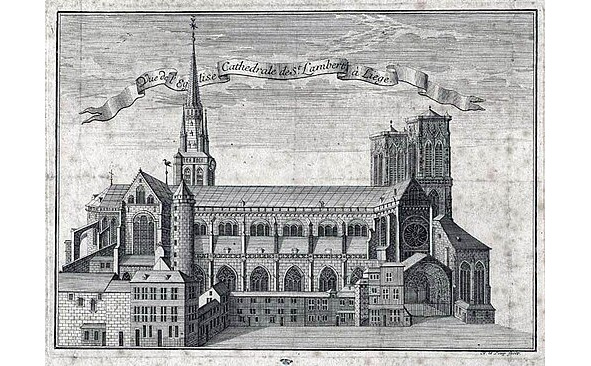
“What was the French Revolution?” asked Valentine. Blaise hesitated. How could he tell the truth without indicting the very class to which he belonged, and himself? He had no choice but to persevere.
“This was part of France at the time. In France there were the king and the nobles who were incredibly wealthy, and on the other hand there were the peasants who were wretchedly poor. The rich cared nothing for the poor. On the contrary they taxed what little the poor had to support their luxurious lifestyle. Finally, the poor had had enough and rebelled. Unfortunately, many bishops and priests sided with the rich. Look at the size of that bishop’s palace. In their rage they destroyed many churches, including the Liège cathedral. They beheaded many bishops, priests, nuns, nobles and the king and queen. You will find from here on-in that the Belgians and French call themselves Catholic, but still hold deep resentment against the church”.
Hipolit and Justin felt embarrassment for Blaise. Had he forgotten the very errand on which they were now embarked, to bring back a fortune to a family for which financing a trip of this length of time was small change? Sensing what they were thinking, Blaise said to them now, “Conditions in Poland, although bad, never approached the wretchedness of the French. For one thing, most of our Polish clergy sided with the peasants. And because of that, our people really believe; they practice their faith, whereas because of the French clergy’s attitude, most French do not. And when you don’t practice your faith, you create a mess for yourself, and then your nation. You know what a decent man my father was, and how well he tried to treat you peasants. I am determined to make a better Poland for you, and that is why we are learning Polish history”. But Blaise felt ashamed, unconvinced by his own words.
As they descended the last few stairs Valentine was trying to stay in the lead. In his hyperactivity he tripped, and his head hit the stone pavement, knocking him out. The men fell to their knees around his supine body. Hipolit and Justin each took a hand and massaged it. Blaise examined his scalp, which had been cut open, and which was bleeding. He rubbed Valentine’s cheeks. The standing Ambrose used his hand to fan some air into his face. The boy gradually awoke, and stood up with help.
“Are you all right?” inquired Blaise.
“My head hurts, and I’m dizzy”, replied Valentine. Hipolit took snow and kept applying it the Valentine’s hair to clean it of blood, and replaced his cap. He and Justin each took a hand as they began to walk.
Blaise found a restaurant in the historical city center (the Carré). Everyone noticed an improvement in the taste of food over what they had previously experienced — not that that had been at all bad. At 12:30 they left and Blaise took them around to the present cathedral of St. Paul, and St. Bartholomew’s, St. Martin’s and St. James churches as well as the 17th century city hall. Valentine was too intent on the throbbing pain in his head to catch a somberness in Blaise, who was inwardly comparing his family’s wealth with the poverty of its peasants.
They left Liège at sunset — 4:51 — and traveled forty-two miles to Namur, arriving at 9:21. They spent the night in Au Le Griffon d’Or (The Golden Griffin) Inn.
This was supposed to be day three for Blaise to show Valentine how to read and write his name beginning with a capital, the rest small letters. Valentine couldn’t concentrate, and Blaise cut him a lot of slack.
It was the fifteenth day for Hipolit teaching Justin and Ambrose. After their lesson Justin, Hipolit, and Ambrose got permission to take Valentine for a walk around town.
Tues. February 1, 1848. This was Day 20 of Valentine’s trip to Paris. At 7:30 Blaise and party left Au Le Griffon d’Or Inn and traveled twenty-five miles to Charleroi, Belgium, passing thru the city wall at 10:12. On the journey Blaise told them, “Nicholas Kopernik, astronomer, was born in Toruń this day in 1472”.
“What’s a astromma-myrrh?” asked Valentine.
“An astronomer studies the stars, the moon and the sun. People used to think that the sun revolved around the earth. It certainly looks that way, doesn’t it? When you first see it, it’s in the east. By day’s end it is in the west. Now our earth is a giant ball called a planet. There are other planets, and they all rotate around the sun. Kopernik showed us that”.
Blaise stopped because Valentine wasn’t paying attention. He was blinking repetitively, and his eyes were rolled upward. He wasn’t moving. “Valentine? Valentine?” Blaise said, trying to regain his attention.
After about twenty seconds Valentine moved, and asked, “Where is Toruń?”
“About fifty miles south of Rogóźno Zamek”, Blaise replied.
He went on, from Dates Important to Polish Patriots:
“Today marks the death of King August II the Strong in 1733. He was a foreigner, and was not good for Poland. He was called ‘the Strong’ because he could break horseshoes with his bare hands. In his lust for the Polish throne he converted from Lutheran to Catholic. He does not appear to have taken the new faith seriously, because he fathered nineteen illegitimate children and only one legitimate one. His wife remained Lutheran and she stayed behind in Dresden when he became king”.
“What’s illegitimate?” inquired Valentine.
“That is when a child is born before his parents are married.”
“Were my parents married when I was born?”
“No, little one. They were not.”
They crossed the Sambre River and passed thru the city walls of Charleroi at 3:11; they traveled thirty-one miles and at 6:30 arrived at L’Auberge du Nord (The Hotel of the North) Inn, where they would spend night twenty.
Today after supper Blaise said to Valentine, “Today marks an important day in your young life. You can print your name and read. From now on we embark on a program of getting you to read more and more so that you get good at it.” To mark the occasion Blaise gifted Valentine with Anthony Gorecki’s First Grade Primer, to start him on his reading career. Valentine was ecstatic.
That night Valentine dreamed that he and Lord Blaise were sitting before Blaise’s fireplace back in Rogóźno Zamek discussing “big people” things, like history and religion and architecture. He dreamed he got up, went to a shelf, got a book, and read something to Lord Blaise, to which the latter replied, “Oh, I didn’t know that”. He dreamt that Blaise came over, put the book on a table, and began to roughhouse and tickle him. He laughed and laughed. He was happy.
Today marked the sixteenth day for Hipolit’s attempts at teaching. He had trouble keeping his two pupils on the subject. Ambrose liked to interrupt to tease him, and he would lose his patience. Tonight he blew up and lunged at Ambrose. When Justin tried to separate them, they wound up in a three-way wrestling match. All their banging around caught the attention of Lord Blaise, who came over and found them down on the floor with shirts pulled out of pants, hair mussed up and Hipolit with his boots off. They all felt very foolish, and came to their feet. Instead of scolding them, Blaise began to laugh. “What’s this I see? Puppies vying with each other over a bone?” He got an explanation out of Justin, and ended by saying, “Now you two know that Hipolit has a short fuse. Do not make his job more difficult. Simply pay attention to what he has to say”. He smiled a very friendly smile, and left.
Wed. February 2, 1848. Day 21 of Valentine’s trip to Paris. At 7:30 they left L’Auberge du Nord Inn. The road was one of descent. On the way Blaise told them,
“One of our greatest kings, John III Sobieski, was crowned today in 1676. He was a native Pole, not a foreigner. He saved all Europe from being conquered by the Moslems in a battle at Vienna in 1683”.
A few miles before Valenciennes, France they crossed the Belgian-French border. It was twenty-four miles between their last inn and Valenciennes, where they arrived at 10:02.
This was Candlemas day –Mary’s Purification, and although they were too late for Mass, Blaise hurried them along in the -14° air and 10” of snow to the church of Our Lady of the Holy Cord. In the vestibule he told them the story behind the name.
“In 1008, a terrible famine brought the Plague to this region. The town was spared from plague after a hermit named Bertholin prayed. Mary appeared to him, and asked that the entire town be enclosed with a red cord which she held in her hand. It was done, and those afflicted were cured. The people have been protected from the disease ever since. There is a pilgrimage to the church every year on September 8th — Mary’s birthday. Pilgrims walk the nine-mile road round the town, in what is called the tour of the Holy Cord.”
The travelers knelt and prayed a Rosary, and each lit a candle. Justin announced that his was for his brother Ignatius, whose namesday was yesterday.
They finished dinner at 2:00 and Blaise took them to the Tower of Dodenne. He explained that it was all that remained of the medieval walls after Holy Roman Emperor Charles V ordered them torn down. While there a bell began ringing. Blaise explained, “That bell is rung in honor of Our Lady of the Holy Cord”.
Blaise then took them to an open place and explained, “You remember a few days ago I told you about the French Revolution. A large number of French people wanted to do away with kings and nobles and to govern themselves. They wanted what we call a republican form of government. Those who still wanted kings were called Royalists. Unfortunately the Republicans began a reign of terror, chopping off the heads of people they accused of being Royalists. This largely stopped after their leader, a man named Robespierre, was himself beheaded. The following July 5, in 1795, the Republicans of Valenciennes tortured, raped and guillotined 5 Ursuline nuns, and this is the sacred spot where it happened”.
“What’s rape?” asked Valentine. Blaise thought a while to come up with a suitable answer. “That’s when a strong man forces a weaker person to submit to his desires. That other person is usually a woman, but on rare occasions it could be a boy or girl”.
Valentine said, “I don’t understand”, and Blaise gave him a lesson in human sexuality suitable for a five-year-old. Valentine’s memory flashed back to George Nicpoń at Rogóźno Zamek.
Kup książkę, aby przeczytać do końca.