
Bezpłatny fragment - Val Karnowski, Boy Revolutionary
This book is intellectual property protected by copyright. This means it is a violation of civil or criminal law to make copies for other than personal use without the permission of the author. Permission in other cases will be granted on an individual basis. Authors of intellectual property depend on copyright to protect their work and to allow them to earn income by selling it. Without such protection there would be much less incentive to create such works in the first place. By respecting the author's rights you can help to create a better environment for all creative endeavors.
Author's Foreword
This book, and other ones in this series, are works of fiction. I have attempted to make the depiction of history as accurate as possible, but where the facts were scant or non-existent at the time of writing, I invented them. Don't think that because you read something in one of my books it must be true. Check everything I say. Much of my historic data comes from sites that I visited on the Internet, so the data is as accurate as that.
The cover was designed by AI. I did not solicit help from AI in writing the book.
The Angel Zuriel’s Foreword
I am Zuriel, the guardian angel of Valentine Karnowski, whose life is the unifying thread of this, one previous, and subsequent books. As an angel in the presence of the triune God, Who is Truth, I know a lot more than you on earth: I know the truth, rather than commonly-held beliefs about human events. I am a precise kind of being, and that is why I often give times of sunrise, sunset, high- and low- temperatures, wind speeds and other facts of weather, because I know the influence these can have on human events.
Well, why am I writing these books? Valentine Karnowski has led a most unusual life, having lived through many events of historical significance. I want to show the hardships forced on him and the Polish nation, of which he was a part. I want to show the faithfulness of the Poles to Jesus's Catholic faith.
This book is in the form of a journal, because the life of Man happens day by day. something While is happening in one place, something else is happening in another. The problem with many novels written by chapter is that eg, in chapter 1 they will deal with the weather over a period of time, then in chapter 2 they will go back to day 1 and deal with geography. Chapter 3 will go back to day one and deal with Mr. X, etc. I tell you about things that are happening simultaneously.
How am I writing them? I give inspiration to Mr. Schmidt, and he types it all out.
It would add to your enjoyment to follow trips from one place to another. You can find the places mentioned in this book on an Internet map of Europe, and on Google Earth. You will get indispensable background that happened prior to this book from Book One, The Possession of Moishe Karnowski .
Part I of II. Calm before the Outbreak of Revolution
Chapter One: Val’s Life in the Country
Mon. March 29, 1847 . The sun rose at 5:48 on this, the first day of Holy Week. Adalbert Nering (47), had been lying awake for at least an hour in the dark, oblivious to the snoring of his sleeping family. All night long he had readjusted his body on the mattress, trying to find a comfortable position. It wasn't the mattress that was bothering him; it was his conscience. He kept remembering a March 29 th — a Monday like today — back in 1841, when he had killed his thirteen-year old son, Laurence, and disposed of his body. He lived from day to day fearing that he would be caught and executed.
It had been a compulsory work day. The overseer had ordered him and Laurence to load rocks onto a wagon in an isolated location on the farm near Gruta , one of the villages owned by his master, Lord Rogoziński. He had brought a bottle of vodka, and began to take swigs from it when he determined no one would see. Laurence would plead with him again and again to stop. It was raining hard and the ground was slippery mud. The wind never ceased to rage, varying between 21 and 41 mph. Just at the moment when the rain was blowing in Adalbert's face the wind caught him off-guard. At the very same time his feet slipped on the mud and Laurence begged, “Daddy, please stop! You'll get punished!” In this concurrence of events Adalbert lost his patience, gave in to a terrible drunken rage and brought the rock he had been carrying down on his son's head. The boy fell to the ground. In the ensuing blackout he straddled his supine son and rained down more blows. The rain carried away the boy's remaining lifeblood.
With his mind still in a besotted state, he took off the boy's clothes and dragged the body to the nearby pond, Lake Orle. He filled the shirt with rocks and tied its arms together; then he tied the remaining length of the arms around the boy's neck. He made a similar weight out of the pants and tied the legs around his knees. Then he dragged the weighted body out to where his own nose was just above water, and left the body there, on the bottom.
When he got home he was still very drunk and soaked thru and thru. He told a story of how Laurence had run away. The family was inconsolable. Knowing the misery his drinking had caused, everyone was only too ready to believe that the boy had indeed run away. Needless to say, he never turned up.
Adalbert and his family lived in the village of Słup , which, along with the villages of Gruta, Szczepanki , Jasiewo and Nowe Mosty, belonged to His Magnificence Romuałd Rogoziński, lord of Rogóźno Zamek manor. Besides the main farm at Rogóźno Zamek, Lord Romuałd owned lesser farms, known as folwarks, at each of these villages. Adalbert was what the locals called an Einlieger , a German word for day laborer, lower than a serf. Sometime in the distant past the gentry class had decided that peasants like him “owed” compulsory labor to their masters, and he “owed” Lord Romuałd two such days — Monday and Friday — usually on Lord Romuałd's main farm at Rogóźno Zamek; beyond that he had to hire himself out where he could.
Adalbert's family at this time consisted of his wife, Rosa née Wolszlegier (45); son Julian (23); and daughters Daria (22); Eve (14); and Bronislava (13). Adalbert's son Simon had died July 1, 1830 at age six months. He had a daughter, Marta (20), whom he had disowned and turned out when she was found pregnant at the end of November, 1841 — over 5 years ago. Marta was now a housemaid in the Rogoziński palace; her illegitimate son Valentine, who would be five on May 29 th , and whom Adalbert had rarely seen, lived with her. On July 13, 1843 Marta's lover, Moses Karnowski, had been executed. (See Book One: The Possession of Moishe Karnowski ).
The Nerings lived in a long rowhouse with eleven other Einlieger families. There were walls dividing the living units from each other. The floor was compacted earth over which rushes were stretched to keep down dust. Periodically the Nerings would repair to the shallows of the Osa River to replace them. Adalbert and Rosa slept in one bed; Julian slept in another. Daria, Eva and Bronislava slept in another, head to foot across the width of the bed. Their roof was of that. This, too, had to be replaced periodically. They kept a small vegetable garden, two chickens, a duck and a goose. Rosa knew how to weave and had taught the girls to weave. The family supplemented their income by taking on infrequent weaving jobs.
A neighbor's cock crowed shortly before dawn at 5:48. Rosa made sure that everyone got up. All except Adalbert knelt before a corner shrine, and offered their day to God. After breakfast Adalbert and Julian left to report for a day of compulsory work at the Słup grange. The overseer informed them that spring plowing would begin today. He correctly judged that this would be the beginning of a period where the low temperatures would be above 32°. That period turned out to be six days. They would begin the planting of oats, potatoes, and sweet potatoes in fields; and beets, turnips, parsnips, and a first crop of radishes in kitchen gardens.
In 1837 in the United States an Illinois blacksmith - John Deere - had made an improvement to the plow, adding a plate of steel placed on angle at its front, which broke the soil nicely, and turned the soil over to the side. Lord Rogoziński kept up with such matters, so he had bought several. Adalbert Nering and son Julian walked over to the stable, hitched a muscular Polish work horse of the Sztum variety up to a plow, and each proceeded out to a field and began to turn over the soil, which was largely of sand, and not at all difficult to do.

This was because the topsoil had all eroded thru centuries of poor soil practices. The land was generally flat, but there were some rises. The peasants had never heard of contour plowing, which meant that their furrows ran down hill and carried the topsoil away when it rained. Even had some enlightened person come in to show them the benefits of contour plowing, they would have rejected it: “We've never done it that way; all our ancestors have always done it this way,” would have been the reply. Such is the universal peasant mentality.
When the workers had turned the field into all furrows, the harrow was brought out to break up the clods. Right behind the harrow, other workers were broadcasting oats, and by sundown — 6:35 — the field was planted.
Wed. March 31, 1847. The planting of sugar beets was begun in the area.
Marta Neringówna , Adalbert's daughter, was given the task of planting a second crop of carrots in the kitchen garden at the Rogoziński manor. She decided that it was time for her son Valentine Karnowski (5) to learn something so as to be useful. She worried that he would be considered unprofitable. After Mass and breakfast she took him to the kitchen and issued the following commands:
“Get a big bowl and put it on this table.”
“Now, go to that cabinet and take out the jar with the picture of carrots on it and empty the seeds in it into the bowl.”
“Now go to where we keep used coffee grounds and empty them into the bowl, too.”
“Mix 'em up.”
She took the boy outside and said, “This is the hard part.” She staked out an area with sticks and string. She took a shovel and turned over the earth within it. Being mostly sand, this was not hard to do, just time-consuming. “You will go over the ground that I have turned and break it up with this rake,” she said. Then she brought over a wheelbarrow of manure and placed it alongside the carrot patch. “Now you will take a shovel and spread this manure all over the patch, then you will rake it into the dirt”, she ordered.
“I'm not gonna eat any of those carrots!” he protested.
“All the carrots you ever ate were from patches treated just this way”, she informed him. So the boy began to do as he was told. Finally the patch was ready.
She took a stick and stuck it in the ground to mark the beginning of the first row; then another to mark its end. She then said, “You will lay out all the remaining rows”, and he began to do so. When that was all done, she said, “Now take the rake’s handle and drag it from stick to stick to create a furrow”. Finally she said, “Now carefully sprinkle that mixture along the furrow. When you are done, cover it all with dirt”. It took all day, but at its end, the boy felt accomplished.
Thurs. April 1, 1847. Holy Thursday. The liturgy at St. Laurence church in Szczepanki was celebrated at 6:00 am — early — out of consideration for the needs of the local agrarian economy. The entire Nering family except for Adalbert attended, as well as the entire Rogoziński family and servants, and all the overseers of the folwarks.
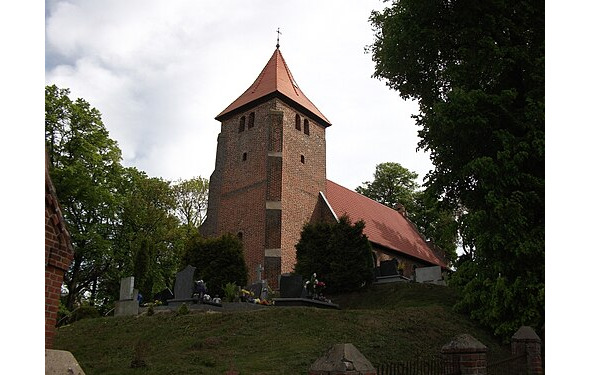
Afterwards, out in the area in front of the church, Marta Neringówna ran to her family, seeing that her father was absent. There was much embracing and kissing and catching up on the news. Oh, how Marta missed them all, especially her older brother Julian. Indeed, he was her only living brother. He was good to her, and functioned as the father that Adalbert was not. They had a close relationship. That, of course, is a relative statement, for this was an alcoholic home, where mother and children were hesitant to divulge their most intimate feelings, aspirations and thoughts, fearing that they would be treated with scorn. Fear, shame and guilt were the motivators in this household, not love, and with each passing year, the fear, shame and guilt grew.
Taking her aside while the others were preoccupied, Julian inquired, “How’re things at the manor?” She hesitated to speak, looking downward, but the need proved just too much: “Lord John, the heir, takes indecent liberties with me. Lady Rogozińska and her two ‘princess’ daughters give me a lot of grief. The two girls with whom I share a dorm don’t like me, and Valentine has no one with whom to play,” she blurted out.
The boy Valentine had been standing silently by her side, hanging onto her skirt, picking his nose, not interested in adult conversation. When he heard his name, he perked up. He could see that his mother liked his uncle Julian, who was obviously sympathetic to her. When she saw that he had become interested in their adult conversation, she said, “Valuś, find some of the children with whom to play; we won’t have much time before we have to leave.” And he did so.
Julian’s heart went out to his sister. He wanted to ease her burden, but what could he do?
An idea came to him. “Marta, let’s go to Lord Rogoziński right now. I’ll make a request of him,” he told her. He approached the Lord, with Marta right behind, and stood off to the side. Lord Rogoziński was laughing with a neighboring noble. When it appeared that the tête á tête was over, Julian seized the moment, stepped forward, bowed, and said, “Praised be Jesus Christ, your Honor”, to which the lord replied, “for ages of ages.” “As your Honor knows, Marta here is my sister. She needs the support of her family, and due to our father’s attitude to her, there is little opportunity for interaction,” Julian explained.
“And what do you propose?” asked the squire.
“Would you arrange her days off to be on Thursdays? That way, there would be some chance of my spending some time with her and Valentine,” he explained. After some back and forth discussion on the matter, it was agreed that Thursday would be her day off. This would allow the two of them to meet at some pre-determined spot. Marta was always to check to see if the next week’s day off could still be Thursday. She would inform Julian.
“Now mark: there may be some time when she is needed. She is not guaranteed a day off,” said the Lord.
“Of course, of course,” answered Julian. Lord Romuałd turned to another noble, and Julian wisely concluded that the interview was over, bowed low, and left.
Lord Rogoziński was a compassionate man. He knew how much Marta missed her family, so he lingered a long while in the church’s forecourt. Besides, he had his own people with whom he wanted to talk.
This was not a compulsory labor day; however Adalbert and Julian were needed and would be paid. When they reported to work, while others continued to plant in the light drizzle, they were re-assigned to repairing the harrows. Plowing leaves the soil in large clumps. Harrows are tools that break up the big clods into a more uniform, finer texture: best for planting. Here Lord Rogoziński was not so up-to-date: His harrows consisted of a heavy horizontal oak beam, about 1 foot X 1 foot X 8 feet long. Every 6 inches a hole had been bored about 1 ½ inches in diameter. Into these holes were inserted oak dowels, each of which protruded about a foot. This entire assembly was pulled by a team of Sztum horses, the more quickly the better. After a certain amount of use, some of these dowels would break and needed to be replaced, and that was the work that the two did.
Rosa and the girls worked in a similar way to prepare the patch where the family’s vegetables and spices would be planted next to their barracks. They would be planting root crops of beets, turnips, parsnips, their first crop of radishes, and sweet potatoes. Julian had made rakes similar to the harrow: horizontal oak bars about 3 feet long with oak dowels drilled into them, attached to a pole.
*
On the Rogóźno Zamek manor’s own farm, where he and his mother lived, little Valentine helped at planting beets in the kitchen garden. He turned to daydreaming about being with his mother, who was occupied with in-house tasks. He imagined a friend his age whom he named Raymond. He was the “king of summer”; Raymond was the “king of winter”. Val imagined how impressed Marta would be when she saw him causing beets and carrots to grow just by willing it; and Raymond making a fairyland of white snow on everything also just by willing it.
Fri. April 2, 1847. Good Friday. Fr. Berent offered the Mass of the Pre-Sanctified at 6:00 am. It was a long-standing custom among Poles to drop back into church between noon and 3:00 pm for a while, then to return home and resume one’s work in silence in solidarity with Jesus’ suffering on the cross. Marta took Valentine to St. Laurence, Szczepanki. She dropped to her knees and had Valentine do the same. Together they advanced on their knees to kiss the cross exposed on a pillow in the opening in the altar rail. When they left, the boy asked, “Mama, why did we do that?” She explained that it was penance, adding our little sufferings to those of Jesus, to show our appreciation for His dying for us. On the way out she filled a bottle with Holy Water. When they got home Valentine helped at planting turnips in silence.
After 3:00 pm she said, “Go to the chicken coop and gather twenty eggs. Then go to the root cellar and bring lots of red cabbage leaves, red onion skins, yellow onion skins, and some beets”.
After supper Marta told Valentine, “Now we’re gonna have some fun. We’re gonna dye Easter eggs”. She boiled some eggs. She got four pots of water boiling and added some vinegar to each. Into the first she placed lots of cut-up red cabbage leaves. This would produce blue eggs. Into the second she put lots of yellow onion skins and cut-up carrots. This would produce orange eggs. Into the third she put cut-up beets. This would produce pink eggs. Into the fourth she put lots of red onion skins. This would produce red eggs. Then she handed Valentine a ladle. “Now you put an egg into the ladle and hold the egg under water. The longer the darker”, she said. He obeyed, and to his delight, he came up with blue, orange, pink and red eggs. Then he decided to experiment. The next four he later dipped into a second color after the first. Then he tried dipping only half an egg the second time. “That’s using your imagination!” she exclaimed.
Sat. April 3, 1847. Holy Saturday. Fr. Berent celebrated the Easter Vigil at 6:00 am. Late in the morning, after the liturgy, people began to return to church with a basket covered with a white cloth whose edges were richly embroidered with folk motifs and containing kiełbasa, ham, horseradish, rye bread, Easter eggs, butter, salt and other things for a blessing known as “święconka”. Marta carried a basket for the Rogozińskis; Valentine carried one for the servants. He was very proud of his Easter egg artistry that both contained. Back home he helped at planting parsnips.
In early afternoon Marta and the female servants collaborated on bathing. They placed a large tub in their dorm. One by one each washed in it, while the others fetched hot water and later emptied it. Feeling refreshed, Marta got some scissors from Sophia and trimmed Valentine’s hair. Then, getting the other women to leave, she gave him a good bath. This was all done in preparation for Easter. At 4:30 she went to Confession in the manor chapel to Fr. Kalkstein-Osłowski. Everyone — masters and servants — went to Confession except the heir, Lord John (26).
Sun. April 4, 1847. Easter. The main Mass of the day was before dawn at 4:30 and included a procession. The entire Rogoziński household — nobles and servants — was present at St. Laurence, Szczepanki. The Rogozińskis sat in their special places in the sanctuary; the servants sat wherever they could find a place. They managed to sit as a group. Up front and off to the side was the empty plaster tomb. Above it was a statue of the resurrected Jesus, wearing a loose white cloth, His wounds showing clearly, and holding a white standard with a red cross on it.
When they all got home, the servants were expected to serve while the Rogozińskis ate a breakfast of the food blessed the day before. Then the servants were allowed to go downstairs and have their own święconka celebration. The main meal was at noon, after which there was much dropping in by neighboring nobility, hence, Marta was exhausted by day’s end, what with tending to their every whim.
Mon. April 5, 1847. Valentine helped at planting beets. Cook Sophia gave him a bucket of various garbage and said, “Go throw this to the pigs”. He got to the sty, where the pigs were slobbering around in the mud. He obediently threw in the refuse, and the pigs vied with each other to get there first. “How come you pigs like to be in mud so much, and to eat garbage?” he asked them. He said to himself, “Pigs are sure different from people!”
Thurs. April 8, 1847. The sun breached the horizon at 5:24, waking Marta Neringówna on this, her day off. She knelt down and offered it to God. She awoke Valentine, got him to kneel with his hands folded in her lap and pray. Then they went to 6:00 Mass in the palace chapel. She felt a surge of joy at the prospect of spending the day with her brother Julian, when she heard the line in the gospel:
“Mary Magdalen came and told the disciples: ‘I have seen the Lord, and these things he said to me’.”
Marta imagined Mary’s joy at knowing that this God-man who had restored her dignity and given her secondary virginity was alive and had forgiven her and could be prayed to!
They ate a large breakfast, then Marta bundled them up. They had agreed to go blueberry-picking in the woods along the Osa River, so she had baskets for herself and Valentine. She had secured permission from Lord Rogoziński for her brother Julian to collect blueberries for the Nering family; after all, the berries she would pick would all go to the Rogoziński household. The rendezvous point was at a place where a small stream entered the Osa on the east, about halfway between Rogóźno and Słup. She packed some kiełbasa, rye bread, and blessed Easter eggs. They would eat their dessert that they gathered right there, and scoop water from the river.
*
Julian had attended the 6:00 Mass in Szczepanki, and after he had eaten breakfast, he set off. Since they had both set off at about the same time, when the first one — Julian — got there, he didn’t have long to wait. Valentine had walked as fast as he could, due to his excitement at the prospect; still, because of his short legs Marta was forced to walk slowly.
When they assembled they set in immediately to collecting berries. Valentine could hardly contain himself, he was having so much fun. “Look, Uncle Julian. Mushrooms! Get these!” he shouted.
“Those’re not mushrooms; they’re toadstools and they’re poisonous.”
“What’s ‘poisonous’?”
“It means that if you eat them, you’ll die.”
“When mushroom season comes up, we’ll collect them. Of course, we’ll have to get Lord Rogoziński’s permission,” came back Julian’s reply.
“Don’t get too far ahead; there are bears in these woods,” he cautioned.
At a certain point Julian said, “Shhhhh. Everyone stop and be quiet.” As they stood there, not breathing, he pointed to a large white-tail deer with just the beginning of antlers standing beyond some bushes. “Lucky for us: he’s upwind of us. If the wind were coming from our backs he’d smell us and be off,” he whispered. Valentine inadvertently stepped on a twig, cracking it, and the deer bounded away.
When it got time for lunch they sat on the bank of the Osa. Marta produced the food. As they ate Valentine spotted various fish swimming by, likewise frogs and turtles. “How clear the water is! I can see all the way down. See that grass bending with the current?” he asked.
When they finished Marta and Valentine got up, assuming that they would resume their berry-picking. “No, no, let’s just sit here a while and let our food settle. Take notice of the beauty around you,” Julian advised. He took a position with his back against a tree. In his left arm he embraced Valentine; in his right his sister. All three sat there warm, full and very content as they looked down at the clear flow of water and at the surrounding forest, breathing in its scents.

Sun. April 11, 1847. Low Sunday. In Berlin, 186 miles west, their king, Frederick William IV (52), after a long delay due to his reluctance, succumbed to pressure and called the First Vereinigter Landtag — Prussian United Parliament. It was called “United” because it was composed of representatives of regions within Prussia, each of which had its own local parliament. Its members were nobility, rich peasants and urban landowners like Otto von Bismarck (32). The mass of the rural population and urban lower-class landowners was not represented. Its promoters wanted to extend to the non-nobility some say in how they are governed. Germans were used to their sovereigns’ issuing decrees; these sovereigns did not take kindly to input from what they considered the unwashed masses. Consequently in his throne speech in the White Hall of Berlin’s StadtSchloss Frederick William IV was brusque and condescending with the delegates.
Wed. April 14, 1847. Now that he knew how to do so, Valentine was sent out to the manor’s kitchen garden to sow the second crop of radishes, even tho the first crop had not yet matured.
Sat. April 17, 1847. The Kwasigroch family lived in Szczepanki. Witold, the father, was a colonus. That doesn’t mean that he was a colonist; it means that Lord Rogoziński allowed him at least one hide of land (enough land for him to support himself and his immediate family). They lived in a detached house consisting of one large room. Witold and Frances slept in one bed. As of January 1, 1847 their children slept thus: Paul and Hipolit in one bed; Fabian and Simon slept in one bed before Fabian was drafted; and Danuta slept in another. They had a horse, a plow, a cow, a pig, chickens, and a goose. They had a small pond, a cherry tree, and an apple tree.
Witold had what was known as a strong right to the soil. He didn’t own his real estate — it all really belonged to Lord Rogoziński — but the unwritten agreement between him and Lord Rogoziński was that the property could be passed on to his descendants. Neither Lord Rogoziński nor his descendants had to honor this tradition. Unless something unusual happened Leon, the oldest, who was married, stood to “inherit”.
The Kwasigrochs were a devout family. They said a Rosary nightly. Witold and Frances took parenting very seriously, and had raised fine offspring. Witold took some wódka on special occasions, but otherwise did not drink. He did not smoke — he was afraid that a spark would ignite stored hay, etc. They all went to bed early so as to arise early.
They made their own soap and candles. Frances knew how to weave and had taught daughters Stanislava (now married) and Danuta that art. At one time the family depended on their weaving their own cloth. Now cloth had become available commercially, so they didn’t weave very often.
The floor of their hut was wood joists laid directly on the ground covered with wood boards. The roof was thatched. There was a large fireplace where meals were cooked. Their outbuildings were arranged around a small square court, or barnyard. Because the fowl left their droppings all over this yard, everyone kept a second pair of shoes just outside the door for use inside the house.
They kept a vegetable garden for their own needs. Everyone still owed Lord Rogoziński two days’ compulsory labor per week. They kept a barking dog on a leash, to menace any intruders.
Paul was born January 8, 1823. The fifth child to be born, he was the oldest sibling living at home. Three older siblings were married and lived close by. An older sister, Bibiana, had died in 1822, just short of three years old. Paul was conceived as a way to assuage the parents’ grief over losing Bibiana. This did not result in his being treated any differently than if Bibiana had lived. He had red hair, pink skin and freckles, a rarity for a Pole. This indicated some genes inherited from a German ancestor in the distant past. He was smarter than Hipolit, but was careful not to “rub Hipolit’s nose in it”. He loved his brother, who confided in him. He had that rare skill called listening. He had no formal education, but had learned that many of a man’s troubles arise from running away from painful feelings that he fears will surface. He gently got the troubled one to divulge those feelings. He believed that it was time for him to get married, and had consulted Mrs. Krajecka, the matchmaker. He played the kobza — a Polish bagpipe, which he made himself from a goat’s skin. He was introspective and less outgoing than Hipolit.
Hipolit was born February 10, 1825. He was the sixth child to be born. He played the gęśle — a folk violin, which he made himself, and liked to sing. He was 5’-11” tall, with straight dark brown hair, which he got cut with bangs in front, and straight across the back of the neck just at the collar line, like most peasants whose hair is not curly. He had brown eyes, and was very sanguine in personality: he wanted people around him to be happy and to like him. He had a disarming smile and an affinity with animals. He was muscular and hairy. He and Paul were close: they liked to wrestle and josh each other. He was a heavy drinker, but usually knew when to stop before he got drunk or rowdy. He liked to kid around with the unmarried girls at church, but had as yet not consulted the matchmaker.
Mon. April 19, 1847. The harvesting of winter wheat and rye began today, and Adalbert and Julian Nering were sent from Słup to the manor folwark to help with it on this, a compulsory labor day. The wheat crop was found to be damaged by the Hessian fly; the rye crop by ergot.
*
Valentine was sent to the Rogoziński kitchen garden to harvest the first crop of radishes. When he brought them in to Sophia, cook and head of female servants, she saw that they were damaged by flea beetle.
Chapter Two: George Nicpoń, Molester
Thurs. April 22, 1847. At Rogóźno Zamek Sophia sent Valentine to the kitchen garden to plant cabbage. “This cabbage that you plant today will be ready to harvest around July 21st”, she told the lad.
“How do you know when July 21st is?” he asked her, knowing that she could not read. She took him over to a calendar.
“It’s true that I can’t read, but I know how to count. I know that April is the fourth month, and July is the seventh month, so I flip until I get to the fourth month, count 80 starting at 22, and that lands me on July 21st”, she replied. Valentine marveled at her smartness.
Tomorrow would be the namesday of George, a servant in Rogoziński manor. He was born in 1800, altho, like most peasants, he did not keep track of his age. George was of quite less than average intelligence. In the next century an “Intelligence Quotient” will be devised. (I, the angel Zuriel, know this.) On it George would score about 71. He was shorter than most men, stocky, and always needed a shave. His lower jaw protruded such that his lower lip almost covered the upper one. There was usually a deposit at the corners of his mouth consisting of food crumbs, dried saliva, and saliva bubbles. There was a thick rim of skin along the edge of his eyelids, which seemed to weigh them down, so that they were never fully open, and a patch of pure white hair on the back of his head. He didn’t have much of a neck, and he walked with his head slightly hunched forward, like a vulture. Father Berent had besought Lord Rogoziński to take him in when his remaining parent, his mother, died. His other siblings claimed that they just could not afford another mouth to feed.
When the servants assembled for supper around their table in the cellar of Rogóźno Zamek manor, Sophia presented them with a treat that George loved: czarnina soup with kluski noodles. The reason they were celebrating today instead of tomorrow was the czarnina treat. On Fridays no meat was eaten, and that included blood, an ingredient in the soup obtained from the duck.
The czarnina reminded George of his mother. Instead of putting him into a good mood, it turned him sad and morose.
All the servants had to work for their room and board, and young Valentine was no exception. So they all pressed him into service when they needed help. The only time Marta would object was if the work seemed too dangerous or beyond his strength. In his scratchy, phlegmy voice George croaked to Marta, who had returned from her day off in time for supper, “I’m gonna need Valentine t’ help me wit’ some chores in da stable”, and she consented.
Parents in those days had a much greater expectation of what their children could do. George lit some lanterns and handed one to Valentine. He followed George out to the stable, where George told him to shovel up horse manure, deposit it on a pile, and lay in a supply of hay in the horses’ mangers. George began currying the coats of the master’s horses. Every now and then he stole a look at the youngster, and an idea began to gain seriousness in his mind. “Valentine, stop dat for a while and come ‘ere”, he said, moving toward a spot that was somewhat secluded, but from which he could still see the doors. When the lad got there George quickly forced the lad to perform a bad act on him.
George then turned very angry and threatened, “You keep dis to yourself, unnerstan’? If I fin’ out dat you have tol’ anyone — your mudder, de udder servants, or da Rogozińskis — dey will probably kill me or beat me up. Dey may kill you, too. Even if dey don’t, I’ll kill you. I’ll have nuttin’ to lose at dat time. Unnerstan’?” The boy’s heart was beating wildly. He didn’t understand. “Do you swear never t’ tell anyone?” George demanded.
Valentine shook his head up and down. “Uh-huh”, he replied weakly. He needn’t have threatened; Valentine was certain that had he told his mother, she would have punished him severely, accusing him in some way.
“Now finish what you started”, George warned.
*
At 9:00 pm Marta called Valentine to her and said, “All right, Valuś. It’s time for bed”. He didn’t want to go; he argued with her to stay up until she went to bed. Marta prevailed; got him to wash his face and hands and kneel down, fold his hands in her lap, and say his night prayers. She blew out the candles and went to the kitchen to do some work there.
As he lay there Valentine imagined black silhouettes coming thru the door, and peering up at him from the foot of his bed. He fought falling asleep but when he finally went to sleep he had nightmares.
*
After sundown several of the overseers of Lord Romuałd’s folwarks came to him and informed him that from their experience this would probably be the last day with any frost, and that tomorrow they would like to begin sowing summer barley. And even if they were wrong, it would do no harm to have the seed in the ground. Lord Romuałd consented.
Fri. April 23, 1847. Today began the planting of summer barley, as well as potatoes and summer wheat in all the Rogozińskis’ folwarks. Adalbert and Julian Nering participated on the palace folwark on this, one of their compulsory labor days. In the kitchen garden Valentine helped to plant the third crop of radishes.
Sat. April 24, 1847. Fr. Berent, pastor of St. Laurence church in Szczepanki, always sat in the box listening to confessions from 4:30 to 6:00 pm. He had already heard several when, upon sliding open the door behind the grille, he heard, “Bless me Fader, for I have sinned. It’s been mont’s since my las’ Confession.” There was some hesitation.
“There is some embarrassment. I will coax it out of him”, thought Fr. Berent. “Don’t be afraid; I am not here to punish you. God is pleased that you have had the courage to come for His forgiveness”, said the priest. Father heard what sounded like trying to push air from a constricted throat. “Take your time; use whatever words are comfortable to you”, he urged.
“You’ve never heard anyone as bad as me”, rasped the voice.
“I was ordained in 1817; I’ve been hearing confessions for 30 years. I’ve heard it all”, answered the priest.
“I got a little boy to do somet’in’ to me.”
Father recognized the voice of George, servant at Rogóźno Zamek. “Have you ever done this before? Now be honest with me”, inquired the priest.
“No, fader, and I wan’ it to be d’ las’ time”, answered the penitent.
“You must make a firm purpose of amendment. Do you know what that means?” inquired Berent.
“No, Fader. What?”
“It means that you have to plan how you are going to avoid this bad sin again,” he answered; “When you leave this confessional, say a Rosary as a penance, and sit and plan how you are going to avoid this sin. All right?”
“Yes Fader”.
Sun. April 25, 1847. At Rogóźno Zamek after Mass, during breakfast, son Blaise read in the Berliner Zeitung, that on April 21st in Berlin, 186 miles west, there had been hunger riots.
“Today hunger riots were broken up after 3 days by the Prussian army. Fisticuffs began at the Gendarme Market. One dealer, as well as other sellers, had increased their price of potatoes greatly and the protesting female customers became provoked by the cynical remark that ‘They are lucky that the farmers don’t offered them no more than hay in the future’. The working women then cut open a number of potato sacks and helped themselves, without paying. Similar scenes occurred in the wheat market in the Dönhoffplatz where market stalls were destroyed and traders were threatened. The two policemen on the spot were unable to prevent the attacks.”
In the afternoon the Rogozińskis had guests with a boy about Valentine’s age who had recently been ill. During the visit sweetened black currant juice was served, and the boy did not finish his. Valentine helped his mother take the used dishes back to the kitchen. When he got there, he could not resist finishing off the boy’s juice.
Mon. April 26, 1847. The sowing of barley began on the folwark of Słup, where the Nerings lived. The overseer ordered Adalbert and Julian Nering to work there on this, a compulsory labor day.
Fri. April 30, 1847. Today Blaise read an editorial in the Berliner Zeitung criticizing the women staging the hunger riots in Berlin. They cynically called the riots “the so-called Potato Revolution”. Then, to himself he said, “I hope that this year’s potato crop is a bumper one, for the sake of these women, and all peasants. Really, for everyone’s sake. Still, if the crop fails, I hope that good comes from that.”
Sun. May 2, 1847. The servants of Rogóźno Zamek manor trudged off to 9:00 Mass at St. Laurence church, Szczepanki thru a spring rain. George was moved to do some thinking when he heard these words of the Epistle:
“As strangers and pilgrims restrain yourselves from carnal desires.
“Lord, help me t’ renew my desire t’ stay away from dat kid, dat Valentine”, he prayed.
Then he heard,
“Be ye subject to every human creature for God’s sake… Servants, be subject to your masters with all fear, not only to the good and gentle, but also to the severe…”
George knew that he was not smart. He had experienced people’s laughter at his slowness; it had imperceptibly built up a negative attitude toward people in general which erupted at times. One such time was when butler Stanislav, who everyone but George knew was really a gentle man, would give him an order. Another such time would be when Lord John, the master’s son, or the Panienkas (misses) Louise and Benedicta — Lord Romuałd’s daughters — gave him an order. He was smart enough not to show any signs of anger; he usually lowered his head and hunched it forward at the same time. But he felt a deep resentment that he placed on the pile of existing resentments. “What made dem my betters?” he asked himself. He returned from church in a bad mood.
After the Rogozińskis had been served Sunday dinner, and after all the servants had eaten, a friend of Lord Blaise, Lord Romuałd’s son, rode in on his horse for a visit. George had been alerted, so was waiting and given the horse to take to the stable. He put the animal in a spare stall, and forked some hay into its manger. He then took a curry comb and proceeded to groom the animal. No one had bidden him to do so; he just felt a kinship with animals, more than with humans.
He seemed gone inordinately long, so Stanislav found Valentine and asked him to fetch him, as there was work to do in the manor. “Please, Sir, I don’t want to go”, replied the boy.
“What’s this — refusing an order? Young man, you must learn that we don’t always get what we want. Now go”, he said, not unkindly.
Valentine gathered his strength and proceeded to the stable. George could see him approaching, and the temptation grew in him again. “You mustn’t, you mustn’t”, he told himself. Valentine stopped at a distance of about twenty feet and called to him with a stern look on his face, “Stanislav says you must come back to the manor right now!” George dropped the curry comb, ran and grabbed the boy and pulled him into that same place as before, and forced him to the same act once again.
“Remember: if dis gets out, I’ll kill ya”, he growled; “Now dry yer eyes before you go back in dere”. There was great fear in George as he watched Valentine return to the house. Would he tell or not? But besides fear there was self-hatred. “Oh God, I’m sorry, I’m sorry!” he prayed as he wiped tears from his eyes with his dirty fat fingers.
Tues. May 4, 1847. In family gardens they planted the fourth crop of radishes. At Rogóźno Zamek Valentine was made to do this. As he stood up to stretch he caught the sight of George glaring menacingly at him.
Fri. May 7, 1847. From those same family gardens they harvested the third crop of radishes. They, too, were damaged by flea beetle. By now this was regarded as Valentine’s special task at Rogóźno Zamek.
During the servants’ supper celebrating his namesday, Stanislav, in the happy mood that being the center of attention creates, told them, “Today, in 1794 Kościuszko issued the Proclamation of Połaniec.”
“What was that?” asked Marta.
“By then Poland had gone thru two partitions; there wasn’t much of a country left. Kościuszko wanted to start an uprising to drive the foreigners out.”
“How was he goin’ to do that?” she asked.
“He appealed to us peasants to join an army. He promised to grant us freedom. He wanted to reduce compulsory labor to one day a week. He gave total liberation from compulsory labor to men who would become soldiers in his army, and their families.”
“Did the Manifesto affect our area of Poland?” she asked.
“No, because Royal Pomorze, where we live, was separated from Poland already in 1772. Besides, Kościuszko was eventually defeated,” said Stanislav.
“How old were you when Kościuszko issued the Proclamation?” asked Marta.
“I was thirteen — old enough to remember a lot,” answered the butler, defensively. Valentine felt proud that his mother was engaged in conversation with someone as smart as Stanislav.
Sat. May 8, 1847. George was back for Confession. “Bless me Fader, for I have sinned. It’s been one week since my las’ Confession.” There was a long pause. He was too embarrassed; he couldn’t find words that were the right balance between specific and vague, and also not the vulgar ones with which peasants were familiar but which made him ashamed.
“Just blurt it out; I understand” said the priest, patiently.
“I got dat boy to do da same to me, jus’ like las’ week”, he said quickly.
Father Berent knew full well that this was George on the other side of the grille, yet he did not want to cause any additional embarrassment. “What happened?” he asked. George told him. “Well, you did not go seeking him out. That’s good. Continue to avoid him. Run away from him if that’s possible”, counseled the priest.
“Fader, I’m so afraid dat I‘ll be sacked or worse, hauled before a judge an’ put in jail”, said George.
“It may not seem like it now, but getting let go may be the best way for you to avoid this sin”, said Fr. Berent. Again George was given a Rosary to say as penance, and after making a prayer of sorrow for his sins he was sent out into the church.
Wed. May 12, 1847. It was a grey, overcast day; it rained off and on. George, servant at Rogóźno Zamek manor, had been fasting and abstaining for three days now, the Rogation Days. Between that and the weather he was feeling grumpy and irritable. His fasting and abstaining were not his own idea; they came from Sophia and Stanislav, who controlled the meals. Another reason to resent authority. His lust was up. The only realistic outlet for him was Valentine, again. All day he plotted ways to get him alone. When night came he still had not done so, so he tossed and turned until after midnight.
Thurs. May 13, 1847. Ascension. The entire Rogoziński household, including the servants, went to 9:00 Mass in Szczepanki. Valentine was complaining of not feeling well. He said he had a headache and had no appetite. When Marta felt his forehead, he seemed to have a fever. Marta asked permission to borrow Lord Rogoziński’s thermometer, and from Lord Blaise the illiterate mother found that his temperature was found to be 102°. Sophia was consulted and informed Marta that about 99° was considered normal. Marta judged Valentine not well enough to go to church, so he was left home, with the admonition that he remain in bed.
As it turned out, George, too, was honestly not feeling well, so he begged off attending, and asked for permission to stay in bed. He was told that he could do so, but to do only those duties that were necessary. He hitched up a horse to a carriage and saw the Rogoziński family drive off in it. He saw the servants set off on foot. Valentine was not among them! He waited a good fifteen minutes to make sure that no one would return for something forgotten, then proceeded to the female servants’ dorm. Valentine’s bed was against the wall. When Valentine saw him he sat upright and pulled himself against it. “GET AWAY FROM ME! DON’T TOUCH ME!” shouted the frightened lad.
“Dere’s no one here t’ hear you; d’ sooner you give in t’ me, d’ better off you’ll be”, he growled. This time he did the act on the boy.
*
The Nering family were all at Mass save for Adalbert. After Mass Marta ran over to them and announced that Valentine was unwell, and because of that, she might not be able to meet Julian for their usual time together on her day off.
Richard Skibiński, the choir director, happened by and said to Rosa, “We missed Adalbert today. I hope he is well”.
She replied, “Mr. Skibiński, he’s hung over. We all suffer so much from ‘is drinkin’ up what little ‘e earns”.
The man felt sympathy for her. To the children he said, “You are all lucky to have such a heroic mother”.
Chapter Three: Mumps
Fri. May 14, 1847. Marta was in the habit of waking Valentine after she had done her morning toilettes for Lady Jadwiga, and the Panienkas Louise and Benedicta. She awoke him, and he immediately complained of painful swallowing. His left cheek and the underside of his jaw below his ear were greatly swollen. He looked like a squirrel or a pig on the left side. Marta took him to Sophia, who pronounced, laughing slightly, “He has świnka — mumps”.
Sat. May 15, 1847. In Berlin Bismarck made his first speech in the First Vereinigter Landtag — the United Prussian Parliament. It outraged the other deputies. It was anti-republican, pro one-man rule and pro the status quo. Remember, so far he is just a deputy, like any other.
*
Today when Marta awoke Valentine his right cheek and underside of jaw below the ear were also greatly swollen. Word gradually spread among the Rogozińskis and the servants. Eventually this reached George, who suffered an immense attack of guilt. “I mus’ be responsible fer dis!” he told himself. “Jezu, help me!” he prayed.
Mon. May 17, 1847. In the hamlet of Szonowo szlacheckie to the east, Marianna, illegitimate, was born to peasant Julianna Przypyszna (16). This was Julianna’s second illegitimate child. The father of each was John Rogoziński’s friend Bogumił Gruszczyński, lord of Gruszczyn manor, about whom I, the angel Zuriel, will have much to say later.
*
Today the harvesting of carrots from family gardens began. At Rogóźno Zamek Marta went thru the kitchen garden grabbing the leaves of each carrot and pulling up. She found most of the crop to be badly damaged by carrot-fly larvae.
The Rogozińskis would not eat anything but perfect carrots. Marta set into triage. Onto one pile she threw carrots that were so badly damaged that they would be fed to animals. Onto another she threw slightly damaged carrots that peasants would find acceptable. Onto a third pile she threw perfect carrots. This pile was very small.
She took the worst pile to the heap of rotting sugar beets for the cows. She carried the middle pile to Sophia in the kitchen. Sophia, Barbara, Ursula and Catherine would do what they could to get rid of the larvae. Dropping them into hot water and immediately retrieving, sharp banging on a table, picking with a twig, would all be employed.
Marta took the good pile to an outside place which could be expected to stay relatively cool and shaded. She made a bed of hay seven inches thick, dumped the carrots onto it, added another seven inches of hay, and dug a drainage trench around this mound, throwing the soil on top of the hay. She then went into the kitchen and got the de-larvaed carrots and made the same kind of storage place for them.
With this work done, she stood, took a deep breath and looked around. “It’s spring. Fruit trees are in bloom; the air smells of perfume. The bees are busy in the trees and on the flowers”, she ruminated wistfully. Then she remembered that she had a sick child.
Fri. May 21, 1847. When Marta awoke Valentine she saw that the swelling had disappeared from his left side.
Sat. May 22, 1847. Today Marta saw that the swelling had disappeared from Valentine’s right side as well. Outside a gale of 35 mph was blowing down a heavy rainfall with bone-shaking explosions of thunder and sky-rending bolts of lightning. The sky had so darkened that it seemed evening. All of this, and the knowledge of Valentine’s illness, had George quaking with guilt. He was sure that God was punishing him for his misdeeds.
Sun. May 23, 1847. Pentecost. The local tradition was that children in the area’s parishes made their Confirmation today. Marta Neringówna was in the habit of attending 9:00 Mass at St. Laurence church, Szczepanki with Valentine, almost five, and the other servants. She judged him well enough today to resume attendance at Mass. Bishop Gierszewski was going to be there, all the way from Pelplin, and she did not want to miss the pomp surrounding that. When the bishop proceeded into the church, with the organ playing and the choir singing, she was moved. She pointed out the bishop to Valentine excitedly. “Someday a bishop will confirm you”, she told him. Upon returning home, she put him back to bed, just to be sure.
Tues. May 25, 1847. There was no way that Marta was going to permit Valentine to leave his bed to do work, so she braved the 35 mph gale to harvest the fourth crop of radishes in the kitchen plot. They, too, were damaged by flea beetle.
Fri. May 28, 1847. Today the harvesting of beets from family gardens began. Marta judged Valentine well enough to help with this. They grabbed the bunch of leaves and pulled up one beet at a time. They cut off the leaves, which they put into a pile. The Rogozińskis would not eat the leaves. Since they would not last, they would be distributed to any peasants who wanted them. Some would be kept for the servants at the manor. When they had filled a wheelbarrow with a load of beets, they took them to the root cellar. There, workers had already prepared a five inch thick layer of sand. A layer of beets was placed on it. Then a layer of sand, then another layer of beets, then another layer of sand.
Sat. May 29, 1847. Because Valentine had been sick Marta had neither cut his hair nor bathed him. Ordinarily she would have cut his hair outside, but a strong wind was blowing all day, so she did it in the kitchen after supper. She combed it down all around his head; then took scissors and cut it horizontally across the back of his neck, and horizontally just above his eyes. Then she bathed him and herself.
Tues. June 1, 1847. Today Marta gave Valentine a basket and told him to pick gooseberries. He would pick them again and again this month.
The overseer of the peasants of Lord Romuałd’s own farm sent them to one of his meadows to mow hay. George and Edward, ordinarily house servants, were sent with them. They began after breakfast, which they ate right after sunrise, 3:49 am. George was one of several using the scythe when he began to feel feverish. His head began to ache and when around noon they broke for dinner he lacked appetite. He wanted to go to the overseer and ask to be excused. His own negative attitude toward those in authority proved to be his enemy now, for he was sure that the overseer did not like him and would report him to Lord Romuałd as lazy. So he worked on, dragging himself thru til sundown, 8:20 pm.
*
Supper in the Kwasigroch household, Szczepanki, was a very sad one, for Fabian (20), was to be conscripted into the Prussian army tomorrow. Present were his father Witold (53), mother Frances (50), brother Leon (32) with wife and children, brother Peter (30) with wife and children, Paul (25), Hipolit (22), Simon (18), sisters Stanislava (29) with husband and children, and Danuta (21). There was wódka at the meal, and Hipolit drank too much. “C’mon, everyone, wipe those sad looks off your faces. Paul, get your kobza. I’ll get my gęśle. Let’s liven things up!” he shouted. They began to play a happy Krakowiak, and the mood did pick up. But then their mother broke into tears. “I can’t pretend. That makes things worse”, she said, and went over to Fabian and hugged his head to hers, sobbing. Their father Witold said, “All right, everyone. In time of sorrow we turn to God. We say our Rosary”. When that ended the guests left, after each gave Fabian a hug.
Wed. June 2, 1847. At dawn, 3:49, Fabian Kwasigroch, after another round of hugs and many tears by all, got into a farm wagon driven by his brother Hipolit, and took off for Łasin to be conscripted into the Prussian army.
*
Today when he awoke George’s left cheek and jaw under his left ear were greatly swollen. As yesterday, so today, except now it was Stanislav who was his enemy. So he attempted to put in a full day’s work again. This time it was his superior who saw him. He called to him, “George, what’s wrong with your face?” George dismissed it as an infected tooth. “I can handle it”, he reassured him.
Thurs. June 3, 1847. Today was Corpus Christi, and ordinarily there would be a procession with the Blessed Sacrament around the outskirts of St. Laurence parish, Szczepanki, but it was raining, so everyone knew they would have to be content to proceed around the interior of the church. This was also the day on which children in local parishes received their First Communion.
Before Mass began Fr. Berent came out and announced to the people that Pope Gregory XVI had died two days ago. There were gasps and tsk-tsks. He asked them to pray for his soul, and that a worthy successor would be chosen.
Although this was Marta’s day off, she attended and sat with the other servants. Her family always attended this 9:00 Mass; that is, everyone except her father Adalbert, whose attendance was irregular. He liked to sing and when he came the only reason for doing so was to sing on the choir. It was only on days when he was not there that Marta would approach her family. Marta knew from such chats that today her sister Eva, who was now fifteen, would be making her First Communion; consequently Rosa had dragged Adalbert there.
A heresy known as Jansenism had flourished in a past century. It was characterized by extreme rigidity, and an acute sense of unworthiness; it was the influence of hard-core Calvinism on the Catholic faith. It was a fire that was largely dead, but one remaining ember was the reluctance to receive Communion. A church law had to be instituted requiring people to receive at least once per year. So one’s First Reception was held at fifteen.
All the candidates sat up front, boys on the left, girls on the right. Everyone’s face and hands had been scrubbed. They had taken an unaccustomed bath in some local pond, of which there was no lack. The boys’ still-wet hair, unused to being combed, was beginning to fall back into their faces as it dried. Each child had the cleanest, nicest clothing their families could provide. The girls had a wreath of field flowers on their heads; the boys had a little spray of them attached to their coats or shirts. All had been given a candle.
When they began to go up to the altar rail, Marta lifted Valentine to the top of the pew in front of her and said to him, “See, Valuś, auntie Eva is receiving Jesus for the first time.” Valentine did not understand; all he saw was the priest putting something white into her mouth.
After Mass let out she exited with the other servants, clutching Valentine’s hand. Lord Rogoziński, being a kind man, usually let them stay around a bit after Mass to catch up on the news, but not too long, since there was dinner to prepare at the manor. From her place within the knot of servants she looked around for her family. She spotted them, and one of them spotted her and told the rest, pointing to Marta. They all looked, except Adalbert. Finally the First Communicants exited and joined their families. Rosa gave her daughter a bouquet of flowers. Everyone hugged her. Eva had to initiate a hug with her father. Julian pointed Marta out to Eva and the two waved at each other and blew kisses.
In time Stanislav gathered the servants together and all left for the manor. Marta felt sad at not being with her family for the happy party that would follow in their home in Słup.
*
Upon returning home for Eva’s First Communion party Adalbert set in to getting himself drunk. By day’s end he had consumed at least half a liter of wódka, and many mugs of beer. He kept drinking heavily for the next week, and when he showed up for work, he was sent home.
Fri. June 4, 1847. This was the last day on which carrots could be harvested from family gardens. This crop also was damaged by carrot fly. Valentine helped Marta to harvest the ones from the kitchen garden at Rogóźno Zamek manor.
Today when he awoke George’s right cheek and jaw under his left ear were greatly swollen. He knew he had a fever, but thought he would work all day anyway. When he got to the breakfast table Sophia recognized his condition and announced, “George, you have mumps! Didn’t you ever have ‘em as a child?” Without waiting for an answer she told Stanislav, “We have to go easy on ‘im. Give ‘im light duties.” George became convinced that this was God’s punishment for what he had done to Valentine and began to loathe himself. When he was alone he would punch himself in the jaw.
Thurs. June 10, 1847. At Rogóźno manor, George had been stubbornly working instead of resting. Today when he awoke he found his left testicle greatly swollen. He felt that he had a high fever, so went to someone whom he did not mistrust — his fellow servant Edward — and told him. He in turn went to Stanislav and asked him to talk to George. Stanislav ordered him — with unaccustomed sternness — to take to bed, and to get under some blankets.
George experienced shaking chills, a continual headache, nausea, vomiting, and abdominal pain. Now he was all the more sure that this was in punishment for his sins with Valentine. “Jezu, be merciful. Save me. Make me well and I won’t do dis again. I swear”, he promised. His condition did not improve for two more days. “I offer my sufferings t’ You to make up fer my sins”, he swore.
Today certain peasants at Rogóźno Zamek finished the checking of each beehive to see if colonies that had been split had been successful. This was done by checking for the presence of a queen and her eggs in each. The splitting had been successful, so there would most likely be a bountiful honey crop.
Chapter Four: A case of Delirium Tremens
Sun. June 13, 1847. At Rogóźno Zamek when servant George awoke his testicle was back to normal, and his fever was gone. He couldn’t wait to get to Szczepanki for 9:00 Mass with the other servants to give thanks.
*
At Łasin Pauline Kunegunda, daughter of Franz Nehring, the Germanized mayor, and his German wife, Maria Kerner, was baptized by the German Lutheran pastor Irmler in the facility that the government was renting for the local Lutheran colonists until the new state-sponsored church should be built. One godparent was James Nehring. Franz and James were relatives of Marta Neringówna. Marta learned that Franz, in his zeal to make economic progress, had formally renounced his Catholic faith and become Lutheran, and James was imitating Franz. “The power of good- or bad- example”, thought Marta, sadly.
This same day St. Catherine church, Łasin, held its annual Outdoor Festival. The actual parish feast day was November 28th, at a time much too cold to hold events outdoors. Marta was allowed to take Valentine. They caught up with her brother Julian. Valentine found children with whom to play. While Marta and Julian wandered about adult interests, the children wandered over to where horses were being bought, sold and bartered. Valentine admired the beauty of the variously-shaped or -colored animals and imagined himself and his nonexistent friend Raymond galloping off on two of them.

In another part of the parish festival it was about 2:00 pm and Adalbert Nering had found some of his drinking buddies, and began to get himself drunk. He had been drinking heavily daily since Eva’s First Communion. At a certain point he fell such a thrill of exhilaration that he hurled the heavy glass beer mug high into the air. It came down and exploded into a hundred sharp shards in the vicinity of a woman. One shard hit her arm and she began to bleed. She screamed and was immediately surrounded by the curious. A man who had seen it all pressed other men into seizing Adalbert. “Go get Herr Detektiv Polizist Welsch”, he ordered a boy, who did as he was told.
Having heard the commotion, Julian and Marta hurried over to it. By now Welsch was getting testimony from eyewitnesses. Julian forced a way thru the crowd and when they arrived in the open space, Julian exclaimed, “Oh, no, not you, daddy. Officer Welsch, what has he done?” Not recognizing Marta, who hid behind Julian to hide her shame, Welsch explained, then hauled Adalbert off to the jail. The woman was not seriously hurt.
In the jail Adalbert went immediately to sleep in his cell, snoring loudly and breathing like the classic inebriate, i.e., it seemed that his body was working mightily to expel the poison by forcing out loud vaporous exhalations. At about 8:00 pm he awoke with tremors in his hands. Within minutes his whole body was shaking. His head began to ache. Within the next six hours he began to sweat copiously. He felt sick to his stomach, and vomited more than once. After his stomach was emptied he had what the peasants called the “dry heaves”.
At 2:00 am, with none of these phenomena abating, he began to feel anxious: intense fear not focused on anything.
He looked at the man in the next cell and saw not a man, but his murdered son Laurence, now grown. He screamed out loud, and Welsch came over. “Sleeping it off, are you? This stay in jail will wind up doing you good”, he laughed, and returned to his desk.
Withdrawing to the back of his cell Adalbert took another frightened look into the next cell. “I know that Laurence is dead: I killed him. Snap out of this!” he told himself. But the hallucination persisted, and he continued to try to stay grounded in reality. He feared he was losing the battle. He tried to sleep, but succeeded only for brief periods, with intense nightmares.
Mon. June 14, 1847. In Berlin the First Vereinigter Landtag took up the question of whether or not to grant full rights to Prussian Jews.
*
In the Łasin jail at about 2:00 pm Adalbert let out an unnatural shriek, lost consciousness and fell to the floor. He clenched his teeth. Shortly after falling, his arms and upper body started thrashing about wildly, while his leg muscles stiffened to the point of pain. The man in the adjoining cell shouted, “HEY WELSCH, DERE’S SOMET’IN’ WRONG WIT’ DIS GUY!” and Welsch came running over, while the other inmates pressed themselves against their bars and focused their attention on Adalbert’s cell. Meanwhile Adalbert’s face and lips had turned blue. After a few minutes they saw the jerking stop.
His muscles began to relax and as he did so he lost control of both his bladder and bowels. He fell fast asleep. His consciousness returned slowly, and he was drowsy and confused as he rose to a sitting position on the floor. He knew that something must have happened, because he was on the floor, and he had bitten his tongue, which was bleeding; a thick gluey saliva had oozed from his mouth down his neck, and his muscles all felt very sore.
A clamor arose from all the prisoners: “HEY WELSCH: DO SOMETHIN’ ABOUT DIS GUY’S STENCH! WE’RE ALL GONNA PUKE!” Welsch ordered Adalbert to remove all his clothes, and took him and the clothes outside, where he commandeered a tub and ordered him to bathe in it. He sent policeman Kauffmann to the Nering home with the clothes, ordering Rosa to give the policeman a clean outfit and send back the soiled ones when they had been washed. He told them all what had happened.
After he left Rosa and the girls set in to weeping. Rosa shuffled about disconsolately, saying, “Today and Friday would have been his compulsory work days. This is bound to anger Lady Rogozińska. A whole week in jail! No money comin’ in! O God, what’s to become of us?”
Tues. June 15, 1847. In Berlin, in the First Vereinigter Landtag, Deputy Bismarck addressed the delegates on the question of granting full rights to Prussian Jews. “I admit that I am prejudiced against them, like all Junkers; like you, I am against their cheating ways and refusal to assimilate; consequently I would grant them no rights!” he fumed at the delegates.
Wed. June 16, 1847. At Rogóźno Zamek Marta, on a trip to the well, was overcome with a happy feeling caused by the cloudless sky, balmy air, and moderate breeze. She sought out Valentine and said to him, “We’re gonna pick cherries today. Would you like that?”
The boy replied, “Oh yes, mama! Let’s go!” Marta picked the low-hanging ones, and Valentine climbed the trees and picked the high ones. They brought back several baskets of red and yellow cherries to Sophia, the cook.
*
In Łasin’s jail, minutes before his usual wake-up time, Adalbert Nering had a nightmare. He was on the bank of a nearby pond. Out of its rushes arose his dead thirteen-year-old son Laurence, who started walking toward him. What he saw was a glistening grey skeleton with bits of decaying flesh and clumps of wet mud dripping blood. It was raining hard; there was much thunder and lightning. He, Adalbert, turned and tried to run, but his movements were slow-motion. Strain as he might, he could barely move. The skeleton gained on him. He could feel the cold radiating from the hands as they reached for his neck, and the wild beating of his own heart.
He awoke and looked out the tiny window at a cloudless sky. Then he noticed the crayfish crawling across the floor toward him, their antennae scanning from right to left, their beady eyes trained on him. They began to advance up under his pantlegs, and to eat his flesh. Several hundred of them. He tried to brush them off, to shake them off. “We don’t like what you did to our water-mate Laurence”, a chorus of miniscule voices hissed.
“YAAAAAH!” Nering screamed; “YAAAAAAAH!” GET ‘EM OFF! THEY’RE EATIN’ ME!” He could feel a hundred pinches where the tiny red creatures had bitten off a piece of flesh. Welsch came over and saw that he was sweating intensely. Adalbert did not seem to be aware of Welsch’s presence. Welsch unlocked the cell and led Adalbert to his bunk, and forced him into it. Not knowing what to do, he felt his forehead and recognized that he was feverish. He put his ear to his heart and detected a fast beat. “I’m not gonna send for Dr. Burckhardt — not for a drunk. Keepin’ ‘im locked up is the best medicine for ‘im”, he convinced himself.
Thurs. June 17, 1847. When the residents of Rogóźno Zamek manor awoke today it was to a massive downpour and 43 mph winds — gale intensity. Although dawn should have come at 3:42, it was still very dark outside all the way up to 6:00 Mass in the house chapel. All throughout the day there were crashes of thunder followed by immediate flashes of lightning. At Mass’s end, Fr. Kalkstein-Osłowski invoked the intercession of the Fourteen Holy Helpers.
This was Marta’s day off. She stayed in because of the weather. Sophia asked her, “Go around the entire palace with Holy Water and sprinkle every room with it”. She took off with Valentine in tow.
Sophia reached up to a beam from which hung dried bouquets of flowers. These had been taken to Mass last Assumption day and blessed by Fr. Berent. They were kept for just such occasions as this. To servants Catherine and Barbara she said, “Brew teas made from these flowers. We’ll serve them to The Family and drink some ourselves”. This was a form of invoking heavenly aid on the health of those who drank.
*
Since yesterday in Łasin’s jail Adalbert began to alternate periods of sleep and being awake that had nothing to do with day or night. Besides experiencing more of everything that he had until now, he became disoriented: he did not know that he was in jail. Sometimes he thought that he was still home: he saw Welsch as son Julian; the other prisoners as his wife and daughters. At other times he saw the shadows of the bars on the floor as snakes. He had an intense feeling that something horrible was about to happen to him. In a rare period of lucidity he was convinced that Welsch knew about Laurence and was going to stand him before the firing squad.
*
In Berlin the First Vereinigter Landtag rejected by a vote of 220 to 219 the right of Jews to hold public office or to serve in the Christian state. Deputy Bismarck was happy at the outcome; but sad that the vote was not overwhelmingly against the Jews.
Sun. June 20, 1847. In Szczepanki at the 9:00 Mass Fr. Berent announced, “We have a new Pope. His name is Pius IX. He was chosen on June 16th”.
*
Welsch had planned to release Adalbert Nering this afternoon, but his activities of yesterday had been the worst since his incarceration so he kept him, planning to check day by day. By day’s end today he seemed no better.
*
In Berlin Bismarck (32) spent the day with King Frederick William IV and his Pietist wife. It began at a Lutheran service at the “German cathedral” in the Gendarme Market. Later, at dinner, the queen expressed delight at how pious Bismarck was. “Your majesty, I am most devoted to our Evangelical faith. It is the backbone of our Prussian state, not to mention our Junker class. Like your majesty, I am a Pietist in my leanings”, he lied. “That ought to ingratiate me to this dizzy female. In fact I care not a whit for religion”, he said to himself.
Mon. June 21, 1847. Sophia sent Valentine out to plant cabbage. She had hoped to do so on the 17th but the weather was against it. Then Sunday intervened. “This is the last possible day for planting cabbage this year. Cabbage planted today will be harvested on September 20th“, she told him. She had been right before, and he had faith that she’d be right now.
As the boy stooped to do his planting, his Uncle Julian came up to him. “Hello, Valuś. It’s me: Uncle Julian. How are you?” he asked.
The boy stood up. Of course he recognized him: they and his mother had spent many a happy Thursday together. “I’m fine, uncle. I’m planting cabbage”, he said proudly.
“Well, I can’t tarry. I have to go to the field and do some work. Greet your mother for me. I’ll see you on Thursday”, Julian said, and walked off.
Wed. June 23, 1847. Vigil of St. John the Baptist. At sunset — 8:34 — bonfires began to be lit all over Poland: on the heights, on the roads, on the borders of forests, along river banks. There were several along the road and the Osa River just south of Rogóźno Zamek. This had been Kupalo Night in pagan days, regarded as the longest day of the year, a festival celebrated by unmarried young people. It not only welcomed summer, but more importantly, the hope of love and fertility. It did so with the primitive symbols of fire and water. It had now been Christianized into St. John’s Eve.
Sophia and Stanislav judged that it would be good for the servants’ morale to watch the goings-on, considering that life in the region could be so monotonous, therefore, carrying lanterns Edward, George, Ursula, Barbara, Catherine, Marta and Valentine walked thru the gates and took a place on the bank.

Seeing the young girls’ dance-circles around fires, the throwing of their handmade wreaths onto the water and the wreaths floating along, and the boys’ jumps thru fires, created for Edward (49) and Ursula (48) a feeling of nostalgia for their lost youth; for Barbara and Catherine a longing for a husband. For Marta it brought up the rape and murder her lover Moses Karnowski had committed at St. John’s Eve in 1843. She picked up her son Valentine and held him tightly. “St. John the Baptist, do I dare ask for a husband, considering my sin? Anyway, I DO ask it, if for no other reason but to give my son a father”, she prayed.
*
Adalbert had been in Łasin’s jail since June 13th. This was the 10th day. Welsch, in looking back, saw that the worst day for Adalbert had been on the 20th, but that he had been returning to normal (“What’s normal in his case?” he asked himself humorously.) so he let him go. His parting words were, “You’ve been thru the worst. If you know what’s good for you, you’ll stay sober from now on”. He had ten days’ stubble; he had not bathed nor changed his clothes since day one.
When he got home he was shunned. Julian broke the silence with, “We’ve given away your wódka. Why not use this occasion to make a new start?”
Sat. June 26, 1847. In Berlin the First Prussian Vereinigter Landtag met for the last time today. Otto von Bismarck had been a deputy. One law it enacted was to forbid Jews from exercising rights inherent in class or status. Thus they could not be members of district- or provincial- parliaments. They could not exercise any rights associated with knightly-estate ownership.
Sun. June 27, 1847. After Mass Julian Nering found his sister Marta and said, “Marta, if the weather is good next Thursday, we will go boating on the Osa, all right?”
Valentine piped up and said, “Oh, mama, let’s do it! Let’s do it!”, so she said, “I’d love it”.
Mon. June 28, 1847. Julian and a sheepish Adalbert Nering reported for compulsory labor on the Rogoziński manor folwark. Julian had to play for the overseer’s sympathy, saying that if his father were flogged for missing work last week, it would be hard for him to find day-labor, and the entire family, which was after all innocent, would starve. The overseer gave in and the Nerings went to help with the barley harvest.
It would be a long day: sunrise was at 3:46; sunset was at 8:34 pm, making a day of sixteen hours, forty-eight minutes in length. To make matters worse, this was a night of full moon, so they worked after sunset by the light of the moon. The only good thing that could be said for it was that the high temperature never got above 70°; the low never lower than 52° and they were fanned by moderate breezes. But there was little to show after all that back-breaking work: the crop was much damaged from corn aphids.
*
Marta and Valentine began harvesting turnips from the kitchen garden. The crop was diminished by root maggots. Marta told Valentine, “This time we can’t eat any of the diseased turnips. And if we put them with the rotting sugar beets the bugs will continue to breed”. She got him to build a bonfire of dried wood and one at a time throw in a diseased turnip. He enjoyed this immensely. She took the few good ones to the root cellar.
Today workers at the folwark at Rogóźno Zamek began putting “supers” (boxes with frames containing pre-made honeycombs) over the box with the bee colony so they would fill them with honey. This process would be finished in early July.
*
When Julian and his father got home to Słup Adalbert was in a foul mood and after supper announced that he was going out for wódka. “Aduś, stop, please. If you do that you won’t be able to work tomorrow. What’ll we live on?” she said. He began to beat on her, and was pulled off by Julian. He stayed home and sulked.
Thurs. July 1, 1847. This was Marta’s day off. After breakfast she packed a sizeable picnic basket, dressed Valentine, and waited outside the gates to Rogóźno Zamek manor. After waiting about half an hour a farm wagon came by with a rowboat in it. Julian and the driver hopped down and carried it and the oars down to the riverbank. Julian said to Marta and Valentine, “We’ll pull out of the water downstream at Zakurzewo, just before the Osa empties into the Vistula. It’s a ten-mile trip. The farmer who delivered the boat lives there”.
With Julian holding the sides to keep it steady, Valentine was made to go way up front to the bow seat and face forward. “Both of you: hold on to the sides as you make your way”, he said. Next Marta was made to go to the middle seat and face forward. Finally Julian shoved off and when the boat was water-borne, climbed in and took the oars.
It gave Valentine a good feeling to be carried on the water, much like when people carried him in their arms as a child. The boy was very attentive. They passed woods on one side or the other; woods on both sides created a tunnel effect. They passed thru open fields. There were many twists and turns. Sometimes after coming around a peninsula or loop of land, they were just thirty or so feet from where they had just been. Valentine waved to people crossing overhead on wooden bridges. He waved to people on the road when it was near the river. He waved to people working fields. They passed the villages of Gardęga, Sarnówko, Lisie Kąty, and Owczarki. The came up to an island. “Oh uncle, can we explore the island?” he begged.
“Certainly. It’s time for our midday meal anyway”, said Julian. As Marta spread a blanket and set things up, Valentine, conscious that people just do not visit this island, and feeling like the first, looked around. When he had satisfied his curiosity, he came back and they ate. Afterwards they sat against a tree and just enjoyed being alive and in each other’s company.
When they got underway again, near Kłódka they passed the place where the Trynka canal branches off to the left. Julian said, “The legend says that that canal was ordered dug by King Zygmunt August in the sixteenth century”. They pulled the boat out at Zakurzewo and Julian went to fetch his local friend to help him get the boat to his home.
They sat talking with the man for a while. Valentine was a fountain of excitement as he recalled all the marvels he had seen. Finally Julian said, “We’d better go. Would you drive us home?”
When Valentine got home he couldn’t wait to tell everyone about his marvelous outing.
Sat. July 3, 1847. The process of putting “supers” over the boxes with the bee colonies ended today.
Sun. July 4, 1847. At Jakubkowo, which the Germans were beginning to call Jakobkau, a village owned by the Gruszczyńskis of Szonowo szlacheckie, Julian, illegitimate, was born to Maria Grabowska. He was baptized by Fr. Konieczny, pastor of St. Catherine’s, Łasin, the same day. He was the product of a seduction by Bogumił Gruszczyński, lord of Gruszczyn manor, friend of John Rogoziński. More of John later.
Chapter Five: a Cruel Plot is Hatched against Val’s Mother
Tues. July 13, 1847. Marta Neringówna, ladies’ maid at Rogóźno Zamek Manor, awoke at about 4:00, knelt down by her bed and offered her day to God. As she prayed and her senses gradually came back to her, she remembered that Moses Karnowski, the only man whom she had ever loved, had been executed on this day by firing squad in 1843, four years ago. She would think off and on, as she did her chores today, of how they had met, and of events during the brief time that she had known him. He had given her a son — Valentine — although they had never married. Valuś was five now.
She went over to his bed and looked down at him sleeping peacefully. She worried that he had no other children with whom to play on a regular basis. He spent a lot of time making his own fun. He had invented a playmate, Raymond. Occasionally one of the family or the other servants gave him some small errand to perform. She was actually grateful that this was so.
As she studied her son, her mind went back in time. She remembered his first word, “mama”, and how proud she had felt. She remembered breast-feeding him at first twelve, then eight, times a day. She remembered the first solid food he had taken, a gingerbread mashed in milk, served in the kitchen on his namesday. She remembered his kidnapping by his own father and the trial in which Moses was convicted of this and several murders. She remembered the execution, and how she had dipped a cloth in his blood as the only contact Valentine would ever have with his father.
“That cloth.” She reached under her bed for the bundle of her belongings and peered inside. “Still there”, she told herself. She fondled the cloth with the dry blood stain thoughtfully. She worried what would happen to her if she never found a husband and if Valentine should ever leave. “He would not abandon me,” she tried to reassure herself. But enough of reminiscing. She had work to do.
She went out to the well and poured a basin of water, then came back in and quickly washed her face and hands with the soap that was made right on the premises with chicken- and hog-fat.
After doing the toilettes for Lady Jadwiga (48), and her daughters Benedicta (24), and Louise (23), she came back to the dorm which she shared with the two other servants Barbara (21), and Catherine (20), and woke Valentine. She took a seat, and got him to kneel down and place his folded hands on her lap, and say his prayers. Then she washed his face and hands. After that she went to the kitchen, with Valentine hanging onto her skirt, to help prepare breakfast.
Fellow-servants and dorm-mates Barbara and Catherine were already there. Barbara was slicing bacon and frying it. She suddenly announced to Sophia (47), the chief cook and head of the female servants, “I hafta go t’ de outhouse”. On her way back she passed the pigsty where she picked up one of the shoats. “Oh, you’re so cute!” she told it, holding the little pig like a baby, and tickling it. When she returned she resumed her slicing and frying.
When the entire Rogoziński family had seated itself around the breakfast table, Lord John, the oldest offspring, now twenty-six and not yet married, announced, “I have invited some friends over to play cards after supper tonight. Marta, I want you to wait on us. We will require wine, coffee, and assorted pastries.” Inwardly Marta winced. She felt uncomfortable around Lord John, who was in the habit of taking liberties.
Sophia inquired, “How many guests will there be, sir?” to which he replied, “Three. That will make four for cards.”
After supper one by one the friends arrived in various types of carriages. George, one of the three male servants, was the designated stable-boy, although he was already forty-seven. He stood next to Stanislav, the butler and head of male servants, as each guest alighted. Stanislav was dressed in baroque livery; George was in attire befitting work in the stable. When each guest had entered the manor, George led the horse and carriage to the stable.
When Lord John hosted events like this he wanted his family gone, so, since there was no lack of rooms in the palace, his parents, brother Blaise and two sisters found things to do elsewhere. Stanislav ushered the guests to the game salon, where a special card table imported from England was in readiness. Marta entered the room. “Marta, we will begin with some port wine. Please fetch a bottle”, Lord John ordered. She left for the wine cellar. When she was gone, John asked his three friends, “What a delectable dish, don’t you think? Oh, how I would like to bed that!”
„Well, why don’t you? After all, she is just a servant”, said one.
“Rape is not my style. I’d rather have her voluntarily.”
“Is she married?”
“She got pregnant by a certain Moses Karnowski, the peddler from Łasin, who left her with a son. He was shot for some murders a while back. Surely you must have heard of it. It was a sensation,” replied Lord John.
“Is SHE the one? Well, this Moses has excellent taste, or should I say, ‘had excellent taste?’” said Martin, laughing snidely.
“She is kept pretty occupied here, so does not have time to go courting”, answered Lord John. “I have tried kissing her, but she wiggles out of my arms. She infuriates me. She has my father’s protection, so I have to watch my step. He threatens to leave the estate to Blaise if I don’t let her alone. Oh, how I want to get even with the b___h”, he announced, bitterly.
All three of his friends were scoundrels like himself. Their names were Bogumił Gruszczyński — already mentioned, Cyril Jażdżewski, and Martin Bojanowski. All were spoiled sons of aristocrats, from neighboring manors. What the four of them had in common was gambling and seducing women, then getting together to boast of their conquests.
Bogumił was strikingly handsome. He stood six feet 4 inches tall, had curly blond hair, a square masculine jaw, broad shoulders and a tight waist. Of the four of them, he was the only one who worked on keeping his body in shape. Toward this end he did lots of sit-ups. He wasn’t so much interested in general health as in knowing that looking good gave him better chances with women. His father had died July 7, 1846, leaving the Gruszczyn estate at Szonowo szlacheckie to him.

At any rate John suddenly said, “Look, boys, I have an idea of how to get even with this Marta. Boguś (Bogumił), I want you to make her fall in love with you. Turn on the charm. When she is really hooked, we spring the trap and tell her it was all a joke. I’ll fix that b___h!”
“Why don’t you do it? After all, she lives with you,” he replied.
“For one, she knows what a cad I am. I cannot suddenly turn nice. She is not stupid. On the other hand, she does not know you. Also, I am not so vain as to think that I am good-looking. No, the best way is for me to send her to you,” John replied. At this they all came to agree that this was the best plan. For the rest of the evening they kept Marta busy, but showed a certain niceness toward her.
Wed. July 14, 1847. The Rogoziński household consisted of Lord Romuałd (52), the owner; Lady Jadwiga (née Prądzyńska, i.e., of Prądzyń manor, 48), his wife; Lord Romuałd’s father Lord Gregory (82), the former owner, who had written the estate over to his son with the proviso that he be cared for until his death; Lord Romuałd’s sons John (26), the panicz or designated heir, and Blaise (25); daughters Louise (24) and Benedicta (23). Living with them in retirement was the priest Fr. Andrew Kalkstein-Osłowski (85). All these were served by a staff consisting of Sophia (47), chief cook and head of female servants, Marta Neringówna, almost 21, Ursula (48), Barbara (21), and Catherine (20); Stanislav (66), butler and head of male servants Edward (49) and George (47).
The Rogozińskis had owned the estate Rogóźno Zamek for many generations. It consisted of 4,554 hectares (11,248 acres), and included the villages of Szczepanki, Słup, Gruta, Jasiewo and Nowe Mosty. Besides a farm at Rogóźno Zamek, there were farms, known as folwarks, at each of these villages. They were under the supervision of overseers.
In 1772, when the Germans came in, there was already a German element that had been allowed to live in the area in peace by their Polish neighbors for centuries. They had never assimilated with the Poles, altho they had adopted many Polish customs and their Low German dialect was heavily influenced by the Polish and Kashubian languages that surrounded them. These Germans thought that with Germans now in the ascendant, they were going to be favored for being on the winning side. They believed, for instance, that large estates like that of the Rogozińskis would be subdivided and handed out to Germans. To their surprise, the new rulers decided to govern thru the societal system that was already in place, at least for the foreseeable future. Thus, until 1841 Lord Rogoziński had been the local Landrat (president of Grudziądz County).
Since the November Uprising in Russian-held Poland in 1830 the Prussian authorities had been pushing out Poles from positions of responsibility and replacing them with Prussians. It was tightening its grip on the land that it had seized in 1772. For example, in 1845 the Prussian government bought up the Propinacja from the landlords with tax funds. This meant the landlords no longer had the right to distill wódka on their estates.
Many hectares of the estate were devoted to meadow and forest. During Lord Romuałd’s lifetime the Prussian government was still on the threshold of enfranchisement of the peasants, i.e., allowing them some say in governing their own affairs, such as voting. In the Polish days, i.e., prior to 1772, men like Lord Rogoziński had the right of corporal punishment for their serfs. In an earlier day they even had the right of capital punishment. The serfs still had to perform compulsory labor two days per week for him, on one of his folwarks. No one really owned land except nobles like Lord Rogoziński; peasants had varying rights to use it, but it all belonged to him and those in his class. The peasants could gather firewood and fell lumber from HIS forest, mow hay from HIS meadow, fish in HIS ponds — all at his discretion. Given the morēs of the society and class into which he was born, Lord Rogoziński was a decent man, of advanced views, and respected by his peasants.
Lord Gregory Rogoziński, the patriarch of the family, was seven years old when the Germans took over Royal Pomorze, as it was known in the Polish days. People were always asking him what life was like then, but what could a seven-year old boy remember? Still, that gave him a certain prestige. He was not above inventing stories out of whole cloth, as they say.
The nobility class, to which the Rogozińskis belonged, had no particular loyalty to Poland. Their loyalty lay in holding on to their privileges, wealth and land. The fact that Poland had gone under was largely their fault. It was no wonder that in all of the 3 partitioned regions of Poland — under Russia, Prussia and Austria — these people co-operated most shamefully with the occupying powers: thus, they were allowed to keep their privileges, wealth and land.
The oldest Rogoziński child — John — was spoiled. As the heir apparent and a male, he was used to getting his way. He was not very industrious. Why would he need to be? In time the estate would be his. It would provide a more than comfortable living. He was nasty to the servants.
*
After supper, which ended about 6:30, Lord Romuałd felt and heard a gurgling in his intestines. He lost no time in running to his bedroom, reaching under his special chair and uncovering his chamber pot, sitting down and having a movement of diarrhea. “I must be getting stomach flu”, he mused to himself. Returning to his family, seated in a salon, he said, “Jadwiga, I am not feeling well. I think I will lie down here on the chaise longue. Louise, why don’t you play something on the new fortepiano — soothe your old daddy?” He lay down; Louise moved to the fortepiano and began to play a piece by Chopin. The romantic, serene beauty of the melody began to put him at ease, when suddenly Romuałd gripped his belly and exclaimed, “Excuse me, everyone. I feel another attack of diarrhea coming on”. He ran to his boudoir and relieved himself again. Pulling the brocaded cord he summoned George, who, as least bright, usually got the dirtier work details. “George, please empty my chamber pot into the privy”, he asked, kindly.
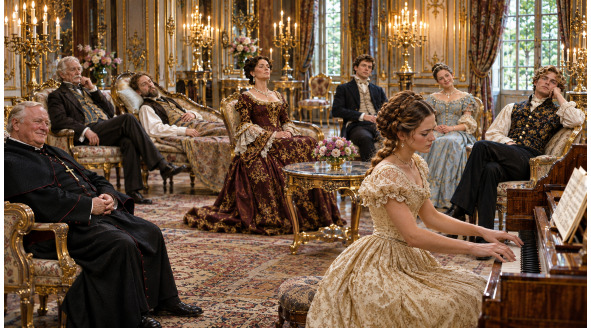
George took the covered pot away, inwardly resentful. Unlike the usual smell, the stool smelled fishy. His curiosity got the better of him. When he got out of sight he investigated the contents. It was yellowish and appeared to have bits of cooked rice in it. “Dat’s strange: we haven’t served rice fer weeks”, he told himself; “Is dat some kinda worm?” He found a stick and successfully isolated one of the bits of “rice”. Holding it by his thumb and forefinger, he peered closely. It didn’t move; it just didn’t look like a worm or maggot. This was about 7:00 pm. He returned to the master’s bedroom and replaced the pot under the chair.
By now Lord Romuałd had donned his nightshirt and gone to bed. “Please fetch Lady Jadwiga”, he requested.
George went to the music salon where the family was still seated. “Da master wants t’ see you, my Lady”, George announced to Jadwiga. She excused herself and went to the bedroom. George figured he might as well accompany her: she was bound to have some further request.
She felt her husband’s forehead. “Go get the thermometer”, she ordered, and George shuffled off to get it.
He did have a fever. She asked George to instruct Ursula to make some barley water. George went to Ursula’s dorm with the request. Ursula went to the kitchen; added a scoop of barley to some water; and boiled it. When the water was pink it was judged ready. This folk remedy was considered the best way to stop up diarrhea. It was too hot to drink, so Ursula emptied the contents from one utensil to another, letting the material absorb the excess heat. When it was ready she brought it to the master’s bedside.
Between herself and Lady Jadwiga they got Lord Romuałd to sit up. “Now drink it all, Romuś”, Lady Jadwiga demanded in a firm yet kindly way.
“I am not thirsty, but if you insist I will do it”, he replied. No sooner had he downed the liquid than he ran to the chair and expelled more diarrhea. “I am sorry, my dear Jadzia, to do this in front of you, but time was of the essence”, he apologized. He returned to bed and Jadwiga felt his forehead and inserted the thermometer again. He was hotter than before. She began to worry. She sat by his side and held his hand. She noticed that the skin of his hands was wrinkled, like a woman’s who does laundry for a living. His head and neck were covered with sweat and appeared oily.
“Ursula, prepare a basin of cold water and a small towel. Go to the ice house and chip off a few bits and put them in the water.” When it was brought she immersed the towel in the water, and wrang it out a bit. She mopped all the exposed skin, leaving a film of water to cool him. She fanned his wet skin with an ornate ivory fan. She dipped the towel again, wrang it again, folded it and placed it on Lord Romuałd’s brow. The two women sat down, both watching Lord Romuałd, who now seemed to be most uncomfortable. He moaned now and then.
At about nine pm the rest of the family came by to see how he was doing. “You all go to sleep; I will stay with daddy”, ordered Lady Jadwiga. The last one to leave was Fr. Andrew, who prayed over Lord Romuałd at some length. The closest path from the bed to the door was on Lord Romuałd’s left, and in leaving, Fr. Andrew took his left hand in his hands, and shook it to instill confidence.
At nine-thirty Lord Romuałd suddenly grabbed for the basin, and vomited. He got out of bed and moved for the chamber pot, where he had another movement of diarrhea. Jadwiga insisted that he drink more barley water, and he did so. “Ursula, make sure that there is a supply of it. Go quickly”, the Lady ordered, and Ursula left.
On her way to the kitchen she passed the dorm where Marta, Barbara and Catherine slept. “The master’s in a bad way. Better do some prayin’ for ‘im; he doesn’t look good”, she informed them.
At nine forty-five he jerked painfully. “Oh, oh, I have cramps in my calves!” he cried. Jadwiga reached under the covers and tried to massage away the cramp, to no avail. “Oh Jezu, help me to bear the pain!” he cried, weeping softly, knitting his brow and biting his lower lip.
The Lady felt useless and helpless. “Ursula, get my Rosary”, she ordered. When it was brought she made some feeble attempt to pray, but was more absorbed in her husband’s health.
He asked Ursula to bring him a small crucifix, upon which he looked frequently. “My heart is beating so rapidly!” he exclaimed. The Lady reached over, pulled away the covers and placed her palm over his heart. It was true. While she stood over him, she noticed that his lips were dry and cracked.
“Open your mouth”, she ordered, and saw that the insides were dry. “Aren’t you thirsty?” she asked.
“Well I wasn’t before, but I am now — ravenously” he answered, so she gave him more barley water.
As the night wore on he became irritable, which she took in stride, correctly attributing this to his discomfort. She did not answer back tit for tat. She became more alarmed at the frequency of diarrhea movements, and the amount of water that each contained. George was kept running emptying the chamber pot into the privy. He was sent to bed and Ursula took over emptying the pot.
*
At a little after 11:00 pm George was awakened from sleep by a gurgling in his intestines and an urgent need to defecate. He ran out to the privy, just making it before the movement burst forth. He wiped himself with some crushed and recrushed old newspaper that was kept there for the purpose. He went to the well, drew up a bucket of water, poured it into a vessel and washed his hands. He returned to bed but was awakened by a need to go again. After relieving himself he woke Stanislav, and fearfully informed him that he thought that he had whatever it was that Lord Romuałd had. Stanislav went to Lord Romuałd’s room and told the Lady about this.
*
When Fr. Kalkstein-Osłowski got to his room he sat down to say his Office. He knelt beside his bed and did an examination of conscience for the day. He went to bed. At about 1:30 he was awakened by a rumbling in his intestines. Getting out of bed as quickly as he could with his rheumatism, he moved to the toilet chair, uncovered the chamber pot, and relieved himself. This happened several more times. He concluded that he had the same malady that Lord Romuałd had. He went to Lord Romuałd’s boudoir, being fairly certain that he would find Lady R. there. She was, and he informed her of his condition. He went back to bed.
Chapter Six: Valentine Experiences Three Deaths
Thurs. July 15, 1847. Marta’s day off. She didn’t take it; it seemed unkind to turn her back on the master, who was seriously ill.
At about 3:00 am Jadwiga looked at Romuałd and noted that his breathing had become shallow and rapid. He seemed to be staring into space with little consciousness. He pushed the covers aside to make another trip to the chamber pot, but his movements were slow and fumbling. Jadwiga helped him get up. He was dizzy and weak. “That’s it”, she told herself; “Three sick people here; Romuałd is worse. I am sending for the doctor.” She pulled the cord. Presently Stanislav appeared. “Have Edward ride to Łasin and fetch Dr. Burckhardt immediately” she ordered. He went to the dorm shared by Edward and George, woke Edward and sent him on his way, and took a quick appraisal of George.
It was about 5:00 am when Edward and the doctor returned. It had been light for about an hour. The doctor went in to Lord Romuałd and after examining him asked to see the other two.
He returned to Lord Romuałd’s room and announced, “We have an outbreak of Cholera here.”
“O Jezu!” exclaimed Lady R.
The doctor opened his bag and administered a dose of calomel to the patient. He took out his monaural wooden stethoscope and listened. The heart was beating very quickly.
Realizing the seriousness of the situation, Lady R. told Stanislav to send to Szczepanki for Fr. Berent. Edward and the pastor arrived about 6:00 am. Her Ladyship summoned to the bedroom the entire household, her children and those servants who were well, and asked them to kneel and pray. Five-year-old Valentine Karnowski was among them. “His Lordship, Fr. Andrew and George all have Cholera”, she announced to them solemnly; “We must pray for their return to health”. Everyone began weeping, everyone except John. When he realized this, John tried to come up with some tears; the best he could do was to adopt a sad mien.
Fr. Berent set up a sick-call table and heard Lord Romuałd’s Confession. Because the sick one could not keep anything down Father snipped off the tiniest spec of the Eucharistic Bread and gave it to him. He anointed him. When the Last Sacraments were finished, Lord Romuałd addressed the group in little more than a whisper, punctuated by short shallow breaths. “I don’t know — - if I will outlive — - this disease, — - or if I will be — - lucid much longer,…” At this he lapsed into what seemed like sleep.
Recovering, he continued, “ — - I may be addressing you — - for the last time. — - I beg forgiveness — - for any harm — - I have caused you.” He fell away again.
Coming to, he said, “ — - It is sad — - that I could not — -have done so — - until pressed — - by the prospect — - of eternal — - damnation.”
He paused a long time. “My will — - is registered in Kwidzyn. — - There is a copy — - in my roll top desk. — - John, I leave — - the estate to you, — - as is traditional…” At this Lord R. drifted off again.
He opened his eyes only slightly and said, “ — - Be good to — - our servants, — - especially to Marta — - and her son — - Valentine Karnowski.”
Doctor Burckhardt and Fr. Berent left the praying group to visit George. After examining him Dr. Burckhardt told Fr. Berent, “Yes, clearly, a case of Cholera.” He gave him a dose of calomel. He summoned Edward and told him, “You stay with him. Give him barley water as often as possible, and calomel every three hours”.
They left to visit Fr. Kalkstein-Osłowski. “Yes, it’s Cholera”. He summoned Sophia and gave her instructions about barley water and calomel. Returning to the boudoir, Dr. Burckhardt announced, “This estate is under quarantine. From now on no one is to come or go until I say so.”
“Doctor, what shall we do?”
“Put a pillow under their feet. Keep those feet elevated. Keep them warm. We want to sweat it out of them. Continue to give them liquid — at least water.”
Lady Jadwiga said, “You servants, you heard the doctor. Do as he says — gogogo! Otherwise, go about your daily tasks. Children, go eat breakfast. I will stay with your daddy and eat later”.
As they walked away, Valentine asked his mother, “Mama, is Lord Romuałd gonna die?” It was his first experience with human death, with the death of someone whom he knew well and liked. It frightened him.
“We don’t know, Valuś. That’s in God’s hands”, she replied. “We must pray that he get well”. She was worried. “What would life be like with Lord John in control?” She shuddered at the prospect.
The doctor got Stanislav to make a sign that said, “Cholera. Stay away until August 23rd. Fr. Berent & Dr. Burckhardt are here.” Stanislav could not read or write, but the doctor wrote the words in charcoal, and Stanislav traced over them with paint.
Doctor Burckhardt kept up a circuit of moving between three rooms, seeing to his three patients.
As John knelt by his father’s bedside he was thinking, “This illness has advantages and disadvantages. If he dies I am in control of this estate. Mama should be easy to control. It will be to my good fortune if Fr. Kalkstein-Osłowski dies. He would have been a problem. I don’t wish daddy or him dead — I’m not as bad as all that, but on the other hand I can’t wait to have it all. This quarantine will postpone our little plan of getting even with that Marta.”
At about 8:30 am Jadwiga noticed that Romuałd’s fingertips and lips were blue. He was sweating. At 10:00 he complained of chest pain. At 11:00 he became delirious, clutching at his belly, then lapsing into a coma. Doctor Burckhardt spoke softly into her Ladyship’s ear, “I think it’s time. You may want to call the entire household”.
She pulled the cord. Stanislav came. She instructed him to gather the staff. When they had assembled Fr. Berent anointed Lord Romuałd for the last time, as everyone wept and prayed silently. His breathing became very shallow; his face showed great pain. Lord Romuałd was thinking, “My Jesus, you suffered for me. Help me, help me, to bear these sufferings to atone for my sins. I believe that you are merciful. I throw myself on your mercy.” At 12:30 noon his face relaxed, and he breathed his last.
Dr. Burckhardt stayed around to look in on the two other patients. Actually, he had been called too late, in his estimation, but one never knew…
At about 16:00 pm Edward called the doctor to George’s room. Edward rightly diagnosed George as being in extremis. The doctor, who was Prussian and a Lutheran Pietist, called for Fr. Berent. The latter came and set up the sick-call table. After making his last Confession, George said, “Fader, I offer — - my suff’rings — -to atone fer — - d’ terrible sins — - I’ve committed, ‘specially — - wit’ Valentine”. Stanislav and Edward were in the room, kneeling and praying. They had not heard any of this. At about 5:00 pm George gave up his spirit with a loud gurgling death rattle. The other two felt a great sadness, which surprised them. They had worked together a long time, so long that their feelings for each other were taken for granted and buried. Now they surfaced.
At this point the doctor was not needed, so he moved on to Fr. Andrew’s room. He died at about 7:30 pm, after receiving the last sacraments from Fr. Berent.
The doctor was faced with a dilemma. For the quarantine to work, he had to be sequestered along with the others, but he was a doctor! Lots of people would need him. He came up with a compromise: if he or no one else died or even got sick for the next two days, he would leave.
Current thinking was that Cholera was spread by breathing contaminated air. If he could just stay far enough away from anyone, that ought to work. He went into solitary confinement; the servants left his meals outside his room.
Stanislav had a problem on his hands: what to do with three bodies which couldn’t be buried until who knew when? They had an ice house — really a cellar — where blocks of ice, cut from the Osa River in winter, were kept under a deep layer of straw. But he wanted to make the ice last until fall frost, and, since he didn’t know how long they’d be using the ice, this was out. He finally decided on constructing some coffins out of rough boards, smearing them with pitch, covering the bodies with salt, and burying them temporarily. He got Edward going on this, and enlisted Valentine in the work. Valentine felt as tho he had entered into a new phase of his life: doing the work of a man.
Valentine felt a great sense of relief as he looked down at the unmoving body of George, his molester, now covered with salt. He also felt hatred for this strong adult who had shown him his childhood weakness. He felt shame, he blamed himself: there was something about him and no one else that had elicited this from George. He felt fear of telling his mother. No, he was firm: he would never tell her.
George’s death should have made him sleep soundly, but Lord Romuałd’s death — and even George’s — scared him and made him worry about his own dying. “What is keeping me alive?” he asked himself; and did not want to hear the sound of his own heartbeat as his ear pressed against the pillow, being sure that it would stop. So as not to hear it, he propped his elbow in his pillow and rested his head on it. In time he got drowsy, his arm gave way, his head hit the pillow and he fell asleep.
Chapter Seven: Quarantine
Fri. July 16, 1847. Val’s grandfather Adalbert and Uncle Julian Nering showed up for compulsory labor on the Rogóźno Zamek manor folwark. Adalbert had already had enough to drink to make him wobbly. The overseer could not read, but in some way found out about the quarantine. He became the de facto decision-maker for the estate until August 23rd. Adalbert wrongly assumed that he would be able to slacken off. The overseer tied him to a tree and flogged him and sent him home. The Nerings helped spread the news of the quarantine.
With Fr. Andrew dead and himself in quarantine, Fr. Berent assumed the duties of manor chaplain. He said Mass at 6:00 as was house custom. It was the feast of Our Lady of Mt. Carmel. In attendance were Lord Gregory, the patriarch; Lady Rogozińska; daughters Louise and Benedicta; and son Blaise. They were all attired in black. There was much weeping and sobbing thruout, on the part of everyone in the family.
After breakfast Fr. Berent sought out Lord John, the new owner, and said, “Ever since the doctor proclaimed the quarantine an idea has been developing in my mind. Rather than regard the next forty days as a boring curse, why not see it as an opportunity for spiritual growth? Why not devote part of it at least to a retreat? A week, perhaps.”
“What do you have in mind?”
“Let us begin on Sunday morning, and finish up the following Sunday morning”.
Lord John wasn’t at all keen on the idea. He called his family to get their opinions, hoping that they were negative, in which case it wouldn’t be his decision. No one was against it; each had a different degree of interest, however: Lords Gregory and Blaise most enthusiastic; Lady Rogozińska next, and the girls least of all. “All right, Fr. Berent; you may have your retreat, but I will not be there”, said the heir.
Father had some planning to do.
*
At midmorning Lord Jażdżewski, a nobleman from an adjoining estate, father of Lord John’s young friend, happened to be riding by the front gate of Rogóźno Zamek manor. He saw a large wreath with black ribbon and read the sign. He galloped to Szczepanki, to the rectory, and found the organist. He informed him of Fr. Berent’s whereabouts, then rode in to Łasin.
A device called the telegraph had been invented in America in 1844, and the Prussian government had set up a telegraph office in Łasin. Going up to the clerk, Lord Jażdżewski ordered the following telegram to be sent to Pelplin:
“To Bishop Gierszewski. Cholera and death at Rogóźno Zamek manor. All residents under quarantine until 8/23/47. Fr. Berent, pastor at Szczepanki, included.”
After paying and watching the clerk click out the message, he was in awe: what used to take two days now done in minutes! He then rode to the city hall/jail and informed Herr Detektiv Polizist Theo Welsch about the doctor’s whereabouts.
*
The organist, Richard Skibiński, rode to Gruta and informed Fr. Musolf about the Cholera, and that they would have no priest at Szczepanki until August 23rd. He asked if some arrangement could be made. The priest thought a bit, and said, “When the people come next Sunday at 9:00, have them say the Rosary, read the Epistle and Gospel, and tell them that I will ride in for a Mass at 11:00, i.e., after my own 9:00 Mass is over. And spread the word”.
Sat. July 17, 1847. Fr. Berent said the Mass of St. Alexius at 6:00 in the manor chapel. After breakfast he retired to the bedroom he was given and began to prepare for the retreat. He wished the servants to attend, too; therefore he wanted their duties to be light so that they could be present. Among other things, this meant simple food, quick to prepare. Besides, for the nobles to eat such food was good mortification. He worked up a morning talk and an afternoon talk. Each to be followed by an hour of silent time before the Blessed Sacrament. He discouraged — but didn’t totally outlaw — conversation. “Keep it down to what is necessary”, he had said. He heard confessions at 4:30. He asked everyone to go to confession as a way of clearing the way for the Holy Spirit to work.
Since neither he nor anyone else had gotten sick after the last death, Dr. Burckhardt took his leave after 7:30 pm while it was still light. On his way home he smelled the star thistle and sweet clover, and saw the bees at work on them. “Some life ends; other life goes on,” he philosophized to himself.
Sun. July 18, 1847. When the folks assembled at 9:00 in St. Laurence church, the organist did as he was bidden.
*
At the manor Fr. Berent announced after Mass that the retreat would last not seven but eleven days, and would cover the following topics: today thru Wednesday: The Four Last Things: Death, Judgment, Heaven or Hell. Thursday thru Wednesday: the Capital Sins. One topic a day beginning today. The day would begin with Mass in the chapel at 6:00, then a simple breakfast. At 8:00 am they would re-assemble in the chapel for the first talk. All talks to take an hour. After that a fifteen-minute intermission to stretch and/or relieve oneself, then re-assembly in the chapel for an hour of silent adoration of the Blessed Sacrament. Between then and noon retirement to one’s room for personal meditation. At noon a simple lunch, to be served by the staff. After that, the staff’s own lunch and cleanup. Re-assembly in the chapel at 2:00 for the second talk, followed by a fifteen-minute intermission. Then an hour of silent adoration of the Blessed Sacrament. Between then and supper retirement to one’s room for personal meditation. Supper at 6:00 pm, followed by servants’ supper, cleanup, and preparation of next day’s meals. Confession every evening.
Lord John had been in the habit of attending Mass out of deference to his father. He even went to Communion, but he never went to Confession. Fr. Andrew had occasionally brought this up to him. Lord John decided that for the time being he would continue to attend Mass and go to Communion. After Mass today he ate a simple breakfast with the others, but after the servants left the kitchen and assembled in the chapel, he went back to the kitchen and supplemented his meager meal with some additions more to his liking.
Valentine had gone to Mass with Marta, but was judged too young to understand the substance of the talks, so he was dismissed with the admonition, “You can play outside but you must stay very close to the manor. Do NOT go anywhere near the gate; if you come near anyone from the outside they may get sick, and you don’t want that, do you? Do you understand?” to which he replied, “All right, mamuś.”
Then Marta added, “And come back for dinner and supper when I ring the bell”. The bell was used when it was known that people were outdoors.
It rained lightly much of the day, so Lord John and Valentine were both confined to remaining indoors.
Today’s topic: Death. Due to the recent deaths of three people, people to whom everyone in the chapel was close, this topic was taken very seriously. The grey sky, and occasional thunder and lightning aided considerably in putting everyone’s thoughts on their Final End. Even Lord John, tho he was not in actual attendance, but who was perfectly aware of the subject of today’s talks, thought of death occasionally.
Lord John went to the library, and took out book after book to keep his mind anywhere but on death. He was too lazy actually to read anything; he languidly turned pages hoping for pictures. After a while this bored him, and he moved to the music room, where he took out some music by Chopin and began to play the fortepiano. Again, he was too lazy actually to improve his playing, and traversed a slew of pieces, all of which proved boring. There was a stack of old newspapers, all in German. His eyes quickly scanned the columns, hoping for some bit of titillation that he had overlooked in previous perusals. Putting them down, he picked up a pile of old Polish newspapers that had to be mailed in from Paris and the Austrian partition in sealed envelopes. There was nothing in them that concerned the local scene.
He moved to the window, and thru the rain making its crooked tracks down the panes he looked out at the estate. He studied the intricate lace-like patterns of the clipped boxwood in the formal gardens. He admired the English informal garden, and the fountain with its statues pouring out continuing flows of water from large seashells, and dolphins spitting forth streams of water. He saw the orangerie, where they grew their own oranges, a building that needed to be heated in winter. He saw the little park with the pergola of pleached hornbeams leading to the chinoiserie gazebo. He forgot his boredom momentarily. “This is mine — all mine!” he told himself.
Eventually he heard the bell announcing dinner. He went to the dining room and joined the silent family. He tried to talk with Louise, but Lady Rogozińska, casting a glance sideways at Fr. Berent for approval, put her index finger across her lips requesting silence.
After dinner the family disappeared to the chapel again. John, instead, moved from salon to salon, admiring the baroque beauty of the floors, walls, and ceilings. In the process he ran into young Valentine, doing the same. John went from portrait to portrait of his ancestors. Valentine was feeling lonely, tho at his age he did not know what to call the problem. He attached himself to Lord John; the latter was too apathetic to shoo him away, so the two traveled along together. “I would tell you about these people, but you are still too young to understand. In fact as a peasant, you will never understand…” said Lord John. Valentine looked into Lord John’s face for some further explanation of this remark, but it was not forthcoming. This caused him from then on not only to look at the paintings themselves, but to study Lord John’s reaction to them.
John studied one depicting Thomas Rogoziński with Sigismund III Vasa, king of Poland and Sweden. Thomas helped to defeat the archduke Maximilian of the Holy Roman Empire at the Battle of Byczyna, January 24, 1588.
Here was one showing king Vladyslav Jagiełło with Chrysostom Rogoziński, who helped defeat the Teutonic Order in the Battle of Grunwald, July 15, 1410. Jagiełło had conferred the estate on Chrysostom in gratitude.
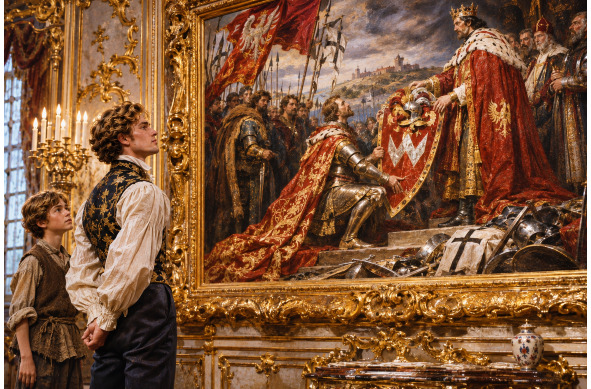
Here was the image of Nicholas Rogoziński, who fought the Teutonic Order in the Battle of Lake Melno, which was nearby, September 27, 1422.
Here was the likeness of Damazy Rogoziński, who participated in the Second Peace of Toruń, October 19, 1466 between the Poles and Teutonic Order which formally ended the 13-year war in Poland’s favor.
Here was Silvester Rogoziński, who helped defeat the Swedes in the Battle of Kircholm, 1560.
This one, Marcel Rogoziński, helped defeat the Muscovites in the Battle of Pskov, August 24, 1581, under King Stefan Batory.
Here was Vincent Rogoziński, who helped defeat the Turks at Vienna, fighting under John III Sobieski, on September 11, 1683. Lord John may have been lazy, but he took a great deal of pride in his ancestry. It made him feel better than most people, even other nobles.
After this little tour, the reality of his situation returned to him: he was bored. “Be off with you now,” he snapped down to Valentine. “No. Wait. Find me a bottle of red wine,” he ordered. Only too happy to be given something useful to do, Valentine ran off.
He looked thru the wine cellar. Nothing. He ran to the kitchen. “Aah, there’s one,” he told himself. He found a Waterford crystal goblet, and played with it for a while, turning it around different ways to catch the colored spectrum-lights as they moved from slash to slash.
Remembering his errand, he put the wine and goblet on a tray, and brought them to Lord John. “Now get lost,” ordered Lord John. Valentine took off, hurt at not having been thanked, and at the hope for friendship dashed.
When John arrived at the supper table he was obviously slightly intoxicated. Since no one would converse with him, he talked out loud to no one in particular.
Mon. July 19, 1847. Today’s topic: Judgment. It was another rainy day, like yesterday, and Lord John spent it pretty much the same way he did yesterday. Valentine, fearing Lord John, made sure that Lord John was nowhere in sight, and did his own tour.
Tues. July 20, 1847. Today’s topic: Heaven. Marta was relieved at the positive swing in the talks. Fr. Berent was not a “fire-and-brimstone” kind of preacher; still, the last two days’ talks had played havoc with the insecurity that she felt, alone in the world. Her father, the alcoholic misanthrope, had instilled in her the belief that she was a second-class human being.
Lord John could no longer take the boredom of being cooped up alone. Like so many people who live an immoral lifestyle, he was convinced either that he would be given a deathbed conversion, or that after all, God is too good not to send everyone to heaven. So, since heaven is an agreeable topic to hear about, he surprised everyone by showing up in the chapel. Marta considered it a wise thing to have Valentine present as heaven was extolled. It would be a good means of getting him to become committed to Jesus in His Catholic faith.
Wed. July 21, 1847. Sophia sent Valentine to harvest some of the cabbage that he planted on April 22nd in the first planting. This was the beginning of cabbage harvest season, which would end on September 20th. Crops would be meager, due to an infestation of cabbage worms this year. Lucky for those who made kapusta (fermented cabbage) last year, and have some left over!
Today’s topic: Hell. Lord John did not want to believe that there is a hell, and certainly did not want to be convinced that he was wrong, so avoided the chapel today. Besides, today the sky was solid cyan with not a cloud in sight, and the air temperature was perfect. He decided to spend as much time as possible outside. On the backside of the manor the land sloped down gradually by a series of wide, stone-paved areas to the Osa River. One moved from one area to another by staircases of three or so steps, inspired by the Spanish Steps in Rome. On both sides there were natural woods (except that all dead limbs and bushes were removed from the forest floor) thru which paths led from one sitting area to another. One of these areas had a mock Roman ruin, with a little theater. The river had been straightened out for the length of his property, and the bank lined with cut granite. It was topped with a marble balustrade, punctuated at thirty-foot intervals with pedestals atop which were statues of figures from Greek and Roman mythology. There was plenty here to stave off boredom.
The good weather did not fail to attract Valentine outdoors, either. He climbed trees. It felt good to be way up there, above it all, unknown and unseen by anyone. This was a safe refuge, his own place. He found a tree that suited him best. It was of a circumference around which he could get his little arms to climb. It was very tall so as to look out over other treetops. It had several horizontal branches at certain waystations where he could sit safely to survey things at different heights.
Eventually he got tired of his tree, and roamed the paths of the woods. He came across a piece of branch with a natural Y to it and got an idea. He broke off all ends to make it compact. He ran back to the manor, to the kitchen, and found a length of rubber banding. He tied it to both ends of the Y and had a slingshot. Returning to the woods he spent a lot of time firing pebbles at various things. Eventually he felt emboldened enough to try for squirrels. He hit a few and left them injured. He exited the woods and spotted a peacock with its fan displayed. Aiming for it, he injured it, and it fell over. He became afraid, realizing he had overstepped himself. He threw away the slingshot and ran off.
The injured bird began making distressed calls, which moved Lord John to find the source of the noise. When he came upon the scene he saw the bleeding bird on its side, trumpeting in pain. He wrang its neck to put it out of its misery and shouted for Valentine. When the boy came forward Lord John angrily asked, “Did you do this?”
Valentine presumed that adults had special powers of perception, and that Lord John had to know that he did it, so he replied, “Yes, your Honor. I’m sorry.” Lord John pulled down his pants and slapped his behind hard many times. Then he grabbed him by the hand and dragged him to the manor.
Bursting into the chapel, he interrupted Father’s talk and announced to all, “All of you: outside the chapel. This urchin just killed one of my peacocks. He must be punished.”
Everyone moved to just outside the doors to the chapel. Marta’s heart was beating wildly, as were the hearts of Lord John and Valentine. “Stanislav, you take one arm. Edward, you take the other,” ordered Lord John. Pulling down Valentine’s pants, and removing his own belt, he whipped his behind ten times. “Marta, you will pay to replace that bird,” stated Lord John angrily. He marched away, breathing heavily, while Valentine, still screaming, ran to the arms of his weeping mother.
Everyone returned to the chapel, except Marta. Instead of embracing Valentine, she too slapped him across his behind, with his pants up. “Now see what you’ve done!” she shouted at him; “Do you know how long it’ll take me to pay for that bird? What did that bird do to you?” She re-joined the others while he ran to their dorm in the basement, sobbing loudly, and threw himself into his cot.
Thurs. July 22, 1847. Marta got up and realized that it was her day off. “But I’m quarantined. Besides, how would it look NOT to be in the chapel?” she asked herself.
Today’s topic: Lust. This was definitely a topic too close to home for Lord John, so altho the sky was grey and there were a few sprinkles off and on, he spent the day outside.
Wed. July 28, 1847. Fr. Berent’s topic: Gluttony.
*
At this time it is necessary to spend some time on Otto von Bismarck, since his anti-Polish policies will play a devastating role in Polish history and Valentine’s later life. Today, 109 miles northwest of Rogóźno Zamek, there was much excitement in the village of Barnowiec (Reinfeld), one and a half miles southwest of Kołczygłowy (Alt Kolziglow), Farther Pomerania, which by now had been entirely Germanized, and Lutheranized. Bismarck (32), who had had trouble finding a wife, was finally to be married, after three unsuccessful engagements. He had asked for the hand of Johanna von Puttkamer in a letter written in a diplomatic and rhetorical style to her father last December 21st.
Reinfeld was Johanna’s home. Otto chose Johanna because, being only 23 to his 32, he was more likely to get his way, and because she was so unlike him. Politics bored her. She was not a social climber. She had little concern for the things of this world. In her speech she was frank rather than roundabout. She was loyal to him and backed him, altho her health was not robust. A lady friend once said that it was a shame that his wife did not share some of his interests. Bismarck replied, „… this has its good side. I get into quite a different atmosphere at home”.
But first a little of Bismarck’s history leading up to this event.
Bismarck had abandoned religion in 1831, at age 16, after he was confirmed in the Lutheran faith. In later life he said, “Not out of indifference, but as the outcome of mature conviction, I abandoned the practice to which I had been accustomed since early childhood: I gave up saying my prayers, for prayer seemed to me to conflict with my view of the nature of God. I said to myself that either God ordained everything in virtue of His omnipotence, i.e., independently of my thought and will; or else, that if my will be independent of God, it would be arrogant to believe that God could be influenced by human petitions.”
He claimed that his father was not a Christian; that his mother was partial to theosophical writings (Theosophy would only be formally established as a science in 1875), and that neither of his parents ever went to church. Otto received instruction in religion from theologian Schleiermacher, who regarded prayer as a developmental stage on the way to magic, and only recommended it for its refining influence. His mother showed an enthusiasm for Emmanuel Swedenborg, the Seeress of Prevorst, and the theories of Mesmer.
In 1833, at 18, Bismarck became acquainted with count Albert Theodore Emil von Roon, a Prussian army officer who, with General Helmut von Moltke, would bring the German empire into being and make Germany the leading power on the continent of Europe.
In 1835 at age 20, Bismarck passed his examinations for the bar at the University of Berlin, with the aid of a crammer. He became a lawyer pleading cases at the Municipal Court in Berlin.
In 1836, at 21, Bismarck became a referendary in Aachen, near Belgium.
On Tues. January 1, 1839, when he was 24, his mother Wilhelmine Mencken, died. He didn’t like her. He had an older brother, Bernard, born 1810, and a younger sister, Malwine, born 1827. Otto and Bernard together took over the management of their father’s estates Kniephof (Konarzewo), Külz (Kulice) and Jarchelin (Jarchlino) in “Farther” Pomerania, altho their father was still alive.
On June 7, 1840 when Otto was 25 Frederick William IV became king of Prussia.
On September 17, 1841 brother Bernard married Adele Fanning.
In 1844 when he was 29 Bismarck developed friendships with Thadden and Blanckenburg, who were to play a part in Prussian government. That year Otto’s sister Malwine married Oscar Arnim-Kröchlendorf, a childhood friend of Otto’s. Brother Bernard’s wife Adele died in 1844 after the birth of their son Philip.
November 22, 1845. When he was 30 Otto’s father Ferdinand died– one year, eight months previous to Otto’s wedding. Bismarck moved back to Schönhausen, where he became a dike-reeve.
Kup książkę, aby przeczytać do końca.