
Introduction
The history of popular music is full of bands that go beyond the boundaries of pure entertainment. Yet there are a few whose work functions not merely as a collection of songs but as a coherent, multi-layered cultural message — a story unfolding across years, albums, symbols, covers, sounds, and silences. Pink Floyd unquestionably belongs to this small group.
For over half a century, Pink Floyd’s music has prompted listeners to ask: why do these songs form narrative sequences? Why do themes of madness, memory, fear, alienation, and time recur with obsessive regularity? Why do successive albums feel like chapters of a larger story?
The band’s official historiography — biographies, interviews, rock encyclopedias — offers convenient, fragmentary, and often contradictory answers. It speaks of chance, inspiration, drugs, personal conflicts, “artistic chaos,” and “genius of the moment.” This project assumes that such explanations are insufficient.
Even if they explain how the music was created, they still do not answer why it works in such an extraordinary way. Why it does not age like most rock music of its era. Why it continues to demand interpretation, not mere nostalgia. And finally, why successive Pink Floyd albums feel like elements of a larger whole, rather than autonomous works.
This book rests on a simple yet consistent premise: Pink Floyd’s work can be read not as a collection of songs, nor even as a series of albums, but as a process.
An internal process, extended over time, recorded in sound rather than words. A process closer to a diary than a manifesto, closer to introspection than to social commentary.
A diary has its own rules. It need not be linear. It need not be objective. It is full of returns, obsessions, repetitions, and gaps. Some events are exaggerated, others pushed to the margins. Time flows within it not according to the calendar, but according to emotion. And this is precisely how Pink Floyd’s music functions.
Recurring motifs — of time, childhood, the body, fear, guilt, isolation, violence, and loss of control — are neither decoration nor a random collection of themes. They form a structure of consciousness in which individual songs are like records of fleeting states, and successive albums like stages on an inner journey. The listener does not so much “learn the story” as immerse themselves in another’s experience of experiencing the world.
Therefore, this book does not attempt to answer the question, “what did the author mean?” Such a question presupposes a single creative act and a fixed meaning. Pink Floyd, however, is a body of work created over many years, in shifting personal, emotional, and cultural configurations, and its meaning is not a point, but a trajectory.
The aim of this book is to read that trajectory attentively: album by album, song by song, motif by motif. Without rushing. Without the need to draw immediate conclusions. With the understanding that meaning does not always reveal itself directly, but often exists in between: between sounds, between lyrics, between covers, and even between the silence of one song and the beginning of the next.
This is not a biography, although biography will appear throughout.
Nor is it a classic musical analysis, though music remains its foundation. It is an attempt to view Pink Floyd’s oeuvre as a coded autobiography — not of one man, but of a particular way of experiencing reality.
If this interpretation makes sense, it is because Pink Floyd’s music can still evoke a sense of unease and recognition simultaneously. As if telling a story we have never fully lived, yet somehow remember. And perhaps that is precisely why it cannot be listened to indifferently.
Pink Floyd — The Band’s Name
A very intriguing question concerns the band’s name — Pink Floyd — which, much like Led Zeppelin, remains shrouded in ambiguities and misconceptions. To unravel this enigma, one must focus not on what is officially known, which often results from the deliberate “misleading” of amateurs prone to drawing too simplistic conclusions, but rather carefully filter the individual components of the band’s name — Pink and Floyd. First, however, it is worth examining the highly interesting etymological and prehistorical origins of the band’s name.
The group was formed in the spring of 1965 in London, initially under the name Sigma-6. Its members were students at the architecture faculty of the London Polytechnical School: Roger Waters (guitar, vocals), Richard Wright (guitar, vocals), Nick Mason (drums), Clive Metcalf (bass guitar), Keith Noble (vocals), and Juliette Gale (vocals). Initially, the band was heavily influenced by the rhythm and blues music popular at the time, yet even then it did not shy away from musical experiments, such as incorporating fragments of classical music into its compositions. The formation frequently changed its name (T-Set, Tea Set, The Screaming Abdabs, The Architectural Abdabs) as well as its lineup.
(link) — https://pl.wikipedia.org/wiki/Historia_grupy_Pink_Floyd
Let us start from the very beginning:
When Barrett arrived in London in 1964 to begin his studies in painting at Camberwell Art School, he was immediately invited by Waters to join the band. The group — initially called Sigma 6—was undergoing, at that time as well as later, frequent changes of lineup and name. When Syd Barrett joined the band, the group performed under the name The Tea Set. When it turned out that they were scheduled to perform a concert alongside another band with the same name, Barrett proposed the name The Pink Floyd Sound.
(link) — https://pl.wikipedia.org/wiki/Syd_Barrett
The Tea Set is commonly translated as: “tea set.” One can imagine Syd laughing at such a trivial and unoriginal name for a band. Breaking down this name into its components reveals a subtle but telling clue, which hints at an attempt to understand what he knew but could not openly declare at the time.
Tea — a rumor or personal information belonging to someone else; a scoop; the latest news. To “spill the tea” about what happened in the club.
(link) — http://www.urbandictionary.com/define.php?term=tea
Firstly, the band’s name, “The Tea Set,” was changed from “Sigma 6” solely due to Syd Barrett’s intervention.
Secondly, his occult inclinations and artistic genius would, I believe, have prevented him from giving the band such a trivial name. Confirmation that this was a gnostic intention behind choosing a specific name is seen in the subsequent transformations: “The Screaming Abdabs” and “The Architectural Abdabs,” which I will analyze further below.
Thirdly, by combining the “subliminal” meaning of the word Tea with the seemingly “ordinary” meaning of set — a collection, a group, a set — one can surmise that the central motif of the band’s artistic activity would revolve around deeply personal experiences of a specific individual; it would function as a highly personal diary, as I will demonstrate in later entries. Another “archaic” band name, “The Architectural Abdabs,” is also frequently misunderstood. It is necessary here to correct a commonly repeated error:
An article by Barbara Walters, published in the Regent Street Polytechnic magazine (today Westminster University), is probably the first press mention of the group that later evolved into Pink Floyd. […] Many biographical publications on Pink Floyd repeat the mistaken information that the band allegedly used the name The Architectural Abdabs for a period during its pre-formation activities. This is a misunderstanding. The actual name was simply The Abdabs (literally: fright, nerves), and the supposed prefix “architectural” was inferred from the above article.
(link) — http://skibek.pl/ciemnastrona/index.php…
Thus, here is another clue that strongly indicates what “revelations” one might expect in the above-mentioned (The Tea Set) “vivisection diary”: abdabs — fright, nerves — which I hope to prove through my detailed interpretation of all the band’s subsequent albums and songs.
And finally, the official and widely known band name — Pink Floyd.
When the Tea Set realized that they were not the only band with that name, Barrett proposed changing it to The Pink Floyd Sound, after two blues musicians — Pink Anderson and Floyd Council. Ultimately, the band decided to shorten the name to Pink Floyd at the request of the group’s managers, Peter Jenner and Andrew King.
(link) — https://pl.wikipedia.org/wiki/Pink_Floyd
Perhaps yes, perhaps no, or perhaps maybe. Based on such “information,” it is easy to fall into the trap of superficial conclusions. I, however, will continue to follow the “occult thread” and, using an urban dictionary of slang and colloquial speech, assert that once again a gnostic type of message has been employed here.
Pink — The color pink is a pale shade of red, named after the flower of the same name. It was first used as a color name at the end of the seventeenth century. According to studies conducted in Europe and the United States, pink is most commonly associated with charm, kindness, sensitivity, tenderness, sweetness, childhood, femininity, and romance. The combination of pink and white is associated with purity and innocence, while pink combined with black is associated with eroticism and seduction.
(link) — https://en.wikipedia.org/wiki/Pink
Floyd — A person so cool that people cannot help but give them all their love. A guy, whose nickname is just that cool. He is the ultimate Floyd.
(link) — http://www.urbandictionary.com/define.php?term=floyd
By combining these two different definitions: pink and floyd — which were by no means borrowed from the names Pink Anderson and Floyd Council, one can deduce a very important conclusion, which may seem bold or even unclear at this moment, but after becoming familiar with the interpretation of individual Pink Floyd songs, the intentionality of this choice will become evident.
Taking into account everything mentioned above regarding: The Tea Set (a collection of personal information — the central motif of the band’s artistic activity revolving around deeply personal experiences of a specific individual, functioning as a highly personal diary), and also The Screaming Abdabs, The Architectural Abdabs (a terrifying, nervous scream) — through the band’s final name, Syd Barrett clarifies that it will be a diary of a specific, rather neurotic woman — Pink Floyd: (feminine pink color, cool person).
Which woman is this? That question will be addressed in the following chapters.
Pink Floyd Band Logo
The main topic of this chapter is the Pink Floyd band logo from 1985. To explain the mystery hidden in this logo, it is necessary to recall the archetypal knowledge encoded in the band’s name.
Pink — a pale shade of red, named after the flower of the same name. It was first used as a color name at the end of the seventeenth century. According to studies conducted in Europe and the United States, pink is most commonly associated with charm, kindness, sensitivity, tenderness, sweetness, childhood, femininity, and romance. The combination of pink and white is associated with purity and innocence, while pink combined with black is associated with eroticism and seduction.
(link) — https://en.wikipedia.org/wiki/Pink
Floyd — A person so cool that people cannot help but give them all their love. A guy, whose nickname is just that cool. He is the ultimate Floyd.
(link) — http://www.urbandictionary.com/define.php?term=floyd
By combining these two different definitions: pink and floyd — which were by no means borrowed from the names Pink Anderson and Floyd Council, one can deduce a very important conclusion, which may seem bold or even unclear at this moment, but only through familiarity with the interpretation of individual Pink Floyd songs will the intentionality of this choice become fully evident.
Taking into account everything mentioned previously regarding:
The Tea Set — (a collection of personal information — the central motif of the band’s artistic activity revolving around deeply personal experiences of a specific individual, functioning as a highly personal diary), and also The Screaming Abdabs, The Architectural Abdabs — (a terrifying, nervous scream) — through the band’s final name,
Syd Barrett clarifies that it will be a diary of a specific, rather neurotic woman — Pink Floyd: (feminine pink color, cool person).
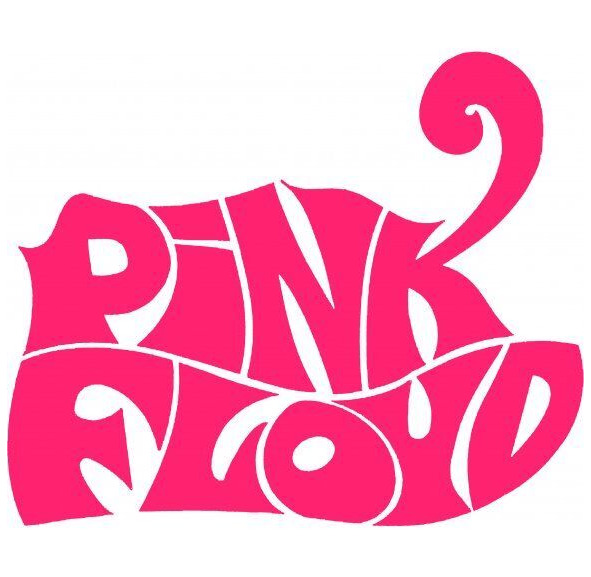
The Pink Floyd band logo from 1973 contains fascinating encoded knowledge. Its most important feature is the pink color, which is generally preferred by women.
P — profile of a female head/face
K — a strand of hair
F — torso, legs, and arms in profile
D — buttocks
Band Logos: Pink Floyd and Led Zeppelin — The Unity of Opposites: Female and Male
The logos of Pink Floyd and Led Zeppelin are not merely random graphic symbols or simple elements of visual identification. They are part of a much deeper symbolic order, based on archetypes present in human culture for thousands of years. To understand their meaning, one must view them not through the lens of music, but through iconography, Jungian psychology, and the universal symbolism of gender.
The Pink Floyd logo from 1973 (used, among others, during the era of The Dark Side of the Moon) employs soft lines, color, and profile, which in itself aligns with classic representations of the feminine principle. The color pink is not accidental here — in color psychology, it has long been associated with empathy, emotionality, sensitivity, and corporeality. It is the color of the body, of skin, of the blood flowing just beneath it — that is, of life and biology, rather than construction or technology.
P — profile of a female head/face, K — a strand of hair, F — torso, legs, and arms in profile, D — buttocks
In contrast, the elongated shape of the airship — the Led Zeppelin logo — personifies the most important attribute of masculinity, the phallus. The scrotum is represented by the fragment of the tower to which the airship was moored. Equally significant is the imitation of male pubic hair — the clouds of smoke rising from the airship during the fire.
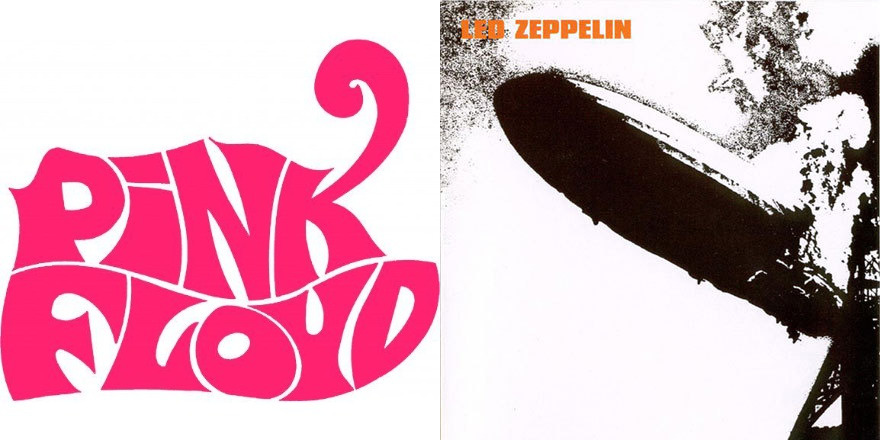
Confirmation of these conclusions can be found in the graphic logos of both bands, which in their “subliminal” symbolism quite cunningly reference: the attributes of masculinity — public hair, the shape of the airship — phallus, scrotum (Led Zeppelin), and the attributes of femininity — pink color of the logo, profile of a female face — on the left side, strand of hair — on the right side (Pink Floyd).
What was encoded in their logos around fifty years ago is a form of subliminal communication that operates independently of the audience’s conscious awareness. This is precisely why these bands have become enduring cultural icons — not merely because they created good music, but because they touched upon archetypes deeply embedded in the human psyche.
Ultimately, what matters most is not how fans interpreted the works of the two bands, nor the narratives that grew around them over time. What counts is that their symbolism was designed on a level far deeper than aesthetics or marketing. It was a conscious or semi-conscious attempt to record universal knowledge about gender, energy, and balance — a knowledge that operates not through argument, but through image.
The Unity of Opposites
A comparison of songs from the first two Pink Floyd albums with the first three Led Zeppelin albums visually demonstrates the remarkable similarities between these two bands. This resemblance is not accidental. As I have already mentioned, the knowledge encoded in the album covers and songs of these bands constitutes a narrative about the life experiences of two individuals. Who exactly these individuals are is not the subject of discussion here — we are only at the beginning of this musical epic.
The most distinctive feature of the early works of both bands is a logical-historical continuum, tracing the origins of life on Earth, as well as all the most important historical events, both in the distant past and in contemporary times. There will be an opportunity to discuss later albums — not related to universal history — in due course. For now, let us compare the first albums of both bands.
Pink Floyd: The Piper at the Gates of Dawn / Led Zeppelin: I, II
1. Astronomy Domine — Projection of intelligence / 1. Good Times Bad Times — Formation of the Solar System
2. Lucifer Sam — Moon / 2. Babe I’m Gonna Leave You — Formation of the Moon
3. Matilda Mother — Era of the dinosaurs / 5. Your Time Is Gonna Come — Era of the dinosaurs
4. Flaming — Dawn of a new era / 6. Black Mountain Side — After the extinction of the dinosaurs
5. Pow R. Toc H. — Human evolution / 8. I Can’t Quit You Baby — Human evolution
6. Take Up Thy Stethoscope And Walk — Communication / 1. Whole Lotta Love — Transcendent being
7. Interstellar Overdrive — Break in communication / 3. The Lemon Song — Consequences of excessive curiosity
8. The Gnome — Judaism / 5. Heartbreaker — Judaism
9. Chapter 24 — Christianity / 6. Living Loving Maid (She’s Just a Woman) — Christianity
10. Scarecrow — Islam / 7. Ramble On — Islam
11. Bike — Modern times / 8. Moby Dick — Medieval massacre
Pink Floyd: A Saucerful of Secrets / Led Zeppelin: III
1. Let There Be More Light — Discovery of America / 1. Immigrant Song — Discovery of America
2. Remember a Day — Pioneers of the Wild West / 2. Friends — Pioneers of the Wild West
3. Set the Controls for the Heart of the Sun — Declaration of Independence / 3. Celebration Day — Declaration of Independence
4. Corporal Clegg — Peter Graham Scott film: Captain Clegg / 4. Since I’ve Been Loving You — Ethos of work, perseverance, and thrift / 5. Out on the Tiles — Emergence from the shadows into political salons
5. A Saucerful of Secrets — Hiroshima and Nagasaki / 7. Tangerine — Hiroshima and Nagasaki
6. See-Saw — Behind the Iron Curtain / 8. That’s the Way — Behind the Iron Curtain
7. Jugband Blues — Martin Luther King / 9. Bron-Y-Aur Stomp — End of discrimination
This comparison is not intended to prove “influence” of one band on the other, nor to suggest any artistic rivalry. It is an attempt to show that both discographies have functioned from the very beginning as two parallel streams of the same narrative, describing the same sequence of events, but from opposing perspectives.
Pink Floyd and Led Zeppelin appear here not as incidental participants in the history of rock, but as carriers of an archetypal narrative, in which woman and man, intuition and strength, memory and action, darkness and light, form a single, indivisible whole. Later chapters will demonstrate that this unity of opposites does not end with the first albums but forms the foundation of the entire musical epic.
This comparison does not claim the authority of final interpretations, nor does it aim to close meanings within rigid formulas. Rather, it is an invitation to a different way of listening — one in which albums are not merely collections of songs, but chapters of a larger whole, in which sequence and structure are as meaningful as the sound itself. In this sense, the first albums of Pink Floyd and Led Zeppelin do not merely open the history of two bands — they establish the framework for a narrative that will continue to unfold, progressively moving away from universal history and drawing ever closer to the personal story.
Syd Barrett
The entire output of Pink Floyd — music, lyrics, as well as the covers of individual albums (which, in the case of Led Zeppelin, was also an integral part of the message) — forms one enormous “mountain of information.” Standing at its base, we can only contemplate its appearance — each viewer sees only a one-dimensional artistic aspect. However, to truly grasp the magnitude and beauty of this symbolic mountain, one must climb to its summit, to perceive from this as-yet inaccessible level its full, multidimensional — “perspective-driven” — message, beyond the reach of those at the lower levels.
These sentences may sound overly grandiose, but even a brief (recent) acquaintance with Pink Floyd’s lyrics makes these conclusions seem remarkably appropriate. Most of my following entries will be dedicated to proving this highly emotional statement.
I do not write this without reason, for it is feelings, affects, moods, and passions that play the leading role in this “theater” of psychological retrospection, which constitutes the lyrics of the vast majority of songs. Whose feelings these are, whom they concern (as the example of decoded Led Zeppelin lyrics shows — presumably it will relate to a specific individual), is for now too early to answer.
To address such questions substantively, I must first provide the necessary introduction: a look at the biography of one of the most important figures in the early phase of Pink Floyd, Syd Barrett.
There is no need or space for a detailed historical outline — everyone can consult the many available sources themselves. In this entry, I focus on the abnormal behavior of one of the band’s founders, whose influence on their “discography” was indisputable.
Regarding the essence of the matter, I would like to point out that the correlation between Led Zeppelin’s and Pink Floyd’s work lies precisely in the initiatory imperative of the two most important figures of these bands: Jimmy Page and Syd Barrett. Much has already been said about the former in the context of decoding Zeppelin’s work; now it is Syd’s turn.
Roger Keith ‘Syd’ Barrett (born 6 January 1946 in Cambridge, died 7 July 2006, there) — British singer, rock guitarist, painter. Member of Pink Floyd, considered one of the most outstanding representatives of psychedelic rock. […] From childhood, Syd Barrett was friends with two people he later met in Pink Floyd — Roger Waters and David Gilmour. He became particularly close to Gilmour while studying at the College of Arts and Technology. They spent a lot of time together, learning to play guitar and performing together. […] Both the two earlier singles, as well as the next — Apples and Oranges — were the work of Syd Barrett. Barrett became the creator of most of the band’s early material, including that featured on the critically acclaimed The Piper at the Gates of Dawn. Out of 11 songs on the album, eight were written solely by Barrett, and two were co-written by him. […] In the period just before the release of The Piper at the Gates of Dawn, the first signs of changes in Barrett’s personality appeared. […] There was much speculation about Syd Barrett’s mental state. Many believed he suffered from schizophrenia. Some suspected he had Asperger’s syndrome. It is well known that Barrett experimented with psychedelic drugs, especially LSD, in the 1960s. Public opinion holds that drugs caused or at least accelerated the development of his condition… (link) — https://pl.wikipedia.org/wiki/Syd_Barrett
All well and good. Barrett was a drug user, a mentally ill person — but this is only part of the truth, and not the most important part.
From Julian Palacios’s book: Syd Barrett and Pink Floyd: A Dark Globe, we learn something far more significant, which, in my view, had and still has such a cardinal influence that overlooking it would be a mistake.
More importantly, it serves as confirmation of my earlier thesis: that these “subliminal” values played a primary role in the genesis of both the formation and the creative work of the leaders of both bands.
“Syd lived with us,” says Seamus O’Connell. “He had a studio apartment. My mother set up the apartment for tenants; many acquaintances stayed there. It was truly a terrible place, but it had atmosphere. Syd began to take an interest in the occult, which my mother practiced. She read tarot.”
Barrett’s interest in the occult grew very quickly. He spent many nights discussing astrology, runes, and other similar subjects with Ella O’Connell. Sitting in the smoke-filled room among tapestries created by Ella and her former husband, he read the Encyclopedia of the Occult.
Ella gave Barrett a first edition of Aleister Crowley’s 1929 novel Moonchild (chapter 18 is titled The Dark Side of the Moon). The Moonchild tells the story of a young woman imprisoned by a magician representing white magic, entangled in a war of wizards. Through the magician, the girl becomes pregnant with an ethereal moon child and confronts the occult.
Barrett sat in the dilapidated room and read: “Do what thou wilt shall be the whole of the Law.”
And now everything becomes clear. This is the sought-after THREAD leading to the “labyrinth” of Jimmy Page. The information in the first quote clearly shows that the other members of Pink Floyd in a sense “continued” the work begun by Syd Barrett.
It is precisely here that the paths of Pink Floyd and Led Zeppelin cease to merely “intersect” and begin to run parallel, leading to the same symbolic center. From this point onward, we no longer speak of chance, inspiration, or coincidences — but of conscious continuation.
1. The Piper at the Gates of Dawn
The Cover of Pink Floyd’s First Album
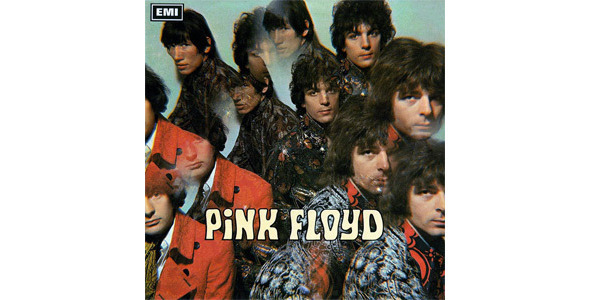
It is now time to consider the cover of Pink Floyd’s first album. To properly engage with this topic, the somewhat lengthy introduction was necessary, which includes the extraordinary — and unfortunately largely unknown and underappreciated — figure of Syd Barrett, as well as my “subliminal” interpretation of the band’s name, and finally, the “decoded” title of their debut album. However, to fully understand the message behind this “code” sent into the “musical spacetime,” one must know a bit more about it.
What else can be added to avoid getting lost in the labyrinth of erroneous conclusions, or, more irritatingly, in the ignorant belief that everything produced by this band is merely another, one of many, artistic visions of some “drugged” rock musicians?
In my view, Pink Floyd’s first album, The Piper at the Gates of Dawn, in both form and content, strikingly mirrors the early stage of Led Zeppelin’s work, while the cover of their debut record encrypts this notion in an artistic and visionary manner.
One does not need much effort to establish this. Comparing the cover of the album currently under discussion with the cover of Led Zeppelin’s third album, certain similarities become evident, and any skepticism quickly “dies down” upon examining the lyrics of individual songs from both bands.
The same applies to the illustration on the back of the Floyd album. What could this strange figure symbolize? What content might one expect — keeping in mind that this is not just a “random” artistic vision of some “random” artist? The fact that this is not merely an “ordinary,” quickly forgotten illustration is suggested by the following expressed opinion — the final sentence of the quote:
“It is hard to believe that nearly half a century has passed since the release of this album. The band, whose spiritus movens at the time would soon delve too deeply into the world of drugs, pushed rock into new realms of psychedelia with this work. Experimental, at times trance-like music was accompanied by a photograph intended to convey hallucinogenic visions. At that time, it was standard to place a photo of the band on the cover. That Pink Floyd had not yet formed a clear artistic vision was taken for granted (photos of the group no longer appeared on covers in the 1970s). EMI chose a random photographer and then left him free rein, without paying special attention to the album packaging.
Vic Singh did not have a large budget, but he wanted the photograph to capture the dreamlike character of the music. Instead of spending money on post-production, he used a prism lens given to him by a friend, one George Harrison (neither of them had yet seen a use for it). The photographer advised the musicians to wear the brightest clothes they could for the session and invited them to the studio. They came, smoked a few joints with him, and posed.
Barrett really liked the undertaking; he even took some test shots through the prism, and after the session he painted the artwork for the back cover.
For those whose psychiatrists mark in red the answer to the task ‘say what you see in the drawing’: the above is not a mutant from radioactive swamps, but a simple outline of a group of dancing people.”
(link) — http://okladki.net/okladki/show/134-pink-floyd--the-piper-at-the-gates-of-dawn
Just as the front cover is meant to symbolize the broadly branched and “chaotic” evolution — which is one of the main principles of this process of change over time — the back cover is an ideogram that personifies these changes in the literal sense of the word. It contains in a single symbol the entire process undergone by the hominid being: all previous developmental stages of the hominid are superimposed, from which, through evolutionary changes, the contemporary Human crystallized. And that is the entire “secret” of this cover, confirmed by all the songs included on it.
Thus, reducing this cover to merely a product of the psychedelic fantasy of the era is a serious simplification. We are not dealing with chaos or a random vision, but with a visual record of a process — a movement from primitive forms toward the conscious figure of a human being. The front and back covers serve as both a symbol and a map, guiding the listener into a narrative that only fully unfolds in the music. In this sense, The Piper at the Gates of Dawn does not close a story, but consciously opens it.
1. Astronomy Domine — Projection of Intelligence
Already in the inaugural track of Pink Floyd’s first album, there are so many signs and clues that it can make your “head hurt” — to put it colloquially. To an untrained “eye and ear,” it may seem somewhat trivial — some funny pip pip at the beginning, followed by lyrics that are not entirely comprehensible. Here, once again, I must refer to my decoded work on Led Zeppelin, specifically to the fact that in almost every element of their oeuvre, one can encounter this type of “obstacle,” whether in the lyrics of individual songs or in album covers.
To handle these encoded pieces of information, I was forced to rely on “hints,” meaning I had to consult source materials (quotes, links), through which I could, in a minimal yet credible way, document my “assumptions.” The same applies to the work of the currently discussed band. Most of my conclusions will be preceded by a very telling introduction. To begin, a few introductory pieces of information are needed to untangle the next “Gordian knot.” To understand anything, we must start with decoding the term — Dan Dare.
Dan Dare is a British science fiction comic book hero, created by illustrator Frank Hampson, who also wrote the first stories. Dare appeared in the comic Eagle in the series Dan Dare, Pilot of the Future from 1950 to 1967 (and later in reprints) and was broadcast as a radio play seven times a week on Radio Luxembourg (1951–1956). The story was set at the end of the 1990s, although the dialogue and behavior of the characters resemble British war films from the 1950s. Dan Dare has been described as “Biggles in space” and as the British counterpart to Buck Rogers.
(link) — https://en.wikipedia.org/wiki/Dan_Dare
Buck Rogers is a fictional space opera character created by Philip Francis Nowlan in the novella Armageddon A.D., later appearing across various media. In the story Armageddon 2419 A.D., published in the August 1928 issue of the pulp magazine Amazing Stories, the hero’s name was “Anthony.” The continuation, titled The Airlords of Han, appeared in the March 1929 issue. […]
The character first appeared as Anthony Rogers, the main protagonist of Nowlan’s Armageddon 2419 A.D. Born in 1898, Rogers is a World War I veteran and by 1927 worked for the American Radioactive Gas Corporation, investigating reports of strange phenomena in abandoned coal mines near Wyoming Valley, Pennsylvania. On December 15, while in one of the lower mine levels, he suffers a collapse. Exposed to radioactive gas, Rogers enters a “state of suspended animation, free from destructive catabolic processes and with no visible effect on physical or mental faculties.” Rogers remains in this state for 492 years.
Rogers awakens in the year 2419. Believing he has only slept a few hours, he wanders for several days through unfamiliar forests (which five centuries earlier were Pennsylvania). He notices a person dressed in strange garments under attack…
(link) — https://en.wikipedia.org/wiki/Buck_Rogers
If I say this is a reference to the cyclicality of the Universe — the rebirth of Life on a macro scale (evolution) and micro scale (man) — it is probably still not convincing enough. Therefore, further arguments are presented below. The track title: Astronomy Domine.
“Astronomy Domine” is a song by the English rock band Pink Floyd. The song, written and composed by the first vocalist/guitarist Syd Barrett, was the debut track on the album The Piper at the Gates of Dawn (1967). The lead vocals were sung by Barrett and keyboardist Richard Wright. The working title was “Astronomia Domine (Astral Chant).” “Domine” (vocative of “Lord” in Latin) is a word frequently cited in Gregorian chant.
(link) — https://en.wikipedia.org/wiki/Astronomy_Domine
The initial pip pip sounds, as well as the whole track, unmistakably reference the cosmic atmospheres we know from Stanley Kubrick’s most famous film. To verify this, one does not need much — simply listen to the track.
Thus, the track title — Astronomy Domine (Pastor of Astronomy), the working title (Astral Chant), and the famous monolith from Kubrick’s film — are more than enough to establish that this is not a banal song among many recorded before or after it. It is certainly too early to draw a final conclusion, but all these mentioned “circumstantial” evidences point toward the definition of an “intelligent design,” though I do not fully identify with that term, preferring instead what the term “projection of intelligence” suggests — but that is a topic for another “story.”
Even the lyrics of the song are not accidental. They carry a greater meaning than one might expect.
„Lime and limpid green, a second scene
Now fights between the blue you once knew
Floating down, the sound resounds
Around the icy waters underground […]
Stars can frighten
Blinding signs flap
Flicker flicker flicker blam (pow! pow!)”
lInk: https://www.tekstowo.pl/piosenka,pink_floyd,astronomy_domine.html
All these expressions narrate the process of the creation of our universe from the very beginning, which, incidentally, “did not exist,” since the time of our universe is measured from the highly conventional Big Bang. The beginning of our Universe was the collapse of the “previous” one, which is an inherent part of ours, and at the end of our Universe, the next one will begin — and so on infinitely.
2. Lucifer Sam — The Moon
So, we already have the initial stages of the formation of the Universe behind us. It is time for another very important event. Fairy tales about Barrett’s cat (Sam), his girlfriend (Jenny Spires), and other similar stories exist precisely so that the whole “narrative” appears very trivial. And that is fine — that was exactly the intention. The fact that it turns out otherwise is another matter entirely. In this case, the next clue is the quote presented below, which clearly explains the influence of “Lucifer” (the Moon) on the falling and rising of the ocean’s water level.
„Lucifer Sam, Siam cat
Always sitting by your side
Always by your side
That cat’s something I can’t explain!
Jennifer Gentle, you’re a witch
You’re the left side
He’s the right side Oh, no!
That cat’s something I can’t explain!
Lucifer go to sea
Be a hip cat, be a ship’s cat”
link: https://www.tekstowo.pl/piosenka,pink_floyd,lucifer_sam.html
Ocean tides (high tides and low tides) — the regularly recurring rise and fall of the ocean’s water level. The rotation of the Earth causes the gravitational pull of the Moon and the Sun (the tidal force) to change at a given location over the course of a day. The magnitude of tides depends on many factors, such as the shape of the coastline (large tides occur in bays), sea depth, and the changing position of the Sun and the Moon relative to the Earth, which is linked to the Earth’s rotation. The strongest tides (spring tides) occur when the influences of the Sun and the Moon add together (i.e., when the Moon, the Earth, and the Sun are aligned in a straight line — during the full Moon and the new Moon).
(link) — https://pl.wikipedia.org/wiki/P%C5%82ywy_morskie
That Barrett encodes information about the Moon in this piece can be confirmed by other clues as well:
Lucifer [from Latin — light-bringer; lucem, accusative of lux (light) + ferre (to carry)].
link — https://pl.wikipedia.org/wiki/Lucyfer
Cats are animals that are active at night. It is therefore not surprising that especially at night, when they are the most alert and eager to play, they demand our attention with loud meowing.
Witches (and not only witches) work with the lunar cycle, most often understood as: waxing Moon — full Moon — waning Moon — new Moon. We know when to focus energy on what we want to develop, and when on what we want to get rid of. As a rule, we feel a surge of creative power during the full Moon, and we withdraw from the world during the new Moon.
link: https://www.podksiezycem.pl/2019/04/ksiezyc-w-zyciu-czarownicy_19.html
In summary, this entire piece is one great “apotheosis” of our Earth’s satellite — the Moon.
Finally, it is worth noting that in this “apotheosis” the Moon ceases to be merely a celestial body and becomes a mediator between the cosmos and everyday life: it regulates the rhythms of the oceans, sleep, imagination, and myth. Barrett, hiding it behind the mask of a cat, a witch, and an apparently banal story, shows that what is truly fundamental works most effectively when it does not demand attention directly. The Moon sits “right next to you” — quiet, consistent, impossible to fully comprehend — and that is precisely why its influence is so ubiquitous and inevitable.
3. Matilda Mother — Era of the Reign of Dinosaurs
The lyrics of this piece convey in an evocative way who once ruled the Earth — and it is by no means a king or a dynasty that is meant here. Maintaining the previously adopted convention of the time continuum, it is not difficult to conclude that this is a “story” about the dominant group of vertebrates that ruled for a relatively long period, the end of whose reign was marked by a meteorite impact approximately 65 million years ago.
Of course, this refers to the reign of the dinosaurs, and one does not need much to establish this — it is enough to take a close look at the musical layer of the piece. The pompous mood and the heavy, sluggish tempo resemble the march of a herd of enormous reptiles. The interpretation of the individual lines should prove my above assertions.
„Matilda Mother
There was a king who ruled the land.
His majesty was in command.
With silver eyes the scarlet eagle” — What the Mesozoic reptiles of that era looked like (or might have looked like) is not difficult to determine. Evidence for this is provided by the results of scientific research, which has led to increasingly precise descriptions, illustrations, and even films — who has not seen Steven Spielberg’s film Jurassic Park?
„Showers silver on the people.
Oh Mother, tell me more.
Why’d'ya have to leave me there
Hanging in my infant air
Waiting?” — Presumably, this refers to the “rivalry” between reptiles and mammal-like reptiles, from which humans eventually evolved. Mammal-like reptiles had to wait a very long time for their chance — for an evolutionary leap.
„You only have to read the lines
They’re scribbly black and everything shines.
Across the stream with wooden shoes
With bells to tell the king the news
A thousand misty riders climb up
Higher once upon a time.
Wandering and dreaming
The words have different meaning.” — And so the mammal-like reptiles finally had their moment. Around 65 million years ago, a gigantic asteroid struck the Earth.
Syd Barrett clearly emphasizes that the true sense and meaning of this expression — as well as of most others — must be inferred.
„Yes they did.
For all the time spent in that room
The doll’s house, darkness, old perfume” — These lines encode information about a period of “captivity” — the dominance of reptiles.
„And fairy stories held me high on
Clouds of sunlight floating by.
Oh Mother, tell me more
Tell me more. Aaaaaaaah”
link: http://www.tekstowo.pl/piosenka,pink_floyd,matilda_mother.html
Matilda — a female given name of Old Germanic origin, meaning a woman strong and brave in battle: macht (strength, power) and hiltia (battle) — personifies the dominant role of reptiles, whereas Mother says much about the shared evolutionary origin of both groups: reptiles and mammal-like reptiles.
I will only add that Pink Floyd’s Matilda Mother is identical in its message to Led Zeppelin’s Your Time Is Gonna Come.
4. Flaming — Dawn of New Times
Once again, the musical backing constitutes a very important complement to the libretto of the piece. Already the opening fragment (exactly 15 seconds long) explains a great deal. These are the sounds of an ancient world which, after the annihilation of the dominant species, spread during the Eocene, Oligocene, and Miocene. One can imagine the panic among the “subjects” caused by the terrifying roar of the dominant predator, Smilodon.
The further course of the piece precisely recounts the subsequent fate of the genus Homo, to which Homo sapiens also belongs.
„Alone in the clouds all blue
Lying on an eiderdown.
Yippee! You can’t see me,
But I can you,
Lazing in the foggy dew
Sitting on a unicorn.”
(link) — http://www.tekstowo.pl/piosenka,pink_floyd,flaming.html
My interpretation of the song’s title refers to one of the epochs in the development of life on Earth — the Eocene.
The name comes from the combination of the Greek words eos — dawn and kainos — new (in an informal translation: ‘the dawn of new times’). The Eocene owes its name to the fact that during its duration many orders of mammals that still exist today appeared, as well as some families that have also survived to the present.
(link) — https://pl.wikipedia.org/wiki/Eocen
The title of this piece, Flaming (fiery, burning), in the intention of its authors, as I believe, is meant to refer to the fact that humans, through the use of fire, paved their way to a dominant role in the surrounding world, which was hostile to them.
The climate and mood of this song are very similar to the instrumental piece Black Mountain Side from the debut album of the band Led Zeppelin.
5. Pow R. Toc H. — The Evolution of Man
In this case, we are dealing with an instrumental piece; for this reason, all evidence pointing to the gnostic character of Pow R. Toc H. should be sought in its musical layer. Both the vocalizations and the special effects are intended to create the impression that we are right in the middle of a tropical forest, surrounded on all sides by the sounds of wild and untamed nature, with clearly emphasized noises produced by anthropoid beings.
In the background, one can hear sounds that are more familiar to us — such as those that might be heard from the mouth of the successor (that is, modern humans), representing an entire range of emanations of the primate mammal family. Proof that this is the correct direction in which to guide one’s thinking is provided by the following quotation:
“Pow R. Toc H.” was renamed The Pink Jungle in the section “The Pink Jungle” in The Journey. Pink Floyd performed the song live between 1967 and 1969.
(link) — https://en.wikipedia.org/wiki/Pow_R._Toc_H.
The title of the piece also has its own “non-ordinary” meaning. It is yet another encoded piece of information about the evolutionary roots of our entire anthropoid family, from which we originate.
Toc H (TH) is an international Christian movement. The name is an abbreviation of Talbot House, with “Toc” representing the letter T in the signal alphabets used by the British Army during World War I. Talbot House was a center for rest and recreation for soldiers, founded in December 1915 in Poperinge, Belgium. Its purpose was to promote Christian values, and it was named in memory of Gilbert Talbot, the son of Edward Talbot, the then Bishop of Winchester, who was killed near Hooge in July 1915. The founders were Gilbert’s elder brother, Neville Talbot, who at the time served as Senior Army Chaplain, and the Reverend Philip Thomas Byard (Tubby) Clayton. Talbot House functioned as an “Every Man’s Club,” open to all soldiers regardless of rank. It was conceived as an alternative to the “licentious” entertainment life offered by the city.
(link) — https://en.wikipedia.org/wiki/Toc_H
Pow R (pow’r) — power, strength, authority — encodes information about a world decidedly unfavorable to life for the weak and defenseless hominids of that time: the world of wild animals.
Toc H (Talbot House), the “Every Man’s Club,” conveys information about the family of hominids who still had to fight for their very existence, using their most dangerous weapon — their rapidly evolving brain.
The piece Pow R. Toc H. by Pink Floyd carries the same message as I Can’t Quit You Baby from the debut album of Led Zeppelin.
6. Take Up Thy Stethoscope And Walk — Communication
This time, the lyrics of the song are so “twisted” that, in order to unravel which period in human history they refer to, I will make use of a piece comparable to the Floyds’ work — How Many More Times by Led Zeppelin.
According to the definition of a musical drama in the song How Many More Times, particular musical themes are of great importance, as they reflect that “biblical drama.”
The beginning of the piece up to 3:37 — these are the “warnings of God”; from 3:38 to 5:15 — the dramatic “voice of God” (a special sound modulation produced by bowing along the guitar neck), which states the fact of the breach of the “covenant” (the eating of the forbidden fruit), the expulsion from Paradise; from 5:16 to 7:03 — one must get to work — gathering and hunting; from 7:04 to the end — agriculture and animal husbandry.
The beginnings of the existence of modern humans consisted of the expansion into all available territories — an increase in population numbers. The hunter-gatherer mode of life was replaced by agriculture and the breeding of animals. As for Take Up Thy Stethoscope and Walk, what remains is the title, and it is thanks to it that it will be possible, at least to a minimal extent, to “lend credibility” to my “assumptions.” Let us begin at the very beginning.
A stethoscope (from Greek στήθος, stēthos — chest, interior, and σκοπή, skopé — to observe), also known as a phonendoscope, is a diagnostic instrument used in medicine, serving to auscultate the patient, mainly the chest, heart, and abdominal cavity.
(link) — https://pl.wikipedia.org/wiki/Stetoskop
The stethoscope is, of course, a deliberately used metaphor, intended to draw attention to the fact of direct communication (“observing the interior”) between the “newly born” modern human and his transcendent “guardian.” The stethoscope is in fact a synonym for everything contained in the term “brain antenna.”
This song encodes an extraordinarily breakthrough event in the entire history of the emergence, evolution, and spread of modern humans, ever since they gained awareness of the power of their own minds. Dominance over other species (the extermination of Neanderthals) is nothing in comparison with the fact that humans also gained (attained) awareness of the existence of a transcendent being.
7. Interstellar Overdrive — Breaking the Connection
Once again, we are dealing with an instrumental piece, and just as in the case of Pow R. Toc H., the hidden meaning should be sought in the musical layer and in the title itself. As I have consistently argued, all individual works by Pink Floyd have their counterparts in songs by Led Zeppelin; therefore, instead of once again decoding what the author intended to say, I will “prove” the mutual correlation of the creative output of both bands by means of a relatively simple device — comparison.
As for Interstellar Overdrive, one can, without fear of error, perceive a clear similarity with What Is and What Should Never Be by Led Zeppelin. For obvious reasons, special attention should be paid to the musical layer of both of these pieces. Let the music itself “speak.” Thus: Interstellar Overdrive — from the very beginning up to 2:20 — is identical to What Is and What Should Never Be — from the start of the song up to 3:30. Therefore, without exerting myself further, I will quote the relevant fragment of an entry that I had already included when discussing the work of Led Zeppelin.
The song What Is and What Should Never Be is a continuation of the story connected with a transcendent being. Contact — dialogue — has been established, I believe in both directions. Man has gained (attained) this awareness, which science describes as symbolic thinking. At times calm, at times threatening melody. A plea and a warning at the same time. Where do we know this from? From the Bible — the Book of Genesis — a plea and a warning at the same time, addressed to newly born (self-aware) man.
While listening to this piece, please pay attention to its critical moment at 3:30 — the wind stops blowing (communication in both directions has been severed).
The Zeppelin piece then comes to an end, whereas Interstellar Overdrive continues. Thus, it encodes some further information. What kind? The answer to this question lies in the subsequent works of Led Zeppelin. Namely, between 2:20 and 8:39 it is a story known from The Lemon Song, while between 8:40 and the end it is a reference to Thank You.
Disobedience became a fact. One must not pluck fruit from the tree of life (Genesis 3:22). The lemon has a bitter taste, and bitter was the taste of the disappointment experienced by our “Guardian.” How religion presents this is known from the Bible. In my interpretation, the murderous floor is a symbolic designation of the difficult beginnings of the existence of the first creators of esoteric knowledge, encoded in the form of caves and megalithic structures. Maximum effect achieved by means of minimal, and how primitive, tools.
Thank You is a beautiful confession of love and eternal devotion. Thank you, “Guardian,” for everything — for your effort, for your sacrifice. I have understood my mistake; now I am going my own way, I am going to correct my error. Perhaps this sacrifice of mine, this effort of mine, will cause you to forgive me, the prodigal son. I am very sorry.
What more is there to add? Everything is a matter of interpretation. Certainly — but a far more important issue at this moment is who was imitating whom. Are we therefore dealing here with plagiarism? If not, then what is all this about? I believe the matter is far more complex and mysterious at the same time than it may appear to outsiders.
At this point, one should recall who the lyrical subject of the entire body of work by Led Zeppelin, as decoded by me, actually is — a bearded man.
Adding to this what I presented in the first entry concerning Pink Floyd as the main thesis — namely, that we are dealing here with a woman (the diary of a neurotic woman) — the conclusions seem obvious; however, this is not the moment to articulate them explicitly.
Did each of these bands, while creating their works, know what their “compatible competitors” had in mind? Did they communicate with one another? Did they even record their songs with full awareness of their second, symbolic meaning, or did everything occur purely by chance? Many more such questions could be asked. Limiting myself to only the most essential ones and, as it were, cutting short further deliberations, I will add that due to the fact that their works “complement” one another, we are dealing here with something truly exceptional and esoteric.
8. The Gnome — Judaism
In the previous entry decoding Interstellar Overdrive, I claimed that all individual Pink Floyd tracks have their counterparts in Led Zeppelin songs. It is now time for another pair of “twin” works. As is not hard to check, the next song on Led Zeppelin’s second album after Thank You is Heartbreaker, which I have associated with the first of the three great monotheistic religions.
As for the song under discussion, The Gnome, relying solely on the lyrics it is difficult to prove its correlation with Judaism, because the text is extremely enigmatic. However, there is no need to worry: the creators of this riddle, in their perspicacity, anticipated that the lack of convincing arguments could expose potential decoders to the discomfort of unproductive searching. There is one fairly reasonable clue that leads to the solution of this puzzle. That clue is, unsurprisingly, the title itself: The Gnome — but to recognize this, one must consider what we “probably” know on the subject.
The song tells the story of a gnome named Grimble Gromble, wearing a scarlet tunic. The lyrics were said to have “come spontaneously to [Barrett’s] mind” during his early, exceptionally creative period. According to reports, the piece also draws inspiration from the works of J. R. R. Tolkien. The Gnome appeared on the B-side of the American Pink Floyd single Flaming (Tower 378), which was never released in the United Kingdom.
(link) — https://en.wikipedia.org/wiki/The_Gnome
According to Tolkien scholar John Rateliff, author of the two-volume history of The Hobbit published in 2007, Tolkien drew inspiration from Hebrew texts and the history of the Jews when creating dwarves. As craftsmen exiled from a prosperous homeland, the dwarves used both the languages of the nations among which they lived and — within their own community — a language inspired by Hebrew, developed by Tolkien. […]
Over three decades after the publication of The Hobbit, Tolkien spoke of the Jewish-dwarf connection in an interview with the BBC. “I did not intend it this way, but when you have such people in charge, you have to make them somehow different, right?” Tolkien said in a 1971 interview. “The dwarves are, of course, quite clearly — wouldn’t you say that in many ways they resemble the Jews? Their language is Semitic, of course, constructed to be Semitic. Hobbits are simply rural Englishmen,” he added.
(link) — https://www.timesofisrael.com/are-tolkiens-dwarves-an-allegory-for-the-jews/
For anyone with even a basic knowledge of world history, it is well known what hardships members of this “chosen people” suffered at the hands of the rulers and societies that hosted them. Unfortunately, it was far from idyllic. Therefore, this obvious pejorative comparison is, again unfortunately, appropriate. It stems from Judeophobia, and the causes of this lie beyond the scope of this blog.
In summary, I believe that the title of the song, The Gnome, is connected to Judaism, and confirmation of this should be sought in the lyrics. The verses highlighted in red speak volumes about the faith’s canon and the history of this group of people: tradition, the expectation of the Messiah, the Promised Land, eternal wandering, restitution; way of life, food, waiting for one’s time, and then one day — hooray! Another solution appeared for the gnome; way of life, finding the goal of the journey, and then, one day — hooray!
As a matter of formality, I will add that Pink Floyd’s The Gnome is identical in its encoded content to Heartbreaker from Led Zeppelin’s second album.
9. Chapter 24 — Christianity
According to the historical continuum, the next major monotheistic religion is Christianity. Identifying the most characteristic features of this great religion in Pink Floyd’s song Chapter 24 is already childishly simple — it only requires carefully examining everything represented by Chapter 24 of the ancient Chinese book, the I Ching.
Hexagram 24, called 復 (fù), “Returning.” Variations: “Turnaround.” Inner trigram: ☳ (震 zhèn) shock = (雷) thunder, outer trigram: (坤 kūn) field = (地) earth.
(link) — https://pl.wikipedia.org/wiki/Heksagramy_Yijing#Heksagram_24
This welcoming hexagram signifies a return to joy, intimacy, passion, and purpose. Light has returned and pierces the darkness. Walk with your head held high, knowing that the tide has turned, and that love is growing. Like the winter solstice, this is a time of new beginnings and opportunities. The time for true health and potential has arrived. Your hard work will pay off. Love, energy, and opportunity are in the air. Be aware of changes at this moment. Some things must end for other things to begin. The turning point has been reached.
(link) — http://www.ifate.com/love-i-ching-reference/hexagram-24-the-turning-point.html
The description of this hexagram “fits” everything we know about this revealed religion, which originated with Jesus of Nazareth, something Syd Barrett himself surely knew — something that is no longer a mystery.
The song Chapter 24 by Pink Floyd is identical in its encoded content to Living Loving Maid (She’s Just a Woman) by Led Zeppelin.
10. Scarecrow — Islam
The most enigmatic of all the tracks on Pink Floyd’s first album. One needs a great deal of imagination to perceive the subliminal message of Syd Barrett within it. The lines highlighted in capital letters indicate which major religion we are dealing with this time.
Green, as is widely known, is the color of Islam, while black may refer to the fact that a black turban indicated descent from the Prophet Muhammad’s lineage. Only a few centuries of Islam’s power are reflected in the line:
„The black and green scarecrow is sadder than me
But now he’s resigned to his fate
Cause life’s not unikind — he doesent mind”
The sounds of horse hooves and the oriental-style music in the final part of the track provide additional information about the turbulent history of this part of the world.
The song Scarecrow by Pink Floyd is identical in its encoded content to Ramble On by Led Zeppelin. This interpretation fits Syd Barrett’s symbolic language, which often hid meanings in seemingly simple images. The scarecrow here may signify civilization after a period of expansion — enduring, yet reconciled with the loss of former power. Comparing Scarecrow with Led Zeppelin’s Ramble On emphasizes a shared theme of myth and history as a poetic echo of past worlds, rather than a literal religious or political commentary.
11. Bike — Modern Times
All the historical events that have been the main subject of the previously described Pink Floyd tracks form a single cause-and-effect chain, where it is difficult to single out one turning point in the entire process. For the purposes of history, one such date has been agreed upon to separate ancient times from the more “civilized” era. This conventional date is the birth of Christ, which defines the time of our era. Everything is, of course, relative. In different civilizations, cultures, and religions, this conventional date is determined differently. That is not the point here.
The song Chapter 24, in its symbolic layer, encodes information about Christianity, and thanks to our knowledge of how to interpret hexagram 24 of the ancient Chinese I Ching, we know that this turning point is precisely the hypothetical date of Jesus’ birth.
What does this have to do with the track under discussion? The lines below indicate that we, too, according to the Floydian continuum, are moving into modern times (from the Big Bang, the age of dinosaurs, the evolution of man, and the period of formation of the great religions).
„I know a room of musical tunes
Some rhyme, some ching, most of them are clockwork
Let’s go into the other room and make them work”
The solo drumming in the instrumental track Moby Dick captures this theme in a strikingly similar way. It exemplifies a great danger — the era of wars that, over the centuries (from the most ancient times through the early Middle Ages), swept across all regions and continents of the known world.
The rise and fall of great powers, the Crusades, religious wars, the Inquisition, the extermination of heretics, Mongol invasions, the migration of peoples, and many other examples testify to the constant struggle between emotion and reason. The era of early medieval wars was one great massacre.
Another point: regarding the lyrics of Bike, it is not about a girl, a bicycle, or a basket — these should all be understood as highly free metaphors. The lyrical subject, in this case, is the “Pilgrim among the Natives” — that is, the Monolith, present everywhere… Providence… Consciousness… Intelligence… see Led Zeppelin’s seventh album, Presence.
The Piper at the Gates of Dawn — Album Summary
Pink Floyd’s debut album, released in 1967, is an experimental, psychedelic masterpiece that combines rock music, cosmic improvisation, and poetic visions. Each track narrates a fragment of human history, from the creation of the universe, through prehistoric eras, the evolution of man, the dominance of great religions, and up to modern times.
1. Astronomy Domine — The Beginning of the Universe
The track introduces the listener to a cosmic dimension and symbolizes the birth of the universe. Its mood and musical layer evoke the formation of stars and planets.
2. Lucifer Sam — The Moon
The story of Lucifer the cat symbolizes lunar cycles and their influence on nature and humans. The lyrics and music encode nighttime activity and the rhythms of nature.
3. Matilda Mother — The Age of Dinosaurs
Symbolizes the dominance of reptiles and the evolution of life on Earth. The pompous, march-like musical mood evokes large herds of prehistoric creatures.
4. Flaming — The Dawn of New Times
Refers to the Eocene, an epoch when many mammalian orders appeared. The title symbolizes humanity’s dominance through fire and the gradual conquest of its environment.
5. Pow R. Toc H. — Human Evolution
An instrumental track reflecting the spread of anthropoid species in nature. The title encodes the struggle of hominids for survival and the development of their intelligence.
6. Take Up Thy Stethoscope and Walk — Communication
The stethoscope metaphor symbolizes direct communication between man and his transcendent guardian. The track shows awareness of the mind’s power.
7. Interstellar Overdrive — Breaking the Connection
An instrumental track illustrating the severing of dialogue between man and the transcendent being. The music conveys disobedience and the consequences of lost contact.
8. The Gnome — Judaism
The story of the gnome Grimble Gromble symbolizes the difficult fate of the Jews and their perseverance while awaiting the Messiah. The track references the tradition and history of the chosen people.
9. Chapter 24 — Christianity
Refers to Hexagram 24 of the I Ching, symbolizing the return of light and a new beginning. The track encodes Christian values and the significance of Jesus’ birth.
10. Scarecrow — Islam
Symbolizes the Black and Green Scarecrow, referencing the colors and history of Islam. The track reflects the turbulent history and survival of this religion.
11. Bike — Modern Times
Transitions the listener to modernity, symbolizing the passage from antiquity to contemporary civilization. The instrumental section depicts the era of wars and cultural transformations, while the symbolism of the bicycle and the “second room” refers to human progress and discovery.
2. A Saucerful of Secrets
A Saucerful of Secrets — Album Cover
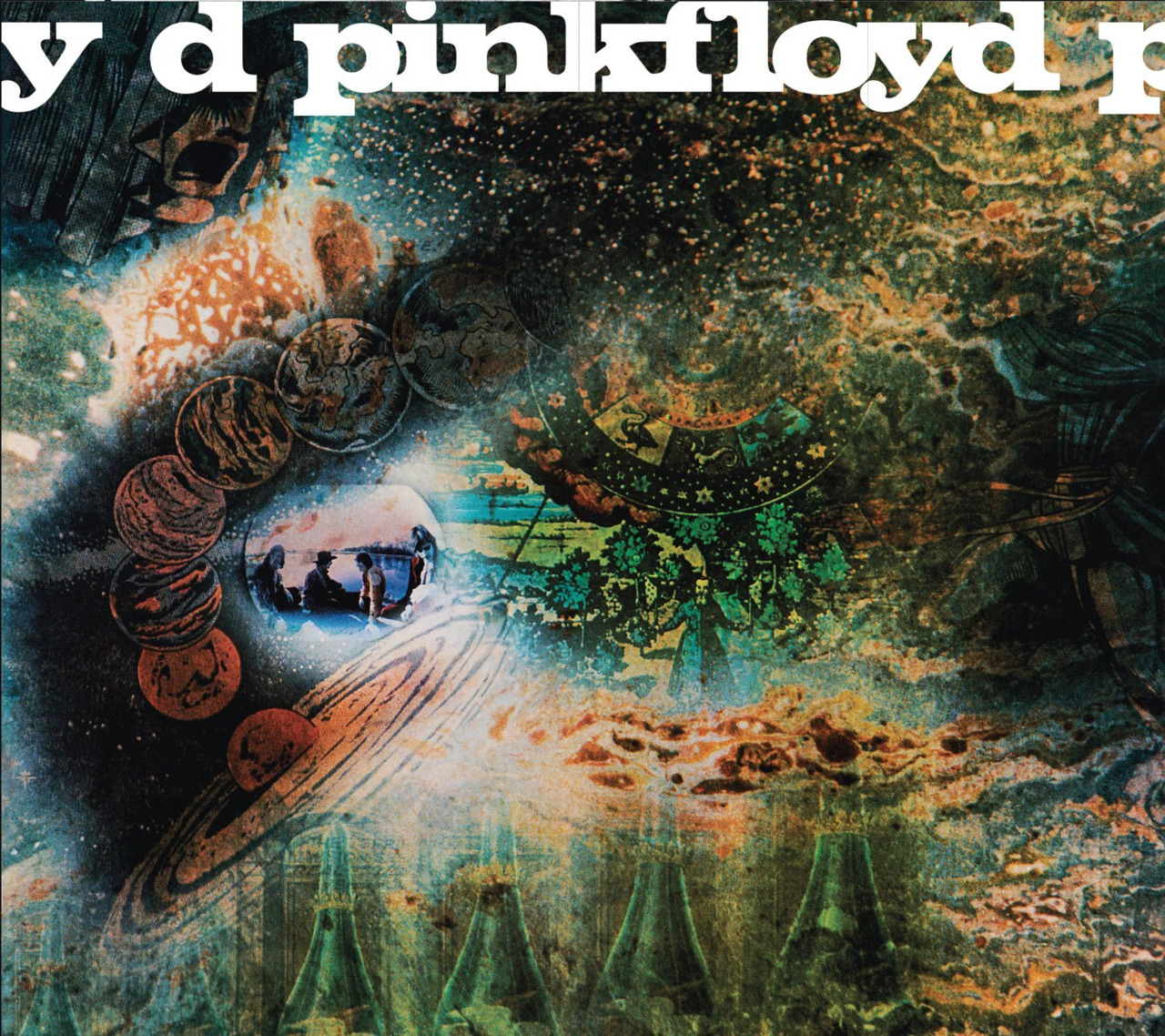
Pink Floyd’s second album, A Saucerful of Secrets, like The Piper at the Gates of Dawn, contains profound messages, as anyone can see by examining the album cover. The cover is packed with knowledge — largely inaccessible to laypersons — so the rather enigmatic title comes as no surprise.
To perform an exegesis of the cover’s significance, a brief introduction in the form of a quote is necessary.
Several times I wondered what exactly the illustration depicted, but I did not see anything remarkable — just a mystical, cosmic collage. Perhaps because of distorted colors, or the small format of my digital cover, I overlooked that besides the band photo, other illustrations were embedded within it. Only purchasing a physical copy and searching longer online allowed me to identify two of them as the main parts of the collage.
The first is a scene from the Marvel comic Strange Tales (No. 158/1967 — art by Severin Marie). Doctor Strange (a lesser-known, but certainly “super” hero) receives a vision from a figure with the charming nickname “Living Tribunal.” On the cover, the speech bubbles have been erased (imperfectly — look at the lower part of the cover), but it is a crucial moment: the Cosmic Magician informs Doctor Strange that he intends to preemptively destroy Earth because it poses a threat to the world. Judging by the silhouettes of the heroes left on the cover, the designers were interested not only in the cosmic motif of planetary corals but also in the confrontation between these two forces. I bet you hadn’t noticed the presence of comic characters until now.
To decode the second image, we must go back to 1583—it is an engraving by Johann Daniel Mylius (alchemist and composer) for his work Opus medico-chymicum — Contrasts in the Macrocosm and Microcosm. In the Pink Floyd version, the most striking element is the figure of a bearded man marching through a forest. For the initiated, he is a Hermaphrodite holding two axes (Careful with That Axe, Eugene). Above his head floats the zodiac, and with some effort, one can spot the symbols of the elements in the tree crowns.
(link) — https://okladki.net/okladki/show/136-pink-floyd–a-saucerful-of-secrets
To understand the content emerging from this somewhat complex “comic” puzzle, one must also consider its other elements: in short, the stages of the formation of our planet (certainly not a string of planetary corals), the band members in some vessel or lens, and four other vessels resembling laboratory containers for chemical reagents.
Finally, there is the figure from Mylius’ engraving Opus medico-chymicum. All elements of this collage have symbolic meaning — their placement on the album cover gives it an additional “subliminal” impact.
This is neither the time nor place to decode in detail all the elements hidden in the cover, but it can be stated in general terms that we are dealing with the quintessence of knowledge — so far hidden in a fog of semiotic symbols.
In my view, the two main figures of this puzzle personify two antagonistic forces of Good and Evil, whose symbolism can be compared to the two mutually driving forces that make the phenomenon of the Cyclic Universe possible. The Cosmic Magician represents the Negative part of the Megacycle, and Doctor Strange — the Positive.
Viewed according to the logic of the Ophite Diagram — from right to left — we first encounter the Positive part of the Megacycle: Doctor Strange. It consists of two elements: four vessels resembling chemical reagent containers (the Big Bang, formation of the Universe, emergence of Life on Earth) and the figure from Mylius’ engraving (Opus medico-chymicum, Human Evolution).
The entire Mylius engraving should be understood as a turning point in the history of our Universe and, understandably, in the history of Man.
Now for the Negative part of the Megacycle. On the album cover, it is some kind of vessel or lens containing the four band members (Prunikos — this is the time when God will be in Man and Man in God — the Kingdom of God, Star of David, Pyramidion, Nirvana, etc. — the most beautiful and eagerly awaited moment when those who have left and will leave meet those who were and will be).
Graphically, it also shows the stages of planetary formation — this time to be read “in reverse” — collapse (we must pass through “Gehenna” and fall into “Tartarus”). This signifies that Leviathan — the cosmic serpent — will eventually bite its own tail and “Mega-Life” will end.
Viewed from right to left, the last element of the cover puzzle is the figure of the Magician seeking to destroy Earth — naturally, the personification of the Negative part of the Megacycle.
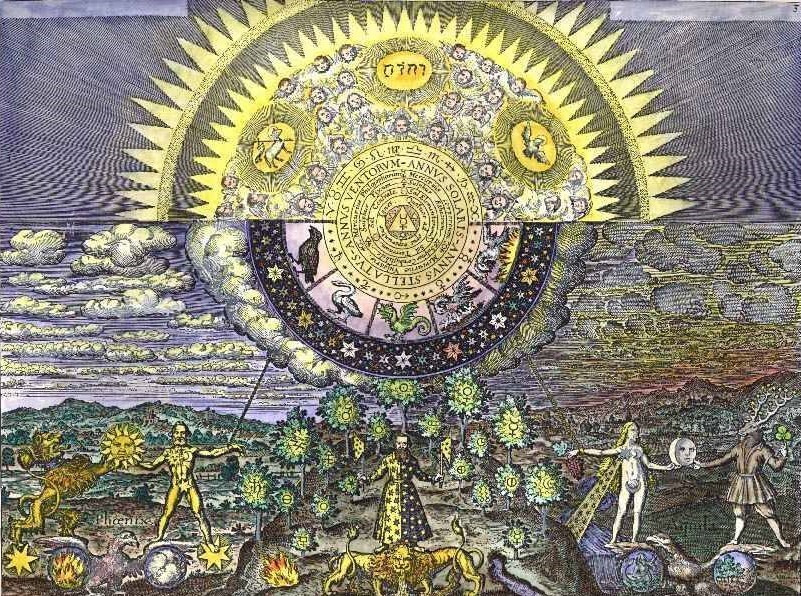
Another engraving by Mylius from Opus medico-chymicum (1618) — in quintessence form — encodes information about the cyclicality of the Universe, the Positive and Negative parts of the Megacycle: „Occultum fiat manifestum et vice versa. Aqua cum igne tandem in gratiam redit”
(„The hidden becomes visible and vice versa. Water with the fiery glow of passion finally returns to grace.”)
Confirmation of the universality of knowledge about the Cyclic Universe — encoded in the symbol of Man and Woman (understood as two antagonistic values: Positive and Negative, Good and Evil) — is everything established by the proper understanding of the gnosis of ancient Egypt and Mesopotamia.
The interpretive personification of these two “mysterious” civilizations underlines my thesis: these are two antagonistic and complementary forces — Man and Woman — the two extremes of the Cycle of the Universe.
1. Let There Be More Light — Discovery of America
As I have written elsewhere, the thematic foundation of Led Zeppelin’s third album revolves around events and matters related to the history of the United States’ formation and development. Following the assumption that Pink Floyd is the “twin” counterpart of Led Zeppelin, decoding the subject matter and content of all the tracks on A Saucerful of Secrets poses no problem. First, the “source” lyrics:
„Now, now, now is the time, time
Time to be, be be aware
Carter’s father saw him there and
Knew the road revealed to him
The living soul of Hereward the Wake”
Hereward the Wake (also known as Hereward Outlaw or Hereward the Exile, c. 1035 — c. 1072) was the leader of local opposition against the Norman conquest of 11th-century England. This base, leading a rebellion against the Norman rulers, was located on the Isle of Ely. According to legend, he roamed The Fens, covering North Cambridgeshire, Southern Lincolnshire, and West Norfolk, leading popular opposition against William the Conqueror.
(link) — https://en.wikipedia.org/wiki/Hereward_the_Wake
For commentary, a simple comparison of Pink Floyd’s Let There Be More Light with Led Zeppelin’s Immigrant Song suffices.
As can be seen, both lyrics use references to Norse conquests and invasions to symbolically allude to the early (around the 10th century) European interest in lands west of Greenland. A fragment from Let There Be More Light refers to the Viking age:
„Far, far, far, far away, way
People heard him say, say
„I will find a way, way
There will come a day, day
Something will be done”
Then at last the mighty ship
Descending on a point of flame
Made contact with the human race at Mildenhall”
For comparison, the corresponding fragment from Led Zeppelin’s Immigrant Song:
„We come from the land of the ice and snow,
From the midnight sun where the hot springs blow.
The hammer of the gods,
Will drive our ships to new lands,
To fight the horde singing and crying:
„Valhalla I am coming!”
A later fragment from Let There Be More Light refers to the most important and breakthrough event: the “discovery of America”:
„Oh my, something in my eye, eye
Something in the sky, sky
Waiting there for me
The outer lock rolled slowly back
The servicemen were heard to sigh
For there, revealed in glowing robes, was Lucy in the sky”
link: http://www.tekstowo.pl/piosenka,pink_floyd,let_there_be_more_light.html
The key phrase, “Lucy in the sky”, of course references The Beatles’ song Lucy in the Sky with Diamonds, but that is a superficial association — the meaning goes much deeper. It actually refers to a groundbreaking archaeological discovery: the most complete skeleton of one of the earliest bipedal hominids — Lucy.
Lucy, officially AL 288–1 (other name in Amharic: Dinqineš / Dinkenesh, meaning “You are beautiful” or “You are marvelous”) — a female Australopithecus afarensis — was discovered on November 24, 1974, in the Awash River Valley near Hadar in the Danakil Depression, Afar Region, Ethiopia. The skeleton’s age was estimated at approximately 3.2 million years based on argon and potassium isotope analysis.
(link) — https://en.wikipedia.org/wiki/Lucy_(paleoanthropology)
This discovery parallels the Viking explorations and indeed aligns with Christopher Columbus’ “discovery” of the Americas, encountering new lands and peoples.
2. Remember a Day — Pioneers of the Wild West
Below, I interpret Remember a Day not as a sentimental return to childhood, but as a metaphorical story about the birth and loss of American innocence. The successive images in the lyrics are read through the lens of colonization history — from the first settlements to forced migrations, where nostalgia intertwines with the irreversibility of time. In this sense, the Pink Floyd song almost mirrors Friends by Led Zeppelin, linking private memory with collective experience.
„Remember a Day
Remember a day before today
A day when you were young.
Free to play alone with time
Evening never comes. (Establishment of the first English colony on Roanoke)
Sing a song that can’t be sung
Without the morning’s kiss
Queen you shall be it if you wish
Look for your king (Pilgrims on the Mayflower Puritans)
Why can’t we play today
Why can’t we stay that way (Thanksgiving Day)
Climb your favorite apple tree
Try to catch the sun
Hide from your little brother’s gun
Dream yourself away (Indian Removal Act 1830)
Why can’t we reach the sun
Why can’t we blow the years away (Migration of settlers on the trail Oregon trail)
Blow away
Blow away
Remember
Remember”
link: http://www.tekstowo.pl/piosenka,pink_floyd,remember_a_day.html
It doesn’t take much effort to say that the theme I have decoded, and more importantly, all the details of the song: Remember a Day, almost perfectly correlate with the second track from the third album by Led Zeppelin: Friends.
3. Set the Controls for the Heart of the Sun — Declaration of Independence
This interpretation reads Set the Controls for the Heart of the Sun as a symbolic chronicle of the American Declaration of Independence, where cosmic imagery masks a revolutionary awakening. The “heart of the sun” becomes a metaphor for the birth of a new political consciousness, echoing the same historical moment encoded in Led Zeppelin’s Celebration Day.
„Set the controls for the heart of the sun
Little by little the night turns around
Counting the leaves which tremble at dawn
Lotuses lean on each other in yearning
Under the eaves the swallow is resting (Boston Tea Party)
Set the controls for the heart of the sun
Over the mountain watching the watcher
Breaking the darkness waking the grapevine
One inch of love is one inch of shadow
Love is the shadow that ripens the wine (American Revolution)
Set the controls for the heart of the sun
The heart of the sun…
Witness the man who raves at the wall
Making the shape of his question to heaven
Whether the sun will fall in the evening
Will he remember the lesson of giving? (Thomas Jefferson — Founding Fathers of the United States)
Set the controls for the heart of the sun
The heart of the sun…
link: http://www.tekstowo.pl/piosenka,pink_floyd,set_the_controls_for_the_heart_of_the_sun.html
As with the previous chapter, the entire mystery of this third track “hides” in the stage directions. It is the next important, if not the most important, Day in the history of the democratic world — the Declaration of Independence of the United States.
The track Set the Controls for the Heart of the Sun — in its symbolism — encodes the same events as the song Celebration Day from the third album by Led Zeppelin.
Musically, the song reveals a deep meditative rhythm, where the repeating percussion motif and hypnotic instrumental background create an atmosphere of anticipation and triumph, reflecting the emotional dimension of historical events that changed the face of the world.
4. Corporal Clegg — Film Petera Grahama Scotta: Captain Clegg
The official explanation for the title of this track can be learned from Roger Waters himself, but as was the case with Led Zeppelin, such “explanations” are as true as UFOs.
Corporal Clegg is about my father and his sacrifice in World War II. It’s a bit sarcastic — the idea of a wooden leg is something you “won” in the war, as a trophy.
(link) — https://en.wikipedia.org/wiki/Corporal_Clegg
This may indeed have been true regarding his father, but considering the continuum of place and time (we are on the other side of the ocean, at the moment when the United States had just formed), it is still too early for events related to the Second World War.
Confirmation that it is not about this war comes from the close resemblance between Pink Floyd tracks and Led Zeppelin tracks. At this point in U.S. history, it was the time of intensive work and building the foundations that the country would soon achieve.
In the decades following the American Civil War, the United States developed into the world’s largest industrial power. From the administration of James Monroe onward, the main doctrine of American politics was isolationism (Monroe Doctrine — no involvement in European affairs and limiting the sphere of influence to both Americas). All subsequent presidents considered that America should close itself off from European influence and act only as an arbiter among the countries of the New World.
Only Thomas Woodrow Wilson, facing Germany’s declaration of unrestricted submarine warfare, broke with this doctrine (April 6, 1917) and declared war. From that moment, the United States emerged from the shadow of particularism and, using its political and economic position, secured its status as a world leader and promoter of democratic values. The United States began to be seen as the world’s sheriff — or more humorously, a global policeman.
Thus, based on the knowledge obtained from deciphered Led Zeppelin tracks, I am inclined to assert that the title and, of course, the lyrics of Corporal Clegg refer precisely to this somewhat humorous synonym.
Everything above is important background — now for the core issue. The track Corporal Clegg deliberately compensates for the entire history of the United States, from the Declaration of Independence to the time the country achieved the status of a world leader, both economically and politically.
For Led Zeppelin, this took a bit longer, specifically the fourth and fifth tracks of their third album: Since I’ve Been Loving You — the ethos of work, perseverance, and thrift — and Out on the Tiles — emerging from the shadows onto the political stage.
Considering the historical continuum and the almost identical subject matter of all Floyd tracks with those recorded by Led Zeppelin, I conclude that the sources for correctly understanding the title of the track should not be sought in the vague and misleading statements of Roger Waters, but in the almost identical title of the film (and, of course, its content), which served as the basis for encoding very interesting information.
I am referring to Peter Graham Scott’s film Captain Clegg, known in the United States as Night Creatures. [link to film — http://www.dailymotion.com/video/x1x47iy]
The similarity in titles — Peter Graham Scott’s film Captain Clegg and Pink Floyd’s track Corporal Clegg — is the leading clue to solving this long-standing mystery puzzle.
Secondly, in the very first sentences of the film, an interesting date appears: 1776 — the date of the execution of a certain pirate. This is not coincidental, as it relates to the date of the Declaration of Independence.
The figure of the formidable and relentless Captain Collier has a symbolic connection to how the United States is perceived in the world and the role it plays. The presence of a pirate with a wooden leg in the film obviously relates to the wooden leg of Corporal Clegg in the song.
The figure of Captain Clegg himself (the Reverend Dr. Blyss) also alludes to the history of the world policeman — especially in the opening part of the film. The final scene of Peter Graham Scott’s film — the death of the pirate-cleric Captain Clegg — foreshadows the next track by Pink Floyd, but that is another story.
In summary, the authors of Corporal Clegg, giving it this particular title, had in mind the similarity of the title to Scott’s film Captain Clegg, as indicated by the selective fragments of the film and its main characters: Captain Clegg — judging and sentencing the pirate, and the fearless Captain Collier successfully conducting the investigation.
5. A Saucerful of Secrets — Hiroshima and Nagasaki
An instrumental track, consisting of four parts:
I. Something Else (3:57)
II. Syncopated Pandemonium (3:07)
III. Storm Signal (1:34)
IV. Celestial Voices (3:19)
Until now, I have avoided personal commentary on the content of individual tracks, but this time I cannot deny myself this pleasure. Approaching the decoding of Led Zeppelin’s discography, I had no idea at the time that a similar effect could be expected in Pink Floyd’s work.
Moreover, my familiarity with the latter band’s tracks was very fragmentary. Adding to that my rather basic knowledge of English, it is obvious that what I am writing now about Floyd is quite a surprise — it is a journey into the unknown.
All this pales in comparison to the fact that, after several years of a break from studying the “hidden knowledge” of Zeppelin, I am once again walking almost the same twin path, and — strangely enough — all subsequent encoded tracks by Pink Floyd, a posteriori, confirm almost entirely the accuracy of all my interpretations!
One more note, this time concerning the track in question. How closely A Saucerful of Secrets corresponds to Led Zeppelin’s Tangerine still shocks me to this day. This is, of course, a mild euphemism, but it is so unusual and mysterious that words fail to express all my impressions.
So, without further delay, this track should be listened to very carefully and almost meticulously compared with everything I have already written while decoding the Zeppelin track. But first, a few notes on the individual parts of this instrumental piece.
“A Saucerful of Secrets” (initially, in the band’s early performances known as The Massed Gadgets of Hercules) became a cornerstone of Pink Floyd concerts from 1968 to 1972. […] Although the song is listed on all album releases as “A Saucerful of Secrets,” some pressings of Ummagumma divide it into four distinct sections.
The first part, Something Else, was recorded as Richard’s Rave Up when the track was laid down at EMI Studios. The second part was recorded as Nick’s Boogie before being renamed Syncopated Pandemonium, and the final part was titled Celestial Voices.
(link) — https://en.wikipedia.org/wiki/A_Saucerful_of_Secrets_(song)
It is not hard to see that the original title of this track, The Massed Gadgets of Hercules, fits my concept that it is a synonym for the nuclear explosion that occurred in Hiroshima and Nagasaki. The enormous mushroom cloud — or, in context, Hercules’ club.
Now it is worth looking at the titles of the individual parts of this “ghostly suite”:
Something Else (0:00–3:57, slow entry of cymbals and echoed organ)
Syncopated Pandemonium (3:57–7:04, percussion loop, furious cymbal section, screeching guitar)
Storm Signal (7:04–8:38, bells and organ)
Celestial Voices (8:38–11:56, bass, organ, Mellotron, and backing vocals)
(link) — https://pl.wikipedia.org/wiki/A_Saucerful_of_Secrets_(utw%C3%B3r)
The first part, Something Else, recorded as Richard’s Rave Up.
In the opening sequence of this part, one can hear an approaching airplane — the bomber Enola Gay — followed by the diving deadly bomb — Little Boy. I do not intend to discuss the historical circumstances surrounding the use of this deadly weapon, but the undeniable fact is that it was a unique and, fortunately, the only case of its kind in history. This makes the title of this section understandable — it really was something else. Another point: the earlier name, Richard’s Rave Up, can be understood as preparation for action — the peak of a wild party. Rave Up — “A wild or vigorous musical performance” — is reflected in the sound design of the first section.
The second part was recorded as Nick’s Boogie, before being renamed Syncopated Pandemonium.
This part is one big pandemonium of the nuclear bomb explosion. Syncopation — a kind of metrical disruption in the track’s course, while Boogie — a repeated rhythm or pattern used in blues. (link — https://en.wikipedia.org/wiki/Boogie)
If we treat these briefly defined musical terms as semiotic — and therefore encoded — information, then considering the context of events (the atomic bombings of Hiroshima and Nagasaki), the genius of the creators of this multi-layered puzzle becomes apparent. Metered disruptions — phases of the nuclear explosion. Repeated rhythm — two bombs.
The third part: Storm Signal
Is an exact synonym of the next phase of the nuclear explosion — the shockwave.
The final part, Celestial Voices
Conveys information about a phase as dangerous as the shockwave — penetrating radiation and ground contamination. Celestial Voices — the story of the immediate and long-term effects still felt by the inhabitants of both cities for many years. The music captures this mood very vividly: hopeless despair, grief, and sorrow.
6. See-Saw — Behind the Iron Curtain
With each subsequent track on this album, I find it increasingly easy to explain how to interpret them and to which period in our history they should be assigned, and this is because I continuously use the “assistance” of the already decoded discography of Led Zeppelin.
The previous instrumental track was so suggestive that it didn’t even require much explanation. In the case of the current track, musically speaking, there’s little to guide us — almost no hints, except perhaps the fact that it is incredibly boring, as even its author Richard Wright admitted: “The Most Boring Song I’ve Ever Heard Bar Two.”
In my use of the word “almost”, there is a subtle hint that, nevertheless, this track provides some point of “grip” from which one can start building an interpretation. If previous tracks had their counterparts, then according to the pattern, this one should as well. One only needs to look for potential similarities. I find them in the lyrics.
The characters of Brother and Sister personify a very interesting period in history: the post-World War II era, when the world — especially Europe — was divided into two competing blocks, ideological and political systems, symbolized by the Iron Curtain.
Who Brother and Sister represent is probably obvious, but to avoid ambiguity: the entire democratic world, remaining on the “right” side of the seesaw, elevated its civil rights and prosperity, whereas those members of the same democratic pre-war family who suffered equally from the war remained doubly wronged by fate and were kept “down” by the inhumane and undemocratic “red colossus.” The melancholic mood of the track is thus fully understandable.
Finally, a formality remains: the equally melancholic track by Led Zeppelin, That’s the Way, addresses the same theme in a similarly metaphorical manner as See-Saw.
7. Jugband Blues — Martin Luther King
Once again, I have no choice but to express my admiration for the genius of the creators of this album. Incidentally, the band Led Zeppelin also deserves this fame. It is simply incredible how, in such a simple and uncomplicated form, one can convey such a complicated content. What events are we witnessing this time? Knowing my interpretation of the twin track by Led Zeppelin: Bron-Y-Aur Stomp, it will certainly not be difficult to determine this.
Well, no less, no more, we are at the very center of disgraceful events — racial segregation in the United States, whose most prominent symbol is the figure of Martin Luther King. Listening to this song minute by minute, one can find in it all the most characteristic and groundbreaking facts from the history of this period.
So from the beginning to 2:22 minutes — it presents, in an essential way, the entire history of the inhumane treatment, exploitation, and finally discrimination of black slaves in America. One can distinguish individual phases of this phenomenon, with the authors of this song focusing on the most dramatic and pivotal moment of this epic, which was the fight to abolish racial discrimination in the mid-1950s.
The beginning of the song is still rather a calm “protest song,” which is a summary of the suffered wrongs and humiliations — from the beginning to 1:06 minutes.
Next, one can notice the growing sound of a jazz orchestra, a musical style whose most prominent performers at that time were, of course, African Americans.
From 1:07 minutes it is still rather calm, but the tempo of the music gradually increases, to further turn into a cacophony of disturbing and irritating sound. This is musically illustrated by the entire course of events, beginning with the protest of Rosa Parks, who, contrary to the law, refused to move to the back seat of the city bus (December 1, 1955). After that, it only gets louder.
The culmination of these protests was the assassination of the leader of the movement for civil rights and the abolition of racial discrimination — Martin Luther King, which is reflected in the song — exactly at minute 2:22, the sound suddenly cuts off…
The fact of PASTOR KING’s assassination has a very symbolic reference in the song’s lyrics — in the form of plus signs: +++++++. Unfortunately, these are not ordinary plus signs…
From minute 2:29 to the end of the song — a sudden change in mood. This is, of course, already the time of mourning, but also a time for reflection. And then, history teaches what the consequences of this struggle were. What draws attention are the lyrics after the “pause” +++++++.
One can recognize in them the words of Pastor King himself, which will forever be a symbol of the fight for African Americans’ equality — I Have a Dream.
A Saucerful of Secrets — Album Summary
The second album by Pink Floyd, A Saucerful of Secrets, is a musical masterpiece full of mysteries, symbolism, and cosmic inspirations. The album combines psychedelia, instrumental experiments, and reflection on history and the human condition. In terms of theme, each song is precisely coded and often connected to historical events, creating a coherent narrative and symbolic chain.
1. Let There Be More Light — Discovery of America
The song tells about geographical and historical discoveries at the turn of the Middle Ages, including contacts with new lands. It refers to cosmic visions, archaeological discoveries, and analogies to Vikings and Christopher Columbus. The symbolism of “Lucy in the sky” connects humanity’s past with the beginning of a new era of exploration.
2. Remember a Day — Pioneers of the Wild West
This song transports the listener to the times of the first American colonies, pilgrims, and settlers of the Wild West. The lyrics and mood relate to the hardships of pioneer life, settlers’ migrations, and the resulting social transformations. The music is nostalgic, reflecting longing for freedom and childhood.
3. Set the Controls for the Heart of the Sun — Declaration of Independence
A symbolic song referring to the struggle for the independence of the United States and the ideas of the Founding Fathers. The atmosphere and lyrics evoke heroism, reflection, and changes of the colonial era.
The sound builds a mystical climate, where history merges with cosmic reflection.
4. Corporal Clegg — Capitain Clegg Film and U.S. History
The song is associated with the title of Peter Graham Scott’s film Capitain Clegg and symbolizes the evolution of the American state from the Declaration of Independence to achieving the role of a global leader. The lyrics and narrative present history in a humorous and metaphorical way. The music emphasizes the process of building power and political responsibility.
5. A Saucerful of Secrets — Hiroshima and Nagasaki
An instrumental suite in four parts: “Something Else,” “Syncopated Pandemonium,” “Storm Signal,” and “Celestial Voices.” Each part symbolizes successive stages of the nuclear catastrophe, from the bomb’s explosion to the shockwave and radiation. The song is full of tension, instrumental experiments, and metaphorical meanings.
6. See-Saw — Behind the Iron Curtain
A reflective song describing the division of the world after World War II and the creation of two competing ideological blocks. The characters Brother and Sister symbolize the democratic West and the Eastern bloc. The music conveys the sadness, disappointment, and inequalities of that era.
7. Jugband Blues — Martin Luther King
A simple yet deeply symbolic song describing the struggle for racial equality in the United States. It touches on the dramatic events of segregation and protests, culminating in the symbolism of the assassination of Pastor King. The music and structure convey the process of protest, tension, and reflection after the tragedy.
3. More
More — Album Cover
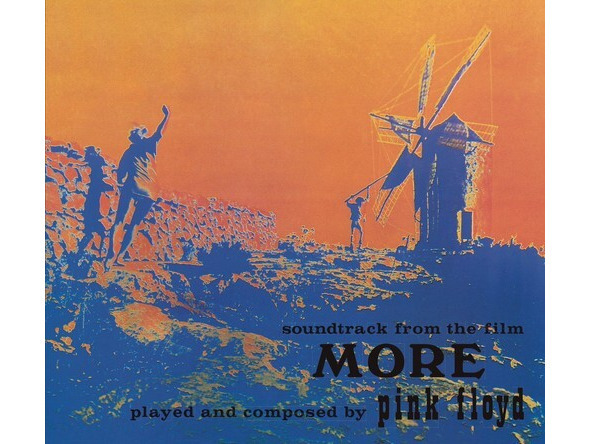
It’s time to discuss the next album by Pink Floyd. According to the principle I adopted, “first in line” is the cover. As I have already mentioned, hidden knowledge should not only be sought in the band’s lyrics and music but also in the covers, which form an integral part of their message. A brief digression is in order here.
The author of most of the graphic designs used by the band was Roger Waters’ schoolmate from Cambridgeshire High School for Boys — Storm Thorgerson. This is very important information because I suspect that their collaboration had a “second layer” in the form of precise information from the band members about what was supposed to be on these covers — what hidden content it should contain.
Let’s go back to Cambridge in the 1960s. Young Roger Barrett attended the local Cambridgeshire High School for Boys. Two grades above him studied his namesake, Roger Waters. At that time, no music group was planned. One played guitar a little, the other occasionally came to listen, but for now he was more interested in sports. Waters played in the rugby team together with another schoolmate, Storm Thorgerson. Storm also had no musical ambitions. He was not a musician and would not become one (in later interviews he jokes that he cannot even tell the two sides of a guitar apart). A few years later, however, he would take an interest in photography and, together with another friend he met in Cambridge, would establish the Hipgnosis graphic studio. It was then that Waters would reach out to him, asking if he could handle the covers for the increasingly popular band.
(link) — http://okladki.net/artykuly/show/33-okladkologia-pink-floyd-i
Before proceeding to decipher what content is “hidden” in the cover of Pink Floyd’s third album, it is useful to recall what, after the period of the “historical” continuum, was the theme of the fourth album of their “colleagues” from Led Zeppelin.
All previous songs in Led Zeppelin’s discography had specific (historical) recipients. The fourth album also has a recipient — but its originality lies in the fact that it is not a collection of people and historical facts associated with them; instead, all songs concern and describe particular events from the life of just one person. The individual lyrics on Led Zeppelin’s fourth album describe successive stages in the life of a “bearded man” — it is a kind of “diary.”
If the individual songs of the two previous Pink Floyd albums showed more or less compatibility with Led Zeppelin’s songs, then logically, one should expect a continuation of both form and — more importantly — content, which should provide an answer to the fundamental question regarding the validity of my assumption about the twin “legacy” of both bands.
Considering that the entire work of Led Zeppelin tells the story of a “bearded man,” and as follows from my reasoning, the etymology of the name Pink Floyd has decidedly feminine connotations, one can, by way of contrapuntal reasoning, deduce to whom the album More is dedicated.
The Tea Set (a set of personal information) — is a hint that the central theme of Pink Floyd’s entire artistic activity will be topics related to the intimate experiences of a specific person. It will indeed be a very personal diary. The Screaming Abdabs, The Architectural Abdabs (terrifying, nervous scream) — using the final version of the band’s name, Syd Barrett clarifies that it will be the diary of a specific, rather neurotic woman: Pink Floyd (girlish pink color, a nice person).
Now knowing what the foundation of the album More will be, one can calmly examine all of its individual songs and compare them with the songs from Led Zeppelin’s fourth album. Searching for potential (mirror) similarities, one can in a minimal but still meaningful way confirm the correctness of my assumptions (time continuum). The first such indirect proof is precisely the album cover, on which one can notice the silhouettes of two people: a woman and a man — this is, of course, a frame from Barbet Schroeder’s film.
The adventures of the main couple have little connection with the biographies of the couples in the discographies of both “our” bands, but the very fact of their meeting (the cinematic one) does have its counterpart in reality. At the moment, this statement seems extremely enigmatic, but only after thoroughly understanding how I “see” all this, one can formulate some general conclusions.
1. Cirrus Minor — Time of Mourning
As I have already mentioned, the theme of the album under discussion is the fate of a certain woman. It’s time to present all the most important pages from her “diary.” Just like with Led Zeppelin’s fourth album, this story has the qualities of a very personal “confession,” and for that reason, not everything can be fully described in detail. These will be only the most important and breakthrough events, which, like milestones, marked traces in her life story.
As usual, the title of the song synthetically announces what the theme will be. Cirrus — a cirrus cloud, occurring in the upper troposphere. Minor — in Latin translation — smaller, but considering the musical context, this probably refers to the minor key.
The minor scale (from Latin mollis — soft), also called the minor scale (from Latin minor — smaller, referring to the minor third between the I and III degrees of the scale) — a seven-note scale with a characteristic half-step between the II and III degrees. Minor scales and fragments of musical works based on them have a sad sound, in contrast to major scales.
(link) — https://pl.wikipedia.org/wiki/Skala_molowa
So, this is not about a “small cloud,” but about the sad sound — the sad mood of the song. The confirmation that the train of thought should go in this direction is, for example, the very “climate” of the piece (to determine this, one must listen to it), and equally important, the text, whose meaning is indisputable — cemetery, graves, weeping willow.
All of the above “leads to” the conclusion that we are dealing here with an extremely dramatic, and consequently sad, moment in the life of a certain person, to whom, as I previously assumed, the main part of Pink Floyd’s discography is devoted, and it is, no more, no less, the time of mourning for someone who was very close to her.
Who it concerns, which period it refers to, is not that important; the more important point is that, as follows from the order of the songs on the album, this was the first very important and, as it turns out, extremely traumatic moment in the life of the main “lyrical subject.”
This extremely sad event, which this woman had to face in the first — youthful — stage of her life, had cardinal consequences for her, which she would later have to struggle with throughout her adult life. The subject is of such delicate and personal nature that it would be inappropriate to elaborate further. The most important thing in all of this is the information about the rather unfortunate, initial moments in the life of “our” woman, which could have had a (neurotic) influence on how she perceives the reality surrounding her.
At this point, it is worth mentioning the first song from Led Zeppelin’s fourth album: Black Dog — the year 1978. Both the date and everything I “established” on this topic are of great significance for the subject under consideration. It is the first song on Zeppelin’s album and, just like the first song on Floyd’s More album, it tells about the first breakthrough moments in the life of the main character of their discography — this time, a man. So we have the first moments from the lives of two people, two “lyrical subjects,” at the center of attention of the two twin bands.
What more to add — everything comes together as a whole — all the “lost” puzzle pieces form a single picture. As a result, one can conclude that the two main characters from Barbet Schroeder’s film, whose silhouettes can be recognized on the cover of More, have much in common with the (bearded) man and the (neurotic) woman, whose meeting took place in the first stage of their lives.
As is usually the case with covers, attention should be paid to this cinematic frame — it contains a bigger idea, a greater message, which will be more clearly expressed only after becoming familiar with the entire album.
2. The Nile Song — A New Place of Residence
It’s time for the next breakthrough moment in the life story of our main “lyrical subject,” who, I remind you, is the “neurotic woman,” and as I emphasized, this will be a milestone of the heaviest kind, which will weigh on her for many years.
It so “happens by chance” that a milestone of similar weight was also “entrusted” to the main character known from Led Zeppelin’s discography. It is simply extraordinary how the fate of these two people intertwined with a single fate, a single destiny, which, like a DNA helix, occasionally makes itself known in the form of “similar” songs.
Andy Kellman from AllMusic declared that “Nile Song” is “one of the heaviest songs the band has ever recorded.” The chord progression is a series of modulations, starting from A, then rising a whole step with each repetition, cycling through six different keys, returning to the starting point A, and continuing this pattern as the song fades. The song’s style has been described as heavy metal and hard rock.
(link) — https://en.wikipedia.org/wiki/The_Nile_Song
A very important piece of information is contained in the title of the song: The Nile Song. It is the address of the new residence of the “neurotic woman” after a period of traumatic childhood, during which she will (or had to) face new life problems. Interestingly, the lyrics contain certain expressions that describe the mood not only of the main character (to whom this song is dedicated) but also of her male “mirror” alter ego, which makes this song even more symbolic and multi-dimensional.
I remind you that in the life of the “bearded” man, in the second song recorded on Led Zeppelin’s fourth album: Rock and Roll, a time of aimless spinning in circles had arrived, but compared to the fate awaiting this woman, one can only guess that it was also not an easy time — “one of the heaviest songs the band ever recorded.”
3. Crying Song — A Smile Through Tears
The way this song is titled: Crying Song, is a clue indicating that it is a continuation of The Nile Song. Just as the previous entry was devoted to the place of residence of the “lyrical subject,” this time Pink Floyd focused all their attention on the emotional feelings of that person. Not much more can (or should) be written on this topic, as it concerns very personal emotional experiences, and such dissections are not pleasant for anyone.
I interpreted this song as: “a smile through tears,” because, as can be seen from the lyrics and the extremely atmospheric, almost “tearful” arrangement, the main character of this album — the “neurotic woman” — faced very unpleasant times in her new place of residence.
The third song on the “mirror” fourth album by Led Zeppelin is titled The Battle of Evermore. Does it have any connection to Crying Song? The answer to this question should be sought between the lines of the respective songs. I believe that the mirrored reflection in this case, just as in all previous cases, is indeed very noticeable, and the key word of The Battle of Evermore: “Bring it back” is the most significant confirmation of this.
4. Up the Khyber — Commotion
This time we are dealing with an instrumental piece, and for this reason interpreting which period of the “neurotic woman’s” symbolic life it concerns is definitely more difficult, but not impossible. As I have already tried to demonstrate in previous entries, the “gnostic” content encoded by the creators was multi-layered: in the symbolism of album covers, in the lyrics of individual songs, as well as in their melody line or the mood of the song itself. This time, in my opinion, the hidden meaning of this song should be sought in the title.
Firstly:
The title is a naughty joke, because “Khyber” in Cockney slang refers to the “Khyber Pass,” meaning the buttocks. It may also refer to the 1968 film Carry On Up the Khyber.
(link) — https://en.wikipedia.org/wiki/Up_the_Khyber
Secondly:
Carry On… Up the Khyber — Commotion in the Khyber — film description: India, 1895. Sir Sidney Ruff-Diamond, the governor managing the northwest province of Kalabar, enjoys entertainment and lavish parties. During sports events, the governor’s wife catches the eye of her husband’s enemy, Khasi, the wealthiest and most influential rajah in northern India. Meanwhile, the pass at the Khyber, the gateway to India, is guarded day and night by the famous Scottish Highland Regiment, called by the locals “devils in skirts.” Khasi plans to attack them and finally drive them out of Kalabar.
(link): https://www.filmweb.pl/film/Awantura+w+Khyberze-1968-38172/descs
In the above quote, I highlighted what, in my opinion, Pink Floyd conveyed from the film into their song.
The plot of the film itself is not so important, but the thread involving Khasi, the governor’s wife, or the governor himself is significant for the problem at hand. The most important aspect is the attack by the governor’s enemy on his wife, with a clear emphasis on this “villainous” act.
Taking the above into account, the real troubles of the main “actress” of the Floyd discography become understandable, which caused her neurosis. “Devil in a skirt” — this enigmatic expression taken from the film fits well with the mental state the woman found herself in during this unhappy period of her life. This is perfectly represented in the extremely dramatic and lively musical background, to which only the lyrics now need to be added.
To do this, one must carefully recall all the previous stages in the life of our “neurotic woman,” represented by the three earlier songs on the album More.
Cirrus Minor — concerned a very dramatic moment from the woman’s childhood. The initial fragments of this song are filled with the blissful mood of singing birds — a rather happy childhood. Unfortunately, later, a sacred-mourning-traumatic mood intrudes and eventually dominates this happy time.
The Nile Song — a time of crucial and very heavy decisions, resulting in a change of residence. Unfortunately, the “fairy islands” from the lyrics of this song soon turned out to be an illusion.
Crying Song — this song, in its atmospheric mood, resembles a lullaby. It is an instrumental backdrop for the next stage in the life of the neurotic woman, which was the consequence of a change in residence as well as poor matrimonial decisions, resulting in maternal obligations.
Taking into account the context of these three songs and my interpretation, only now can one conduct a further exegesis of this fragment of the woman’s life. Unfortunately, both the mood and the dramatic tempo of this song foreshadow a Commotion. It is a commotion between the “devil in a skirt” and her enemy, whom the woman finally expels from Kalabar. This somewhat poetically camouflaged statement should be translated into the rather trivial statement that this concerns the stage in the woman’s life when, fighting for her dignity, she finally “gets rid of” the cause of her marital troubles.
The instrumental song Up the Khyber is a story about drama, struggle, and liberation.
Finally, an equally important matter — which song from Led Zeppelin’s fourth album should be identified with the troubles of her female counterpart? The answer is not too complicated — it is an equally “difficult” period for the “bearded man,” and it is contained in everything I wrote when decoding the songs Misty Mountain Hop and Four Sticks.
5. Green Is the Colour — Hope for a Better Time
Once again, the title of the song contains the whole secret of how it should be interpreted, and in this particular case, the emotional state of the woman (after all, this is a diary) whose experiences with “relationships with men” usually ended very badly.
It is commonly known that the color green is considered the color of hope, and this mood began to dominate her psychophysical state. Equally important is the song’s lyrics, in which I highlighted the essential fragments.
From the lyrics, it follows that after a period of “infatuation” came sobering, and consequently, a time of fighting for her dignity and freeing herself from a toxic relationship (two relationships). All of this again seems very enigmatic and at this stage, let it remain so.
There remains the issue of the mirrored fate of the “neurotic woman” with her male alter ego, namely, which song in Led Zeppelin’s discography should be identified with it. In the previous entry, I connected Floyd’s songs with two tracks, and this time it will be the same: Going to California and When the Levee Breaks.
The songs of both bands, telling stories from the lives of such different characters, must necessarily deal with the problem in a different way, but the accents (by which one can recognize the identity of the pair of protagonists’ fates) remain unchanged.
For example, the verses from Going to California and When the Levee Breaks clearly indicate emotional experiences, attempts at change, and life challenges that both the woman and her male mirrored alter ego had to face.
6. Cymbaline — “It’s Time, So Wake Me Up”
To explain how to interpret the next “milestone” in the life story of the “neurotic woman,” a brief introduction is necessary.
As I have already mentioned, the symbolic life line (for better understanding, I used the comparison with a DNA helix) of the main protagonists in the discographies of Led Zeppelin and Pink Floyd intersected once before, as evidenced by the songs: Black Dog (first band) and Cirrus Minor (second band). When this meeting took place is not a secret. Taking this information as the basis for further considerations, and also what I wrote at the beginning when decoding the “secret” of the More album cover — that this frame from Barbet Schroeder’s film about the meeting of two young people translates into their actual, real-life fates — it seems an obvious conclusion that these life lines intersected again — a renewed meeting of the man and the woman.
Was it indeed so, or is it possible that these events form the basis of the libretto of the next Pink Floyd songs? Previously, in Led Zeppelin’s songs, I described the life line of the man; now it is time for a closer analysis of the further course of the second discography.
So far, all the individual tracks on the More album had their “mirror reflection” in Led Zeppelin’s fourth album. But the album is now nearing its end, and there are still a few tracks from the current album to discuss. Rest assured, the continuation exists. The life line does not break here; this proverbial helix has its intersection, and it will be the story told through the Houses of the Holy album.
Now it is worth recalling how I interpreted the title of that album and what knowledge is hidden in its cover, which is of great significance for the main topic of this entry.
In the creators’ concept, the Houses of the Holy album is, it will be, a place where two different “groups” meet — the “Lords,” who are currently in a different “state of matter,” and the “Lower House,” which indeed is lower, but its state of matter is perfectly stable — until our hourglass, in the lower position, reaches its maximum weight.
Thus, just as with the first Pink Floyd album, whose “counterparts” were the first two Led Zeppelin albums, this time too the two albums — the fourth in order and Houses of the Holy — will be identically associated with More.
Having all these explanations behind us, it will be easier to decode the song Cymbaline, which is very close to the first track of Led Zeppelin’s fifth album, The Song Remains the Same. Knowing already how convoluted the paths must be to reach the truth, I suggest taking the following quote as the basis for further considerations:
Cymbeline — a comedy by William Shakespeare, written around 1609. […] Overview of the plot: Posthumus, a man of low birth but many virtues, secretly married Imogen, the daughter of King Cymbeline. The king, angry at the news, exiled Posthumus from the kingdom. Iachimo, a Roman soldier, bets with Posthumus that he can seduce Imogen. Imogen, who learns this from Posthumus’s servant, travels to the western coast of Britain. There she meets two men. She does not know, however, that they are in fact her brothers. They deceive her, claiming that Belarius, the king of Britain, conspired with the Romans, forcing Cymbeline to overthrow him. In retaliation, Belarius kidnapped Cymbeline’s sons so that they could not ascend the throne. The princes were raised by a caretaker they called mother.
(link) — https://pl.wikipedia.org/wiki/Cymbelin
The title of Shakespeare’s play differs slightly from the title of the Pink Floyd song — that is a fact — but the two sentences highlighted in the above quote fit quite well into the “atmosphere” of the discographies of both our bands, and the named individuals and their complicated fates are by no means coincidental; they have much in common with the adventures of the main characters, both in the More film and, more importantly, their real-life counterparts: the “bearded” man and the “neurotic” woman.
To notice the similarities, much “imagination” is needed, it is true, but as I explained at the beginning of this adventure decoding hidden knowledge, this knowledge could not be “easy or pleasant” so that no outsider could solve it too soon. That these puzzle pieces were scattered in such an effective way is already thanks to the members of both bands, but I think the way I interpret it aligns with their vision.
Similarly to what happened with The Nile Song, in the lyrics of Cymbaline one can find certain phrases whose “author” is not the lyrical subject of the entire album, but her male “mirror” alter ego:
„For it’s time,
Cymbaline,
It’s time, Cymbaline,
So wake me up.”
These lines directly refer to the artistic vision of the creators of the next Led Zeppelin song, The Rain Song.
7. Party Sequence — “I Need Your Love”
Once again, we are dealing with an instrumental piece, which results in a limited amount of information. Therefore, to solve this puzzle, a correct interpretation of its title is necessary. Sequence — an ordered series of signs, symbols, names, or events, constituting the structure of a system. The occurrence of subsequent elements follows a specific rule or form. Party — most likely a celebration, as indicated by the song.
To continue with the topic, it is necessary to also take into account the recurring theme present in all the tracks: the life lines of the woman and the man, who have met before. Combining this information as a whole, one can conclude that the next important stage in the biography of the main protagonist of this album, as well as her “mirror reflection” (illustrated on the More album), will be the desire to re-establish contact. This will not be a single attempt, but a whole sequence of signs and symbols, which will be elements of the structure of a larger plan.
The main instrument in this track is the bongos — a Cuban instrument consisting of two permanently connected drums. I believe this instrument was used intentionally in this piece. The sound of the bongos is closely related to the sound of the percussion instrument: the Tam-tam — used in Africa as a signaling instrument, serving to transmit messages over long distances. In this particular piece, its creator, Roger Waters, encoded information that a period of long-distance communication via signs and symbols took place between the bearded man and the neurotic woman.
Whether this actually happened, or whether this was the intention of the creators of this track, cannot be determined at this moment. However, there is also the discography of Led Zeppelin, where confirmation can be sought. The next track after The Rain Song from the Houses of the Holy album is: Over the Hills and Far Away.
All the tracks from Led Zeppelin’s fifth album — Houses of the Holy — describe future, subsequent events in the life story of the “bearded man.” After a period of inactivity in the sentimental “brei” (The Rain Song), the time for action comes with Over the Hills and Far Away. But is this active action on the part of the main character — the “bearded man” — or rather waiting for a specific step from his interlocutor? The first line of the song clearly directs: you’ve got the love I need — “you got the love I need.”
8. Main Theme — Announcement of the Reunion
Another instrumental track. What had been foreshadowed in the previous pieces — that is, the re-crossing of the life lines of the main characters of the album, More, so to speak — has become a fact. As the title of this track indicates, it will (or was) a very important “crowning” of their expectations.
This piece is played at the beginning of Barbet Schroeder’s film, when one of the main characters in the film, Stefan, is waiting for someone to pick him up on the way to Paris.
The track The Crunge by Led Zeppelin serves as a suggestive “libretto” for Main Theme.
Houses of the Holy, The Crunge
I wanna tell you bout my good thing
I ain’t disclosing no names but — He sure is a good friend and!
I ain’t gonna tell you where he comes from, no!
If I tell you you wont come again! Hey!
I ain’t gonna tell you nothin but I do will, but I know, yeah!
I should do but I know now let me tell you bout my girl: Open up a newspaper and what do I see? Ahh, ah
See my girl, ah, looking at me
Ooh, And when she walks, Ooh, lemme tell ya: She walks and when she talks, she talks and
When she looks at me in the eye
She’s my baby lord I wanna make her mine
Tell me baby what you want me to do!
You want me to love you, love some other man too?
Ain’t gonna call me Mr. pitiful, no!
I don’t need no respect from nobody…
I ain’t gonna tell you nothing I ain’t gonna no more, no!
She’s my baby let me tell you that I love her so and
And! She’s the woman I really wanna love
And let me tell you more, oooh!
She’s my baby she lives next door
She’s the one a woman the one a woman that I know. I ain’t gonna… tell you one thing that you really ought to know ooh!
She’s my lover baby and I love her so and
She’s the one that really makes me whirl and twirl!
And she’s the kind of lover that makes me me fill the whole world and
She’s the one who really makes me jump and shout, ooh!
She’s the kind of girl — I know what it’s all about!
Take it take it
Excuse me
Oh will you excuse me
I’m just trying to find the bridge… Has anybody seen the bridge?
(Have you seen the bridge?)
I ain’t seen the bridge!
link: https://www.tekstowo.pl/piosenka,led_zeppelin,the_crunge.html
A very significant part of the lyrics suggests that the form of communication and the way information is conveyed in the lives of the characters evolves over time: “I open the newspaper and what do I see?” Times change — and so, understandably, the form of communication becomes more modern. At this moment, it is not the details of the lyrics that matter, but the symbolism of the instrumental narrative. Main Theme can be interpreted as the climax point, where the life lines of both characters intersect again, and the expectations and hopes built through the previous tracks find their spatial and emotional reflection.
This is an extremely important moment, as it shows that after all the adventures, relocations, emotional struggles, and attempts at liberation, the protagonists are coming closer to each other — not through words, but through symbolic sound, rhythms, and instrumental lines that become their shared language. It is also a sign that musical narrative can express more than words — it is a bridge between emotions, time, and space, connecting all previous stages of the characters’ lives into a coherent whole.
9. Ibiza Bar — “Dancing Days”
The previous tracks, like “milestones” on the symbolic path of life, described the most important, often pivotal events in the life of the woman, and the same applies in this case. As for Ibiza Bar — this is coded information referring to the emotional as well as physical experiences from the time of the reunion of the main characters of both discographies: Led Zeppelin — the bearded man, and Pink Floyd — the neurotic woman.
Once again, the title, as well as the “atmosphere” of the track, hints at what kind of events are being described. Ibiza — a very summery and at the same time entertaining island in the Spanish Balearics, while the term Bar requires no translation — it is a place where entertainment can be “amplified” with the help of alcohol.
*I live where I lived — on the shelf, like others
The epilogue resembles a funeral song
Take your camera, use me again
And create this world for me…”
The entire lyrics of this song are a record of reminiscences from that meeting. What these impressions are and what they concern can be inferred by oneself — in certain situations, it is not appropriate to speak about the details, but again, based on the hint provided by Led Zeppelin’s discography (Dancing Days), one can still reach concrete conclusions.
10. More Blues — A Sad Time of Separation
Instrumental track. The closer we get to the end of the album, the further we move away from easily verifiable past, and crossing the invisible yet elusive mist of the present, we slowly enter the domain of a future unknown to anyone. All subsequent entries lose the quality of a diary in favor of a (undefinable) part of the timeline that lies ahead of us.
The track More Blues is a record of the most current events — a record of the emotional state (of both main “actors” of this album — it can be assumed so) after a period of intense experiences.
Thus, after a period of joyful reunion, the next chapter begins in the life of the “neurotic” woman, and — understandably — the “bearded” man as well. It is a sad time of separation, and exactly as heard in the track, it is a time of blues — music of nostalgia, suspension, emotional resonance of what has been, and uncertainty of what is yet to come.
The Led Zeppelin track D’yer Mak’er, symptomatically, maintains a very similar, melancholic atmosphere. This is another proof that the mirrored lifelines of the protagonists of both discographies, although momentarily diverging, still remain in close emotional correlation.
11. Quicksilver — A Time of Mourning
Quicksilver is an instrumental track with a very somber mood. As has been the case previously, the guiding information for deciphering the “gnosis” of individual tracks had to be sought in their lyrics, musical backing, or in the illustrations on album covers. Additional hints were also provided by the song titles. In this case as well, the clues must be sought in the correct interpretation of the title of the currently discussed track.
As is known, mercury is the only metal that occurs in liquid form under normal conditions. Thus, one can say that in terms of metallic properties — it is a transitional metal. Extending this analogy further, one can liken this metal to a human being, who is also a unique kind of “transitional metal.”
Without venturing into more eschatological speculations, it is clear that a human has both a body and a soul. The body, as is known, is mortal, whereas the soul is eternal. A person does not die, but merely changes their “state of matter” — and from this, it is not far to conclude that they are, in essence, a “transitional metal.”
Possessing the source text in the form of Led Zeppelin’s discography, one can make an important supplement in those instances when we are dealing with instrumental tracks, because everything related to the life story of the “bearded” man has an undeniable connection to the life story of the “neurotic” woman. This highly condensed comparison of the properties of mercury to a human being finds its confirmation in everything encoded in Led Zeppelin’s track No Quarter.
I consider the main theme of this track to be death, a time of mourning. A particularly significant fragment of the track — the oscillator effect — seems to imitate the process of a person “transitioning” to another state of matter.
Quicksilver is another period — a “milestone” — in the life of the neurotic woman, and also, understandably, her male helical counterpart — the “bearded” man. From the fact that the life story of the main character of this album does not end with this track, one can infer that the experiences associated with what the oscillator effect encodes in no way concern her (or them).
12. A Spanish Piece — A Time of Fiesta
A Spanish Piece is a track whose title immediately indicates a joyful, festive mood — a time of fiesta. As I already mentioned while decoding More Blues, the closer we get to the end of the album, the more we move away from easily verifiable past events, and crossing the invisible yet elusive mist of the present, we gradually enter the domain of an unknown future. With this, all subsequent entries lose the character of a diary in favor of an (indefinable) part of the timeline that lies ahead.
It is time for the final section of the currently discussed album More. To remind — it is a kind of “diary” from the life of the neurotic woman. At this point, a very important issue is the precognitive value of Pink Floyd’s tracks. Whether this was indeed the case, or whether we are dealing with an extraordinarily improbable coincidence, each must decide for themselves.
Just as the previous track on this album, Quicksilver, had a decidedly negative message, A Spanish Piece tells of decidedly more joyful moments to come in the life of the neurotic woman. Whatever this may mean, it will be a time of fiesta, as indicated by the context of the previous track on this album: Ibiza Bar — and by the earlier interpretation of the entire narrative.
Confirmation of this meaning of the track is found in the analogy with the song The Ocean from Led Zeppelin’s fifth album — Houses of the Holy, which in its symbolism corresponds to A Spanish Piece from the album More.
13. Dramatic Them — “Finis coronat opus”
The final segments of this instrumental track suggestively encode the information that just as every road, no matter how long, has its end, so too will the main “life role” of our titular character — the neurotic woman in her “theater of life” — eventually reach its conclusion.
At this point, it is worth recalling that the interpretations presented for all the individual tracks on the album More concern the most important moments in the life of a particular woman. As I have repeatedly tried to demonstrate, all these “milestones” in her “curriculum vitae” have their twin “counterparts” in the form of similar life experiences of the “bearded” man — the main character from Led Zeppelin’s discography. I have often paired songs from both bands with one another. In my opinion, there is no mistake — these two characters share similar fates, occurring in roughly the same timeframe, like an invisible double helix of DNA.
How, why, and in what way the members of both bands — Pink Floyd and Led Zeppelin — knew this and decided to convey it to us, along with all others involved in this extraordinary project, I will not discuss at this moment — perhaps the parties involved will speak on the matter themselves. I will only add that the track Dramatic Them has no counterpart on Led Zeppelin’s album Houses of the Holy, since that album ends with the song The Ocean. Matters related to the ultimate departure into “eternal rest” were addressed by that band on another album — but that is an entirely different issue.
More — Album Summary
1. Cirrus Minor — Time of Mourning
The first track on More symbolizes a dramatic moment from the woman’s childhood — initially a blissful mood of happy childhood, which is soon disrupted by trauma and a sense of loss.
Counterpart: Black Dog (Led Zeppelin) — introduces a similar psychological weight in the life of the male alter ego, signaling the beginning of a difficult and complex story.
2. The Nile Song — A New Place of Residence
Here we observe a turning point in the woman’s life — the decision to move and confront new problems. The song is heavy, almost metallic, symbolizing the intensity of emotional experiences.
Counterpart: Rock and Roll (Led Zeppelin) — depicts a period of aimless spinning in circles, contrasting with the dramatic weight of the woman’s experience.
3. Crying Song — A Smile Through Tears
This track reflects the emotional consequences of relocation — uncertainty, sadness, and moments of internal struggle. Its lullaby-like atmosphere suggests melancholic introspection.
Counterpart: The Battle of Evermore (Led Zeppelin) — with the words “Bring it back,” it signals a return to earlier experiences and emotions, serving as the male counterpart to the woman’s reflective state.
4. Up the Khyber — Quarrel
An instrumental track that encodes a dramatic period in the woman’s life — her struggle for dignity and liberation from marital difficulties.
The title conveys both danger and a certain absurd humor in the situation.
Counterpart: Misty Mountain Hop / Four Sticks (Led Zeppelin) — reflect similar challenges for the male character, recurring in his life.
5. Green Is the Colour — Hope for Better Times
After difficult experiences, the woman enters a period of hope and awakening — she fights for her dignity, freeing herself from toxic relationships. Green symbolizes renewal.
Counterparts: Going to California and When the Levee Breaks (Led Zeppelin) — the male characters face similar challenges, learning through experience and loss.
6. Cymbaline — “It’s Time, So Wake Me”
This track illustrates the woman’s reunion with her male alter ego. Its narrative atmosphere evokes a return to shared events, building the scene for the continuation of their story.
Mirror counterpart: The Song Remains the Same (Led Zeppelin) — a similar moment of meeting and introspection in the man’s life.
7. Party Sequence — “I Need Your Love”
An instrumental track symbolizing the desire to establish contact and communication between the characters after a period of separation. The bongos create a signaling rhythm, referencing the exchange of emotions and information over a distance.
Counterpart: Over the Hills and Far Away (Led Zeppelin) — indicates anticipation and subtle initiation of contact.
8. Main Theme — Foreshadowing a Reunion
An instrumental track that serves as the culmination of previous events — the characters’ life paths intersect once more. It symbolizes the peak of emotional expectations and the beginning of shared experiences.
Counterpart: The Crunge (Led Zeppelin) — rhythmically and narratively corresponds to the moment of reunion in the male character’s story.
9. Ibiza Bar — “Dancing Days”
This track portrays the joyful moments shared by the characters — a reunion, lightness of life, and celebration. Ibiza symbolizes a holiday atmosphere and carefree vibes, while the bar is a place of interaction and enjoyment.
Mirror counterpart: Dancing Days (Led Zeppelin) — similar joy and return to carefree moments for the male character.
10. More Blues — Sad Time of Separation
An instrumental track presenting a period of melancholy and separation. After the joyful reunion, the characters face emotional emptiness and longing.
Counterpart: D’yer Mak’er (Led Zeppelin) — a similar atmosphere of sadness and reflection experienced by the male alter ego.
11. Quicksilver — Mourning Time
A moody instrumental track of a somber character, symbolizing confrontation with mortality and the inevitability of change. Mercury, as a “transition metal,” becomes a metaphor for the transformation of life and spirit.
Counterpart: No Quarter (Led Zeppelin) — reflects a time of mourning and introspection for the male character, with an oscillator effect symbolizing passage to another state of being.
12. A Spanish Piece — Fiesta Time
The final instrumental track on More signals happier moments in the woman’s life — a time of celebration and festivity. Previous tensions give way to freedom and optimism.
Counterpart: The Ocean (Led Zeppelin) — a similar motif of joy and celebration in the man’s life, full of freedom and expression.
13. Dramatic Them — “Finis coronat opus”
The final track closes the woman’s narrative. “Finis coronat opus” symbolizes the end of her “life role.” The instrumental sounds fade into dramatic silence, representing the conclusion of her story and its reflective character.
Counterpart: No direct counterpart on Houses of the Holy — the conclusion of the male character’s arc is addressed on another Led Zeppelin album.
4. Ummagumma
Ummagumma — Album Cover
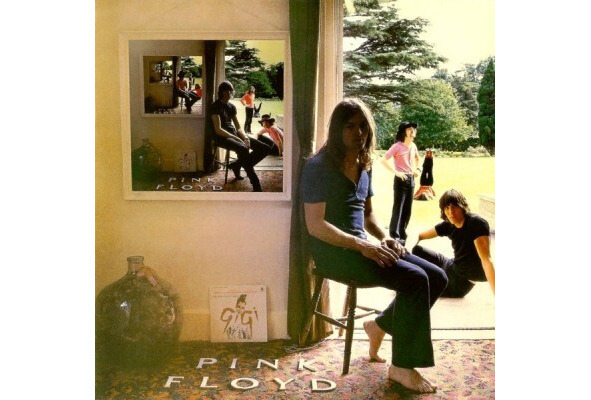
Once again I will allow myself a moment of privacy, although it is neither pleasant nor easy — I have to get this out of my system. Namely, while peregrinating through the “historical” continuum of the first two albums, I did so with full awareness and engagement, and since the subject matter was neutral, it came to me with ease.
Decoding the next album was already more difficult — it was, to paraphrase the title of Irving Stone’s book, an “agony and the ecstasy,” because everything that can be learned from the “subliminal” message of this album was not very pleasant either for the main character of the epic or for me now.
Despite this, it was a certain form of ecstatic pleasure, because I was discovering “virgin” territories that no one had ever dreamed of seeing before.
When I became familiar with the album Ummagumma, my impressions became even more surreal. My heart breaks into four pieces, and the blame cannot be assigned to anyone — perhaps only to a mocking fate, for being so ruthless. Nevertheless, the main goal is what matters — the correct interpretation of everything that has been encoded in the covers and the compositions. The point is to bear witness to the truth, whatever it may be, because the compilers of both discographies did not work on this project so that the message would have only a one-dimensional, purely entertainment-oriented musical character.
In order not to prolong this introduction, it would finally be appropriate to move on to the essential part of this entry, which will be a very important and multi-threaded story about the genius demonstrated by the creators of the graphic design of the album currently under discussion. It is simply unbelievable how much content can be contained in a single graphic project such as an album cover. This is undoubtedly the merit of the graphic studio Hipgnosis (nomen omen), but also of the members of Pink Floyd, who (as I believe) took an active part in creating this cover and certainly made a significant contribution to its final form.
The album was the first album released by the band on the Harvest label. The cover features a Droste effect with the group, with a picture hanging on the wall showing the same scene, except that the band members have changed positions. The cover of the original LP differs between British, American/Canadian, and Australian releases. The British version has the album Gigi leaning against the wall directly above the words “Pink Floyd.” During a talk at Borders Bookshop in Cambridge on November 1, 2008, as part of the “City Wakes” project, Storm Thorgerson explained that the album was introduced as a red herring to provoke debate and that it has no intended meaning.
(link) — https://en.wikipedia.org/wiki/Ummagumma
Thorgerson’s opinion stating that the album Gigi has no meaning is precisely what one should start with in any attempt to understand the significance of the subject. This is, of course, a convoluted manipulation, clearly false even at first glance, and since the simplicity of such argumentation is usually the most effective, it is not surprising that equally naive listeners fell for such a naive explanation.
The album Gigi is the starting point for analysis, because the story of Gigi in Vincente Minnelli’s film of the same title tells of fates similar to those that befell the “neurotic woman,” the main heroine of Pink Floyd’s discography.
The film Gigi was based on a book by Colette. The action takes place in Paris at the turn of the 19th and 20th centuries. Gaston, a young wealthy playboy, meets Gigi — a carefree, intelligent, and independent girl. Gigi’s family prepares her for the role of a courtesan, but Gigi rejects these expectations and preserves her identity. Gaston initially wants to treat Gigi superficially, but eventually recognizes true love in her and proposes marriage. The film ends with the happy wedding of Gigi and Gaston, emphasizing the themes of freedom, individuality, and choice in life.
The plot of this film constitutes a starting point for formulating the conclusion that Gigi’s fate is identically convergent with the experience of the “neurotic woman.” In other words: the cinematic Gigi and the Floydian woman share the same fate — admittedly only during a specific period — but the fact of this convergence was certainly known to the creators of this album, which makes the entire situation extraordinarily mysterious.
Who exactly this concerns is not important at this moment; more important is the fact of the correlation of her life story with her mirrored “male” alter ego — this is reflected in the number of discs on the album Ummagumma.
The first part — the concert disc is “dedicated” to the man, while the second, the studio disc, encodes information about the woman.
There will still be time to take a closer look at the compositions included on the discs; now it is time for another interesting element of the décor of the (record) room in which the constantly changing members of Pink Floyd stand — namely, an empty wine demijohn, on the glass of which one can see a blurred silhouette of the photographer against the window. I have the impression that this is a symbolic visualization of the second important character of both discographies.
And just as the album Gigi signals what the woman’s fate will be or was, so the mere reflection on the glass demijohn is an announcement of what the fate of the male aspect of this double “helix” will be or was — and what his life story was can be learned from my entries devoted to the band Led Zeppelin.
Another interesting element of the cipher of the Ummagumma cover are the four fractal versions of one main image depicting the four members of the band in four different poses. The cover shows the “Droste effect,” with a picture hanging on the wall showing the same scene, except that the band members have changed positions.
Just as the album Gigi or the reflection of the figure on the wine demijohn had their second symbolic layer, so these four fractal versions of the cover (and the four band members changing their positions) were not compiled by the Hipgnosis graphic studio in this particular way by accident. They constitute encrypted information. Perhaps it is about the fact that each artist prepared his own material for the studio album. Maybe so, maybe not. This is not the path I would follow.
In my opinion, the four fractally diminishing images are meant to symbolize the perspective of the passage of time — from the largest, that is, the most important period in every human life, which is childhood and youth, to ever shorter stages, the symbolic reflection of which is, for example, an hourglass.
In an extremely concise and symbolic way, this refers to the continuum of time, a phenomenon I have mentioned many times already, and to its influence on the work of both bands: Led Zeppelin and Pink Floyd.
Equally important are the figures of the band members: their changing silhouettes — on each image a different person. In the main plane, a figure sitting on a chair in a room, then sitting on the ground, then a standing figure, and finally one lying down with legs raised upward.
In my opinion, this is meant to symbolize the successive changing turns of fate of the person to whom this album is dedicated. Each image symbolizes successive stages of human life — from childhood, through youth, to adulthood and old age. The changing silhouettes of the band members emphasize the variability of fate — both of the woman and her male counterpart. The smallest image is a copy of the cover of A Saucerful of Secrets, which suggests the continuity of the story and the connections between the albums.
Yes, but the album consists of two discs, and as I have already “proposed,” one — the concert disc — encodes the fate of the man, while the other — the studio disc — encodes that of the woman. There is no contradiction in this; as I will try to prove, all the compositions included on both discs tell of four “mirrored” stages of the lives of the man and the woman — and this is where the whole secret of these four fractal images and the four band members whose silhouettes assume four different positions lies.
The double album Ummagumma is a peregrination through the life stories of both main protagonists of the twin bands. If so much interesting information can be deduced from the obverse of the Ummagumma cover, then one must assume that the reverse also contains some “subliminal” message. Something tells me that the official version is far too “easy” to be true.
On the back cover, roadies Alan Styles (who also appears in “Alan’s Psychedelic Breakfast”) and Peter Watts are shown on the band’s equipment laid out on the taxiway at Biggin Hill airport. The concept was proposed by Mason, with the intention of replicating exploded drawings of military aircraft and their loads, which were popular at the time.
(link) — https://en.wikipedia.org/wiki/Ummagumma
It appears that the equipment arranged in the shape of the letter V is another symbolic element of the cover cipher and carries some specific message. What kind? That will be discussed in the album summary.
Summary of the symbolism of the cover
Obverse and four fractals — stages of the protagonists’ lives, from childhood to adulthood.
Album Gigi — points to the analogy between the film character and the “neurotic woman.”
Reflection on the wine demijohn — an announcement of the fate of the male aspect of the “double helix.”
Reverse with musical equipment arranged in the shape of the letter V — a possible hidden message that is encrypted information.
The album Ummagumma is therefore a peregrination through the life stories of both main protagonists and a visual commentary on their fates, both musically and symbolically. The first part (concert) concerns the man, and the second (studio) — the woman.
Ummagumma — Album Title
The album title is another very important piece of information for understanding the context of the entire record. In this case, the sexual motif will play a leading role, while all aspects of social relationships will constitute the narrative framework of the fates of the main animator of these events — that is, the “neurotic woman,” as well as the “bearded man.”
The title of the album is allegedly derived from Cambridge slang meaning sex, commonly used by a friend of Pink Floyd and an occasional roadie for the band, Iain “Emo” Moore, who used to say: “I’m going home for some ummagumma.” According to Moore, he himself coined this expression.
(link) — https://en.wikipedia.org/wiki/Ummagumma
As I will try to “prove” in subsequent entries, when discussing individual compositions, the changing turns of fate were encoded by the authors of this album largely in the instrumental layer. A considerable dose of imagination will therefore be required, and of course a musical ear.
I believe that the authors of the album Ummagumma, with this strange title, refer to everything that is “represented” by the Indian treatise on sexuality and sexual behavior — the Kamasutra. They carried out an extraordinarily free paraphrase of the title, but it is precisely this sexual motif that is the clue one should follow to reach the essence of the problem. The Kamasutra does not focus solely on sexual positions; by conducting a comprehensive analysis of sexual intercourse, it simultaneously provides a great deal of information about culture and social life in ancient India.
In a similar way, one should approach the individual compositions on the Pink Floyd album — not only the sexual aspect of the works under consideration will matter, but also, and perhaps above all, their emotional context.
The title Ummagumma is therefore the key to the entire album, suggesting that in analyzing the music and the cover one must look multidimensionally — at the musical, visual, and symbolic-emotional layers. It is precisely thanks to this approach that one can begin to uncover the band’s “subliminal” messages, which go far beyond ordinary musical interpretation.
1. Astronomy Domine — Initial Phase of the Influence of the Male Hormone
As I have already mentioned, the first part — the live one — is “dedicated” to the man, while the second, the studio part, encodes information about the woman. It was precisely this principle that the creators of both discs followed when selecting the musical material to illustrate their life stories.
Kup książkę, aby przeczytać do końca.