
Bezpłatny fragment - Phaistos Disc
Testament of the Universe
Phaistos Disc: Testament of the Universe
INTRODUCTION
The Phaistos Disc remains one of the most fascinating and enigmatic artifacts of antiquity. Discovered in 1908 within the Minoan palace complex at Phaistos on Crete, this clay disc, approximately 16 centimeters in diameter, is covered with spirally arranged signs whose meaning has remained a mystery for centuries. Although numerous studies have included paleographic, linguistic, and digital analyses, none of the attempts has led to a definitive reading of the inscription. The Disc retains its enigmatic aura — it is a testimony to ancient intelligence and at the same time a symbol of unspoken knowledge that seems to defy the linear nature of history.
The most important issue concerning the Disc is its interpretation. Attempts at decoding have included, among others, comparisons with Linear A and Linear B scripts, phonetic hypotheses, semantic concepts, and even mathematical-astronomical theories. Each approach has revealed a fragment of potential knowledge, yet no method has fully captured the meaning of the spiral narrative. What seems most significant is the fact that the Disc may not be merely a record of practical information — it may also be a symbolic carrier of cosmic laws, cyclicity, and the relationship between the material world and consciousness.
In my work I decided to undertake the challenge of interpreting the Disc from an extremely subtle yet fundamental perspective: the cyclicity of the universe and the idea of transpresence. This approach does not limit itself solely to historical-archaeological analysis — it assumes that the Disc may be a projection of knowledge about cosmic cycles, the evolution of life and consciousness, and that its symbols function as carriers of memory, awareness, and energy.
Each sign, each spiral line may be a metaphor for return, rebirth, and the constant flow of information — both in the human microcosm and in the macrocosm of the Universe.
Approaching the Phaistos Disc in this context, I assumed that it is not merely a historical artifact but rather a kind of key to universal knowledge about the nature of existence. The symbolism contained in the spiral signs appears to reflect fundamental cosmic laws: the recurrence of processes, the transformation of energy and matter, and also the potential of consciousness for transcendence — to a state which I have called transpresence.
This concept refers to the ability of an individual or a species to “exist beyond local being,” to permeate fields of information in which time and space become relative and consciousness becomes a universal act of knowing itself.
This introduction is not intended to present a final reading of the Disc, but rather to introduce a perspective from which every line and sign gains meaning in the context of cycle, return, and the constant evolution of life and consciousness. The Phaistos Disc is not merely a Minoan relic — it becomes a spiral key to understanding the laws governing existence, a bridge between antiquity and contemporary reflection on humanity’s place in the Universe.
How the Disc should be read
The Disc is read from the center toward the edges — each spiral path symbolizes a successive segment that encodes a separate epoch and significant events. Every element contained within a segment constitutes a fragment of a puzzle, a kind of rebus through which it becomes possible to decode the entire segment and grasp its meaning in the context of history, cosmic cycles, and transpresence. Each sign is not only a record but also a key — it enables the linking of successive epochs and processes of consciousness into a coherent, spiral narrative of the Universe.
Phaistos Disc — Side A
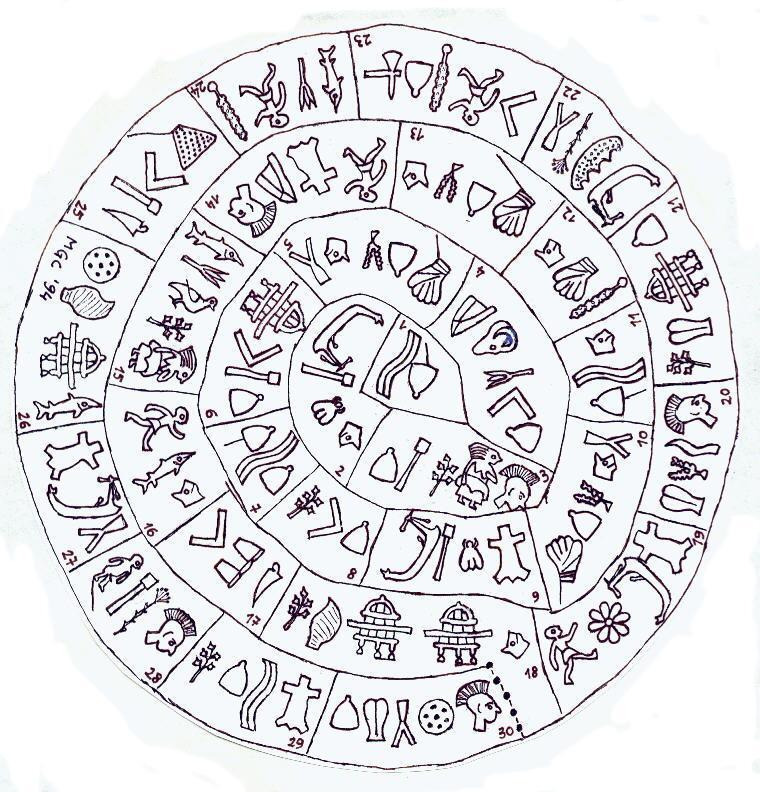
Segment 1 of Side A of the Phaistos Disc
Symbols:
1. Flower / rosette — the beginning of life, the birth of energy and matter; in a cosmological context it may symbolize the starting point of the Universe, the explosion from which structure emerges. It is like the “blossoming of time and space” from primordial chaos.
2. Bald head of a man — conscious observation or the beginnings of consciousness; in cosmology this may symbolize the emergence of ordered structures within chaos, such as galaxies, stars, and planets. It is as if the first “observer” of the Universe, embodying order and concentration within the chaos of energy.
3. Feather / arrow tail (fletching) — movement, direction, the spreading of energy; in the context of the Big Bang this can be interpreted as the expansion of the Universe, the escape velocity of matter and energy into space. It symbolizes dynamics, the wave of expansion that drives the evolution of the cosmos.
Symbolic whole:
Segment 1 can be read as a metaphor for the beginning of the Universe:
Rosette (flower) — the birth of everything from a zero point.
Bald head — the beginning of structure and consciousness, order within chaos.
Feather / fletching — expansion, movement, and the evolution of energy in time and space.
Together: Segment 1 of Side A of the Disc can therefore be treated as a single complex ideogram that tells of the birth and expansion of the Universe.
Segment 2 of Side A of the Phaistos Disc
Symbols:
1. Running man — a symbol of dynamics, movement, and activity. In a cosmological context it corresponds to energy and the rapid interactions of elementary particles in the very early Universe. It is a metaphor for the first movements of matter — quarks, gluons, and leptons — which begin to interact in an extremely hot and dense environment.
2. Cloud of vapor / smoke rising above a vessel — a symbol of matter in an unorganized state, energy that is only beginning to take form. The vessel may symbolize the space in which these processes occur, that is, the Universe as a dynamic system. In cosmology this is the condensation of energy into the first elementary particles — quarks and gluons — forming in the primordial “cauldron” of the Universe.
Symbolic whole:
Segment 2 can be read as a metaphor for the Era of quarks and gluons:
Running man → movement and dynamics of energy in the primordial Universe.
Cloud above the vessel → the formation of the first elementary particles in cosmic space.
Together: “The dynamic formation of elementary matter from energy in motion” — a symbolic description of processes occurring fractions of a second after the Big Bang, when energy begins to condense into quarks, gluons, and leptons.
Segment 3 of Side A of the Phaistos Disc
Symbols:
1.Structure with many protrusions — comb
— A symbol of ordering and rhythmic repetition.
— A comb separates but also arranges — it is an image of the formation of structures from energy, like protons and neutrons forming atomic nuclei.
— It is a visual metaphor for the organization of chaos into the first stable particle systems.
— In the cosmic sense: the birth of the rhythm of matter — the foundation for the formation of elements.
2. Plant stem — papyrus
— A symbol of growth, continuity, and the transmission of information.
— Papyrus in the symbolic sense is also a record — it can be read as the beginning of the laws of physics that “write down” the structure of the Universe.
— In the context of nucleosynthesis: the process proceeds according to a “written plan” — the fundamental physical constants that determine how particles combine into nuclei.
3. Branch with several flowers or leaves
— A symbol of branching and diversity of forms.
— In this context it represents the diversification of nuclear reactions that lead to the formation of different light elements (hydrogen, helium, lithium).
— Each “flower” may represent a different type of atomic nucleus — the result of a different path of synthesis.
4–5. Two animal skins
— A symbol of biological material ready to be formed, but also a reservoir of energy.
— Skins can be interpreted as reservoirs of subatomic particles — protons and neutrons — which constitute the “raw material” for the formation of atomic nuclei.
— Two skins suggest duality — proton–neutron, positive–neutral — thus the fundamental pair that builds atomic nuclei.
6. Shield or sieve with holes
— A symbol of filtration, selection, and the rule of the process.
— It corresponds to the laws of nuclear physics that determine which reactions are possible and which are not (for example the absence of stable nuclei with mass numbers 5 and 8, which limits further synthesis).
— It is the “cosmic sieve” through which only some combinations of particles can “pass” and become stable elements.
7. Head of a man with a mohawk
— A symbol of consciousness, directing energy, an organizing principle.
— In this context it represents the law that orders the Universe, something like the “Logos of physics” — a set of principles that guide the process of element formation.
— Mohawk as a sign of power and concentration is a manifestation of the energy guiding the evolution of matter — the “consciousness” of the primordial creative process.
Symbolic combination of Segment 3
Comb → ordering particles into rhythm, the creation of structure.
Papyrus → the record of the laws of physics — the cosmic code of the synthesis process.
Branch → diversity of reactions and products (H, He, Li).
Animal skins → matter ready for synthesis (protons and neutrons).
Sieve / shield → selection of reactions, laws allowing only stable nuclei.
Head with mohawk → energy and consciousness of cosmic order.
Interpretation of the whole:
Segment 3 represents the moment when energy becomes organized matter — when the chaos of the Big Bang transforms into structure.
Comb orders the stream of energy,
Papyrus records the cosmic laws,
Branch blossoms into new elements,
Skins store matter ready for construction,
Sieve filters possible combinations,
Head with the mohawk — the symbol of the Spirit of Physics — gives direction to the whole.
This is the birth of the chemistry of the Universe: protons and neutrons combine to create the first atomic nuclei — hydrogen, helium, and lithium.
Symbolic formula of Segment 3:
Comb + Papyrus + Branch + Skins + Sieve + Head
= Order + Law + Diversity + Matter + Selection + Consciousness.
Primordial nucleosynthesis — the first act of cosmic alchemy, in which the Universe becomes matter.
Segment 4 of Side A of the Phaistos Disc
Symbols:
1. Flower / rosette
— A symbol of birth and the beginning of a new phase.
— In a cosmological context it can be interpreted as the “opening” of the Universe, the moment when it becomes transparent to photons — the beginning of background radiation.
2. Bald head of a man
— A symbol of the observer or concentration.
— Here it symbolizes structures and forms of photon energy that can now move freely through space. It is the “conscious” order within the chaos of radiation.
3. Feather / fletching
— A symbol of movement, direction, and spreading.
— In cosmology it represents the propagation of the cosmic microwave background (CMB) radiation in all directions of space, carrying information about the early Universe.
Symbolic combination of Segment 4:
Rosette (flower) → the beginning of a new phase, the transparency of the Universe.
Bald head → the ordering of photon energy, structures of radiation.
Feather / fletching → the spreading of background radiation through space.
Whole can be read as a metaphor for the Era of Radiation: the Universe becomes transparent, photons begin to travel freely, creating the cosmic microwave background radiation (CMB), which we still observe today.
Segment 5 of Side A of the Phaistos Disc
Symbols:
1. Branch with several flowers or leaves
— A symbol of branching and diversity.
— In a cosmological context it corresponds to the formation of the first structures of matter — condensations of gas and clouds of hydrogen that will become the seeds of future stars and galaxies.
2. Forked stick in the shape of the letter Y (sling?)
— A symbol of division, direction, and dynamics.
— It can be interpreted as gravitational interactions and the first separations of matter that lead to the formation of clusters of stars in cosmic space.
3. Club or pestle
— A symbol of energy, impact, and the initiation of a process.
— In cosmology it symbolizes the ignition of the first stars (through nuclear fusion) — the moment when hydrogen nuclei begin to burn into helium, creating the first light.
Symbolic combination of Segment 5:
Branch → the formation and branching of matter in gas clouds.
Sling / Y → gravitational concentrations, shaping the first galactic structures.
Club / pestle → ignition of the first stars, initiation of nuclear fusion.
The whole can be read as a metaphor for the birth of the first stars and galaxies: matter gathers, forms structures, and the first stars ignite, illuminating the Universe and creating the foundations of galaxies.
Segment 6 of Side A of the Phaistos Disc
Symbols:
1. Running man
— A symbol of movement and dynamics.
— In the cosmic context it corresponds to the flow of matter and energy in space — the motion of clouds of gas and stars that merge to form larger structures.
2. Cloud above a vessel
— A symbol of condensation and “ready-to-use” matter.
— In cosmology this can be read as individual stellar clouds that are components of a future galaxy.
3. Shield / sieve with several holes
— A symbol of selection, structure, and organization.
— It corresponds to the process of combining smaller clouds into larger units — the first protogalaxies forming according to the laws of gravity.
4. Head of a man with a mohawk
— A symbol of the initiator or the law guiding the process.
— In the galactic context it symbolizes the fundamental laws of physics and gravity that guide the formation of the Milky Way.
Symbolic combination of Segment 6:
Running man → dynamics and movement of matter in the cosmos.
Cloud above the vessel → individual stellar clouds.
Shield / sieve → the process of combining and organizing clouds into larger structures.
Head with a mohawk → the laws of physics governing this process.
The whole can be read as a metaphor for the formation of the Milky Way: smaller stellar clouds move, merge, and condense under the influence of gravity, forming our galaxy.
Segment 7 of Side A of the Phaistos Disc
Symbols:
1. Shield or sieve with holes
— A symbol of structure, filter, and organization of matter.
— In a cosmological context it corresponds to protoplanetary disks — flat structures of dust and gas around a young star (the Sun), from which planets are born.
— Holes in the disk may symbolize the “empty spaces” created as matter accretes into orbiting celestial bodies.
2. Bent tusk / curved shape
— A symbol of force, attraction, gravity.
— In the cosmic metaphor it corresponds to spiral motions and orbital trajectories within the protoplanetary disk.
— It can also be interpreted as a symbol of the spiral vortex that reflects the way the Sun and planets form from a rotating cloud of gas and dust.
3 Bird in flight (falcon) holding something in its claws
— A symbol of ordering force, spiritual center, and dominance.
— In the cosmic context the bird is the Sun — the central source of energy that “grabs” and holds the planets in its gravitational power.
— Falcon (bird of Ra, Horus, Apollo) is a universal symbol of light, order, and the center of the system.
Symbolic combination of Segment 7:
Shield / sieve → protoplanetary disk — the structure from which planets are born.
Curved tusk / spiral → the force of gravity and the orbital motion of matter.
Bird in flight with prey → the Sun as the center of the system that “captures” planets in its orbit.
Interpretation of the whole:
Segment 7 presents the cosmic synthesis of the Solar System:
From the rotating disk of dust and gas (shield) emerge spiral trajectories (tusk), and in the center appears the bird — the symbol of the Sun — which establishes the new orbital order. It is the moment when cosmic chaos becomes harmony — the birth of a system in which light and gravity co-create the planetary rhythm.
Segment 8 of Side A of the Phaistos Disc
Symbols:
1. Sling / Y
— A symbol of tension, concentrated and directed energy.
— In the cosmic context it corresponds to the forces of accretion and collisions that gather dispersed matter into a single body.
— It is the sign of a “gravitational shot” — the attraction that forms a planet from dust and rocks.
2. Pot lid
— A symbol of covering, protection, stabilization.
— It can be read as the primordial crust of the Earth — a thin layer that begins to separate the planet’s interior from cosmic space.
— It is also a sign of thermal balance — the moment when Earth ceases to be a chaotic, molten globe and begins to cool.
3. Boomerang
— A symbol of returning motion, cycle, and orbital dynamics.
— In the cosmic sense it represents the rotational motion of the Earth and its stabilizing orbit around the Sun.
— Its curved shape also suggests the influence of the Moon (which may have formed after the collision of Theia with the young Earth).
4. Figure of a woman with uncovered breasts
— The archetype of Mother Earth — Gaia, Demeter, Isis — the source of life and fertility.
— It symbolizes the Earth as an organism ready to give birth to life, the primordial matrix in which energy and matter reach equilibrium.
— In the cosmic sense it is the planet becoming capable of sustaining biological matter.
Symbolic combination of Segment 8:
Sling / Y → gravitational forces gathering matter — accretion.
Lid → the formation of Earth’s crust and stabilization of the surface.
Boomerang → the rotational and orbital motion of the planet.
Woman → Earth as a living, life-bearing organism.
Interpretation of the whole:
Segment 8 is a symbolic narrative of the birth of Earth as a living planet:
From primordial chaos gravity (sling) gathers matter, the crust (lid) seals the internal fire, the Earth rotates (boomerang), and from it emerges the woman — Gaia, ready to become the cradle of life. It is the moment of the embodiment of matter into the body of the world — the culmination of the entire cosmic process in which lifeless dust transforms into the potential for life.
Segment 9 of Side A of the Phaistos Disc
Symbols:
1. Animal skin (first)
— A symbol of an organic covering, surface, outer layer.
— In the cosmic context it represents the primordial crust of the Earth — its surface before the catastrophe.
— It is the “body” of the planet, still untouched by collision.
2. Boomerang
— A symbol of orbital motion, but also of impact and return.
— Here it represents the trajectory of the protoplanet Theia approaching Earth along a curved, collisional path.
— In a symbolic sense: the inevitable collision of the destinies of two celestial bodies.
3. Seated bird (calm)
— A symbol of silence before catastrophe, equilibrium, but also an observer.
— It may represent the state of Earth’s balance just before the collision, and at the same time the spirit of cosmic order that “watches” the event.
4. Stocks / shackles
— A symbol of binding, connection, the violent joining of two beings.
— In the cosmic interpretation it is the moment of collision — the joining of Earth and Theia, after which both planets partially merge into a single body.
— It is also a sign of imprisonment — the gravitational forces that bind matter into a new system.
5. Second animal skin
— A symbol of the “second body” — Theia itself.
— After the collision the two “skins” (Earth and Theia) partially merge, forming a new planetary system.
6. Shield / sieve with holes
— A symbol of the scattering of matter after the collision, the ejection of fragments and dust into space.
— Holes symbolize particles and rocky fragments that will form a ring around Earth — the future lunar accretion disk.
7. Head of a man with a mohawk
— A symbol of consciousness, strength, and ordering spirit.
— In the cosmological context it embodies the birth of a new system — Earth with the Moon, with a new gravitational dynamic and the stabilizing presence of a satellite.
— Mohawk as a sign of energy, explosion, and power — an echo of a catastrophic transformation into a new harmony.
Symbolic combination of Segment 9:
Skin → Earth — the body of the planet.
Boomerang → Theia — the collision trajectory.
Bird → balance, calm before the collision.
Stocks → collision, fusion of matter.
Second skin → Theia — the colliding body.
Shield / sieve → scattering of matter, formation of a ring of debris.
Head with mohawk → the birth of a new system — Earth and Moon.
Interpretation of the whole:
Segment 9 is a cosmic story of catastrophe and rebirth:
Two worlds (two skins) meet on a curved path (boomerang). In silence (bird) a powerful collision occurs (stocks), tearing matter apart and scattering it into space (shield). From this explosion a new system is born — Earth with the Moon (head with mohawk), a new order and rhythm of day and night. It is the segment of transformation through collision — an archetypal mythological motif: the death of the old world so that a new one may be born.
Segment 10 of Side A of the Phaistos Disc
Symbols:
1. Curved tusk
— A symbol of force, but no longer destructive, rather tamed.
— In the cosmological context it corresponds to the remnants of Earth’s internal energy — the heat that still pulses within its interior, shaping volcanoes and the crust.
— Its arched form reflects the circulation of matter, the cycle of melting and crystallization — the foundation of the planet’s tectonic “breath.”
2. Bird in flight (falcon) holding something in its claws
— A symbol of power over chaos, mastery over the element.
— In cosmic symbolism it represents solar energy (the Sun), which begins to act more gently, stabilizing the climate and enabling the condensation of water.
— “Something in its claws” can be interpreted as a drop, a particle of water, or a cloud of vapor — the process in which Earth’s atmosphere begins to bind moisture and create oceans.
3. Shield or sieve with holes
— A symbol of passage, filtration, regulation.
— In the geological sense it corresponds to the formation of the Earth’s crust — the process in which Earth “cools through pores,” releasing gases and water from its interior.
— It is also a metaphor for the formation of oceans and continents — the separation of land from water, solid matter from liquid.
4. Head of a man with a mohawk
— A symbol of consciousness and the birth of order.
— Here it represents Earth as a conscious organism — a planet that has stabilized, possessing an atmosphere, water, and the first structural differentiation.
— Mohawk — a sign of power, but now controlled: internal fire contained within the form of life and rhythm.
Symbolic combination of Segment 10:
Tusk → internal heat and the circulation of matter within the young Earth.
Bird with prey → condensation of water and stabilization of the climate.
Shield / sieve → creation of the crust, separation of lands and oceans.
Head with mohawk → Earth reaches maturity — it becomes a stable, organized system.
Interpretation of the whole:
Segment 10 shows the moment of transition from the chaos of fire to the harmony of water:
Earth (tusk) still glows from within, but above it (the bird) order begins to prevail — the warmth of the Sun and the coolness of the atmosphere create a cycle of condensation. Gases escape through the pores of the crust (shield), and the planet gains a new identity (head with mohawk): Earth as a calm, breathing being ready to receive life.
Segment 11 of Side A of the Phaistos Disc
Symbols:
1. Silhouette of a running man
— Symbol of movement, energy, intention, but also the first manifestation of consciousness.
— In a cosmological context it corresponds to the initiation of biochemical processes that gave rise to life — the first “movement” in stillness, the first self-replication, the spark of activity.
— In a symbolic sense: the first run toward existence — particles become organisms and the direction of evolution appears.
2. Animal leg with a hoof
— Symbol of grounding, contact with matter, biological rooting.
— In the cosmic and biological sense it represents the primordial structure of organic life — a form that touches matter and reacts with it.
— Hoof, as the ending of the body, signifies the connection of movement with matter — life begins to interact physically with the world, to metabolize and adapt.
Symbolic connection of Segment 11:
Running man → first activity, biochemical dynamics, self-replication.
Leg with hoof → the rooting of life in matter, biological presence, physical existence.
Interpretation of the whole:
Segment 11 is a symbolic scene of the birth of life — the moment when energy begins to run through matter, and inanimate atoms combine into structures capable of persistence and transformation.
From movement (the running man) a body is born (the leg with a hoof). This is the moment when the world comes alive: energy becomes biology, a chemical process becomes rhythm, and Earth becomes an organism breathing and developing.
Segment 12 of Side A of the Phaistos Disc
Symbols:
1. Boomerang
— Symbol of returning movement, cycle and rhythm.
— In a biological context it may represent the photosynthetic cycle — the process in which solar energy returns to the environment in the form of transformed chemical energy.
— It is the loop of life — the rhythm of exchange between light and matter, between gases and the biosphere.
2. Club or pestle
— Symbol of impact, activation, initiating force.
— It corresponds to a catalytic reaction — the process in which photon energy “strikes” molecules, releasing a new type of chemical reaction: photosynthesis.
— It is also an image of the “hammer of light” that shapes a new biochemical order.
3. Feather or shuttlecock
— Symbol of lightness, air, ephemerality.
— In this phase of cosmic history it represents the release of oxygen into the atmosphere — the creation of air that begins to breathe light.
— Feather is the breath of the planet, a subtle sign of the transformation of the atmosphere from anaerobic to oxygen-rich.
4. Ship or boat
— Symbol of path, journey, and transportation.
— In a biological sense it is the biosphere as the carrier of life
— a structure that transports photosynthetic energy through the oceans and atmosphere.
— It may also be read as the boat of the Sun (known from Egyptian iconography) — the vessel by which light travels through the world and “illuminates the waters”.
5. Animal skin
— Symbol of organicity, corporeality, material life.
— Here it represents the first oxygen-using organisms — life that begins to use the new atmosphere.
— It is also the sign of the “new body of the world”: Earth covered with the biosphere, a new “skin” of oxygen-based life.
6. Head of a man with a mohawk
— Symbol of consciousness, dominion, biological order.
— In the ecological context — the planetary consciousness of Earth entering a new state of balance.
— Mohawk again signifies energy — this time not fiery but luminous: the consciousness of light rooted in biology.
Symbolic connection of Segment 12:
Boomerang → the cycle of photosynthesis, the rhythm of light–matter.
Club / pestle → activation of light reactions.
Feather → release of oxygen into the atmosphere.
Boat / ship → flow of energy through the oceans and biosphere.
Animal skin → development of oxygen-based organisms.
Head with mohawk → awareness of life — Earth as a conscious, breathing organism.
Interpretation of the whole:
Segment 12 is the birth of the breath of the world:
Light (the club) sets the cycle of life in motion (the boomerang), and from the water rises breath (the feather). The energy of the Sun flows through the biosphere like a boat (the ship), creating the new body of the planet (the skin). Upon its face (the head with the mohawk) the awareness of existence is born — oxygen as the first spirit of life.
This is the moment when the world becomes a breathing organism — Earth transforms into a planet alive not only biologically, but also spiritually.
Segment 13 of Side A of the Phaistos Disc
Symbols:
1. Curved tusk
— Symbol of strength, biological power, but also defense and structure.
— Tusk is a tool of evolution, an expression of adaptation — a form that “protects” life.
— On the microscale it may symbolize the cell membrane — the boundary separating the interior of the cell from the external environment, flexible yet strong and protective.
— Curvature suggests spirality, which hints at DNA — a new code that begins to organize life in a complex way.
2. Bird in flight (falcon) holding something in its claws
— A bird in flight symbolizes spirit, dynamism, “rising above chaos.”
— The fact that it holds something in its claws signifies the mastery of matter by energy — the integration of energy (spirit, information) with matter (body).
— In biological terms it represents the moment when organelles arise within the cell, especially mitochondria — internal “engines” of energy that allow more complex life.
— Bird also symbolizes the act of symbiosis — the mitochondrion as a formerly independent organism that was “captured” and incorporated into the structure of a new cell.
3. Shield or sieve
— Symbol of structure, order, organization, but also filtration.
— In biological context it represents the cell nucleus and the nuclear membrane, which regulates the flow of genetic information — filtering what enters and exits.
— It may also represent the cytoskeleton — the supporting structure of the cell that maintains its form, like a shield protecting the organism’s integrity.
— Sieve-shield is a metaphor for a system of control and internal communication — the first “organization” within biological life.
4. Head of a man with a mohawk
— Symbol of consciousness, identity, internal hierarchy.
— Here it no longer refers only to physical life, but to the beginning of cognitive complexity in a biological sense — life that “knows” it lives, that is capable of processing information.
— Mohawk — vertical, dynamic, energetic — suggests a central axis, the “energetic spine” of the organism.
— It is a metaphor for the first informational order, where control, signal transmission, and internal cellular communication appear (e.g., nucleus ↔ cytoplasm).
Symbolic connection of Segment 13:
Tusk → structure and protection (cell membrane, DNA, spirality).
Falcon with prey → symbiosis of energy and matter (mitochondria, endosymbiosis).
Shield / sieve → organization and control (nucleus, regulatory system).
Head with mohawk → self-awareness of structure, the first system of biological information.
Interpretation of the whole:
Segment 13 symbolizes the “inner birth of the consciousness of life” — the moment when life organizes itself from within.
From the energy of chaos (the bird in flight) arises organized order (the shield). The tusk — a spiral of power — encloses this within the boundaries of the body. And the head — the sign of authority and awareness — crowns this structure. The interior becomes a world: on the microscale a cosmos is born, which is every cell.
It is a metaphorical representation of the “microcosm within the macrocosm” — every eukaryotic cell becomes a miniature universe, possessing its own center (the nucleus), source of energy (the mitochondrion), and boundary of existence (the membrane).
Segment 14 of Side A of the Phaistos Disc
Symbols:
1. Club / pestle
— Symbol of impulse, creative force, the act of formation.
— In symbolic traditions the club was sometimes the attribute of the creator, the smith, the demiurge — the one who shapes matter through impact.
— In a biological context the pestle may represent the tool of synthesis and integration — the force that unites smaller units into a greater whole.
— It is the act of unification — the transition from a single cell to a complex organism, where energy and rhythm (the strike) determine the structure of life.
— It may be read as the “biological hammer” of evolution that forges complex organisms from simple forms.
2. Fish (tuna) / shark
— The fish is one of the oldest symbols of organic life, breathing in water, fluidity, and adaptation.
— Shark or tuna — a large, dynamic fish — symbolizes instinct, direction, movement, and the power of life.
— In a cosmological or evolutionary context it signifies life in the liquid environment — the birth of complex forms in the oceans, the first colonies of cells forming multicellular organisms.
— The fish represents the union of elements — an organism that already possesses internal systems (tissues, movement system, digestive system), meaning the first differentiation of biological functions.
Symbolic connection of Segment 14:
Club / pestle → impulse, force, act of creation, biological rhythm (energy that unites).
Fish / shark → life in motion, complex aquatic organism, the emergence of a complex and dynamic form.
Interpretation of the whole:
Segment 14 may be read as the symbol of the “forge of complex life” — the moment when biological evolution begins to combine single cells into multicellular organisms.
The club strikes — evolutionary energy unites and organizes living matter. The fish swims — this new form of life begins to move in the ocean of existence, adapting and developing.
This is the stage of the “rhythmization of life,” when division of functions and cooperation between cells appear, and life begins to beat like a heart — pulsating, synchronized, aware of its form.
Symbolic formula of Segment 14:
Pestle + Fish = The strike of life → the birth of a moving whole.
The evolutionary hammer of the Demiurge (Evolution) awakens the ocean to complex life.
Segment 15 of Side A of the Phaistos Disc
Symbols:
1. Structure with many protrusions — comb
— Symbol of diversity, complexity, and branching.
— Comb resembles a genetic structure or the evolutionary “tree of life,” in which many branches grow from a single trunk.
— It is a sign of the differentiation of biological forms — each tooth of the comb may represent a different species, a different evolutionary path.
— In the cosmic-biological sense: the emergence of many independent lines of life from one common source.
2. Plant stem — papyrus
— Symbol of growth, information, and record (papyrus is also a writing medium).
— Here it may represent the genetic code, the biological record of information that directs further evolution.
— It is also a sign of organization and structural growth — life begins to “climb” toward new forms.
3. Branch with several flowers or leaves
— Symbol of the flowering of life, the appearance of new species and structures.
— Flowers are a metaphor for the explosion of forms and colors — exactly what happened in the Cambrian: the sudden appearance of a huge number of species in a short geological time.
— In a spiritual sense — the “blossoming of existence,” an explosion of biological creativity.
4–5. Two animal skins
— Symbol of different species, morphological diversity, “new bodies” in the world of life.
— Skin is a boundary and a form — a sign that life gains concrete shape and begins to “materialize” in many variants.
— Two skins may also symbolize the duality of life: aquatic and terrestrial, male and female, internal and external — the beginnings of functional differentiation.
6. Shield or sieve
— Symbol of organization, system, and selection — the evolutionary filter through which only the most adapted forms pass.
— In the Cambrian context it is an image of natural selection: life filtered through environmental conditions.
— Sieve-shield also signifies balance and protection — the appearance of hard armor, shells, and exoskeletons.
7. Head with mohawk
— Symbol of the consciousness of form, energy, and direction of development.
— In this context it is the “crown of life,” indicating the conscious direction of evolution — life begins to be guided by senses, instinct, movement, and perception.
— The mohawk is a sign of strength and individuality — as if every life form “raises its head,” gaining its own biological identity.
Symbolic connection of Segment 15:
Comb → differentiation of life forms, evolutionary branching.
Papyrus and branch → growth, genetic code, explosion of new species.
Two skins → emergence of diverse bodies and species.
Shield / sieve → natural selection and protection.
Head with mohawk → conscious form, life energy, individuality.
Interpretation of the whole:
Segment 15 is a symbolic chronicle of the Cambrian Explosion — the moment when life exploded into diversity.
From the “comb” of life grow numerous branches of evolution.
From the papyrus of nature new codes of existence are read.
Flowers of consciousness bloom in the waters and shells of new beings.
Skins take shape — bodies arise.
The shield protects, the sieve selects — nature filters.
And the head with the mohawk — symbol of the young spirit — stands like the crown of the evolutionary triumph of life over chaos.
Symbolic formula of Segment 15:
Comb + Papyrus + Flowers + Skins + Sieve + Head = Diversity + Information + Selection + Consciousness of form.
Cambrian Explosion — the moment when the Universe begins to see itself through life.
Segment 16 of Side A of the Phaistos Disc
Symbols:
1. Bent tusk / curved shape
— Symbol of strength, endurance, and adaptation.
— In a biological context it corresponds to the tools of adaptation to life on land — for example the first limbs, supporting structures, grasping organs, or roots.
— Curved shape suggests the ability to overcome obstacles, that is movement across uneven terrestrial terrain.
2. Bird in flight (falcon) holding something in its claws
— Symbol of dynamism, control over the environment, and the ability to acquire resources.
— Here it signifies active exploration and colonization of a new environment — land animals and arthropods emerging from the water.
— Claws holding something during flight symbolize the ability to interact with the environment, obtain food, and adapt to new conditions.
3. Shield or sieve
— Symbol of filtration, protection, and selection.
— In the context of terrestrial evolution it represents natural selection — only forms well adapted to life on land survive.
— Sieve-shield is also an image of protecting the organism from environmental factors — for example UV radiation, dehydration, and predators.
4. Head with a mohawk
— Symbol of consciousness, control, and direction of development.
— At this stage of life it symbolizes the energy and direction of evolution — life “thinks” in a biological sense, reacts, explores, and adapts to land.
— Mohawk, as a vertical element, signifies activity and dynamism of life, readiness for expansion.
Symbolic combination of Segment 16:
Tusk → adaptation to new conditions, structures supporting terrestrial life.
Bird with prey → active exploration, acquisition of resources, colonization of the environment.
Shield / sieve → natural selection and protection from threats.
Head with mohawk → direction and energy of evolution, awareness of a biological purpose.
Interpretation of the whole:
Segment 16 symbolizes the first “emergence of life onto the shore”:
Curved tusk supports and adapts the body to land,
Bird acquires territory and resources, introducing life into a new dimension,
Shield filters and protects — natural selection decides who survives,
Head with the mohawk indicates energy and direction — life consciously explores a new environment.
This is the stage at which the Universe transforms water into the land of life, and life for the first time enters into full interaction with the continents.
Segment 17 of Side A of the Phaistos Disc
Symbols:
1. Running man
— Symbol of movement, dynamism, and active exploration.
— In the context of this era it symbolizes dominant, active organisms — dinosaurs — animals full of energy, in constant motion and exploration of the environment.
— Movement of the running man can also be read as an acceleration of evolution, the development of new lines of life in the world of giants.
2. Animal leg with hoof
— Symbol of strength, stability, and contact with the earth.
— In this context it signifies large terrestrial animals whose mass and body structure define a new order of ecosystems.
— Hoof is also a symbol of adaptation to the land environment, both for herbivores and predators that dominated during this period.
Symbolic combination of Segment 17:
Running man → energy, exploration, dynamism of life, dominance of movement and activity.
Leg with hoof → strength, mass, stability, adaptation to land, biological foundation of the ecosystem.
Interpretation of the whole:
Segment 17 symbolizes the era of giants and the dominance of dinosaurs:
Movement and energy (the running man) drive life,
Mass and stability (the leg with the hoof) define its shape and structure,
Together they create an ecosystem of giants in which the first mammals and birds appear and flowering plants develop.
It is an image of strength and order in the world of great creatures that simultaneously prepares the ground for subsequent waves of evolution, including the dominance of mammals and humans.
Segment 18 of Side A of the Phaistos Disc
Symbols:
1. Boomerang
— Symbol of return and cyclicity.
— In the context of evolution it signifies the return of life into new forms and ecological niches after the extinction of the dinosaurs.
— It also represents dynamic balance: every action (extinction) produces a reaction (the flourishing of new species).
2. Club / pestle
— Symbol of creative force and adaptation.
— In this context it represents new survival strategies of mammals, the tools of evolution in the biological sense — the ability to explore and occupy niches.
3. Feather or shuttlecock
— Symbol of mobility, lightness, and dynamism.
— In the biology of mammals and birds it may signify the development of movement abilities, agility, and adaptation to new environments.
— In a botanical sense it may be read as the dispersal of seeds, that is the spread of new forms of life.
4. Boat / ship
— Symbol of movement and exploration of new territories.
— In the biological sense it symbolizes the colonization of new ecosystems, both for mammals and flowering plants.
— Figuratively: life “sails” into new environments, filling the gaps left by extinct dinosaurs.
5. Animal skin
— Symbol of matter, body, and a concrete form of life.
— It represents the physical body of mammals and plant adaptations (leaves, shoots) that enable life in various ecological niches.
6. Head with a mohawk
— Symbol of consciousness, guiding energy, direction of evolution.
— At this stage of life it represents survival strategy and the development of intelligence, both in mammals and in complex plant systems.
Symbolic combination of Segment 18:
Boomerang → cyclicity of evolution, the return of life into new niches.
Club / pestle → force of adaptation, exploration.
Feather / shuttlecock → mobility, spreading.
Boat / ship → colonization of new ecosystems.
Animal skin → the material body of life, a concrete form.
Head with mohawk → direction, guiding energy, survival strategy.
Interpretation of the whole:
Kup książkę, aby przeczytać do końca.