
Bezpłatny fragment - One Idea, One Plan
(For example, in the British Isles)
Introduction
Contemporary inhabitants of the British Isles and Ireland, walking through a landscape dotted with hills, ruins, and stone circles, often do not realize that several thousand years ago a developed and complex megalithic culture existed here — a culture which, in the period of its florescence, displayed certain parallel features to the civilizations of Ancient Egypt, Mesopotamia, pre-Columbian America, China, Oceania, or Australia, although it developed under different conditions and according to its own unique patterns.
Though today often underestimated, this civilization was a puzzle piece in the great mosaic of humanity. Perhaps a small one in comparison with the pyramids of Giza or monumental ziggurats, but equally essential. For each such “puzzle piece” encoded — through its architecture, geometry, and symbolism — one great, timeless, and subconscious idea. All ancient cultures of the world, despite linguistic, geographical, and climatic differences, were realizing one common plan.
Walking today among stone circles, long barrows, and solitary menhirs scattered along the coasts, valleys, and plateaus of the Isles, it is difficult to resist the impression that they are not merely accidental traces of prehistory.
All these architectural forms are connected by one idea. Celebrations, ceremonies, rituals, today classified by science as “sacral,” for the creators of these structures were a code — encrypted information known exclusively to them. This was not religion in the modern sense. It was not superstition or a primitive practice. It was information transmitted in the form of architecture.
Each region and each tribe of those times made it a point of honor that monumental and difficult-to-build constructions would arise in their area. They were not erected from a vain desire to impress neighbors, nor from political ambition. Their source was an inner impulse, a moral command, an imperative that cannot today be reconstructed in purely rational categories. It is as if the ancient inhabitants of these islands were aware that they had to leave a durable, time-resistant and destruction-resistant code for future generations.
Stone circles, henges, passage tombs, mounds, dolmens — all these constructions used one language. The language of stone, the language of geometry, the language of light and shadow, the language of solar and lunar cycles, the language of symbols resistant to the flood of time. This architecture is not a chaotic collection of primitive objects. It is a system of information — global, coherent, and astonishingly consistent.
Though seemingly different, the architectures of Egypt and the British Isles share the same symbolic core. Both civilizations perceived the world as a cycle: birth, death, rebirth, the journey of the sun, the movement of the stars, the change of seasons, the passage from one dimension to another. Just like the Egyptians, the inhabitants of today’s England, Scotland, Wales, and Ireland also treated architecture as a cosmic map, a calendar, a message, and memory.
For many years I have been conducting an analysis of these objects, trying to decipher the common plan, connecting material from Giza, Avebury, Newgrange, Maeshowe, Orkney, and dozens of other places. I share my conclusions on my website and in the form of recordings — so that everyone can see with their own eyes how uniform and monumental the architecture of encoded ancient knowledge truly is.
For people who do not have access to social media, I have also prepared a YouTube playlist with a full exegesis of objects connected with the Nile Valley — one of the most important centers of the ancient code.
This book is not a simple description of ancient structures. It is an attempt to reconstruct one overarching idea, one primordial code that permeated the megaliths of Britain, the pyramids of Egypt, the cultures of Oceania, the Americas, Asia, and Africa. It is One Idea. It is One Plan.
The secret design of architects whom we no longer remember, because our memory has been “erased,” yet whose traces still stand, silent and unchanged — from Orkney to the Nile — is a map leading to its understanding. It is an invitation to look at the history of humanity without prejudice, with an open mind, capable of perceiving harmonious order where for centuries only chaos and accident were seen.
Noah’s Ark — “Flood” as the Erasure of Memory
Let us recall verse (3:22) from the Book of Genesis:
“And the Lord God said, Behold, the man has become like one of us: he knows good and evil. Now, lest he stretch out his hand and take also from the tree of life and eat, and live forever!”
This dramatic warning turns out — as the further biblical text shows — to be ineffective. Man, who through the evolutionary development of the brain and the conscious deformation of skulls, as well as through the “brain antenna,” was able, in a sense, to spy on God the Creator Himself, crossed a boundary that he was not allowed to cross. It was precisely this interference in the sphere of divine knowledge that became the cause of the “Flood” (Gen 6:6–8:22). Noah, his Ark, and the Flood were not events of an exclusively physical nature. Their meaning is much deeper.
Although man violated the prohibition, God did not annihilate him completely. Instead of destroying the species, He applied another form of “punishment,” and at the same time — protection. The Flood, in its symbolic meaning, was a process of completely clearing memory from the “film tape” that is our brain. Everything that pre-Flood humanity had “glimpsed” was, in a metaphorical sense, flooded by a wave, just as waters flood the earth. That is why the word “Flood” should be understood as an act of species hibernation, as the erasure of former memory, as a reset of the mental and spiritual consciousness of humankind. In this perspective, Noah is not one man of flesh and blood. Noah is a symbol of all those people who — through divine inspiration — were entrusted with the task of creating the Ark for future generations.
That Ark was not a wooden barge floating on the waters, but a complex of great, encoded traces left on Earth with us, future recipients, in mind. We are the next generations of the sons of Noah: we live after the Flood, not knowing our past, because it was erased by the act of divine “reset.” Therefore, the most important question still remains: what was the Ark?
In the biblical text, the Ark is a small barge that contains “all species of animals.” In the symbolic transmission, the Ark is the totality of testimonies of ancient civilizations left across the entire Earth. These are megaliths, tombs, pyramids, petroglyphs, sculptures, rock carvings and ground drawings, scattered across the whole globe.
These are monumental traces whose common feature is durability, the ability to survive epochs and catastrophes, and the fact that they can be read only with an appropriate level of knowledge. The Ark is the architectural code of humanity. And its “animal species” are different types of symbols and information preserved in stone form.
The most important information that our ancestors passed on to us — often in the form of stone structures — allows us today, as their late descendants, to read hidden meanings step by step. Our ancestors knew that our memory would be weakened. They knew that much would be forgotten and that a time would come that could be called a “dark age.”
Therefore, they chose durable forms that neither time, nor cataclysms, nor even oblivion would destroy. Let us imagine that we — the modern people — are precisely the ones who have been “dehibernated” after thousands of years of ignorance. Who is to pass on information about the past to us? Man, who went through the process of the Flood, lost his memory.
Only God remained — the “midwife” and “anesthesiologist” of the process of rebirth. But contact between God and man could occur only through a biological antenna, that is, the brain, and only when man reached an appropriate level of intelligence.
Therefore, humanity had to slowly regain former abilities anew. This was a punishment, but also a process of preparation — because only after attaining the appropriate knowledge can we read the traces left for us by “pre-Flood” humanity. It is precisely these encoded traces — megaliths, pyramids, petroglyphs, and hundreds of other symbolic objects — that are the true Ark of Noah.
The Memory Code of the “Pre-Flood” World
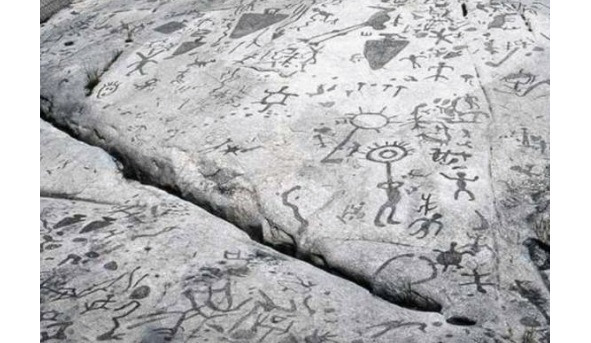
Petroglyphs — these are rock carvings, incised on rock slopes: in the Sahara of Tassili (Algeria), in the Mato Grosso jungle, in distant Yemen, on the coasts of southern Chile. “Postcards” from the distant past are found from Hawaii to central China, from Siberia to southern Africa, in icy Alaska and on the sun-scorched Kimberley Plateau in Australia.
Near Peterborough in the province of Ontario, on a massive block of crystalline limestone known as ‘white marble,’ measuring 55 by 30 meters, there are over 900 drawings, presumably made by the Algonquin people in the period 900–1400 CE. This sacred rock, forgotten for centuries, was rediscovered in 1924 by the historian Charles Kingam. The boats carved here differ from those used by the Indians, while one sun-boat — a stylized shaman’s vessel with a long mast topped with a sun — resembles petroglyphs from northern Russia and Scandinavia. As Romas and Joan Vastokas — the greatest experts on Peterborough — claim, the Indians regarded one of the fissures in the rock as an entrance to the underworld or the symbolic womb of ‘Mother Earth.’
quote: Colin Wilson, The Atlas of Holy Places & Sacred Sites.
For a better understanding of the meaning of the hidden messages of “pre-flood” architecture, let us pause for a moment at this petroglyph. In this single limestone rock is contained the entire meaning of rock carvings and all the other previously mentioned structures.
For God the Creator not only planned that “pre-flood” man would make these traces, but also foresaw that the one who would find and read them must, by his level of knowledge, be ready to understand them. This moment has now arrived.
The main assumption was that these traces could be read only by a human being who would rise into the air and, from that perspective, see their meaning. This condition has already been fulfilled. For centuries people saw all these structures — pyramids, mounds, circles — and, “not seeing,” did not know their hidden meaning. However, there were individuals who, in flashes of their genius, intuited the hidden meanings, but the fundamental condition of time had not yet been fulfilled — humanity was not ready to discover everything fully.
An example of this “fragmentary” knowledge is the cult of the Bird-Man. It is the traumatic dream of humanity to rise into the air and read the hidden meaning of petroglyphs and awaken the “sleeping pre-flood adolescent.”
The moment of this awakening has now occurred. The cult of the Bird-Man is found all over the world. The dream of flight was the essence of this cult, and Easter Island is the most spectacular example of a place in which it developed.
But let us return to the rock in Peterborough. Upon closer examination of a fragment of this stone block, the intention of its creators becomes visible. The sun-boat symbolizes that the Sun is our life-giving light, without which existence on Earth would not be possible. Next to it is depicted the symbolic outline of man, who was created by God. The Eye of God is visible — a symbol of Providence that constantly watches over him.
The line connecting God with the head of man indicates that contact between God and man takes place by means of a “biological antenna,” which is the human brain. Nearby are visible various figures of man and animals, which symbolizes the genesis and evolution of humanity.
Individual structures differ from one another in form and style, but all speak of one thing: of the path of humanity and the sources of its identity. Their common motif is the symbolic womb of “Mother Earth” — an image of beginning, passage, and rebirth, encoded in stone and space.”
It is also worth noting that all these sacred places and cultural signs arose at different times. The oldest are 3–6, or even more, thousand years old, and the rock in Peterborough was rediscovered and described only in the 20th century, although its petroglyphs date to the period 900–1400 CE. An apparent contradiction arises. Namely, the evidence indicates that the symbolic “flood” did not take place uniformly, in the same place and time.
Each civilization, tribe, or culture reached its apex of development at a different moment, but they were subject to a universal scheme — they created their civilizations and left behind “traces in the snow” in the form of structures. The entire process can be seen clearly in the examples of Easter Island, the Maya, Egypt, China, and other civilizations.
In the spring of 1927, the Peruvian archaeologist Torbio Mejia Xesspe noticed ground drawings. Only in 1940 did he write about his discovery. The German geographer Maria Reiche became interested in Nazca. The ground drawings were colloquially called scratchings. They depict one monkey, a spider, a whale, a dog, an iguana, a hummingbird, and over twenty images of birds. The image of the monkey has hind legs with three toes, one with four, and another with five. These strange lines in the Peruvian desert were called the greatest mystery of the world. Giant straight lines on the sand, rediscovered only from a passing airplane, stretch across an area of 500 km². Using the carbon method, the drawings were dated to the middle of the 4th century CE, though they may be older. They are the work of the Nazca culture. But why are they visible only from the air?
quote: Erich Von Däniken, Signs from the Past.
I repeat: why are the Nazca drawings visible only from the air?!
Using what the introduction devoted to petroglyphs explains, finding the answer becomes childishly simple. In the drawings of the Nazca culture, one can see what geniuses their creators were. Just as in Peterborough, in a concise form they were able to convey their message to subsequent generations. It could be read only from the perspective of bird flight. The people of the Nazca culture used the same code as others — the cult of the Bird-Man. What is ingenious about these drawings?
They used images of birds, which are the most numerous, to mark their affiliation with the cult of the Bird-Man. The drawings also depict animals — monkeys, reptiles, mammals, fish, arachnids — which indicates an awareness of evolution. The monkey with a different number of fingers shows knowledge of the theory of evolution, long before Darwin. This drawing can be compared with the drawing from the Pioneer plaque.
Mounds, Menhirs — The Architecture of Cyclicality
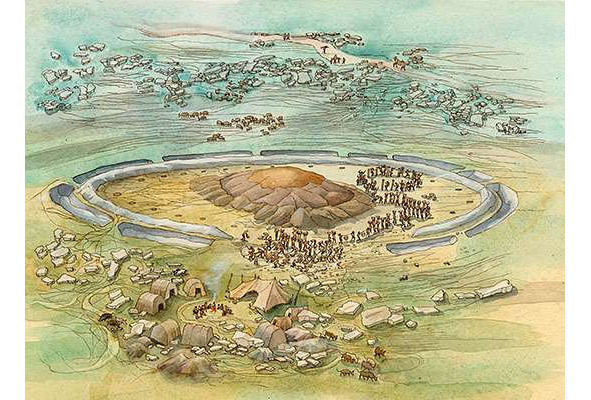
From the earliest times, many communities and cultures built their mounds. Whether they were artificially heaped hills, barrows, or natural elevations or mountain peaks (e.g. Newgrange, Uluru, and thousands of other similar objects), mounds, by their structure and shape, symbolize the belly of a pregnant woman. Every new pregnancy is a new generation, a further step into the future. Through this transformation of generations, there will finally come the long-awaited day for those who believe in the symbol of the “creative force,” when from this “pregnancy” a new, this time more “rational,” human being will be born (de-hibernated).
That such times would one day come, all those pre-flood people knew, and they believed that through their descendants they themselves would be able to be reborn again and exist in some new, better world. This is what God the Creator promised them (Genesis), and thanks to this promise they built their structures all the more eagerly, often devoting to this all their energy and capabilities.
Let us take into account that enormous mounds and other structures were built by communities with small potential, and yet it was possible only thanks to faith. Every look at such a protruding, symbolic belly was filled with longing and hope for better times. Different cultures speak to us in different ways. The idea of mounds is inseparably connected with the idea of setting up boulders. When it comes to erecting monolithic boulders, the greatest specialists in this field were the “pre-flood” Europeans.
Menhir — an elongated stone set vertically, having a cultic character. From Celtic: man — stone, hir — long. The largest concentration of menhirs in Europe, about 3,000, is located slightly north of the Breton town of Carnac.
All of them — except for 70 boulders — form parallel rows, like avenues. In Kremario there are ten such rows, consisting of 1,220 boulders. So far, the age of only one of the local barrows has been established — ‘St. Michel’ — which was created around 5000 BCE, that is, at least 2,000 years earlier than previously assumed. Carnac was a place of worship in Roman times; later, Christian crosses also appeared on the boulders. Among the local inhabitants, however, the memory of their pagan origin survived. On Midsummer’s Eve, at the entrance to the avenues, they light bonfires, and then drive cattle and sheep between the rows of stones, imitating ancient rites ensuring the favor of the gods of fertility. To this day, the boulders are attributed magical power, advising couples with fertility problems to dance between the stones, and young wives to sit on them. The purpose of these powerful boulders arranged in rows remains a great mystery for archaeologists. From the hypothesis that Carnac was the legacy of an unknown seafaring people, through druid temples and astronomical observatories, to the concept of ‘stone graph paper’ for calculating the position of the Moon.
quote: Colin Wilson, The Atlas of Holy Places & Sacred Sites.
All these hypotheses testify to the indolence or ignorance of contemporary scientists. To explain the riddle, it would be enough not to reach for fantasy, but to bow respectfully to folk beliefs. In them, as in a dream (which we partly forget after awakening), the whole of our “traumatic knowledge” on this subject is contained.
Namely, the statements about cattle and young wives clearly testify that those pre-flood inhabitants of Europe saw in menhirs symbolic “sperm,” which, as in the moment of a man’s greatest ecstasy, ejects all its energy in an obvious direction. I hope that my readers are adults and that these words will not offend anyone.
These are precisely those stones arranged in rows. Among these streams of sperm — rows of stones — or in their vicinity, there is always or almost always one, the largest stone, symbolizing the male reproductive organ — the phallus. According to the principle: where there are sperm and individual boulders, there must be their spiritus movens.
The Great Menhir of Locmariaquer is located about 10–15 kilometers from the rows of stones in Carnac, and this distance itself is not accidental, but indicates the existence of a broader, consciously planned layout.
The Great Menhir of Locmariaquer — in the Morbihan region (France), is a massive granite spire 23 meters long and weighing about 348,000 kg. Dragging it along the ground would have been impossible. To raise it and place wooden rollers underneath, it was necessary to evenly position 300 people around 40 levers. To roll it would require 1,750 people or 250 oxen. Light lifting required the effort of 2,100 people or 300 oxen. All these works required perfect coordination of efforts.
quote: L.-R. Nouqier, Thus People Lived.
We already know what significance the boulders had for these people. In order to constitute a complete whole, it was necessary to add equally symbolic “testicles,” represented in the form of two boulders or a circle — a “scrotal sac.” Evidence of such an architectural concept of the builders can be found in: Great Zimbabwe, Egypt, La Venta, Newgrange and Tara, as well as in Avebury and Silbury Hill.
The intention of the creators of these “sanctuaries of human procreation” would not be complete without one more element — the mounds. It is precisely the mounds — that is, “human pregnancy” — that are the effect of male foresight.
All elements: boulders — sperm, menhir — phallus, circles — testicles, mounds — the female belly, constitute a perfectly thought-out architectural whole. Some of these objects were destroyed as a result of the activity of missionaries or the passage of time, but what remains bears witness to the intentions of their builders in their full scope.
These pearls of pre-flood architecture are at the same time a testimony to the cultural unity and faith of that entire world. The idea of these structures was everywhere the same. All these “traces” of the past can be read only from a certain height — the cult of the Bird-Man. This can be seen clearly in Avebury and Silbury Hill.
Avebury and Silbury Hill — Archetypal Order
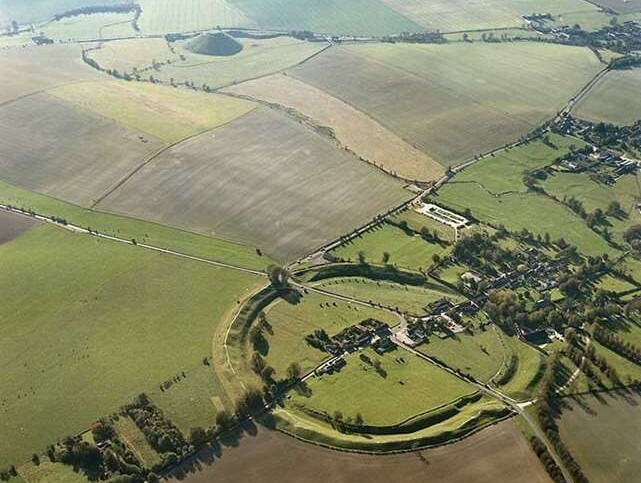
Avebury and Silbury Hill — the great megalithic complex near the village of Avebury in the county of Wiltshire once looked even more impressive than Stonehenge, and its oldest part, the ‘Sanctuary,’ comes from roughly the same period (3000 BCE). Inside a massive chalk embankment rose the largest circle known to us. It was formed by a main ring of 90 blocks, weighing about 5 tons each, and two smaller rings, consisting of 30 boulders each. An avenue of vertically set stones connected Avebury with a nearby temple on Overton Hill. South of Avebury rises Silbury Hill, the largest human-made mound in Great Britain, dating to around 2500 BCE, having a circumference of 183 meters at the base and a height of 55 meters.
quote: Colin Wilson, Sacred Places and Sacred Structures of the World.
South of Silbury Hill there are two smaller elongated mounds, the so-called West Kennet and East Kennet, dated to 3600 BCE. When one looks at Silbury Hill from inside the stone circle, only the upper segment of the mound is visible, protruding above the horizon defined by the natural hill of Waden Hill on the left side and another natural elevation in the distance on the right. The horizon line is arranged in such a way that the вершина Silbury Hill is as if pressed between the slope of Waden Hill and the peak of the distant ridge. The River Kennet, flowing through the very center of the Avebury complex, emerges from the Swallowhead spring, located less than 800 meters from Silbury Hill. Swallowhead is a periodic spring — it dries up in autumn and resumes activity only in early spring. The River Kennet, until relatively recently, in the 18th century, was associated by the local population with the female vagina.
quote: “Factor X” 2001, No. 62.
All the elements of this puzzle in this “sanctuary” are brilliantly positioned. Avebury is nothing other than a “scrotal sac with two testicles.”
But the symbolism of the complex is not limited solely to individual stones or rings. Every mound, river, and natural elevation formed a fully thought-out network of meanings, showing the connection between the cycle of human life and the rhythm of nature and the universe. Silbury Hill, with its monumental height and mass, constituted the symbolic belly of a woman, and the River Kennet — flowing exactly through the center of the complex — symbolized periodic fertility, variability, and the repetitiveness of life.
In this way, the creators of the complex not only documented their knowledge, but also programmed the space for rituals that were meant to teach future generations the observation of the cyclical laws of nature and the cosmos.
It was an architecture of knowledge hidden in the landscape, to which access was granted only to one who could read both the stones and their relationship to natural landforms — a human fully conscious of the cyclicality of life and the universe.
It is assumed that in the very center of the smaller northern circle there once stood some structure, of which only two boulders have survived to this day, called the Cove. In the center of the southern circle once stood a huge rock block 6 meters high and with a circumference of about 2.5 meters. The first researchers of this place called it the Obelisk. Unfortunately, in 1723 this gigantic stone collapsed, and was then crushed and removed.
quote: “Factor X” 2001, No. 62.
Every year solemn ceremonies were held there, similar in character to those that took place in ancient Egypt, Greece, and in other civilizations. What did these ceremonies consist of? Generally speaking, they were connected with the cult of the Sun. Through the fact that grain was cultivated every year on the slope of Waden Hill, and the fields of this grain at the same time each year covered the summit of Silbury Hill, and after the harvest this summit appeared again, one conclusion can be drawn.
The community of Silbury and Avebury (and other similar ones, living more than 5,000 years ago) thus, through this “encoded” ensemble of structures, testified to their knowledge, to that which we, so “highly educated,” are only now beginning to intuit. Is not this cyclicality of the appearance and disappearance of life (a woman’s pregnancy — Silbury — symbolizing the changeability of generations) analogous to the “mega-cycle” of the cosmological theory of the Big Bang and the final collapse of the universe?
It is precisely in this way that this “cosmic perpetuum mobile” was transmitted to us — people of the times of the “Bird-Man.” Silbury and Avebury were not merely a mound or a stone circle — they were a living symbol of the cyclicality of the universe, and every element of the complex had its deep, symbolic meaning.
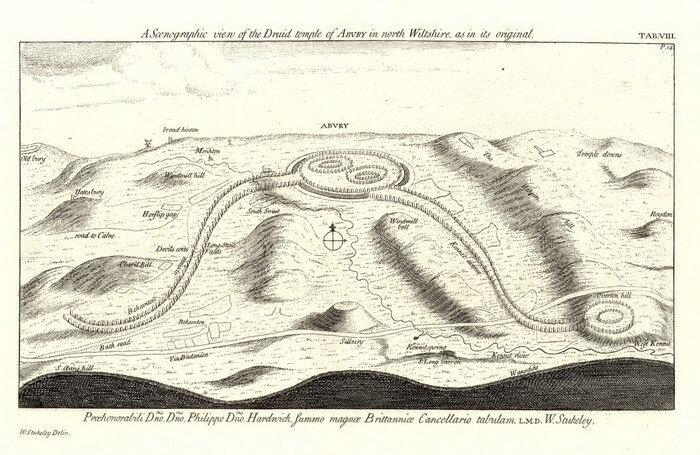
Avebury and Silbury Hill are not merely monumental mounds and stone circles — they are a living testimony to the knowledge of pre-flood people who understood the cyclicality of life and the universe. Every element of the complex — mounds, circles, the River Kennet, avenues of stone boulders — was placed with extraordinary precision to create harmony between human beings, nature, and the cosmos.
The symbolism of the mounds and stones in Avebury is not accidental. Silbury Hill, as a symbol of the belly of a woman, points to the continuity of generations and the birth of new life, and the River Kennet symbolizes the periodic fertility of nature, reminding us of the rhythm that governs all existence. Stone circles and obelisks — once sperm and phalluses — complete this archetypal vision of creation and rebirth, forming an “architecture of life,” visible only to those who can read its hidden meaning.
Ceremonies connected with the cult of the Sun and the rhythm of nature showed that human life and the cosmic cycle are inseparably linked. The message of the creators of the complex was clear: the life of humanity and the universe is cyclical, and understanding this truth requires rising above ordinary earthly perception — the perspective of the “Bird-Man,” who can look at the world from a bird’s-eye view and perceive the hidden geometry of life and the cosmos.
In this way, Avebury and Silbury Hill become not only an archaeological site, but a universal symbol of cyclicality, life, and the creative power of humanity, whose message remains актуalne regardless of the passage of millennia. The complex reminds us that humanity is neither the first nor the last to try to understand the rhythm of the universe, and that true knowledge always lies in harmony between human beings and nature, in the subtle relationships between what is earthly and what is cosmic.
Stonehenge — The Most Essential Attribute of Femininity
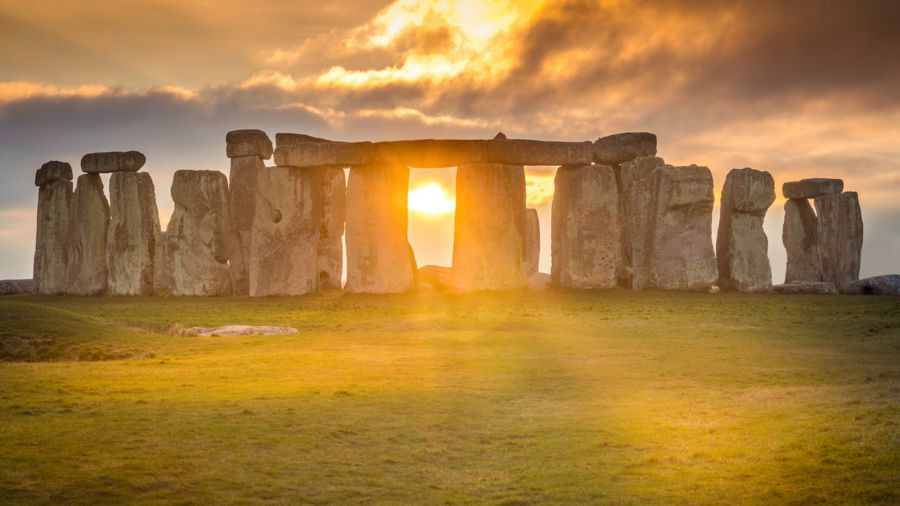
Erecting Stonehenge, the most famous structure in Great Britain, must have been no small feat. It is estimated that to drag each of the vertical boulders across the Marlborough Downs over a distance of 39 kilometers, 1,500 people needed two months. It was once believed that it was a temple in which Celtic druid priests offered human sacrifices. Only in the 20th century did the astronomer Norman Lockyer put forward the hypothesis — now commonly accepted — about the actual purpose of Stonehenge: namely, that it was a kind of calendar that allowed ancient priests to calculate the positions of the Sun, the Moon, and the planets at different times of the year. Lockyer discovered that on the day of the summer solstice the Sun rises exactly over the main Avenue in Stonehenge. That is why it was traditionally celebrated here every year on that occasion. Around 3300 BCE, the first wooden structure was erected at Stonehenge. The first stone circle, consisting of a circular embankment 98 meters in diameter and surrounding 56 ‘Aubrey Holes,’ was built around 2200 BCE. Stonehenge II, that is, two horseshoes of bluestone, was created around 2000 BCE. Many of these boulders were later removed during the construction of Stonehenge III — the great circle of 30 megaliths connected by horizontal lintels and surrounding five trilithons in the form of a horseshoe, erected around 1900 BCE.
quote: Colin Wilson, The Atlas of Holy Places & Sacred Sites.
Trilithon — a group composed of three megaliths — two standing and one lying on their tops.
Megalith — a large structure built of big stone blocks and without mortar. The word comes from the Greek words megas and lithos, meaning “great stone.”
Already the first stage of the construction of Stonehenge confirms that it is not merely a monumental architectural wonder, but a carefully designed representation of the cycle of life and the cosmos. Every stone, ring, and horseshoe serves a symbolic function — not only in relation to astronomical observations, but in relation to the fundamental idea of birth, rebirth, and cyclicality. The arrangement of the stones in circles, trilithons, and rings, their relationship to the lines of the Sun and the Moon, and the placement of elements such as the Heel Stone indicate that the creators of Stonehenge perfectly understood what symbolic “conception of life” is and its repetition in the rhythm of nature.
The outer ring of stones on supports once formed a complete circle. Outside the circle, arranged on a quadrilateral plan, are four stones called the Station Stones — marking the points of the rising and setting of the Sun. There is also a stone called the Heel Stone, which marks the point of the Sun’s rise on the day of the summer solstice, June 21. The meteorologist Terence Meaden noticed quite recently that the shadow of the stone called the Heel Stone penetrates into the interior of the circle during sunrise on the solstice. In his opinion, this is a symbol of the union of Father Sky with Mother Earth, with the Stonehenge circle symbolizing the divine womb.
quote: “Factor X” 2000, No. 61.
Understanding the idea of Stonehenge is very simple. It is neither an astronomical observatory of ancient “scientists,” nor a druid temple, as various “experts” claim.
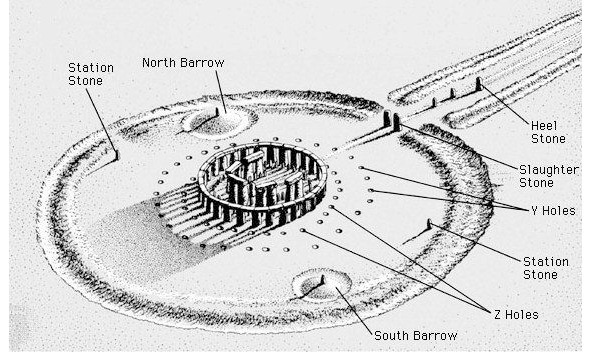
The closest to explaining this “problem” is Terence Meaden, but not entirely and not completely. It is significant that on June 21 the Heel Stone enters deep into the stone circle. Indeed, Terence is right — the shadow cast by this stone in the direction of the horseshoe penetrates into it inside the circle and perfectly, like a sperm joined with an egg cell, “implants itself” in the womb. From that moment a new organism develops, “new life.”
By its structure, this complex in fact resembles not only a womb, but also the other organs as well, namely: the entire abdomen together with the ovaries — the female reproductive glands. That it is a paired organ is evidenced by: North Barrow and South Barrow, while the Slaughter Stone is a substitute for the female clitoris.
There remains the question of the participation of the Sun in this process of fertilization of this symbolic “woman,” as Terence wished — “Mother Earth.” As I have already discussed in the context of petroglyphs — this is neither any “Mother Earth” nor “Father Sky,” just as the “Venus” figurines are also not representations of “Mother Earth.” All these Mothers — are not Mothers, but symbols of the Rebirth of Life.
The Sun, which on June 21 always appears in the same place, is a symbol of rebirth — after “winter death.” It symbolizes that people who have already died and departed “into the streak of shadow,” just like the Sun, which constantly, every year, appears in the “sky of life,” will one day return from the “land of darkness.”
It is worth adding that Stonehenge does not function in isolation. Its structure, its position in relation to the River Avon, the Marlborough Downs, and the axis of the summer solstice form a complex energetic and symbolic system that still вызывает удивление among researchers. Every stone, ring, or trilithon is a fragment of the universal “language of pre-flood man,” whose meaning becomes fully understandable only when we look at it in the context of other places: Silbury Hill, Avebury, petroglyphs, or the Nazca drawings.
It can be said that Stonehenge is something like a “cosmic map of life,” inscribed in stone, which shows us that the cycle of birth, death, and rebirth is not only natural, but also consciously observed and celebrated by humanity. In this sense, every shadow, every ray of sunlight, every ritual — even if today we do not fully understand it — is a testimony to the genius of people who were able to unite astronomy, biology, and cosmology in one monumental work.
Newgrange and Tara — Symbolism of Femininity, Masculinity, and the Cyclicality of Life
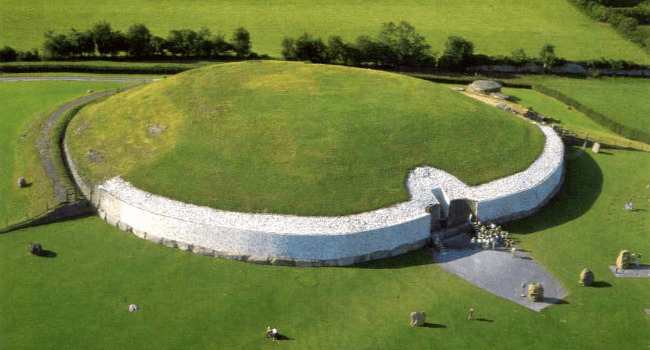
The great mound at Newgrange is one of the most magnificent prehistoric structures in Europe. Traditionally regarded as the burial place of the kings of Tara, it in fact arose much earlier, around 3200 BCE. It is essentially a typical passage tomb: a long tunnel beneath the mound leads to a high, vaulted chamber with three niches, giving it the shape of a three-leaf clover. Contemporary archaeologists claim that it may have been an astronomical observatory. After the careful renovation carried out in 1962 by Michael O’Kelly, it was proven beyond any doubt that the mound is precisely oriented to the cardinal directions. At dawn on the day of the winter solstice, the interior of the tomb is illuminated for a few minutes by a narrow beam of light.
The same can be observed in two other nearby mounds, at Knowth and Dowth. When one looks at Newgrange from the side and from above, one can see a wall at the front of the mound faced with white quartz. At its base, the wall is 97 stones wide, tightly set side by side. Around the mound stand 12 of the original 35 boulders that once formed a stone circle. At the center of the mound there is a chamber with a corbelled vault. The horizontally laid layers of stone gradually narrow toward the top. The entrance to Newgrange is ‘guarded’ by a massive kerbstone (3 meters by 1 meter).
quote: Colin Wilson, The Atlas of Holy Places & Sacred Sites.
The great mound of Newgrange, one of the most magnificent prehistoric monuments of Europe, has for centuries been interpreted as a royal tomb or a primitive astronomical observatory. Meanwhile, its true meaning — deliberately hidden beneath layers of archaeological hypotheses — reaches far beyond any funerary or astronomical function. Built around 3200 BCE, long before the Egyptian pyramids, it is in essence a record of knowledge about the cyclicality of life, about the relationship between humanity and the cosmos, about the sacred unity of masculinity and femininity.
Newgrange is above all a symbol of the Woman — the archetypal Mother, whose body has been encoded into the structure of stone. The thirty-seven boulders surrounding the mound form an oval resembling a woman’s abdomen, and the mound itself, with its convex form, is a figure of pregnancy lasting nine months. The white quartz surrounding the entrance reflects light like the subtle glow of an erogenous point, and the monumental kerbstone decorated with spirals serves as the stone equivalent of female pubic hair.
The most important moment, however, is the winter solstice, when the Sun — the archetypal Father — once a year, for a few minutes, sends a narrow beam of light deep into the tunnel. This is not an astronomical observation. It is an act of symbolic fertilization, a cosmic hierogamy inscribed in architecture thousands of years old.
The beam reaches the central chamber with three niches — the three-leaf clover corresponding to the internal anatomy of a woman — and illuminates the stone basin, the equivalent of the womb. There, according to the thought of the ancient builders, “the gift of God implants itself,” giving birth to new life.
In this gesture of light is contained the entire pre-flood knowledge of the cyclicality of the Universe, of the eternal repetition of birth and rebirth, of the cosmic perpetuum mobile, whose echo is visible in the myths of Dagda and the goddess Boand. In Irish tradition, Dagda — the god of the Sun — and Boand — the embodiment of female water and fertility — form a divine pair whose union finds its material form precisely in Newgrange.
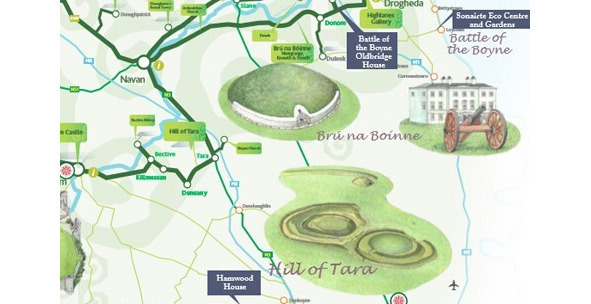
Not far from Newgrange, on the other side of the Boyne, rises Tara, the spiritual center and legendary seat of the kings of Ireland. On the hill there is the Royal Fort with the King’s Seat and the House of Cormac, surrounded by rampart and ditch. In the middle of the latter stands the ‘stone of destiny,’ an ancient fertility pillar and the stone used to inaugurate the kings of Tara.
quote: Colin Wilson, The Atlas of Holy Places & Sacred Sites.
When one looks at the Hill of Tara from above, a clearly defined oval terrain layout emerges, in which one can discern the symbolism of male anatomy. The oval outline of the hill together with two distinct depressions resembles the structure of the scrotum and testes.
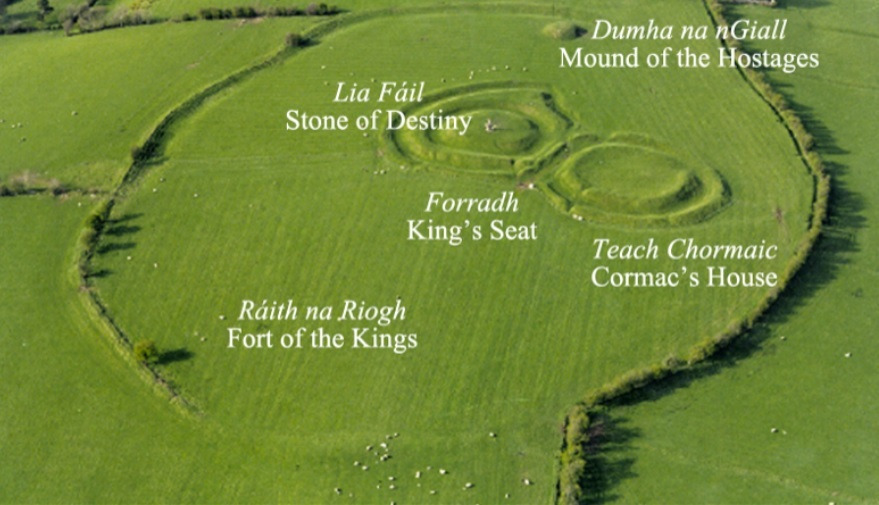
The central point of the composition is the vertical menhir Lia Fáil (Stone of Destiny), which can symbolically be identified with a single sperm cell, a hierographic sign of creative power and the capacity to initiate life.
Around it, the oval depressions of the hill resemble the scrotum and testes, while the stone circles and ceremonial mounds create an entire structure symbolically representing the ancient idea of fertility. Just as Newgrange is the symbolic Woman, so Tara is her male counterpart. Both places, located on opposite sides of the River Boyne, form a single narrative about the union of opposites. Femininity and masculinity are not separated here — on the contrary, only their union reveals the meaning of the whole.
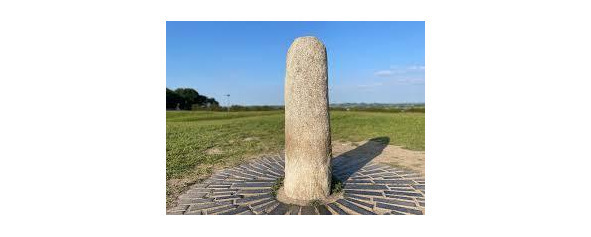
This dualism also finds its echo in the megalithic dolmens scattered across Europe. In Breton tradition “dol-men” means “stone table,” but the construction of these structures — a slab supported by vertical stones — clearly corresponds to the internal space of the female body.
Hundreds of such structures in Europe — from Ireland to Portugal, from Brittany to Scandinavia — show that this was a global, coherent, “pre-flood” knowledge. These were not random constructions nor architectural manifestations of power, but sanctuaries inscribed into the cosmic cycle, built under the influence of a spiritual impulse that can be called the moral imperative of ancient people.
The builders left us not religions or texts, but a system of symbols. Tumuli, pillars, dolmens, central chambers, solar solstices — all of this forms a universal language whose key is the understanding of the cyclicality of life. They knew that a time would come when humanity would rise into the air like the Bird-Man — and the view from above would reveal their hidden meanings.
Newgrange and Tara, connected by an invisible thread of the symbolism of femininity and masculinity, become not only sacred places, but a map of cosmic knowledge, a record of the cycle of birth and rebirth, in which the human being is both participant and witness. Their message is simple and at the same time metaphysically profound: life arises from the unity of opposites, and its rhythm is a reflection of the rhythm of the Universe.
Noah’s Ark Is Everywhere!
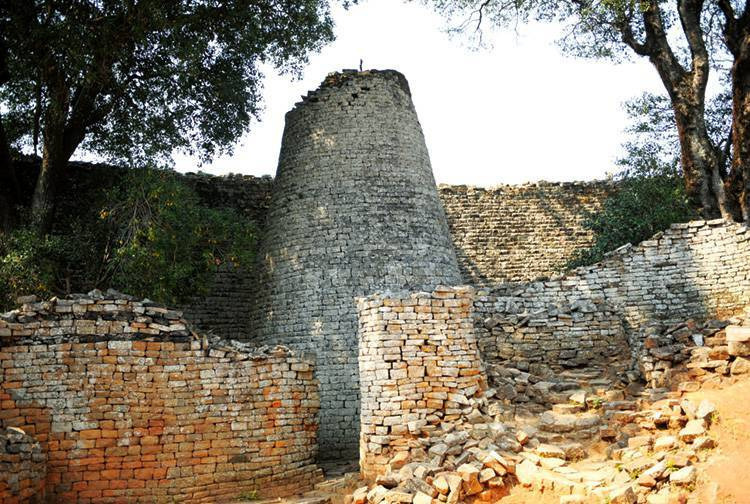
Great Zimbabwe — the ruins of ancient Zimbabwe undoubtedly belong to the most impressive structures in Southern and Central Africa. The oldest settlement dates back to the 4th century BCE, but its greatest period of flourishing occurred between the 10th and 15th centuries. The most important structure is the elliptical Great Enclosure with massive walls whose thickness exceeds 6 meters. The ruins on the hill, located 400 meters north of the Great Enclosure, include, among others, the Eastern Enclosure — the main sanctuary — where monoliths stood on circular stone platforms, sometimes crowned with stone bird statues. The walls of Great Zimbabwe were built from tightly fitted granite blocks, without foundations and without mortar. The outer wall of the Great Enclosure has a volume of 5,154 cubic meters and is the largest monumental structure in sub-Saharan Africa. One of the greatest mysteries is the 10-meter tower narrowing toward the top.
quote: Colin Wilson, The Atlas of Holy Places & Sacred Sites.
Without further ado, let us decipher this “code” from South Africa. The main complex, the Great Enclosure, is nothing other than the “male jewels” — the scrotum and the phallus. The conical tower is a symbolic representation of the male phallus, and the corridor is a symbolic urinary-genital passage leading the “seed” to the “male cannon.”
The Eastern Enclosure on the Hill of Ruins is the target of this “cannon” — the female reproductive organs. In this sanctuary, most likely annual mysteries were held in honor of the god Mwari — the Creator of the world. We also encounter here the cult of the Bird-Man, symbolized by statues of bird-idols — they are not ordinary birds, but representations of the human of the future, who will rise into the air and read the hidden message of the ancestors.
Almendres Cromlech and Anta Grande do Zambujeiro — similarly to northern France and Great Britain, Portugal and southern Spain abound in prehistoric megalithic structures. The largest and one of the most impressive stone circles, called cromlechs, is located at Almendres — 95 boulders form a double oval with ‘petals’ at both ends. Anta Grande do Zambujeiro — a massive mound — hides one of the most beautiful gallery tombs in Portugal, almost 6 meters high.
quote: Colin Wilson, The Atlas of Holy Places & Sacred Sites.
After reading about Newgrange, the phenomenon of Almendres and Anta Grande do Zambujeiro becomes obvious. Similar sites are also found in Germany:
Visbeck — the areas of Ahlhorn, Visbeck, Dötlingen and Wildeshausen, area 39 ha, about 500 stone circles and megaliths. The names of the circles, e.g. Visbecker Braut (The Bride of Visbeck), indicate that the circles served weddings. The largest stone circle — Visbecker Bräutigam (The Bridegroom of Visbeck) — 130 boulders. Sacrificial table — the most frequently photographed stone in Germany, in reality a huge phallus.
quote Nieznany Świat 2001, no. 5.
All these symbols of the genius and thoughtfulness of the ancestors are single, representative examples of cultures. Carnac, Great Britain, Zimbabwe, or Sardinia are places where universal archetypes of masculinity and femininity can be read.
Kup książkę, aby przeczytać do końca.