
Introduction
This book was created from the conviction that the discography of Led Zeppelin is not what it has been considered to be for decades. It is not merely a collection of rock albums, it is not a random sum of lyrics, riffs, and mythological borrowings. It is a precisely constructed cipher — a multilayered narrative in which music, word, image, and symbol cooperate to tell one coherent story.
This story is not the history of the band, nor is it the autobiography of its members. Led Zeppelin used the form of a rock band as a mask, a “decoy,” behind which a much deeper message was hidden: the biography of one real, actually existing man, written out across successive stages of the development of the world, humanity, and consciousness.
That is why the first albums speak of the birth of the Earth and life, the next of spirituality, history, and conflict, and the fourth album constitutes a turning point — the moment when the narrative ceases to concern humanity as a whole and begins to concern one specific individual.
This message was never meant to be delivered directly. It was deliberately encrypted, because only such a form allowed it to survive beyond time, fashion, and the censorship of literalness. The language of this story is not science nor chronicle, but myth, poetry, and symbol.
Meaning is not found in single verses, but in their mutual relationships; not in one song, but in the order of the entire discography; not in the literal meaning of words, but in the tension between sound, silence, and image.
Led Zeppelin’s fourth album — untitled, marked only by four signs — is the key to the whole. The four symbols are not decoration nor an artistic whim.
They are ideograms of the elements: water, fire, earth, and air. The fifth sign, associated with Sandy Denny, completes them as the quintessence — ether, the spiritual element. Only their joint reading makes it possible to understand that we are not dealing with the aesthetics of occultism, but with a consistent system of meanings.
The tracks of this album form the diary of the “bearded” man — a record of key events in his life, encoded in symbols, archetypes, and mythological images. In this book I do not propose a classical literary or musicological analysis. Instead, I indicate dates, stages, and boundary points that allow the synchronization of song lyrics with the real course of history and the development of consciousness.
This is not an attempt to “unmask” the band or to attribute intentions to its members that they did not possess. It is an attempt to read the work as a whole, with the assumption that great art does not arise by accident, and that coherence on this scale cannot be the result of improvisation.
If Led Zeppelin were only a rock band — this book makes no sense. If, however, they were carriers of a story meant to survive decades, then everything begins to fall into a logical sequence. This work does not demand belief. It demands attentiveness. It is an invitation to listen to Led Zeppelin as one listens to a myth: without literalness, without haste, with readiness for the possibility that the history of the world may at the same time be the history of one life.
This Is Not a Book About the Band
To begin with, we must state the matter clearly: this book is not the history of the band Led Zeppelin. If you open it expecting to read a chronicle of the rock 1970s, personal anecdotes of the musicians, or a description of studio recordings — put it down immediately. What you will find here is something far greater, more ordered, and more disturbing: the discography of Led Zeppelin is the carrier of a hidden history of one life.
The band we know from album covers, interviews, and concerts was a mask, a cover for the true message. Every album, every track, every symbol and sound — everything was carefully thought out in order to weave a narrative that the average listener was unable to decode. This is not a work of chance. It is a record of a life, told in the language of myth, archetype, elements, and symbols. If you think Led Zeppelin were creating only for themselves or for the music market, you must abandon those notions — there is no place for accident here.
The band’s first albums do not speak about the members of the group, but about the birth of the world and of life. The subsequent ones focus on spiritual experiences, history, and conflict. Only the fourth album becomes a personal diary — a record of the life of a specific man, whose судьбы were encrypted in songs, symbols, and album covers.
This man does not appear directly; he cannot be read by traditional methods. His life must be read like a cipher, by understanding every element of the whole and every seemingly accidental detail.
The purpose of this chapter is to prepare you, the reader, for a change in the way of thinking. You must accept that Led Zeppelin is not a band, but a form of transmission. Every sound, every pause, every symbol is part of a puzzle. To enter this story, you must reject literalness, reject habits, and open yourself to systemic thinking. Only then will you discover that what for decades was considered a rock legend is in reality a perfectly designed cipher of the life of one person.
From this moment on, you will no longer listen to Led Zeppelin as everyone else does. Now you should read their music as if it were a document. Each subsequent chapter will show you how to decode this story, how to understand the symbols, and how to connect all the elements into a coherent narrative. This book does not give easy answers, but offers something far more valuable: a key to one of the most mysterious musical transmissions of the twentieth century.
Why the History Had to Be Encrypted
Not everything that is true can be said directly. Time, place, convention, and the consciousness of the recipient impose limitations — and Led Zeppelin understood this perfectly. This was not about hiding information for sensational or conspiratorial reasons. It was about the survival of a truth that could not be transmitted safely, without the risk of distortion, omission, or banalization.
The band’s discography is a system: every sound, every riff, every arrangement, every pause, as well as graphic symbols, album covers, and the order of the albums — all of this forms a single, unified narrative. If you try to read these works the way one reads an ordinary literary text, you immediately lose the meaning. Led Zeppelin created a cipher based on the combination of myth, archetype, and elements, which operates on the level of the subconscious and cultural archaeology.
Why was the cipher necessary? Because the real life described by the songs did not fit the form of a traditional chronicle. It was too complex, too multilayered, and at the same time too fragile to survive without protection. It had to survive in the form of music, because music as a medium is invisible, ambiguous, and resistant to banalization. Anyone who tried to read it without a key would see only fragments, not the whole — legend, not truth.
The concealment of the history was therefore not only a necessity, but a strategy of survival. Masking the true biography behind layers of sound, poetry, and symbol protected it from banalization, oblivion, and simplification.
The discography of Led Zeppelin is not accidental — every album, every note, every graphic element was designed to function simultaneously as a musical work and a document of a life.
This chapter is meant to prepare you, the reader, to understand the need for the cipher and to open yourself to methods of decoding. Only by accepting this principle can one see that Led Zeppelin created something far more than a band — they created a durable, multilayered record of a life that survived decades hidden in sound and symbols.
How to Decode the Discography of Led Zeppelin
Now that you already know that Led Zeppelin is not a band in the traditional sense, you must learn to read their music as a document. This means abandoning interpretative habits — no reviews, no gossip, no conventional biographies. Every track, every arrangement, every symbol has meaning only within the context of the whole.
The discography is not a collection of random experiences of musicians; it is a system of signs and relations that form a coherent record of the life of one person.
First rule: pay attention to order. The order of albums and tracks is not random. It is a logical sequence, corresponding to successive stages of life and evolution. Reading them in isolation, you will never see the full picture — you will see only fragmentary images that may seem unrelated.
Second rule: pay attention to symbols and images. Album covers, the symbols of Led Zeppelin IV, and even details of instrumental arrangements, rhythms, and pauses — all of this is part of the code. Every element that seems decorative or accidental performs an informational function within the cipher.
Third rule: understand the language of myth and archetype. The song lyrics describe real events, but they are written in the language of myth, symbol, and archetype. They should not be treated as pure metaphor or poetry detached from reality.
Bacteria, DNA, wars, birth, death, and evolution are present, but encoded in the form of universal images. Myth does not erase facts — it masks them. To read them, one must translate symbolic language into a sequence of real processes and life experiences of the hidden figure.
Fourth rule: the elements as an interpretative key. Water, fire, earth, and air, as well as the fifth element — ether — are the fundamental categories that help decode the meaning of the songs on Led Zeppelin IV. Every musical and graphic symbol corresponds to one of the elements, and their combination creates a narrative map of the hero’s life.
Final rule: think systemically. Songs and symbols function only in relation to one another. What in one track seems insignificant may, in the context of the whole album or the entire discography, be a key element of the story. Only systemic thinking allows one to discover the true meaning and decipher the life recorded in the music.
Mastering these principles is not only a technique of reading. It is an entry into a different way of perceiving music and life. Now that you know the rules, you can begin reading the story — step by step, album by album, symbol by symbol.
The Band’s Name — Official and Subliminal
The genesis of the name Led Zeppelin goes back to 1966, when in the London music scene the idea emerged to form a supergroup involving Jimmy Page and Jeff Beck.
Authorship of the new band name, adopted on October 25, is attributed to Entwistle and Moon from The Who — they stated that a supergroup with them on board plus Page and Beck would go down like a “lead balloon” (lead balloon). Then Peter Grant proposed dropping the letter “a” so that no one would pronounce the first part of the name as leed. The word balloon was replaced with zeppelin, and thus the name Led Zeppelin was coined, which for Page symbolized at the same time both heaviness and lightness. At that time, the following were also considered: The Mad Dogs, The Mad Boys, and The Whoopie Cushions. (link) — https://pl.wikipedia.org/wiki/Led_Zeppelin
The term “zeppelin” itself refers to airships, which directly explains the presence of an airship on the cover of the band’s first album. Initially, George Hardy’s design depicted an airship floating among clouds, but Jimmy Page consciously chose the photograph of the disaster of the passenger airship LZ 129 Hindenburg from May 6, 1937. It was a symbolic choice — combining the power of technology, terror, beauty, and the transience of life, while at the same time announcing a deeper, subliminal dimension of the band’s entire narrative.
All of the above — all this officially accepted knowledge about the genesis of the band and its name — is nothing more than easily digestible “media mush” for well-behaved children and naive recipients of their work. In my interpretation, the name Led Zeppelin and its visual representation are not merely an aesthetic device or a play on words.
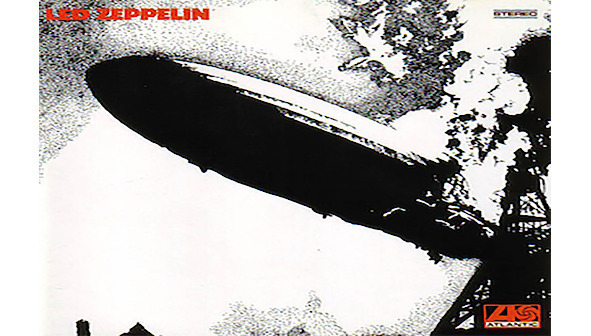
The shape of the airship — distinctly phallic — can be read as a reference to the phallus and the scrotum, and thus to creative energy, agency, sexuality, and the biological drive of life. Proof of the validity of this interpretation is precisely the shape of the airship visible on the band’s first album, which operates unambiguously within this symbolism.
Confirmation of my conclusions is found in the graphic signs and visual identity of Led Zeppelin, which in their subliminal symbolism consistently and clearly refer to archetypal attributes of masculinity.
A key element of this message is the shape of the airship, present both in the band’s name itself and on the cover of the debut album.

The airship — especially in the form in which it was presented on the cover of the first record — has an unequivocally phallic character. Its elongated, cylindrical form, ending in a rounded tip, combined with the massive “base” of the structure, allows it to be read as a symbol of the phallus together with the complementing scrotum. This association is neither accidental nor secondary — on the contrary, it fits into a long tradition of cultural symbolism in which objects that float, penetrate space, and cut through the sky function as signs of male generative energy.
The airship as phallus does not symbolize here sexuality solely in the biological sense. It is a carrier of creative energy, an initiating impulse, a force that fertilizes reality — both in the physical and symbolic dimension. Its ability to float in the air while simultaneously retaining enormous material mass perfectly reflects the paradox of masculinity understood as a combination of the weight of responsibility with the need for transcendence and expansion.
An additional, extremely important element of this symbolism is the choice of a specific image — the Hindenburg disaster. In this framing, the phallus is not a sign of stability or eternal duration, but a sign of tension, risk, and potential collapse. The explosion of the airship can be read as a violent release of accumulated energy — a liminal moment in which creative force simultaneously creates and destroys. It is precisely here that the symbolism of Led Zeppelin gains an existential dimension: masculinity is shown not as triumph, but as a process exposed to catastrophe, transformation, and the inevitability of disintegration.
In this sense, the name Led Zeppelin ceases to be merely a striking signboard of a rock band. It becomes the first element of a complex code that announces a biological-existential narrative spread across the entire discography — a narrative of force, initiation, creative impulse, but also of fragility, downfall, and the necessity of transformation. Music, image, and symbol do not function separately here; together they form a coherent record of the experience of masculinity understood as a fundamental driving force of life.
Symbols of the Band Members
The fourth Led Zeppelin album, released on November 8, 1971, is regarded as the band’s magnum opus. The lack of an official title led to the adoption of various names: Led Zeppelin IV, Untitled IV, Four Symbols, Zoso, Runes, and in Atlantic Records catalogues — The Fourth. What distinguishes this album are the four symbols chosen by the band members, which — as it turns out — conceal a much deeper meaning than is commonly assumed.
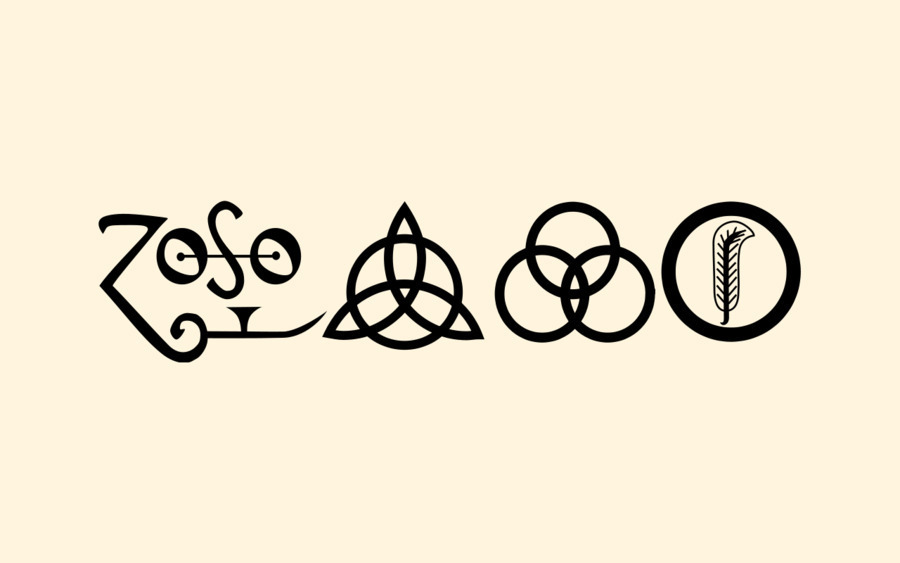
Jimmy Page always claimed that he was the author of his symbol — Zoso. Some interpreted it as the sign of Saturn, and similar forms were also found in books from 1557. Page firmly distanced himself from a literal reading of “ZoSo,” emphasizing that it is an encrypted ideogram.
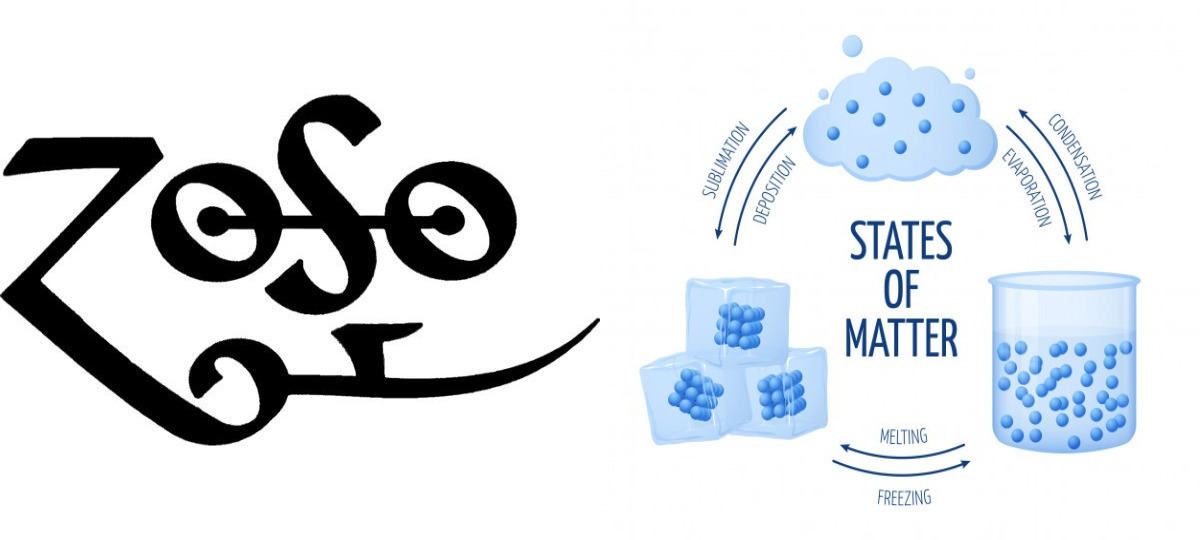
In my view, Zoso symbolizes water — the key element in the system of the four symbols. An analysis of the individual components of Zoso allows one to read the three states of aggregation of water:
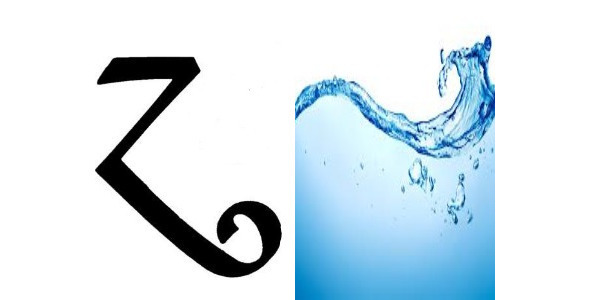
— the Z on the left — a sea wave, a stream flowing from above, symbolizing water in the liquid state,
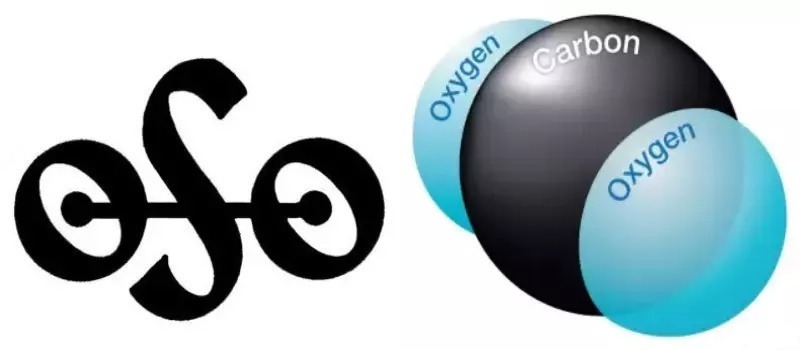
— the oSo at the top — water vapor, symbolizing the gaseous state,
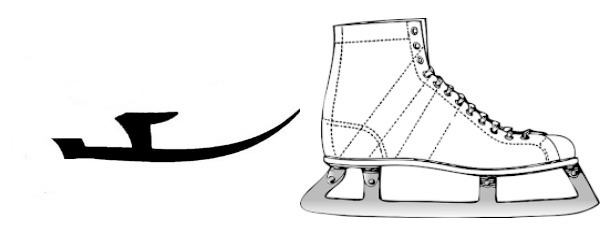
— the fragment at the bottom — unrecognized, but intentionally signifying ice, that is, the solid state.
The remaining symbols encode the other elements: Fire, Earth, and Air.
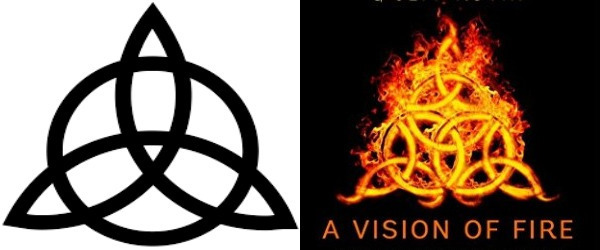
— The symbol of John Paul Jones — fire; energy, transformation, and dynamism in the narrative of the hero’s life.

— The symbol of John Bonham — earth; foundations, stability, and materiality, shown in the drum rhythms and the heaviness of the sound.

— The symbol of Robert Plant — a circle with a bird’s feather inside; air, freedom, spirituality, and imagination.
In this way a coherent system is formed: Water — Fire — Earth — Air. Each symbol is not merely a decoration, but part of encrypted information that leads to the reading of the hero’s life story recorded in the music and symbolism of the album. Only a full understanding of this system allows for a true reading of Led Zeppelin’s fourth album, both in the musical and metaphorical sense.
Symbol of Sandy Denny — Fifth Element

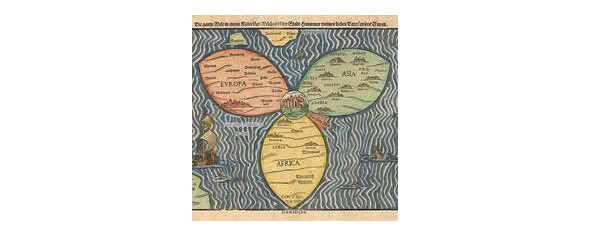
The symbol of Sandy Denny, placed on the inner sleeve of Led Zeppelin IV next to the title of the song “The Battle of Evermore,” serves as a complement to the four symbols of the elements — that is, the fifth element, known as quintessence. Like the other symbols, it is a conventional graphic or written sign that expresses a concept without the use of letters, encoding a deeper layer of meaning. In my interpretation, the Sandy Denny symbol refers to the spiritual capital of the three monotheistic religions — Jerusalem.
On an ancient map of Israel, Jerusalem is located at the crossroads of Europe, Asia, and Africa, which gives it a central role in the mystical understanding of the fifth element.
The fifth element, aether, originates from ancient Greek elemental theory. Initially, according to Empedocles, the world consisted of four fundamental elements: water, air, fire, and earth. Plato combined this concept with atomistic ideas, proposing that reality is composed of basic particles — regular polyhedra — corresponding to the individual elements.
The fifth polyhedron, the dodecahedron, differs in its properties from the others and was believed to be the element from which the heavens are made. Aristotle named this fifth element aether, identifying it with quintessence and the spiritual dimension of reality.
In this way, the Sandy Denny symbol not only completes the four main symbols of Led Zeppelin IV — water, fire, earth, and air — but also unites them into a coherent mystical whole, allowing the album’s deeper message to be read as a story about the unity of the material and spiritual elements.
1. Led Zeppelin I
Cover of the First Led Zeppelin album
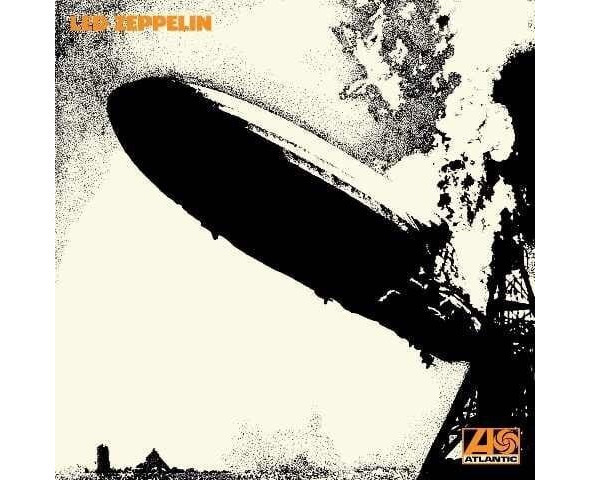
As for the name of the band Led Zeppelin, it is officially known that:
Authorship of the new band name, adopted on October 25, is attributed to Entwistle and Moon from The Who — they stated that a supergroup with them on board plus Page and Beck would dive downward like a “lead balloon” (lead balloon). Then Peter Grant proposed dropping the letter “a” so that no one would pronounce the first part of the name as leed.
The word balloon was replaced with zeppelin, and thus the name Led Zeppelin was coined, which for Page symbolized at the same time both heaviness and lightness. At that time, the following were also considered: The Mad Dogs, The Mad Boys, and The Whoopie Cushions. (link) — https://pl.wikipedia.org/wiki/Led_Zeppelin
And so on, and similar nonsense, which Jimmy Page as well as other initiated members of the band are probably laughing at. The entire existing interpretation of the symbols placed on the album Led Zeppelin IV is a misleading fiction, whose purpose was to divert the audience’s attention from the true gnostic knowledge.
I will only remind that Jimmy Page was, at one time, interested in esoteric knowledge. And it is precisely in this direction that one must go in order to properly interpret his five, not four, symbols — this is the first important clue for correctly decoding his mystery. Incidentally, the lyrics of all the songs, as well as the symbolism of the cover and the interior of the album, are also — how could it be otherwise — encrypted information.
The time has come to take a closer look at the illustrations on the album covers, as well as at the — seemingly banal — band name itself. Judging from the quotation from Jimmy Page included below, the concept of the band’s official name stood in significant contradiction to his previously adopted gnostic plan.
The band’s name comes from the popular term for airships (referring to the surname of the German constructor of these machines), so it is not surprising that an airship appears on the cover of the first album. The design of the cover was commissioned to George Hardy. He proposed an image of an airship in the clouds; however, the idea did not meet with Jimmy Page’s approval. The guitarist proposed instead to use a photograph from the disaster of the passenger liner LZ 129 Hindenburg, which occurred on May 6, 1937, during mooring, after its first flight across the Atlantic. The author of the photograph used was photojournalist Gus Pasquarell from the newspaper Philadelphia Bulletin. Hardy reworked the photograph, giving it a monochromatic appearance using tracing paper. (link) — http://pablosreviews.blogspot.com/2014/06/historie-okladek-led-zeppelin.html
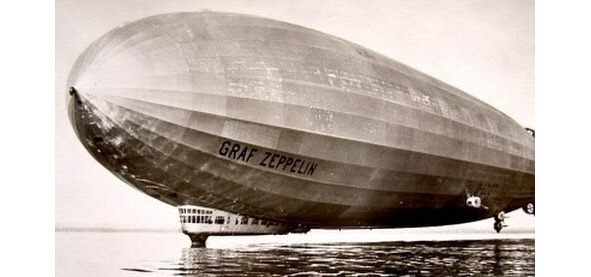
The included illustrations, like Ariadne’s thread, indicate the path of thinking that must be followed in order to exit the labyrinth of false associations.
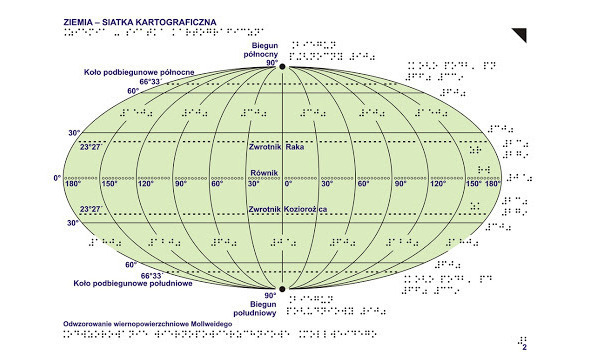
The shape of the airship — in the form of a cigar, and in particular the ribbing of the hull — is very similar to the cartographic grid of the Earth.
Taking, therefore, the similarity of the airship to the grid of the globe as the starting point for further considerations, Page’s suggestion becomes understandable that it should not be an ordinary airship, but an airship in fire — a Zeppelin. It is precisely this and no other airship that was to symbolize planet Earth at the moment of its birth — the Hadean eon, that is, the moment when its entire surface was covered by one great fiery layer — lava.
1. Good Times Bad Times — Formation of the Solar System
The very title of the first track on Led Zeppelin’s debut album leaves no doubt as to its meaning. Good Times Bad Times is not a story about trivial romantic troubles, but a symbolic record of the alternating phases of order and chaos that have accompanied cosmic processes from the very beginning.
One of the key lines to pay special attention to is: “In the days of my youth”, and later: “Now I’ve reached the age”. These lines should not be understood literally, but symbolically. “Youth” here signifies the primal beginning, the period of structure formation, the time of birth of a system that is only beginning to assume a stable form. “Reaching the age” does not refer to the maturation of an individual, but to the moment when the Solar System begins to enter a phase of relative equilibrium.
The recurring refrain: “Good times, bad times” encodes a fundamental principle of cosmogenesis: creation through conflict, collision, and instability. The formation of planets was not a harmonious process — it was a sequence of collisions, accretions, breakdowns, and reassembling of matter. “Good” and “bad” times are here two sides of the same phenomenon. Special attention should also be given to the line: “I know what it means to be alone.” This solitude is not emotional. It is structural solitude — the moment when individual celestial bodies separate from the primordial mass, acquiring their own identity and independent orbits. From that moment, every planet, every object in the Solar System, is alone.
Equally important as the lyrical layer is the sonic layer of the track. In Good Times Bad Times, Jimmy Page used a Leslie speaker, producing a characteristic swirling effect. This is not a random technical trick, but an element that reinforces the symbolic message. The spiral, pulsating character of the sound perfectly evokes the image of the rotating protoplanetary disk from which the future Solar System emerges.
John Bonham’s drumming rhythm creates the impression of a cosmic pulse — regular, powerful, almost mechanical, like processes occurring on an astronomical scale.
The band’s name, album covers, illustrations — all these elements are merely the external façade of encoded esoteric knowledge. Only through analyzing the lyrics, arrangements, and track order does it become clear that each Led Zeppelin album is a fragment of a larger whole.
The lyrics of the first album, without any deviation, tell the story of the earliest beginnings of our planet — the birth of Earth and its “youth.” Good Times Bad Times opens this narrative, describing a moment even earlier than Earth itself: the formation and early evolution of the Solar System.
The hidden content is not presented in a trivial or literal way. This is not a scientific treatise about gas, dust, and gravity. As in all poetry, the meaning lies between the lines, in the overall message, in the rhythm, and in the color of the sound. All subsequent tracks form a single logical sequence — consistent with what modern science has been able to determine and prove.
2. Babe I’m Gonna Leave You — Formation of the Moon (Giant Impact Theory)
Since the first track on Led Zeppelin’s debut album told the story of the formation and early evolution of the Solar System, the natural continuation of this story is the next stage — the separation of the Moon and the formation of the Earth–Moon system. Babe I’m Gonna Leave You represents precisely this fragment of the narrative.
The very title of the song is absolutely crucial here. “I’m gonna leave you” does not signify a breakup, but a necessary separation — leaving that is inevitable, though painful. Symbolically, it is an exact description of the process in which one object separates from another while still maintaining a lasting connection.
The lyrics repeatedly reference a call, an impulse that cannot be ignored, for example in lines like: “I can hear it callin’ me” and “I’ve really got to leave you.” This “calling” is not emotional. It is a physical force, a necessity dictated by the laws of nature. Just as in the Giant Impact Theory, according to which a planet called Theia collided with the young Earth, causing a massive amount of material to break away, which eventually formed the Moon.
Particularly significant in this track is not only the text but a specific moment in the arrangement. Between 2:13 and 2:25, there is a rising, dramatic sound that can easily be compared to the noise of falling meteors. This is one of the most suggestive passages on the entire album.
This sound conveys the catastrophic nature of the collision that led to the formation of our natural satellite. The planet Theia must have generated a far more powerful and destructive force than contemporary meteors — precisely that tension and terror can be heard in this part of the song.
In the lyrics themselves, there are many symbolic references to a close, almost intimate relationship that, despite separation, remains unbroken. The motif of a “friend,” someone dear who must be left but whose bond is never severed, perfectly reflects the Earth–Moon relationship — celestial bodies that, from the moment of separation, remain in a constant gravitational connection.
The repeated assurances of return, of a future “walk together,” of the relationship enduring despite distance, can be read as a symbolic anticipation of orbital stabilization and the long-term balance of the Earth–Moon system, which allowed the further development of the planet.
The track order on the album is not accidental. Babe I’m Gonna Leave You confirms the previously stated thesis that the cover of Led Zeppelin’s first album symbolizes the first stage of Earth’s formation — a violent, chaotic, catastrophe-driven phase, yet absolutely necessary for creating conditions favorable to life. In this sense, the Moon is not an alien body or an addition, but a consequence. It is “that which had to leave” for the story to continue.
3. You Shook Me — Time of Constant Shocks
In earlier discussions regarding the cover of Led Zeppelin’s first album, I pointed out that the burning airship symbolizes planet Earth at the moment of its birth, in the Hadean eon — a time when the entire surface of the young planet was covered by one vast, pulsating fiery layer of lava. The third track on Led Zeppelin I is a direct musical and symbolic development of this idea.
The title itself — You Shook Me — leaves no doubt. Shocks, vibrations, and continuous movements are the essence of this stage in Earth’s history. The Hadean was a period of permanent instability: constant meteor bombardments, violent movements of matter, unceasing quakes, and the pulsation of the planet’s interior.
Repeated phrases in the lyrics about being shaken all night, by a force so intense that it offers no respite, should not be read literally, but as a description of the planet’s state — a planet that has yet to know silence or stability. “Night” in this sense is a metaphor for the primordial darkness, the time before the formation of the atmosphere and the emergence of a solid crust.
Equally important is the choice of musical style. You Shook Me is a blues track, which, against the background of the other compositions on the album, may seem surprising. The question arises: why, here at the very beginning of the band’s discography, and at such a critical point in the narrative, did Jimmy Page choose a song in the classical, raw blues form?
The answer — considering the overall concept presented earlier — is deceptively simple: it was meant to be this way. Blues here serves as the primordial musical language: archaic, simple, based on tension and repetition. It is the musical equivalent of primordial matter — still unformed, raw, and pulsating with energy.
An additional element supporting this interpretation is the use of the characteristic blues call-and-response structure. This instrumental and vocal dialogue can be read as the resonance between the planet’s interior and its surface, between energy and reaction, between shock and the response of matter.
It is also significant that this track became a source of conflict between Jimmy Page and Jeff Beck. Since Page was willing to risk his friendship, it shows that this track was of special importance to him. You Shook Me is not filler or merely a tribute to the blues — it is an essential element of the larger symbolic construction.
The Hadean was a time without forms, without contours, without life, but full of motion, energy, and chaos. This track perfectly captures that atmosphere: heavy, oppressive, full of tension, lacking a melody leading to harmony. It is a musical depiction of a planet that does not yet know what it will become, but is already intensely taking shape.
In this way, the third track on Led Zeppelin I closes the first act of the story of Earth’s birth — a brutal, noisy, and unstable act. The following compositions will gradually guide the listener toward the planet’s cooling, the condensation of matter, and the first, still very tentative steps toward life.
4. Dazed and Confused — Origin and Evolution of Life on Earth
According to the continuum of time for the origin and evolution of life on Earth, after the hellish Hadean came a kind of “purgatory” — the replication of organisms. Science has already discovered and sufficiently demonstrated the successive stages of life’s emergence on our planet, so I will present them here symbolically, without going into more detailed analysis.
The basic “building blocks” of life are: RNA, DNA, bacteria, archaea, eukaryotes, photosynthesis, oxygen, atmosphere, multicellular organisms, invertebrates, vertebrates, and then — following the development of vegetation — the emergence of vertebrates from water, insects, and reptiles. The confusion, chaos, conflicting emotions, and constant tension present in the lyrics perfectly capture this stage — life emerging under extremely harsh conditions, constantly balancing between survival and annihilation.
The following passage clearly confirms that newly emerged life went through many stages lasting millions of years, and this process was neither simple nor uniform. Evolution had its violent moments, crises, and mass extinctions, followed by new explosions of biological diversity.
In his 1997 publication Led Zeppelin Live: An Illustrated Exploration of Underground Tapes, Luis Reydissects the pattern of the song (as it was in 1975) into twelve sections, in order to demonstrate its gradual state of evolution when played live:
Stage 1: Bass intro and wah-wah interludes
Stage 2: Main vocal theme
Stage 3: Fast instrumental and „oriental” riffs
Stage 4: „San Francisco / Achilles Last Stand” or „Woodstock”
Stage 5: Violin bow episode including echo-slapping from the guitar; interlude with Plant’s „instrumental voice”; Gustav Holst’s Mars, the Bringer of War and return of the rhythm section
Stage 6: Fast guitar solo and battle with Plant
Stage 7: Slower tempo solo and „funky” moods
Stage 8: Violent breaks and call and response interlude
Stage 9: Faster solo in crescendos and occasional break-up tempo, some occasions combined with „Walter’s Walk” or „St. Tristan’s Sword”
Stage 10: New arrangement of Mars, the Bringer of War (slow and fast versions) and final frenzy
Stage 11: Return to main theme
Stage 12: Coda. Final instrumental and vocal battle inside syncopated rhythms, drum-solo and final explosion.
(link) — http://self.gutenberg.org/articles/eng/Dazed_and_Confused_(song)
Dividing the song into such clearly distinct sections brilliantly mirrors the previously mentioned, vastly different stages of life’s evolution on Earth. Chaos, violent shifts, periods of relative stability, and sudden structural breakdowns in the music correspond directly to the biological process of evolution.
Dazed and Confused thus becomes a musical metaphor for the birth of life — a long, brutal process full of trials and errors, yet steadily leading toward increasing complexity.
5. Your Time Is Gonna Come — Age of the Dinosaurs
The next stage in the evolution of life on Earth is the era of the dinosaurs. As is well known, for a long period, mammal-like reptiles (synapsids) coexisted with dinosaurs in the same environment. It was a time of tension, competition, and struggle for dominance. For more detailed studies on this topic, I refer interested readers to scientific literature and primary sources.
The lyrics of Your Time Is Gonna Come surprisingly accurately reflect the nature of this conflict. There is a clear division of roles: the dominance of one side, the growing frustration of the other, and the inevitable announcement of change. The chorus — repeatedly stating “Your time is gonna come” — sounds like a prophecy of the end of an era, a warning directed at those who seemed invincible.
Particular attention should also be paid to the musical layer of the song. Jimmy Page used a ten-string steel guitar, which he learned specifically for this recording session. It is hard to believe this was purely an aesthetic choice. Was it only to achieve a unique sound, or also to convey something more — the symbolic weight and monumentality of the era described in the song?
The beginning of the composition — from the opening up to around 1:16 — is truly monumental. It sounds like a musical narrative of power, stability, and the unquestioned reign of the dinosaurs. There is majesty, confidence, and calm derived from dominance.
The remainder of the song clearly foreshadows the impending catastrophe — the event that, around 65 million years ago, determined which species would emerge victorious from the millions-of-years-long conflict between reptiles and mammals. The shift in dynamics, tension, and emotional weight of the lyrics perfectly correspond to the turning point that ended the dinosaur era and opened the way for further development of life on Earth.
Your Time Is Gonna Come can therefore be interpreted as a musical metaphor for the inevitability of change in nature, where no dominance lasts forever. The song reminds us that evolution is guided neither by justice nor morality, but by the relentless logic of adaptation and chance. In this sense, it foretells the next chapter in the story of life — a world after the fall of the giants, where new forms of existence are only beginning to seize their opportunity.
6. Black Mountain Side — After the Dinosaur Extinction
The beginning of the track — the first few seconds — directly follows the ending of Your Time Is Gonna Come and symbolizes the moment of the dinosaurs’ extinction. It couldn’t have been signaled more clearly. Anyone wishing to refute my interpretation of the previous songs should simply listen to the original recording of the band. This transition is deliberate and unmistakable. What comes next? Well — evolution follows its own laws. And mammals took advantage of them.
Musical inspiration: the Irish folk song Down by Blackwaterside. The choice to draw from an archaic, folk musical form is significant — it takes us back to “primordial” structures, simpler but enduring. Exactly as life, after the great extinction, was forced to retreat in order to rebuild itself on new principles.
The song tells the story of a woman who has her heart broken „down by Blackwaterside” when a suitor breaks his promise of marriage that he made to trick her into having sex with him. The morning after her suitor mocks her for believing that he would marry her and tells her to go back to her father. He tells her she has only herself to blame for having sex before marriage. She realizes he will never return and berates herself for believing his lies.
(link) — https://en.wikipedia.org/wiki/Down_by_Blackwaterside
This story — seemingly personal and social in nature — takes on a deeper, symbolic meaning in the context of the entire album. Betrayal, abandonment, the end of the old order, and the necessity to survive in a new reality perfectly correspond to the “post-catastrophe” period, when life must find its place anew.
The Irish folk song, serving as the foundation for Led Zeppelin’s instrumental track, is thus further confirmation of everything described above. After the extinction of the dinosaurs, the world does not end — it transforms. And new life is born in silence, simplicity, and patient endurance.
7. Communication Breakdown — Early Mammalian Evolution
In this Led Zeppelin track, we encounter a symbolic depiction of the next stage in the evolution of life on Earth — the early development and diversification of mammals. The song title, Communication Breakdown, does not refer solely to human relationships. In my interpretation, it serves as a metaphor for periodic ecological crises and mass extinctions that opened up new environmental niches, allowing a new group of organisms — including mammals — to expand and thrive.
The line “Communication Breakdown, It’s always the same” can be read as a symbol of the recurring events of mass extinction that shift the balance of power in nature. These processes allowed mammals to develop and occupy niches left vacant by extinct dinosaurs. This reading aligns with scientific observations:
Mass extinctions have sometimes accelerated the evolution of life on Earth. When dominance of particular ecological niches passes from one group of organisms to another, it is rarely because the new dominant group is „superior” to the old and usually because an extinction event eliminates the old dominant group and makes way for the new one. For example, mammaliformes („almost mammals”) and then mammals existed throughout the reign of the dinosaurs, but could not compete for the large terrestrial vertebrate niches which dinosaurs monopolized. The end-Cretaceous mass extinction removed the non-avian dinosaurs and made it possible for mammals to expand into the large terrestrial vertebrate niches. Ironically, the dinosaurs themselves had been beneficiaries of a previous mass extinction, the end-Triassic, which eliminated most of their chief rivals, the crurotarsans.
Link — https://en.wikipedia.org/wiki/Extinction_event
Musically, the tension and rhythmic drive of Communication Breakdown are significant. The accumulation of energy and repetitive instrumental motifs reflect evolutionary pressure and the dramatic restructuring of the Earth’s ecosystems following the extinction of the large reptiles. The song is thus a symbolic record of a “breakdown in communication” between the old and new biological orders.
Communication Breakdown illustrates a transitional moment — a period of chaos and disorganization from which a new biological order emerges, one based on adaptation and flexibility. In this sense, the song foreshadows the continued path of evolution, leading to increasingly complex life forms and ultimately to the emergence of humans.
8. I Can’t Quit You Baby — Human Evolution
In this Led Zeppelin track, we can discern a symbolic depiction of the final stage of life’s evolution on Earth: the emergence of Modern Humans. The title “I Can’t Quit You Baby” and the lyrics, such as:
„Oh, you know I love you, babe
My love for you I could never hide
And when I feel you near me, little girl
I know you are my one desire”
Can be interpreted as a metaphor for the evolutionary “attachment” of the human species to survival and the continuity of the hominid lineage, from earlier species up to Homo sapiens.
The symbolism of the song points to the moment when humans achieve full consciousness and a definitive place within the Earth’s ecosystem, a position that is the result of all prior evolutionary stages: replication of organisms, the age of the dinosaurs, and the early evolution of mammals. Scientific perspective:
Human evolution is the evolutionary process that led to the emergence of anatomically modern humans, beginning with the evolutionary history of primates — in particulargenus Homo and leading to the emergence of Homo sapiens as a distinct species of the hominid family, the great apes. This process involved the gradual development of traits such as human bipedalism and language, as well as interbreeding with other hominins, which indicate that human evolution was not linear but a web.
link — https://en.wikipedia.org/wiki/Human_evolution
In my interpretation, the song also symbolizes the emotional and biological bond of humans with their evolutionary past and with the species that led to the emergence of Homo sapiens. It serves as the logical conclusion to Led Zeppelin’s first album — a narrative about the birth of Earth, the evolution of life, and finally, the emergence of humans.
The track emphasizes that modern humans are not beings separate from nature, but the culmination of a long, fragile process, whose interruption would sever the connection to their origin. I Can’t Quit You Baby becomes, therefore, a musical reflection on the responsibility of Homo sapiens for the future of life on Earth — a responsibility derived from evolutionary memory encoded both in our genes and in human consciousness.
9. How Many More Times — The Book of Genesis
The last track from Led Zeppelin’s first album, How Many More Times, can be interpreted as a symbolic musical drama presenting the beginnings of man in interdependence with nature and following the biblical narrative. The lyrics and arrangement encode successive stages of human life and its social and biological development.
Beginning of the song to 3:37 minutes — “God’s warnings”
In this fragment of the song, the rules, commandments, and limitations that man encounters at the beginnings of his existence are metaphorically presented. The symbolism of fragments such as:
„How Many More Times, treat me the way you wanna do?
I’ll give you all I’ve got to give, rings, pearls, and all.”
Refers to responsibility, consequences, and the order established in the world — analogous to the prescriptions of the Book of Genesis (2:15–17; 2:18–25).
From 3:38 to 5:15 minutes — Dramatic “Voice of God”
This segment symbolizes the moment of breaking the prohibition, the experience of the fall, and expulsion from paradise. The bow-on-guitar technique and modulation of sound reflect the drama of the situation and man’s awareness of responsibility for his choices (Gen. 3:1–15).
From 5:16 to 7:03 minutes — Gathering and hunting
In this fragment of the song, practical human activity begins — obtaining food, preparing to live in the natural environment. Symbolism in the lyrics:
„Oh, Rosie, oh, girl.
Steal away now, steal away
Little Robert Anthony wants to come and play.”
Shows the first social and organizational interactions, including the beginnings of sharing duties and cooperation within the group.
From 7:04 minutes to the end — Agriculture and animal husbandry
The final part of the song symbolizes the stabilization of human life — cultivation of fields and breeding of animals. Lyrics:
„How Many More Times, barrelhouse all night long.
I’ve got to get to you, baby, baby, please come home.”
Can be interpreted as a metaphor for consolidating social bonds, the home, and control over the environment. The entire musical drama, through various instrumental themes, segmentation, and dynamics, mirrors the biblical narrative and the evolution of modern humans.
In my interpretation, How Many More Times is a symbolic summary of Led Zeppelin’s first album — a story of the beginnings of Earth, the evolution of life, the emergence of man, and the first attempts to master the world. Both the lyrics and, more importantly, the arrangement and segmentation of the individual elements of the drama were intended to symbolically represent the events known from the Book of Genesis.
Led Zeppelin I — Album Summary
Led Zeppelin’s first album, in my interpretation, is not just a collection of rock songs — it is a coherent, symbolic narrative describing the history of our planet, the evolution of life, and the emergence of modern humans. Each track encodes a specific stage of this grand story, both in the lyrics and in the musical arrangement.
1. Good Times Bad Times — Formation of the Solar System
The first track presents the birth and youth of Earth, the dramatic processes of planetary formation, and the early conditions in which life began. The symbolism of the title, lyrics, and instrumentation reflects cosmic forces and the pulsating energy of the young planet.
2. Babe I’m Gonna Leave You — Formation of the Moon
The next track encodes the event associated with the giant impact hypothesis — the birth of the Moon. The rising sound in the track symbolizes the dramatic collision and meteor impacts, while the lyrics symbolically suggest this “loss.”
3. You Shook Me — Hadean Eon
The third track describes the Hadean era — a planet covered in lava with a scorching surface where the first forms of life began to take shape. The blues style and intensity of the track emphasize the dramatic character of this period.
4. Dazed and Confused — Evolution of Life on Earth
Here, the process of life emerging and developing is outlined — from RNA, DNA, bacteria, and archaea, through eukaryotes, photosynthesis, atmospheric oxygen, multicellular organisms, to vertebrates and insects.
The lyrics and division of the track into distinct musical sections symbolize the different stages of evolution, with all their variability and challenges.
5. Your Time Is Gonna Come — Age of the Dinosaurs
This song depicts the dominance of reptiles and the period during which mammal-like forms had to compete for survival. The monumental introduction reflects the power of the dinosaurs, while the latter part of the track represents the catastrophe and mass extinctions that allowed further development of mammals.
6. Black Mountain Side — Extinction of Dinosaurs and the Beginning of Mammal Evolution
The instrumental track symbolizes the end of dinosaur dominance, after which mammals could begin their expansion. The inspiration from an Irish folk song adds historical and cultural depth to the symbolism.
7. Communication Breakdown — Early Evolution of Mammals
The title and lyrics reflect periodic species extinctions and the rapid development of mammals following the dinosaurs’ demise. Phrases such as “Communication Breakdown, it’s always the same” symbolize natural cycles of extinction and life renewal.
8. I Can’t Quit You Baby — Evolution of Humans
This track encodes the emergence of Homo sapiens and its position within the evolutionary continuum. The lyrics emphasize humans’ connection with earlier hominid species as well as the emotional and biological development of early humans.
9. How Many More Times — Book of Genesis
The final track concludes the first album’s narrative as a musical drama reflecting the beginnings of human civilization according to the biblical narrative — from humanity’s fall, through gathering and hunting, to agriculture and animal husbandry.
The segmentation of the track into various musical themes symbolically mirrors successive stages of human life and activity.
Led Zeppelin’s first album, in my interpretation, is a coherent and deliberate story about the history of Earth and life upon it. Each track functions as a “chapter” in this evolutionary narrative — from the formation of the Solar System, through the birth of the Moon, the development of life, the age of dinosaurs, mass extinctions, the evolution of mammals, to the emergence and growth of modern humans.
The lyrics, titles, and musical arrangements of all nine tracks symbolically encode events that science describes in more literal terms. The first album of the band is therefore not only a musical work but also a hidden guide to the history of the planet and the evolution of life, told through symbols, emotions, and musical drama.
2. Led Zeppelin II
Cover of the Second Led Zeppelin Album
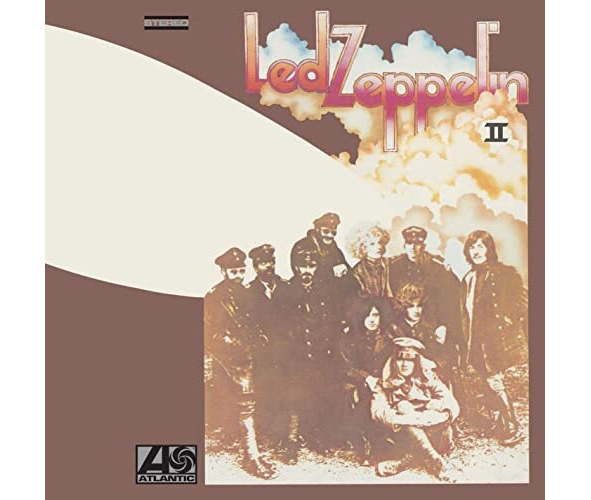
The cover of Led Zeppelin’s second album, in my interpretation, reflects the spiritual sphere of human beings. While the first album told the story of the birth of Earth, the planet’s youth, and the evolution of life up to the Mesolithic period, the second album presents the continuation of this story — the Neolithic period, characterized by plant cultivation, animal husbandry, the development of permanent settlements, and the emergence of the first cities.
The originator of the cover for Led Zeppelin’s second album is David Juniper. He used a photo of the German Luftstreitkräfte unit from the First World War, and then replaced the faces of the airmen with the faces of the team members and others — in his words, they were, among others: Miles Davis (or Blind Willie Johnson), girlfriend of Andy Warhol (probably Mary Woronov) and astronaut Neil Armstrong. In fact, he used the face of another astronaut, Frank Borman. In the background you can see the outline of the airship from the same photo that appeared on the cover of the band’s debut album. Juniper also created a psychedelic illustration hung on the inside of the fold-out vinyl envelope.
(link): http: //pablosreviews.blogspot.com/2014/06/historie-okladek-led-zeppelin.html
The symbolism of the cover is extremely important. As with the debut album, the outline of the airship symbolizes the planet Earth, but this time it appears only as a white contour, which in my interpretation refers to the atmosphere — the gaseous layer surrounding Earth, crucial for sustaining life.
If we draw a parallel between humans and the planet, the spiritual sphere of humans — faith, religion, inner beliefs — is analogous to the atmosphere: invisible, subtle, yet decisive for the functioning of the entire “organism” — both the individual and the community.
Hence, I conclude that the main theme of Led Zeppelin II is the spiritual sphere of humans, and all the tracks on this album can be interpreted as different aspects of faith, spirituality, and the emotional and psychological experiences of the individual in the context of social life and personal development of consciousness.
The first album — the history of Earth and the evolution of life from the planet’s birth to the Neolithic period. The second album — the history of humans in the spiritual dimension, symbolizing consciousness, faith, emotions, and social relationships as the main forces shaping the fate of individuals and communities.
1. Whole Lotta Love — Transcendent Being
The first track of the second album encodes a breakthrough moment in the history of modern humans — the moment when humans gain awareness of the existence of a transcendent being. The song symbolizes the experience of contact with a higher power, and its poetry and music convey the intensity of this spiritual experience. The title and fragments of the song, such as the repeated declaration “Whole Lotta Love,” express the ecstasy of human consciousness in relation to the spiritual being. It is a declaration of love from the “creator” to their creation, expressed in an absolute and intense way.
The most important part of the track, between 1:45 and 3:06, is the essence of the entire album — the quintessence of transcendental poetics. It is the moment in which humans experience the presence of the spiritual being in its full magnitude and enter a state that is difficult to describe with words.
In this way, Whole Lotta Love opens the second album, symbolically initiating the spiritual sphere of humans — the main theme of all of Led Zeppelin II.
This experience has an initiatory character — from this point on, humans can no longer return to a state of primordial unconsciousness, because contact with transcendence permanently changes the way reality is perceived. The song also foreshadows the tension that will build in the following tracks of the album: the conflict between the desire for the absolute and the limitations of human nature.
2. What Is and What Should Never Be — Too Much at Once
The second track of the second album develops the theme of the transcendent being introduced in Whole Lotta Love. In this case, we encounter a dialogue between humans and spiritual consciousness, in which humans learn the limits of freedom and the meaning of prohibitions and warnings — analogous to the Book of Genesis, where the newly created human receives both commandments and cautions.
The melody of the song, at times calm, at times threatening, symbolizes the emotional and spiritual tensions that accompany humans in contact with this being. Lyrics such as “Catch the wind, see how it turns us around” indicate the dynamics of the connection — the possibility of entering into a full relationship or breaking the link.
When listening to this track, special attention should be paid to its critical moment at 3:30, when the wind stops blowing, which can be interpreted as the severing of communication in both directions. Regardless of the interpretive approach, this is the pivotal point of the composition — a turning moment after which the previous order collapses. The meaning of this phenomenon remains ambiguous and open, and its full discussion exceeds the scope of this analysis. The song is therefore not only a continuation of the exploration of spiritual consciousness but also an illustration of the development of symbolic thinking, where humans learn to distinguish what is possible from what should never occur — hence the title: “What Is and What Should Never Be.”
3. The Lemon Song — Consequences of Excessive Curiosity
The third track of the second album, in my interpretation, refers to disobedience toward the laws of nature and transcendental prohibitions — a symbolic taking of the fruit from the “tree of life” (Genesis 3:22).
The lemon, with its bitter taste, represents the consequence of excessive curiosity and the breaking of rules. The “killin floor” symbolizes the difficult beginnings of existence for the first guardians of secret knowledge, encoded in caves and megalithic structures.
The song shows that the consequences of disobedience are felt and real, even if initially the actions seem minor. “I should have quit you, baby-a, oh, such a long time ago, oh” can be interpreted as a reflection on the consequences of acting against natural laws, which lead to suffering and the necessity of learning from mistakes.
Musically, minimalist yet expressive means — raw rhythm, repeating phrases — symbolize the maximum effect achieved with primitive tools, perfectly reflecting the atmosphere of the first attempts at human action and experimentation in a spiritual and cognitive context. The piece can be read as a story about the irreversibility of knowledge — once a boundary is crossed, there is no return to innocence. The Lemon Song thus becomes a musical parable about the price of knowledge: bitter, yet forming the foundation of human consciousness.
4. Thank You — Sacrifice and Effort
The fourth track of the second album, in my interpretation, shows the transcendental dimension of gratitude, sacrifice, and the hardships of human life. This is not solely about interpersonal relationships in the ordinary, everyday sense — between a man and a woman — but about the contact between a human and a higher being, their guardian, creator, or the primal force of the universe. The declaration in the song is forgiveness, recognition of one’s own mistakes, and readiness to make amends. Thank You becomes a symbol of gratitude for the effort and sacrifice that enabled the continued existence and development of humanity.
On a symbolic level, the song represents the dualism of male and female, sun and moon, which survived thanks to the faith and work of our ancestors, forming the foundation of life’s cyclicality. “Your hand in mine, we walk miles together” can be interpreted as humanity moving in harmony with cosmic principles, an acceptance of knowledge and spiritual providence.
The symbolic message contained in this track serves as guidance for future generations, allowing past mistakes to be corrected and ensuring that the knowledge and experience of earlier generations are not lost. The song is thus a combination of transcendence, gratitude, and human responsibility for one’s actions, which influence the order of the universe and the recurrence of life. What strikes in this track is the fact that love and sacrifice have a cosmic dimension, not merely a human one — they become instruments for understanding and correcting the mistakes committed by “pre-Flood” humanity.
5. Heartbreaker — Judaism
The fifth track of the second album tells the story of the chosen people, their faith, struggles for survival, challenges, and fate in the context of the Jewish religion.
Each verse of the song symbolizes key historical events: from the biblical beginnings of the nation, through the settlement in Canaan, the establishment of the kingdoms of Israel and Judah, the fall of Babylon, the Hellenistic period, Roman rule, Jewish uprisings, up to the diaspora and the modern restoration of the state of Israel.
Heartbreaker (Judaism)
Hey fellas, have you heard the news? (Biblical origins of the nation),
You know that Annie’s back in town? (Settlement at the Kaan)
It won’t take long just watch and see (Kingdom of Israel),
how the fellas lay their money down. (Division into Israel and Judah)
Her style is new but the face
is the same as it was so long ago, (Kingdom of Judah)
But from her eyes, a different smile (Fall of Babylon),
like that of one who knows. (Rebuilding of Jerusalem)
Well, it’s been ten years and maybe more (Hellenistic period),
since I first set eyes on you. (Roman rule)
The best years of my life gone by, (Jewish uprising),
here I am alone and blue. (Capture of Jerusalem)
Some people cry and some people die (Masada),
by the wicked ways of love; (To prohibit the practice of Judaism)
But I’ll just keep on rollin’ along (Syria,
with the grace of the Lord above. (Palestina)
People talkin’ all around ’bout the way you left me flat, (Diaspora)
I don’t care what the people say, I know where their jive is at.
One thing I do have on my mind, if you can clarify please do,
It’s the way you call me by another guy’s name when
I try to make love to you.
I try to make love but it ain’t no use. (Religion, Tradition, Menorah, Shabbat, etc.)
Work so hard (Sephardim),
I couldn’t unwind, get some money saved; (edict of the Alhambra)
Abuse my love a thousand times, (Ashkenazim),
however hard I tried. (Pogroms)
Heartbreaker, your time has come, (Declaration of Independence),
can’t take your evil way; (War of Independence)
Go away, (The peace process)
Heartbreaker. (Chosen people)
(link) — http://www.tekstowo.pl/piosenka,led_zeppelin,heartbreaker.html
In my interpretation, this song shows the hardship, suffering, and perseverance of the Jewish people, who for centuries maintained their faithfulness to tradition and religion despite threats and challenges. The instrumental section between 3:04 and 8:05 minutes (Live Earls Court) is a symbolic representation of the Jewish epic — the period of the existence of the state, its fall, dispersion, and ultimate restoration.
The lines “Heartbreaker, your time has come / I can’t take your evil way / Go away!” symbolize the perseverance and resilience of this people in the face of adversity. The instrumental fragments depict the dramatic history, effort, and sacrifice required for Faith to survive in the hearts of the Hebrews.
As with the previous songs, the message of Heartbreaker is not limited to a simple description of historical events — it is a profound spiritual testimony, showing that perseverance, faith, and preservation of tradition were essential for the survival of the nation and for passing values on to future generations.
In this sense, Heartbreaker can be interpreted not only as an allegory of the history of a single nation, but also as a universal story of the survival of faith in a world full of violence and uprooting.
The history of Israel becomes here an archetype of the fate of a community which, despite collapse, exile, and attempts at annihilation, preserves continuity of identity. Led Zeppelin’s music serves as a medium of memory — a carrier of experience that transcends time, culture, and religion.
In this way, Heartbreaker becomes not only a testimony of the past, but also a reminder that perseverance and faith can form the foundation for any community, regardless of time and place. Music functions here as a bridge between history and the present, allowing the listener to experience the emotions and values that shaped the nation over centuries.
6. Living Loving Maid (She’s Just a Woman) — Christianity
The sixth track of the second album symbolically presents the entire history of Christianity, with particular emphasis on Catholicism, its institutions, and clergy.
The individual lines show how each fragment should be understood: from the symbolism of clergy headwear, references to the 30 pieces of silver of Judas, through Protestantism and religious wars, up to confession and the Holy Communion. The song expresses protest, criticism, and even disapproval of abuses and extravagances within Catholicism, especially among the higher ranks of the clergy — bishops and the papacy.
Living Loving Maid (She’s Just a Woman) (Christianity)
With a purple umbrella (Color headgear church hierarchy)
and a fifty cent hat, (A reference to the 30 pieces of silver Judas for betraying)
Livin, lovin, (Jesus),
she’s just a woman. (Not the son of God, but a man)
Missus cool rides out in her aged Cadillac. (Extravagant way of life — known to history)
Livin’, lovin’, she’s just a woman.
*Come on, babe on the round about, ride on the merry-go-round,
We all know what your name is, so you better lay your money down.
(Enerally a matter of Protestantism and religious wars)
Alimony, alimony payin’ your bills, (Simony, charges for prayer, church fund, etc)
Livin’, lovin’, she’s just a woman.
When your conscience hits, (Holy Confession),
you knock it back with pills. (Host — Holy Communion)
Livin’, lovin’, she’s just a woman.
Tellin’ tall tales of how it used to be. (Catechism of the Catholic)
Livin’, lovin’, she’s just a woman.
With the butler and the maid (Joseph, Mary)
and the servants three. (God in three persons — holy trinity)
Comparisons rather inadequate, even despicable, but not the explicitness stake, but the incorporation of symbolic terms in the content of the songs on contemporary themes. And one more general note: every religion, also a Catholic, is a sacred area, and I in no way its translation would not esteemed the profane. this applies, in particular a person that needs to be widespread respect.
Livin’, lovin’, she’s just a woman.
Nobody hears a single word you say. (Atheism, apostasy, reducing the number of the faithful)
Livin’, lovin’, she’s just a woman. (The church faithful to its tradition and canon of faith),
But you keep on talkin’ till your dyin’ day. (Malachi prophecy)
Livin’, lovin’, she’s just a woman.
(link) — http://www.tekstowo.pl/piosenka,led_zeppelin,living_loving_maid__she_s_just_a_woman_.html
The song Living Loving Maid (She’s Just a Woman) is not just a story about the history of religion, but also an expression of opposition to abuses of spiritual power, false practices, and hypocrisy that have appeared over the course of history within religious institutions.
The lyrics and form of the song indicate a critical view by the authors on the way authority over believers is exercised and the gap between the original message of faith and its institutional development.
A symbolically significant device is the placement of Heartbreaker — interpreted as Judaism — and Living Loving Maid — referring to Christianity — almost continuously, one after the other, on the same album. This arrangement emphasizes the common roots of both religions (Old Testament, Book of Genesis), while also showing their divergent paths of development: Judaism as a system based on continuity of tradition and law, and Christianity in the form which the authors subject to critical reflection.
The title of the composition also carries meaning. Living Loving Maid can be interpreted as a reference to the figure of Jesus and the original message of love, while the addition (She’s Just a Woman) shifts the emphasis to the human dimension rather than the divine — which reinforces the critical tone towards later theologization and sacralization of church power.
Instrumentation and expressive vocals further amplify this message, building an atmosphere of tension and irony that visualizes the authors’ distance from Catholicism as an institution. The critique does not concern the very idea of faith, but the mechanisms of control, oppression, and abuse that could appear in the Church’s relationship with believers.
Living Loving Maid thus constitutes a continuation of the narrative about the spiritual history of humanity, begun in Heartbreaker. After the story of Judaism as the foundation of tradition and identity, this song portrays Christianity as a space of tensions, conflicts, and disputes between the sacred and the institution. The whole fits into a broader reflection on the fate of faith in a world where spirituality constantly clashes with authority, history, and human imperfection.
7. Ramble On — Islam
The seventh track of the second album symbolizes the third major monotheistic religion — Islam.
The title Ramble On literally means “to wander, to ramble,” which, in the context of Muhammad’s history and his followers, corresponds to the Hijra — the great emigration from Mecca to Medina, that is, the breaking of old ties and the beginning of a new religious life. The verses of the song symbolize successive stages in the history of Islam: from Muhammad’s youth, his commercial activity, prophetic visions, to the conquest of the Arabian Peninsula and the expansion of Muslim civilization.
Ramble On (Islam)
Leaves are fallin’ all around,
It’s time I was on my way
Thanks to you, I’m much obliged
For such a pleasant stay (Muhammad after the death of his parents grew grandfather and uncle)
but now it’s time for me to go,
The autumn moon lights my way
for now I smell the rain,
And with it, pain (Muhammad dealt with the trade until he suffered while contemplating the vision and began to preach the principles of the new religion — the crescent symbol of Islam)
And it’s headed my way
Aw, sometimes I grow so tired
But I know I’ve got one thing I got to do (Hijra — escape from Mecca to Medina)
Ramble on,
And now’s the time, the time is now
Sing my song,
I’m goin’ „round the world, I gotta find my girl
Kup książkę, aby przeczytać do końca.