
Introduction
For centuries, the birth and death of man have marked the rhythm of life of subsequent generations, like a cast wheel which, turning, finally returns to its starting point. So also we, living today, are part of this movement. However, we do not live on Earth, only us — people. Beside us, similar circles constantly rotate. I am thinking about the world that surrounds us and in which we live — the world of animals and plants.
Man has been and still remains part of this ecosystem since its inception. Like all other species, we are the product of over three and a half billion years of evolution. However, there is something that distinguishes us from the rest of the species inhabited on Earth, rushing in the dizzying whirl of procreation. This something is our brain, which as a result of evolutionary changes, over the space of several million years from the first Hominids to Homo sapiens — has increased its volume significantly.
These are generally known facts. Thanks to this efficient organ, we are a „thinking being” standing at the head of the Animal Kingdom. It is this ability to think that has determined our future as a species. The use of stone to defend against other animals, as well as to obtain food, was the first breakthrough in this process.
Later, skillful processing of it led to the creation of various tools. „Harnessing fire”, the ability to melt metals, domesticate animals, transition from a nomadic lifestyle to farming and animal husbandry, the evolution of social relations — all these achievements are a derivative of these changes.
People differ from animals by another important feature. In order for this process of using „inventions” to proceed smoothly, the ability to pass on from generation to generation all these achievements of civilization development is still needed. At this point I would like to quote Newton’s words in a letter to Robert Hooke: „If I could look further than others, it was because I was standing on the shoulders of giants” — quote from J. Gronkowski, On dwarfs and giants, „Świat Nauki” 2000, No. 11.
I cited a fragment of this letter for a reason, because in this work I often use quotes or photos of other authors. They concern a wide spectrum of scientific disciplines, such as: cosmology, physiology, philosophy, religious studies, history, etc. It was not my goal to blindly imitate or plagiarize these works, but only to show the state of knowledge of our science.
Based on the authority of scientists, whose achievements should be a compulsory reading for us, I also add new content from myself. They will change, in my view, a completely different view of our past. The main inspiration and driving force of my thoughts is the belief that what I write is consistent with what the Biggest Giant sees.
Every new thought, invention, often conflicts with already existing laws. It is something else to reinvent something again, and something else when some iconoclastic truth changes the entire current order. Examples include: Copernican theory, Darwin’s theory, consecutive socio-political systems, new technologies displacing old ones. There are many such „new” ideas in this book. Are they epoch-making discoveries? Is this noteworthy?
Each of us has a taboo, a sanctity that we cannot agree to violate, we are deaf to any arguments. Before delving into the text of this book, each reader should get rid of all prejudices about faith, religion or human sexuality.
It is necessary to get rid of this ballast, which crushes to the ground and narrows the horizon of our gaze, to rise like a bird and glide towards a free and unfettered space from which new horizons of knowledge can be seen.
Man in his history has come a long way and it would seem that now we are at the peak of our potential for civilization development. Time and again provides us with evidence for such a claim. Traveling into space, computers, nuclear power plants, biotechnology, vaccines and medicine for diseases that have just recently killed millions of people. However, I think that we are only in the middle of this cycle and we are still far from being full of possibilities. What motivates me to say that?
Well, as you know, the human brain is used only to a small extent — in about 30 percent. For this reason, it can be assumed that our cells do not use their full potential. Same with genes. There are a lot of inactive genes in our body that contain some information. What — you can only guess. Futurologists have in this field a great „undeveloped space”, which they fill with various ideas — telepathy, telekinesis, spiritualism etc.
„There are more things in heaven and earth, Horatio, Than are dreamt of in your philosophy.” quote from W. Shakespeare, Hamlet, Act I, p. 48. In order for these „suppositions” to be realized, man must take the „next step forward”. Is it possible? There is something that makes me believe that what can be our „springboard” is the Bible.
In the 1970s, American scientists sent the Pioneer 10 probe into space, whose task is to reach deeper into our universe. An aluminum plate covered with a thin layer was attached to the probe body gold. An encoded drawing was engraved on it — a testimony to the level of development of the human race, which is a signal addressed to other intelligent extraterrestrial civilizations.
It contains information: about our position in a number of planets of the Solar System, about our species — the figures of a woman and a man against the backdrop of a space probe, about the level of our knowledge — a scheme of hydrogen in two different physical stages. So man sends his creed into space expecting any answer. It is also missing characterized. Where are we from What is the purpose of human existence? Are there other civilizations in the universe? If so, at what level of intelligence development? Is God the „culprit” of all this „confusion”?
Staring at the sky, we do not realize that these and other similar questions are answered. The Bible is the answer. In the Bible, as in Pionera, all our wisdom is contained, recorded centuries ago by people who „coded” in its content the known truths which we — their descendants — have yet to decipher.
As you know, the content of the Bible consists of: Old and New Testaments. These are two holy books of the followers of the Judaic and Christian religions. In Islam, the holy book is the Koran, which has its sources in the Old Testament tradition. The first book of the Old Testament — Genesis — and the last part of the New Testament — Revelation deserve special mention. John, though, and other books, gospels and letters are equally important.
The above elements of the Bible are an excellent clamp, bringing together all the knowledge about what was and what awaits us. I hope that the individual chapters of this book provide „arguments” to prove this claim.
Although this is the main „lead”, not only in the Bible do we find premises testifying to „signals from the past.” Around us, even through our bodies, are constantly flowing radio waves, hundreds of television images that we do not see until we turn on the receiver.
You need the skill, „fine-tune” our „receiver” and look at the history of our oldest civilizations: Sumer, Egypt, Greece, China, Indus Valley, Maya, Inca, peoples of Africa, North America, Europe, various corners of Asia, Australia, Polynesia, to see and understand their mysterious story. Representatives of these civilizations have gone into oblivion, but only seemingly. Remains of their fossil cultures, like extinct prehistoric animals. There are also other leads. We find them in literature, philosophy and even in history. All this is the subject of this book.
At the beginning of this introduction, we talked about human evolution. It was a purely materialistic view of our „genesis”. Later, I referred to the Bible as the crown „argument” helpful in understanding the merits of the case. Science and faith are opposing values, extremes that are mutually exclusive. What is faith in the Creator of the Universe — giving life to man (You are made of dust and you turn to dust), creating a paradise, sending the flood of almighty God to earth, in the face of scientific evidence that evolution is the main „culprit” and father of man — as the theory says Darwin.
The most perfect thing you can imagine is to understand these areas — faith and science — as a whole. These individuals create unity together — one without the other gives a false image of reality. This thought is the essence of the philosophy of this book. Centuries ago, the greatest geniuses of the human kind wrote about the same topic.
Such a precursor was undoubtedly Heraclitus of Ephesus. He was the first of the unity of opposites to make the thought of his teaching. The ideas of this thinker have permanently entered the development of philosophy. His statements have reached our time only in fragments. We find them in the works of later authors, philosophers and stories.
The following quote is from the text of G. S. Kirk, The Cosmic Fragments, Cambridge 1962, (according to H. Diesel’s numbering) — quote from R. Palacz, “Classics of philosophy”.
8. Opposites are combined with incompatibilities — the most beautiful compatibility and everything follows through the fight […].
10. Harmonious connections: wholeness and incompatibility, harmonious and incompatible, melodic and dissonance, unity and unity from everything — everything.
Chapters on Ionia — treated as a melting pot of various cultures and religions — in which political ideas and philosophical theories began to learn philosophy at every school in the university. Heraclitus of Ephesus was the first to use the term „lover of wisdom”. The shores of Asia Minor lay at the crossroads of Greek and Eastern cultures. All the great thinkers of ancient Greece were full of handfuls of knowledge from the remains of those cultures that were already falling into decline and were gradually falling into oblivion (Egypt, Mesopotamia, the Far East). Thus, Greek philosophy can be compared to the „smelting” created in the „blast furnace.”
The starting material for this „melting” are not only those cultures that created the first civilizations, but also others. We know little about the level of their knowledge. As I have already mentioned, one of the most important ways to transfer knowledge is writing. Thanks to him, we already know a lot about our past (e.g. Egyptian hieratic writing, Sumerian cuneiform writing, Chinese writing, Cretan linear writing).
The beginnings of the magazine are associated with the Sumerian culture and date back to 3200 B.C. Before this date, people had to pass on all their knowledge using speech that, although fleeting, is remembered for a relatively long time, if it is „narrated” by generation from generation to generation through a concise form.
This was the purpose of the legends, myths, epics, rhyming poems, etc. It is said that every fairy tale has a grain of truth in it. Myths, mythologies, legends also contain within themselves such „seed” which is our next hidden trail. It’s time to decipher it. Well, in my opinion, myths contain more truth than we think, from the current truth, which is only a myth.
I would compare the sum of knowledge of a contemporary man entering the third millennium to a tree. The leaves symbolize all humanity, developing from generation to generation. Every year the tree sheds it for the winter, so that with the arrival of spring from new bunches with all its greenness revive to life. Each such leaf is a human being, an individual of society. He struggles with life, constantly succumbing to various „gusts” of history, such as wars, disasters, epidemics.
The leaves grow from twigs, branches and branches. This is the entire output of humanity. Everything that man has achieved during the development of his civilization — his beliefs, religions, development of science and technology, socio-political systems (from slavery to democracy), etc. The entire course of this process is constantly recorded in the trunk of this tree. Every „change” is put away „jar by jar”, from the beginning of our history inside. So history is the trunk of this tree.
Thanks to paleology, we can „see” other such prehistoric trees. They are in the „petrified forest” deep in the Earth. As scientific research confirms, 99 percent of species inhabiting Earth in various eras have died out (e.g. in the age of dinosaur rule, during Permian extinction of species, etc.). Many of them left behind fossils.
The tree does not consist only of leaves, branches and trunk. As everyone knows, its roots are the most important component. It is thanks to them that the tree draws juices needed for life. What are the roots in this puzzle?
For man, these roots, without which he could not only live but also exist — is God. Whatever his name is, whether it would be a God of Judaism, Christianity, Islam or other non-monotheistic faiths and religions, God is our „alpha and omega.” It is our beginning and end, on which everything depends and to which we eventually aim (Genesis 1: 27). How funny in this context sounds the thesis of some skeptics and philosophers, not to mention atheists that man is the „creator” of God.
Finally, one more thing. Monotheistic religions, and in particular Christianity, replaced their whole range of local beliefs in different ways, more or less humanly. However, they were not completely lost. In addition to the myths I have already mentioned, we find them „hibernated” in „forbidden archeology”, especially in architecture. It is thanks to the architecture, remaining „alive”, old pre-Christian buildings that we can say something more about our past today.
Pyramids of Egyptian pharaohs, ziggurats of ancient Sumer, mysterious Carnac menhirs, circles in Stonehenge and Avebury, Newgrange burial mounds, Aztec and Mayan pyramids, temples of the Far East, Chinese Wall and all other buildings of the whole world were not created to be „only” tombs or also a „souvenir” of the excess of rulers who use their subjects. This is the last important, if not the most important, next to the Bible, „signal” from the past. He was sent to us deliberately. It has many times exceeded the „particle” sent into space in Pioneer’s sampler.
How much genius was needed to convey all the knowledge of our ancestors (while having such a „primitive” resource), so that it would not be destroyed by the roller of history (while remaining unencrypted to our times), to become simple enough to understanding that it can be accepted by us without any reservations.
The most complex things can sometimes be solved in ways that later seem very simple and logical. So what is the purpose of all this „armada” of evidence of human ingenuity?
An explanation of the „problems” contained in this introduction will be the content of the book. Reading its individual chapters, I hope to cut this Gordian knot of ignorance and, using logical arguments, show our entire complicated history in its true, factual light.
Chapter I
The System of Doctor Tarr and Professor Fether
What will the future of the universe be like? Will it constantly expand and disperse in the darkness of the darkness, or will new forms of matter arise? Maybe other theories are an alternative to space? For example, string theory, which predicts the existence of ten dimensions, M-theory, that is, the theory of two three-dimensional surfaces called branches, separated by a small gap along the eleventh dimension.
Or the future of our universe is the „new” universe inside a black hole. These and other fantastic theories cannot stand the competition with quintessence theory. Although it has some logical quality, it is not the theory I would subscribe to.
As you have noticed, dear reader, this chapter is entitled — The System of Doctor Tarr and Professor Fether. This is the title of one of the stories by Edgar Allan Poe. How can he relate to cosmological theories? Well, none or almost none. The story itself is not relevant at all. Reading them a few years ago, I did not pay attention to its title, but in explaining the issue I am writing about, it is a very apt statement.
The theme of this chapter is the future of our universe. I would definitely like to state that: from the beginning of its creation, its future is strictly defined and determined. The main and primary purpose of our universe is its final collapse.
What does this mean Well, that after a period of unusually intense inflation from the first second of our universe, after the era of recombination, the formation of the first stars and modern galaxies, we find ourselves at a turning point in our history, which will be followed by slow, but systematic and finally faster and even faster velocity, all radiation matter will collapse back to the center. It is logical that if the Big Bang was the starting point of the whole process, then the turning point is its return. Okay, but what does this have to do with quintessence theory — this ridiculous-sounding title?
Observations made over the past five years have convinced cosmologists that chemical elements and dark matter together give less than half the content of the universe, while the rest are ubiquitous” dark energy „characterized by an unusual property: its gravitational effect is not about attraction, but repulsion. While under the influence of gravity, chemical elements and dark matter are concentrated in stars and galaxies, energy tends to fill the entire space evenly in the likeness of fog. In opposition to these two tendencies, repulsive gravity takes over, which, by overcoming the gravitational attraction of matter, gradually accelerates the expansion of the universe. […]
Measuring the current rate of expansion, assuming it is slowing down, it would appear that the age of the universe is less than 12 billion years. Meanwhile, observations show that some stars in our galaxy are 15 billion years old. By accelerating the expansion rate of the universe, repulsion reconciles the calculated age of the universe with the observed age of celestial bodies.
quote: J. P. Ostriker, P. J. Steinhard, The quintessential universe, „Świat Nauki” 2001, No. 3.
Considering that dark energy is in 70 percent a component of the massive mass universe and the density of this dark energy is almost negligible, I would compare dark energy to the title „feather”. Let’s imagine that it is fluff that you can hardly see, but there is so much of it that it accumulates in itself is a terribly heavy burden. In this counting, dark matter, ordinary matter and radiation are „tar.” As you know, this substance with a solid or heated consistency has a relatively smaller volume than down.
Both these „heaviness” — down and pitch — just like dark energy and matter with radiation are inseparably connected with each other in a simply ingenious way.
Some stars in our galaxy are 15 billion years old, which would indicate the age of the universe. But according to the theory of repulsive gravity, the age of the universe is calculated at 12 billion years. There is a certain contradiction. It can be explained by The System of Doctor Tarr and Professor Fether.
As you know, after the Big Bang there was a huge expansion of energy and mass from the center of the explosion. The whole mass was plasma. Mass has a higher density than energy, which is why in this explosion process the mass velocity was after some time higher than the so-called dark energy. Let’s throw a lump of tar, it will fly faster than a large ball of powder.
So it was the mass that exploded first, followed by dark energy. To bring all this „theory” to an end, it must be assumed that the Big Bang was not the beginning of the process. How is it possible that this big bomb was stuck in time and in a space that, as a result, was not, and suddenly, it is not known for what reason, it exploded. In my opinion, this was not the beginning of space-time.
I would compare this whole process to the cosmic perpetual motion machine — a self-propelled machine that explodes and shrinks again and again, creating a megacycle. And we are just in the middle of it. If this assumption of cyclicality is true, then the whole process would be like this: matter with a higher density than dark energy has gone away first, but also the first one stops its momentum, because its total weight is lower than the total weight of dark energy. Dark energy has a higher total weight, but due to the low density it follows all matter. Dark energy, finally, thanks to the greater total weight overtakes (penetrates) the whole mass and rushes further into space.
It is this process that is „responsible” for the entire age problem of the universe. Invisible dark energy, heavier than mass, eventually gravitational pulls this mass with its enormous weight. Therefore, the edges of our observable universe are not repelled by the negative energy of the vacuum, but quite the opposite — they are attracted by dark energy. Although dark energy has very low density, it also has to „slow down” sometime.
Because dark energy has a very low density, it stretches like very long gum. Thanks to this unimaginable extension, dark energy loses its value as a huge weight. Here comes a key critical moment in the megacycle. The focused mass finally reaches the advantage over the extended dark energy and attracts dark energy gravitatively with all its „firmness”. At first, this one doesn’t have a high „return” speed. But over time this speed increases, reaching such strength that all this „armada” — dark energy and the whole mass of the universe — rushes back towards the center. And this center is the final moment of the megacycle. A new, next explosion is the beginning of the next …
So it is this movement back and forth that is the foundation of our universe. This is essential for all its components. I am thinking especially about our planet and its inhabitants. This is only a theory and you need to confirm its assumptions by others. Cosmologists who have at their disposal an entire arsenal of scientific knowledge certainly evaluate it very thoroughly. If what I have written is contrary to science, you should agree with this without reservation. Submitting this theory to the judgment of science, I would like to say that in the event that it turns out to be a „misunderstanding”, the entire rest of this book has virtually no meaning. Perhaps there are some inaccuracies in it, but the basic meaning of the theory of The System of Doctor Tarr and Professor Fether is the cyclical nature of the universe, which is confirmed by some evidence that will be the subject of most of the chapters presented.
Chapter II
Two details — A bit of the History of Life on Earth
— About 4.5–5 billion years ago — from a cloud of gas and dust the Solar System is formed with the centrally located Sun (over 99 percent of the mass of the system) and the remaining planets, including also the Earth.
— About 4.2 billion years ago — as a result of cooling, the Earth’s crust is formed.
— About 3.5 billion years ago — the first organisms — bacteria — are formed. Cyanobacteria, one of the oldest organisms, thanks to photosynthesis release oxygen, which creates the ozone layer absorbing ultraviolet radiation.
— About one billion years ago — primitive organisms arise.
— About 600–700 million years ago — the first invertebrates arise.
— 500 million years ago — the first vertebrates arise.
— 400 million years ago — following plants, vertebrates “come out” literally and figuratively from the water.
— 250 million years ago — 80–90 percent of species perish (the Permian extinction of species).
— 220 million years ago — the beginning of the reign of dinosaurs.
— 65 million years ago — as a result of a meteorite striking the Earth, dinosaurs become extinct (all larger animals die out). The development of mammal-like reptiles follows, which thanks to the ability to dig burrows survive the catastrophe. Later — an avalanche-like growth of the dominance of mammals on Earth.
The history of life on Earth has already been very well and thoroughly described; however, I would like to present two rather significant details. The first is the matter of the age of dinosaurs and the extraordinarily intensive development of forests in the Carboniferous period 345–280 million years ago.
As is known, crude oil is a liquid mineral, a mixture of hydrocarbons, also containing compounds of sulfur, oxygen, nitrogen and others. It is assumed that it is formed as a result of transformation under anaerobic conditions from the remains of organisms accumulated in marine sediments. What significance does it have for humans, for the development of modern technology?
From crude oil, thanks to technical processes, we obtain: gasoline, gas, liquid asphalt and many other products. The extraction of crude oil is accompanied by the extraction of natural gas (a mixture of volatile hydrocarbons, mainly methane, ethane, propane and butane). This gas serves as a chemical raw material, as well as fuel. What significance does natural gas have for humans?
Let us imagine that in the history of the evolution of the Earth these two elements were missing: the Carboniferous forests and the age of dinosaurs. What would human life look like? The answer suggests itself. These two minerals are for humans the fundamental material of the development of modern technical civilization. Without them, humans would to this day heat their huts with wood, and all the achievements of technology: cars with highways, airplanes, ships (of course with the exception of sailing ships), heavy industry (metallurgy), chemistry with its products — all of this would be only a dream or fantasy.
Well then, such periods did exist and these materials do exist, so one should make use of them, and why should those past events concern the modern human. There remains the “problem” of living fossils.
They are animals or plants that underwent the extinction of species, yet left behind a “representative.” These fossils are the only forms preserved from previous epochs.
Scientists dealing with this field assume that they survived to our times only thanks to a fortunate coincidence. Horseshoe crabs, tuataras, cycad, platypus, Myxotericha paradoxa, coelacanth — these and other fossils are very good traces in the history of the evolution of life on Earth. Thanks to precisely these traces (as well as thanks to real fossils) we can learn and understand the history of evolution.
These two details are very faint traces that were imprinted as if on snow “in winter.” Now we have “summer,” and in order to “read” these tracks (I have the impression that they were left deliberately), one would probably have to rely only on mysticism and faith.
Was there not in this the “hand” of the Creator, who, releasing into the world His “work,” at the same time cares for its future and also makes it easier for it to learn its true past? That this was indeed the case, there is of course no proof, therefore every categorical objection is understandable.
It is not an easy topic; however, I believe that after reading the subsequent chapters all doubts will be dispelled and the more easily so, because no longer on the basis of mere suppositions, it will be possible to agree with these two “details.”
Chapter III
Neanderthal — A bit of Archaeology
As I already noted in the introduction, one of the basic sources of my information is the Bible. I claimed that it is an excellent source of knowledge about our past. The time has come to make use of it. As is known, the Bible begins with the Book of Genesis. The first sentence of this book is: „In the beginning God created the heaven and the earth.” (Gen. 1:1).
Everyone surely knows the continuation of this book, so it is not purposeful to quote it in its entirety. It speaks of the fact that it was God who created the Earth, all plants and animals, and man, whom He placed in Eden. Later came the fall of the first people (Adam and Eve), and so on.
What I am now writing may seem to every reader rather improbable, but I believe that in order to understand precisely and in accordance with the truth the meaning of the Old Testament, the entire text should be treated very symbolically. Every follower of monotheistic faith believes that God created the world in six days, that wishing to punish man, He sent upon him the Flood, that thanks to Noah and his ark He saved the human species and all animals from that catastrophe. Every believer professes this as the foundation, the canon of his faith — God is the Creator.
Well then, but how does this relate to all those undeniable proofs from chapter one, and also chapter two. Why especially the latter?
Because there are described one-hundred-percent proofs found deep within the Earth. How do all these proofs relate to faith in God the Creator? There exists here a particular relationship. It would seem that this is contrary to logic, but according to the principle of that quintessence of knowledge, which is the harmony of opposites, it can be proven that science and faith do not stand in contradiction to each other.
Namely, if we try to treat the contents contained in the Bible in a symbolic way, it will turn out that the traces left by our ancestors show us in all their splendor knowledge about our past reborn like a Phoenix from the ashes. Topics related to Genesis will still be discussed later in this book. Now, however, I would like to “decode” only its fragment concerning this subject.
I will begin immediately without any major introductions. Assuming that the Bible is a symbolic metaphor with a hidden meaning, the fragment contained in it about Abel and Cain should be “understood” as a story about the fate of the Neanderthal and the Cro-Magnon man, from the time when these two species lived next to each other. Up to a certain moment they coexisted peacefully. Later rivalry occurred, and consequently the destruction of one, weaker species.
In science this is already a fairly well described history. Faith describes this fact in its own words. Only by combining these two “stories” do we have the whole truth about what then (about 40–30 thousand years ago) happened. Having at our disposal the “facts” and the “motives” of this undeniable “crime,” it becomes clear that Cain — the Cro-Magnon man — “annihilated” Abel — the Neanderthal. Fantasy? Perhaps. However, once again I repeat that the Bible must be treated symbolically, not literally.
Although the lineage of the Neanderthal is still unknown, most facts indicate that he originated in Africa 200–150 million years ago.
Modern patterns of behavior, however, appeared much later.
The greatest amount of data comes from Israel and its surroundings, where Neanderthals lived already 200 thousand years ago, and perhaps even earlier. About 100 thousand years ago anatomically modern Homo sapiens joined them, and — what is significant — nearly identical sites and tools remained after both species of hominids. As far as is known, both of these human forms behaved similarly despite anatomical differences. As long as this was the case, they managed to coexist in the Levantine environment. In Europe the situation looked completely different. The earliest local sites with remains of modern humans date from 40 thousand years ago, and already roughly 10 thousand years later not a trace is found of the once widespread Neanderthals. […]
In the area of the Levant coexistence came to an end about 60 thousand years ago, when tools similar to Upper Paleolithic ones began to appear. Roughly 40 thousand years ago the place of the Neanderthal in the Levant — just as in Europe — was taken by culturally richer modern humans.
quote: J. Tattersall, We Were Not Always Alone, “Scientific American” 2000, No. 4.
When this principle is applied — the Bible as a code — it becomes clear who was the main “inspirer” of this act with ruthless consequences. Here we already enter the sphere of competence of God the Creator Himself. It is not our matter to judge His intentions and deeds. He, intending to make (from small primitive organisms, later from mammal-like reptiles, from mammals the size of a lemur, from hominids), Man, having such “poor raw material,” had to “dispose of” his intermediate forms in order to reach the final form, that is, modern Man.
Whether intermediate “less perfect prototypes” of man should exist at the same time: Homo habilis, Homo erectus, Homo sapiens neanderthalensis, is solely the decision of the Creator. Was this decision correct? Let us imagine that all these species had nevertheless survived. What would our modern history look like? What would our history look like?
It would be a veritable planet of apes. Science-fiction films in their history have not yet invented what could then have happened.
Let us imagine how this would affect the psyche of modern man, his behaviors (wars, revolutions, historical epochs, socio-political systems, for example slavery, feudalism). A nightmare.
It would be as if an adult man walked down the street, and beside him walked his previous incarnations (man-teenager, man-child, man-infant, man-still-unborn-fetus). Therefore I am convinced that everything that the Creator decided, everything that He did and what He will yet do, was, is and will be the best.
In this whole matter there is only one thing that gives me no peace. It is precisely that already “almost mature,” yet not entirely perfect creation of human evolution — the Neanderthal! I am one of the representatives of the species of Cro-Magnon man, therefore I would like on that account to refer with full respect to that not at all so foolish (as some see him) Neanderthal.
That the Cro-Magnon man displaced and replaced him on Earth, we already know. But the achievements of the Neanderthal are not so small at all. The first and basic matter is that the Neanderthal through tens of thousands of years of “symbiosis” with the Cro-Magnon could, through observation and imitation, learn much from him. This could have been, for example, observing his technical progress. He could also try to imitate the symbolic behaviors of the Cro-Magnon man (burial of the dead).
Having such a small reserve of mental abilities, he tried to imitate the younger, much better equipped by nature man (the brain of the Neanderthal differed only slightly from the brain of the Cro-Magnon — 1450 to 1600 grams). But the abilities of the Neanderthal were strongly limited, and his further development was “of necessity” impossible. So far no indisputable evidence of symbolic behaviors of Neanderthals has been found. Sporadic burials of the dead are never accompanied by gifts that could constitute proof of performing some rituals and belief in an afterlife.
God the Creator, allowing the Cro-Magnon man to “speak,” accelerated — and decisively — the entire evolutionary process of reaching modern forms. Thus there remains only the memory of our “older brother,” who deserves not to be called a hominid, that is, a man-like being, or “Homo — something,” but a human being.
Chapter IV
Bonobo — The Conclusion — Part One
I hope that the readers of this book are adults and fully emotionally mature people. In the introduction I wrote that while reading it, one should rid oneself of various prejudices or falsely understood modesty. The topics discussed in this chapter are intended solely and exclusively to provide a scientific explanation of matters concerning human sexuality, and in particular the physiological causes of the occurrence and significance of erection.
The sympathetic nervous system, one of the two parts of the autonomic nervous system, largely automatically controls the internal reactions of our body, such as blood pressure or heart rate. The reaction of the penis and of the entire nervous system of a man is a reflection of the dynamic balance between stimulating and inhibiting impulses. While the sympathetic nervous system inhibits erection, the parasympathetic system, that is the second part of the autonomic nervous system, constitutes one of several important pathways conducting stimulating impulses. In the phase of arousal, these impulses may arise in the brain, becoming activated, for example, under the influence of thoughts or stimulation of the sexual organs. Regardless of the place where these impulses arise, the stimulating nerves in the penis react by releasing so-called neurotransmitters that trigger erection, among them nitric oxide and acetylcholine. These chemical messengers signal the muscle fibers of the penile arteries to relax, increasing the inflow of blood to it. The cavernous bodies inside the penis fill with blood, causing, as they enlarge, the narrowing of the veins that normally carry blood away from it. Under the influence of pressure, the veins contract and become almost completely closed. Blood becomes trapped in the cavernous bodies, which leads to erection.
quote: I. Goldstein et al., The Secrets of Male Erection, “Scientific American” 2000, No. 11.
In the introduction and in further chapters there was much said about the fact that God left man certain traces so that thanks to them he could more easily reach the “truth.” It was said that among other things living fossils served this purpose. Yet another such “trace in the snow” is precisely this modest animal — the bonobo.
The most astonishing feature of the bonobo is its sexual frenzy, but it is precisely thanks to this constant interest in sex that these apes create in their group structures that in an astonishing way resemble family life prevailing among humans. What may be the main cause of this phenomenon? Namely, the constant practice of sex, in principle the “stimulation” of the phallus and constant erection, is that “accelerator.”
Let us notice that the bonobo is probably the most intelligent animal after man. It was precisely this constant and conscious practice of sex that was the most important factor in the development of intelligence. This constant stimulation of the reproductive organs causes an increase in the amount of testosterone from the gonads as well as the adrenal glands. Thanks to constant erection there is a continuous inflow of this hormone into the organism. Testosterone causes, among other things, an increase in arterial blood pressure. Almost every adolescent during puberty has problems with this. The increase in pressure causes increased blood supply not only to the reproductive organs, but also to the brain.
Our ancestors — the great apes, hominids — over the course of several million years, thanks to the very slow process of the constant inflow of testosterone into the organism, significantly increased the volume of their brain. It was precisely testosterone that was the accelerator of this process, contributing to the growth of human intelligence.
Well then, but there are animals that copulate just as often, yet in them such a noticeable increase in intelligence does not occur, for example rabbits, rats.
The most important reason for the fact that animals remained animals is that they copulate exclusively for the purpose of procreation. Only man is capable of constantly practicing sex for pleasure. It is precisely this that made us human. The bonobo is the “wisest” link connecting the world of animals with man. It shows us our past. Before we “became” Australopithecus and began the run toward the intelligence of the Cro-Magnon, we were precisely such bonobo apes.
Chapter V
The Book of Genesis
As is known, the Bible begins with the Book of Genesis (from the Greek Genesis). It speaks of the fact that it was God who created the Earth, all plants and animals, and man, whom He placed in Eden. Later came the fall of the first people (Adam and Eve).
The first sentence of this Book is: „In the beginning God created the heaven and the earth.” (Book of Genesis 1:1). Every follower of monotheistic faith believes that God created the world in six days, that wishing to punish man, He sent upon him the Flood, that thanks to Noah and his Ark He saved the human species and all animals from that destruction. Believers profess this as the foundation, the canon of their religion — God is the Creator. Well then, but how does this relate to scientifically confirmed evidence that the Evolution of Life on our planet must be counted in billions of years.
It would seem that this is contrary to logic, but it can be proven that science and faith do not stand in contradiction to each other. Assuming that the Bible is a symbolic metaphor with a hidden meaning, then the fragment contained in it about Abel and Cain should be “understood” as a story about the fate of the Neanderthal and the Cro-Magnon Man, from the time when these two species lived next to each other.
Up to a certain moment they coexisted peacefully. Later rivalry occurred and consequently the destruction of one, weaker species. In science this is a fairly well described history. Faith describes this fact in its own words.
However, only by combining these two “stories” do we have the whole truth about what then (about 40–30 thousand years ago) happened. Having at our disposal the “facts” and the “motives” of this undeniable “crime,” it becomes clear that Cain — the Cro-Magnon Man — “annihilated” Abel — the Neanderthal. Fantasy? Perhaps. However, once again I repeat that the Bible must be treated symbolically, not literally.
Applying the principle — the Bible as a code — it becomes clear who was the main “inspirer” of this act with ruthless consequences. Here we already enter the sphere of competence of God the Creator Himself. It is not our matter to judge His intentions and deeds. He, intending to make (from small primitive organisms, later from mammal-like reptiles, from mammals the size of a lemur, from hominids), man, having such “poor raw material,” had to “dispose of” his intermediate forms in order to reach the final form, that is, modern man. Whether intermediate “less perfect prototypes” of man should exist simultaneously: Homo habilis, Homo erectus, Homo sapiens neanderthalensis, is solely the decision of the Creator.
Such examples in the First Book of Moses can be found in greater numbers. The entire process of the creation of the Universe, Life on Earth, corresponds in detail and without any deviations to the knowledge of contemporary Science.
1. In the beginning God created the heaven and the earth (Book of Genesis 1:1–5).
The Big Bang and the formation of the Earth’s crust.
2. The creation of the firmament and the separation of the water under the firmament (1:6–8).
Cyanobacteria, the formation of the atmosphere.
3. Dry land, green grass (1:9–12).
The first plants on Earth.
4. Lights in the firmament (1:14–18).
The Sun and the Moon.
5. Great monsters (1:21–22).
The era of the reign of dinosaurs.
6. Cattle, amphibians and other animals (1:24–25).
The epoch already after the extinction of dinosaurs.
7. Let us make man in our image (1:26–31).
The process of the “creation” of man — from great apes to hominids. A very important statement draws attention: “our.” Why did the authors of the Bible use the term “God” in the plural? The answer to this fundamental question will appear later in the book Gloria Olivae.
8. Thus the heaven and the earth were completed (2:1–7).
The process of the “humanization” of hominids has already been completed. The final stage of this process was the Cro-Magnon Man — already fully formed and with a mind prepared for further “processing.”
9. Then He placed man in Eden (2:8–25).
The “primitive” Cro-Magnon Man mastered the Levant and Europe. The creation of woman from Adam’s rib should not be taken literally. What is meant here is that the human embryo possesses both male and female sexual precursors. If the embryo has the Y chromosome, a protein arises that causes the development of testes. These in turn secrete hormones that cause the development of the penis and male gonads. If there is no Y chromosome, female organs develop.
10. The fall of the first people (3:1–24).
The tempting serpent and the expulsion of man from paradise. The Cro-Magnon Man gained self-awareness of his own humanity. He “saw” that he was no longer a “naked” hominid, but a human who must take the future into his own hands. He must begin to work — the transition from hunting to the beginnings of agriculture occurred. In this whole matter the serpent is the most important. The serpent as a metaphor will be a very important element of the “puzzle” that I will present in subsequent chapters.
11. Cain and Abel (4:1–16).
This story we already know.
12. The descendants of Cain (4:17–24).
The Cro-Magnon Man, spreading out, conquers more and more new lands.
13. Another son of Adam and Eve — Seth and his descendants (4:25–26).
The descendants of Cain spread throughout the world. Seth symbolizes those peoples and tribes who lived in the territories of the Levant — that is, in the Middle East.
14. Then people began to call upon the name of the Lord (4:26).
This is a very important moment in the entire “existence” of man. The Cro-Magnon is no longer a “dark” man. Thanks to the “inspiration” of God he creates art — figurines, engravings, cave paintings. Burials of the dead testify to belief in an afterlife — he already believes in God the Creator.
15. The descendants of Adam (5:1–32).
The earliest descendants of Adam are, after many generations: Shem, Ham and Japheth. The length of life of all these generations is not, of course, an exact reflection of their lives. From generation to generation this length decreases. This means that the oldest in relation to the younger constitute a perspective of the passage of time — from the most ancient times to times increasingly closer to us. Thus Shem is the forefather of the Semites, Ham of the Hamitic tribes, and Japheth of the Indo-European peoples.
16. The corruption of mankind (6:1–8).
That the possibilities of human life are limited to roughly 120 years does not need explanation. The matter of giants and the destruction of man from the surface of the Earth constitutes preparation for taking up the topic of Noah and his Ark.
17. Noah, his Ark and the Flood (6:6 — 8:22).
Explanation of the topic of the Flood in other chapters.
18. Then Noah built an altar to the Lord (8:20–22).
The altar should be understood as monotheistic religions. First Judaism, later Christianity and Islam. Let us not forget, however, about other religions: Buddhism, Shintoism or the religions of the “New World,” Africa, Polynesia.
19. The covenant of God with Noah (9:1–17).
Times “after the flood.” The matter of the bow is also important; however, similarly to the matter of the serpent or the Flood, it will be discussed elsewhere.
20. Noah and his sons (9:18 — 10:32).
Here are listed the individual descendants of Japheth — that is, the Indo-European peoples; the sons of Ham — tribes and non-Jewish states — Babylon, Akkad, Canaan, Cush, Philistines; the sons of Shem — Jewish tribes: Hebrews, Elam and others.
21. The Tower of Babel (11:1–9).
This is not merely a little tale to explain the multiplicity of languages on Earth. The Tower of Babel symbolizes rather the Faith of Babel. The explanation of this problem is connected with times before the Flood.
22. The descendants of Shem (11:10–32).
Continuation of the “listing” up to Abraham.
23. The calling of Abraham (12:1 — 15:21).
This is the generally known story of his life. This subject is the axis of the entire history of the Jewish religion.
24. Hagar and Ishmael (16:1–16).
A contribution to the emergence of the history of the religion of Islam.
25. Circumcision as the sign of the covenant (17:1–27).
This is also an important subject. Explanation as in point 23.
26. Abraham, Isaac, Jacob, Joseph, the journey of the “chosen people” to Egypt (18:1 — 50:26).
This is the history of the Israelites.
Chapter VI
Preschool — A Little About Art
Thus God created man. A more accurate statement here would be that God, who became our “Father,” was presented by “Mother Nature” with an infant. Cro-Magnon man, who became the last — the final element of the process of evolution — can be compared precisely to this newborn child. The “pregnancy” lasted a very long time — from the beginnings of life on Earth until the happy birth — of the Cro-Magnon man.
But to conceive a child is no great art; the more important matter now is its upbringing. From an infant to a mature human being, one must take care of it, teach it in the school of life. The method of learning chosen by our Father is very simple: in order to understand one’s mistakes, one must first make them. But this method can be applied only when the “infant” is capable of understanding anything at all.
Cro-Magnon man (as we know from Chapter Three) was “born” about 100 thousand years ago. Over the next 70 thousand years there occurred a slow process of man passing from infancy to an age that would enable any kind of learning. About 30 thousand years ago, man reached an age roughly corresponding to that of a preschool child, 3–4 years old. As is known, children at this age should devote more and more time to learning. Such learning may include, for example, activities through which the abilities of the mind develop. Manual abilities, skills of communicating with the environment, and others are developed in a child through play, painting, drawing.
These activities also develop the child’s psyche. What else are all those paintings found in caves throughout Europe and the Levant, sculptures made of bone and stone, rock engravings, if not the remains of the “preschool” epoch of man. Thanks to these paintings, the human mind slowly matured so that the child could be sent to the “school of life.” Scientific studies of the history of art precisely describe the entire process of the development of human “talent”:
— the Châtelperronian phase (35 thousand years BCE), Aurignacian (30–27 thousand years BCE), Gravettian–proto-Solutrean (25–18 thousand years BCE), Solutrean and early Magdalenian (17–13 thousand years BCE), middle Magdalenian (13–10.8 thousand years BCE), late Magdalenian (10.8–8.5 thousand years BCE).
The most important matter in all this “joyful” creativity of the Cro-Magnon man is to discuss, with the help of point 14 from Chapter Five, a certain fact that proved significant in its consequences. Namely, in that point there was mention of a very important moment in the entire existence of man. Specifically, it was then that people began to call upon the name of the Lord (Gen. 4:26). This period discussed in point 14 of Chapter V roughly corresponds to the “kindergarten” period of Man.
In addition to rock paintings, Cro-Magnon man sculpted figurines of a woman called the Paleolithic “Venus.” These date to the years between 25–18 thousand years BCE. Earlier, between 30–27 thousand years BCE, alongside the still-existing coloring of the body, animal skins, and weapons, the first attempts at carving and modeling on small and loose rock fragments appeared. Fragmentary outlines of the head, back, or limbs of an animal appear, schematic representations of sexual organs sometimes combined in a manner indicating the awakening of imaginative associations which in later phases would become the main theme of this entire art. The second stage of the development of the visual language of the Paleolithic epoch, 25–18 thousand years BCE — despite all the diversity and variability of stone “industries” — is marked by a certain cultural unity of hunting tribes over an enormous area from the Atlantic to Lake Baikal. The expression of this unity is precisely these figurines of the Paleolithic “Venus.” The “Venus” figurines are characterized by a generally outlined head devoid of facial features, small shoulders, barely indicated arms, as if vestigial, often even omitted feet, with strongly developed central parts — breasts, hips, abdomen. This common formula, rigorously respected, does not exclude considerable richness of individual interpretative variants — from statuettes closest to anatomical truth from Kostienki or Dolní Věstonice, through the stocky, squat shape of the Venus of Willendorf, to the most stylized, almost abstract in its regularly increasing arrangement of rounded forms, the Venus of Lespugue, etc.
quote: M. Porębski, Outline of the History of Art.
This underlined sentence and the entire matter concerning the Venus figurines are the most important “elements” of this chapter. Thus, according to point 14 of Chapter V, Cro-Magnon man already knew the concept of God the Creator. The fact that Cro-Magnon tribes constituted a cultural-tribal unity (from the Atlantic to Baikal), confirmed by identical artistic production, proves that wherever he lived — whether in Spain, the Middle East, or as far as Baikal — he formed a unity in terms of faith in God the Creator.
It may not have been as mature a faith in God as exists today, but let us take into account that his level of perception of reality was indeed at the level of a preschool child. And yet this faith, perhaps imperfect, was universal. It extended not only among the peoples of Europe, the Levant, and the Far East, but also to the remaining continents. At this point one may perhaps already “decode” the meaning of point 21 from Chapter V concerning the Tower of Babel.
The whole earth had one language and the same words (Gen. 11:1). This Tower of Babel was a common faith in the Creator, a common culture and tribal art. The scattering of languages is merely a reference to the fact that in reality, after the Flood, it was not languages but faith that divided into different denominations — the Faith of Babel.
Perhaps at this moment it is still too early for such a theory, but the next chapters will provide more evidence on this subject. There remains the question of the “Venus” figurine created by all tribes. It served a strictly defined purpose. This issue will be described at the appropriate time.
Chapter VII
School — A Story About Einstein
In the previous chapter we dealt with the period between 30–8.5 thousand years BCE. In the Bible this roughly corresponds to point 15 in Chapter V. The time of intensive learning had come, but also of work.
The earliest humans were nomads who hunted animals and gathered edible parts of wild plants. The transition to agriculture and a settled way of life occurred gradually. Agriculture probably developed earliest in the Middle East around 9000 BCE in the fertile crescent-shaped region. When people took up agriculture, they began to build permanent dwellings for themselves, and even entire cities. One of the most famous is Jericho, which around 8000 BCE had as many as 2,000 inhabitants (later destroyed and rebuilt). Around 6000 BCE Çatal Hüyük was a flourishing city inhabited by about 5,000–6,000 people. They engaged in agriculture, trade, pottery, weaving. At that time such centers were very rare.
quote: J. Chisholm, World History in Dates.
People lived, worked the land, and their knowledge increasingly “grew in strength.” But as with such a student — an “adolescent” — sometimes happens, having gained a bit of knowledge, he immediately wants to be wiser than his teacher. And this is precisely what point 16 of Chapter V speaks about. What are the proofs of this? God the Creator in pre-Flood times had a much more “tangible” contact with man than we can currently “observe.”
What might this contact have consisted of? I claim that: God could communicate with man, influence his actions and behavior through the brain — which constituted a kind of receiving antenna.
The functioning of the brain cannot be explained in terms of ordinary electromagnetic interactions. The operation of the brain — in all its aspects of consciousness, super-consciousness and collective unconscious, telepathy, precognition, altered states — will become more understandable if we assume that the brain is a biological antenna capable of receiving signals from outside, from an all-encompassing subtle field of information. In 1955, the 76-year-old Albert Einstein donated his brain to science. The brain was cut into 240 pieces, photographed, and each piece separately embedded in celluloid, after which it was treated with formalin. Only in 1999 did Sandra Witelson — professor in the Department of Psychiatry and Neurology at McMaster University in Hamilton, Ontario — show, as a result of measurements of the brain, that the parietal lobes, located in the upper rear part of the skull, were clearly, by 15 percent, larger than usual, and also unusually symmetrical in both hemispheres. […]
The scientist also stated that normally the deep Sylvian fissure separating the temporal lobe, responsible for hearing and speech, from the frontal and parietal lobes — in Einstein it almost did not exist. From this follows the conclusion that nerve cells had no obstacle in forming extensive connections between the lobes and building a highly integrated network in the cerebral cortex.
quote: M. Kuczyński, Mayans, Einstein and the Brain Antenna, “Nieznany Świat” 2000, No. 10.
Thus it is the shape of our brain (we are not yet considering other aspects of this problem) that is responsible for telepathic “contact.” All this would not be possible without the “inspiration” of God Himself, without which our brain would be only an ordinary “inactive receiver.” Man living in those times — that is, the “adolescent” — reached such a level of knowledge that he realized what potential capabilities his “receiver” possessed. But instead of slowly “improving” his knowledge and standard of living (many long years of apprenticeship still awaited him), he decided to “accelerate” this process somewhat.
Among the Maya, the pressure of boards placed on the forehead, occiput and temples of an infant caused that in the compressed skull (like toothpaste squeezed in a tube), brain substance shifted upward, the parietal lobes developed more freely, and in the compressed part grooves in the mass could disappear, which enabled the formation of additional connections.
In this way the network of neurons was compiled and expanded — the antenna gained greater capacity and the ability to tune to a wider range of subtle signals. There occurred an easier and richer reception than in other people of signals, intuitive knowledge and archetypal ideas from the subtle field, exchange with other brains, and finally with higher beings. Mayan art depicts figures almost always in profile. In paintings and reliefs one can clearly see flattened skulls elongated toward the back, most often hidden under decorative headdresses made of feathers, leaves and fur.
quote: M. Kuczyński, Mayans, Einstein and the Brain Antenna, “Nieznany Świat” 2000, No. 10.
Places where skulls with clearly deformed shapes have been found constitute yet another argument that human knowledge — faith in God — was universal in prehistory.
Deformations begin at the temples; from the forehead the skull bulges outward and then narrows upward like the abdomen of a wasp. Often the occiput has a volume three times larger than in a normal skull. Skull deformations are found among the Inca, in Peru, North America, Mexico, Ecuador, Bolivia, Patagonia, Oceania, in the Eurasian steppe belt, in central and western Africa, in the Atlas Mountains, in prehistoric Europe (Brittany, Holland), in ancient Egypt.
quote: E. von Däniken, Eyes of the Sphinx.
Thus, dear reader, these skull deformations and the attempt to “accelerate” learning, or the attempt to “spy on” God Himself — this is precisely the coded information from the Bible: The corruption of mankind (Gen. 5:1 — 6:8). It was precisely this — the “spying” on God — that became the fundamental cause of the “Flood.” But the “Flood” itself is also not (according to the principle of the “coding” of Genesis) a flood in the literal sense of the word. There were no rainfalls and no flood. It is only a metaphor. More about this in the next chapters.
Chapter VIII
Noah’s Ark — A Little About Architecture
Thus we have now reached point 17 of Chapter V. The pre-Flood times correspond in the Bible to the section Gen. 6:9 — Noah builds the Ark. The causes of the “Flood” are described in Chapter VII. Let us recall verse 3:22:
„And the Lord God said, Behold, the man is become as one of us, to know good and evil: and now, lest he put forth his hand, and take also of the tree of life, and eat, and live for ever:”
This warning, so dramatic, nevertheless proved useless. The deformation of skulls became the cause of the “Flood.” God had His own plans toward man; therefore He did not annihilate him completely. This “adolescent” received a deserved punishment. The punishment was the complete cleansing of memory from that “film tape” which is our brain. Everything that man had “spied out” was flooded, just like a flood that inundates the earth. Thus the word used in the Bible — “flood” — is this very process of “erasing memory.”
Who was Noah? Noah is only a symbol (and not a man of flesh and blood) of all those people who, thanks to the “inspiration” of God, were to build for future generations an equally symbolic ark, and we are the subsequent generations — the sons of Noah. We do not know our past; it was “flooded” in the “Flood” by God the Creator. There remains the matter of the ark. This is the main subject of this chapter. The ark in the Bible was only a small barge, yet it contained within itself all species of animals. Any skeptic could only laugh at this. But this ark truly exists — although only in a symbolic sense.
This ark is the all-encompassing remains, found across the entire globe, of prehistoric cultures and civilizations. I am thinking particularly of the architectural aspect of all these structures — tombs, pyramids, petroglyphs, sculptures, rock drawings, and ground drawings. The material is so vast that I would gladly present readers with all its elements. However, due to lack of space, I will present only individual examples that are representative of particular types and kinds of structures. First, a short introduction.
From Chapter VI we know that Cro-Magnon man created figurines of “Venus.” These were figurines depicting a naked woman with clearly accentuated shapes and emphasized “erogenous” areas — the bust and the crotch of the woman. These feminine features of the figurines had, for their creators and viewers, a very clear erotic subtext.
It is well known that the male — the male animal — derives a great deal of satisfaction from merely looking at the naked female body; in short, he is visually oriented. Moreover, these figurines could have been a “substitute” for a woman. The significance of this “substitute” may be manifold. This will be discussed further in the next part of the book. Therefore the widely known concept of the “Venus” figurine representing the idea of “Mother Earth” should be considered incorrect.
The “Venus” figurines had a very important role to fulfill. The entire world of man before the “Flood” was saturated with the same eroticism and sexuality that we already know from the world of the bonobo. Just as among bonobos: the phallus, testosterone, and the brain were the main factors in the growth of the intelligence of pre-Flood man.
Man knew exactly what “punishment” awaited him, and similarly to American scientists (the Pioneer probe), he decided to transmit to us a “coded” message about his world.
The main and most important information transmitted by our ancestors are, as it turns out, those pieces of information thanks to which we — his “ignorant” descendants — will be able, by reading these “codes,” to learn about what or who was the cause of our coming into the world.
Let us imagine that we, living today, after many years of ignorance, are “de-hibernated.” Who will provide us with clues and information about the past? Man, as a result of the process of the “Flood,” was precisely “hibernated” and no longer possesses that memory.
Our “midwife” and “anesthesiologist” is God, but He can communicate (through the brain antenna) only with a being that already possesses a certain level of intelligence and knowledge. A dark age began. Slowly man had to acquire again, as if as punishment, all the skills previously gained. But thanks to the ingenuity of pre-Flood man we can find his coded traces.
To decode these ciphers a key is needed. That key is precisely the conclusion. Using all the information from Chapter Four, we will be able easily to decipher the problem of pre-Flood architecture, which is this cipher.
Petroglyphs — these are rock engravings scratched onto rock slopes in the Sahara at Tassili (Algeria), in the jungles of Mato Grosso, in distant Yemen, on the coasts of southern Chile. “Postcards” from the distant past are found from Hawaii to central China, from Siberia to southern Africa, on freezing Alaska and on the sun-scorched Kimberley Plateau in Australia.
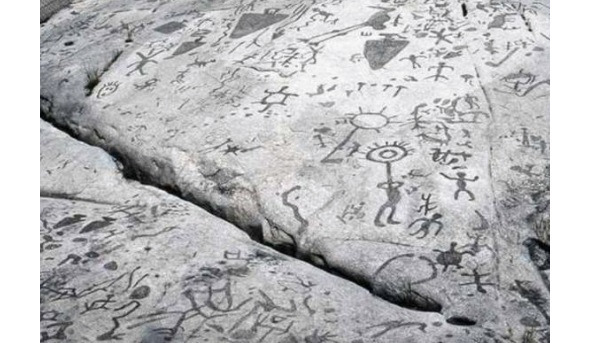
Near Peterborough in the province of Ontario, on a massive block of crystalline limestone called “white marble,” measuring 55 by 30 meters, there are more than 900 drawings made probably by the Algonquins in the period 900–1400 CE.
quote: C. Wilson, The Atlas of Holy Places & Sacred Sites.
For a better understanding of the meaning of the hidden significance of “pre-Flood architecture,” let us pause for a moment at this petroglyph. The very word — petroglyph — indicates that these “pictures” can be seen only from a bird’s-eye view.
This sacred rock, forgotten for centuries, was rediscovered in 1924 by historian Charles Kingam. The boats carved here differ from those used by the Indians, whereas one sun boat — a stylized shaman’s vessel with a long mast ending in the sun — resembles petroglyphs from northern Russia and Scandinavia. As Romas and Joan Vastokas — the greatest experts on Peterborough — claim, the Indians considered one of the cracks in the rock to be an entrance to the underworld or a symbolic womb of “Mother Earth.”
quote: C. Wilson, The Atlas of Holy Places & Sacred Sites.
In this single limestone rock lies the entire meaning of rock engravings and all the other previously mentioned structures. God the Creator not only planned that pre-Flood man would create these traces, but also that the one who discovers them must reach a sufficient level of knowledge to read them. That moment has now arrived. The main assumption was that these tracks could be read only by a human who would rise into the air and from that perspective read their meaning with the help of the key — the conclusion.
The cipher is architecture, the key is the conclusion, and only one element was missing — that man, like a bird, should rise into the air. And this condition has already been fulfilled. Previously, for centuries, people saw all these structures, pyramids, mounds, circles, and yet, “seeing,” they did not know their hidden meaning. However, there were people who, in flashes of genius, “guessed” the hidden meanings of these and other traces, for example Leonardo da Vinci. But the fundamental condition — the condition of time — had not yet been fulfilled; man was not yet ready to learn everything. An example of this “fragmentary” knowledge is the cult of the “Bird-Man.”
It is the traumatic dream of man to be able to rise into the air and read the hidden meaning of petroglyphs, and thereby awaken the “sleeping pre-Flood adolescent.” That moment of “awakening” has now occurred. The cult of the “Bird-Man” is found throughout the world. The dream of rising into the air was the essence of this cult. The most spectacular example of a place where this cult developed is Easter Island.
But let us return to the rock at Peterborough. Upon closer inspection of even a fragment of this block of stone, one can see the “intention” of its creators. The sun boat symbolizes that the Sun is our “life-giving light,” without which our existence on Earth would not be possible. Next is depicted the symbolic outline of a human created by God. The Eye of God is visible — the symbol of Divine Providence constantly watching over him. The line connecting God with the human head indicates that contact between God and man occurs through precisely such a “biological antenna” as the human brain. Next are depicted various human figures and animals.
This symbolizes the genesis and evolution of man (see Chapter Two). The various types of structures differ somewhat in their architecture, yet all of them speak about one thing: the history of man, about what was, and thanks to whom or what (the conclusion) man became human.
The symbolic womb of “Mother Earth” — the meaning and significance of this womb has, I hope, already been partially explained — is, for the above reasons, a representation of the “Venus” figurine that Cro-Magnon people so persistently carved throughout the world. And one more matter. All these structures, architectural traces, were created at different times. The oldest date from about 3–6 thousand years ago.
The rock at Peterborough was created already in our era. There appears to be a contradiction in the difference of time. However, as evidence suggests, the symbolic “Flood” did not necessarily occur equally, in the same place and at the same time. There is one fundamental cause of this process.
All these civilizations, tribes, and cultures reached the peak of their development at different times, but they followed the same basic pattern — they created their civilizations and left behind these “tracks in the snow” in the form of structures. This entire process will be explained in detail using the example of Easter Island, as well as other civilizations: the Maya, Egypt, China, etc.
In the spring of 1927, the Peruvian archaeologist Torbio Mejia Xesspe noticed ground drawings. Only in 1940 did he write about his discovery. The German geographer Maria Reiche became interested in Nazca. These ground drawings were commonly called scratchings. The drawings depict only one monkey, a spider, a whale, a dog, a lizard, a hummingbird, but more than twenty images of birds. The image of the monkey has hind legs with three toes, one with four, and another with five. These strange lines on the Peruvian desert were called the greatest mystery in the world. Gigantic straight lines on the sand, rediscovered only recently from the deck of a flying airplane, stretch across an area of 500 square kilometers. Using the method of activated carbon, the drawings were dated to the middle of the 4th century CE, although they may be older. They are the work of the Nazca culture. But why can they be seen only from the air?
quote: E. von Däniken, Signs of the Gods?
I repeat: why can the Nazca drawings be seen only from the air?! Using our key and what the introduction about petroglyphs “says,” finding the answer to this question will be childishly simple. In the drawings of the Nazca culture one can clearly see what geniuses (of course in appropriate proportions) those people were, who — just as in Peterborough — managed in such a concise form to convey their “credo” to us — their successors.
But this “credo” could be read only from the deck of an airplane. The people of Nazca used the same code as all others — the cult of the Bird-Man. What is so ingenious about these drawings? Namely, in order to inform us that the people of Nazca were aware of this cult — they used images of birds, which are the most numerous.
The fact that there was only one image of each animal — demonstrates their knowledge of the theory of evolution. They distinguished the basic types of animals: reptiles, mammals, fish, arachnids, etc. Thanks to the drawing of a monkey with a different, increasing number of toes, they brilliantly demonstrated their knowledge of the theory of evolution long before Darwin. This drawing of the monkey deserves to be compared with the drawing from the Pioneer probe.
On the Pacific coast of Peru there is a fishing town called Pisco. In this place, on the shore of the bay, in the wall of a mountain ridge, one can see the sign of a gigantic trident or candlestick — “El Candelabro.” The explanation of this sign will be the subject of other chapters.
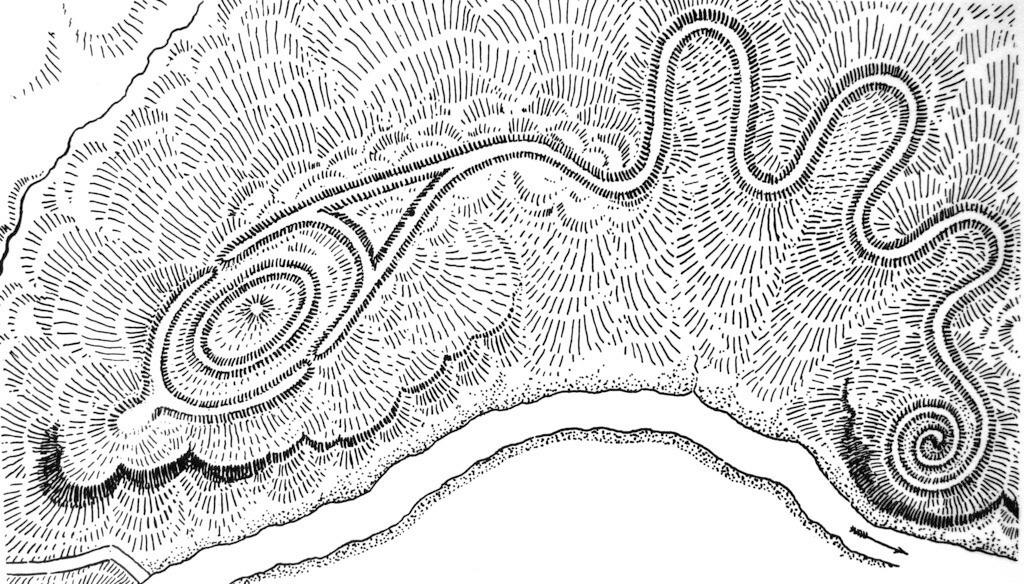
Throughout the 20th century, Americans tried to solve the mystery of the mounds built by people in many places in the United States from the southeast to the Midwest. A hypothesis was proposed that these areas were inhabited by some foreign race, perhaps arriving from Mexico, Scandinavia, or even the legendary Atlantis. The Serpent Mound in the state of Ohio is today probably the most important Indian structure of this type. Who built the Serpent Mound? We do not know for certain, but most evidence points to the Adena Indians, who lived here from the 6th century BCE to the beginning of the 1st century CE. The entire embankment is 366 meters long and 1.5 meters high. From a bird’s-eye view it resembles a snake with an egg or frog in its mouth. From ground level the silhouette of the snake is difficult to recognize.
quote: C. Wilson, The Atlas of Holy Places & Sacred Sites.
Serpent Mound in Ohio. What is the hidden meaning of this mound? The situation from the previous points of this chapter repeats itself. The entire complex is visible only from the air. The genius of this construction is comparable to the previous ones. The Adena Indians more than two thousand years ago, with the symbol of the snake, conveyed to us all their knowledge about what was and what still awaits us in the future.
The Serpent Mound, through its structure, symbolizes what was discussed in Chapter One. It is the apotheosis of the cyclicity of the universe. The tail of this snake symbolizes the Big Bang, its body the winding and changing course of evolution, and its mouth — the final stage of the “megacycle” remembered from the theory of Doctor Tarr and Professor Fether. Brilliantly simple!
Cahokia Mound — a state park on the middle Mississippi — covers lands once inhabited by the largest pre-Columbian community in North America. More than one hundred pyramids and burial mounds belonging to more than 50 tribes once stood here. The culture of the Cahokia Indians flourished roughly between 1050–1250 CE, but long before the arrival of Europeans it declined. The most important structure here was the Monks Mound, more than 33 meters high, covering an area of 6.6 hectares, built from 623,000 cubic meters of earth.
quote: C. Wilson, The Atlas of Holy Places & Sacred Sites.
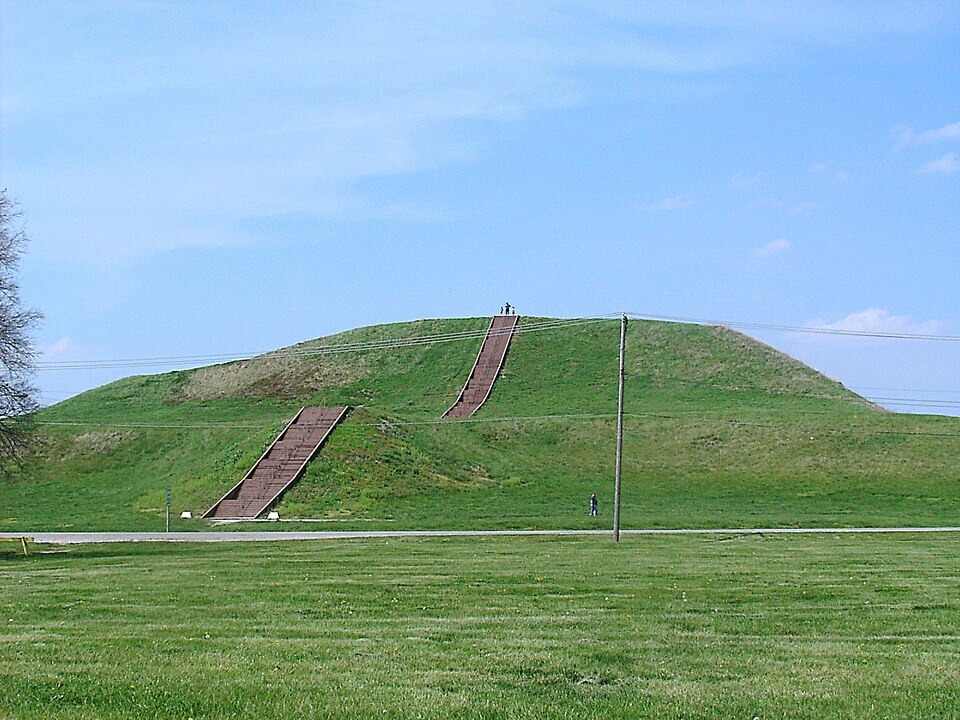
The explanation of the idea of this mound and its shape is found in the chapter devoted to Egypt. Before discussing the next topic, another small introduction will be necessary. Perhaps it should have been placed in the section concerning mounds, but in combination with stones it will be more complete and at the same time easier to understand.
Every culture, every civilization, every state in the world has its mounds. Whether these are artificially built hills, burial mounds, or natural elevations or mountain peaks (for example Newgrange, Uluru, and thousands of other similar objects), mounds generally symbolize in their structure and shape the belly of a pregnant woman.
Every new pregnancy is a new generation, a step further into the future. Through this transformation of generations there will eventually come the long-awaited day — desired by believers in the symbol of the “driving force” — when from this “pregnancy” a new, this time more intelligent human being will be born (de-hibernated).
That such times would one day come, all those pre-Flood people knew and believed that thanks to these descendants they would be able to be reborn and exist again in some new, better world.
Thus God the Creator promised them (Genesis), and thanks to this promise they built their structures all the more eagerly, often devoting to this their entire energy and capabilities. Let us consider that enormous mounds and other structures were often built by communities with limited potential, and yet it was possible solely because of their faith.
Every glance of a human at such a protruding symbolic belly was filled with longing and hope for better times. Different cultures and civilizations speak to us in different ways.
The idea of mounds is inseparably connected with the idea of erecting stones. In the matter of stones, the greatest specialists were pre-Flood Europeans. Having at their disposal only a few thousand years BCE and such modest resources, they too (like other peoples on other continents) managed to create various ingenious structures.
Menhir — an elongated stone set upright, having a cultic character. From Celtic: man — stone, hir — long. The largest concentration of menhirs in Europe (upright standing stones), about 3,000 in total, is located slightly north of the Breton town of Carnac.
All — except 70 stones — form parallel rows here, like avenues. In Kremario there are ten such rows consisting of 1,220 stones. So far the age of only one of the local burial mounds — “St. Michel” — has been determined; it was built around 5000 BCE, at least 2,000 years earlier than previously assumed. Carnac was a place of worship in Roman times; later Christian crosses also appeared on the stones. Among local inhabitants, however, memory of their pagan origin survived. On St. John’s Eve they light bonfires at the entrance to the stone avenues and then drive cattle and sheep between the rows of stones, referring to ancient rituals meant to ensure the favor of fertility gods. To this day the stones are attributed magical power; couples who have difficulty conceiving are advised to dance between the stones, and young wives to sit on them. The purpose of these powerful stones set in long rows remains a great mystery for archaeologists.
quote: C. Wilson, The Atlas of Holy Places & Sacred Sites.
All these hypotheses testify to the incompetence or ignorance of those “scientists.” To explain this mystery, it would be enough not to reach into fantasy, but to bow with respect over these folk beliefs. In them, precisely, as in a dream (when we wake up and remember little), lies our entire “traumatic knowledge” on this subject.
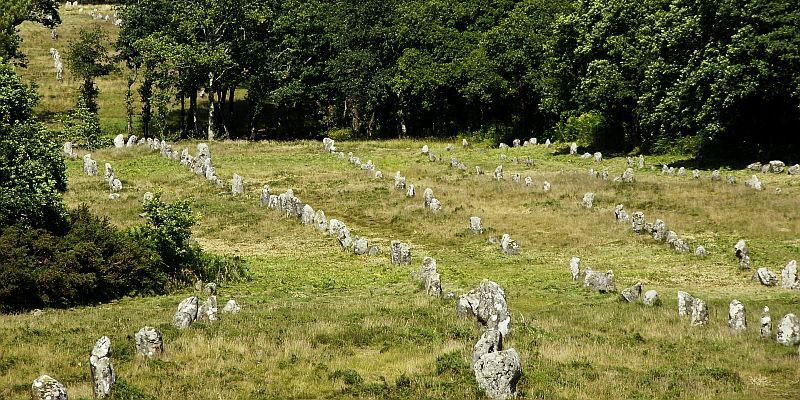
The statements about cattle and young wives clearly indicate that those pre-Flood inhabitants of Brittany and all of Europe saw in the menhirs symbolic “sperm,” which, as in the moment of the greatest — peak, symbolic ecstasy of a man — bursts forth with all its “energy,” in the form of streams in an obvious direction. These are precisely those stones arranged in rows.
I hope that my readers, in accordance with the warning from the introduction, are adults. Among these streams of sperm — rows of stones — or nearby there is always or almost always one, of course the largest stone — symbolizing the male reproductive organ — the phallus. According to the principle that where there are sperm cells and individual stones, there must also be their “spiritus movens.”
The Great Menhir of Locmariaquer — in the Morbihan region (France) — is a massive granite spike 23 meters long and weighing about 348,000 kilograms. Dragging it across the ground would have been impossible. To lift it and place wooden rollers underneath, about 300 people would have to be evenly distributed around 40 levers. To roll it would require 1,750 people or 250 oxen. To raise it would require the effort of 2,100 people or 300 oxen. All this work required perfect coordination of effort.
quote: L.-R. Nougier, Thus Lived People.
What significance stones had for these people we already know, but in order to form a complete whole, to these stones must be added equally symbolic “testicles.” They are represented in the form of two stones, but also in the form of a circle — the “scrotal sac.” Evidence that such was the architectural intention of their builders exists, for example in Great Zimbabwe, Egypt, La Venta, the Hill of Tara, and especially — the most beautifully preserved example — Avebury. All these and other structures will be discussed later.
The intention of the creators of these “sanctuaries of human procreation” would not be complete without one more — perhaps the most important — element. Earlier I wrote about mounds. It is precisely mounds — that is, the “human pregnancy” — that are the result of this male “foresight.”
All these elements: stones — sperm, menhir — phallus, circles — testicles (scrotum), mounds — the female belly, constitute a perfectly conceived and executed architectural whole, created with great precision.
Many years have passed since these structures were built. Some of them, whether as a result of missionary activity or the passage of time, have been destroyed, but what remains testifies in its entirety to the intentions of their builders.
These pearls of “pre-Flood” architecture are at the same time testimony to the cultural unity and faith of that entire world. The idea behind these structures was everywhere the same. All these “traces” of the past can be read only from a certain height (the cult of the Bird-Man). All of this can be perceived only when we look at these objects from a bird’s-eye perspective. The crowning argument for this claim is Silbury and Avebury.
Silbury Hill and Avebury — the great megalithic complex near the village of Avebury in Wiltshire once looked even more impressive than Stonehenge, and its oldest part, the “Sanctuary,” dates from roughly the same period (3000 BCE). Inside a massive chalk rampart stood the largest known circle. It consisted of a main ring of 90 blocks, each weighing about 5 tons, and two smaller circles, each containing 30 stones. An avenue of upright stones connected Avebury with the nearby temple on Overton Hill. South of Avebury rises Silbury Hill, the largest man-made mound in Great Britain, dating from around 2500 BCE, measuring 183 meters in circumference at the base and 55 meters in height.
quote: C. Wilson, The Atlas of Holy Places & Sacred Sites.
South of Silbury Hill are two smaller elongated mounds known as West Kennet and East Kennet, dated to 3600 BCE. When one looks at Silbury Hill from inside the stone circle, only the upper segment of the mound is visible, protruding above the horizon defined by the natural Waden Hill on the left and another natural elevation in the distance on the right. The horizon line is arranged in such a way that the summit of Silbury Hill appears squeezed between the slope of Waden Hill and the crest of the distant ridge.
The River Kennet, flowing through the very center of the Avebury complex, emerges from the Swallowhead spring located less than 800 meters from Silbury Hill. Swallowhead is a seasonal spring — it dries up in autumn and resumes flowing again in early spring. The River Kennet, until relatively recently — as late as the eighteenth century — was associated by local inhabitants with the female vagina.
quote: Faktor X, 2001, no. 62.
All the elements of this puzzle in this sanctuary are brilliantly positioned. Avebury is nothing other than a “scrotal sac with two testicles.” Where are its sperm?
It is assumed that in the very center of the smaller northern circle there once stood a structure of which only two stones remain today, called the Cove. In the center of the southern circle there once stood a massive rock block 6 meters high with a circumference of about 2.5 meters. The first researchers of this site called it the Obelisk. Unfortunately, in 1723 this enormous stone collapsed and was subsequently broken up and removed.
quote: Faktor X, 2001, no. 62.
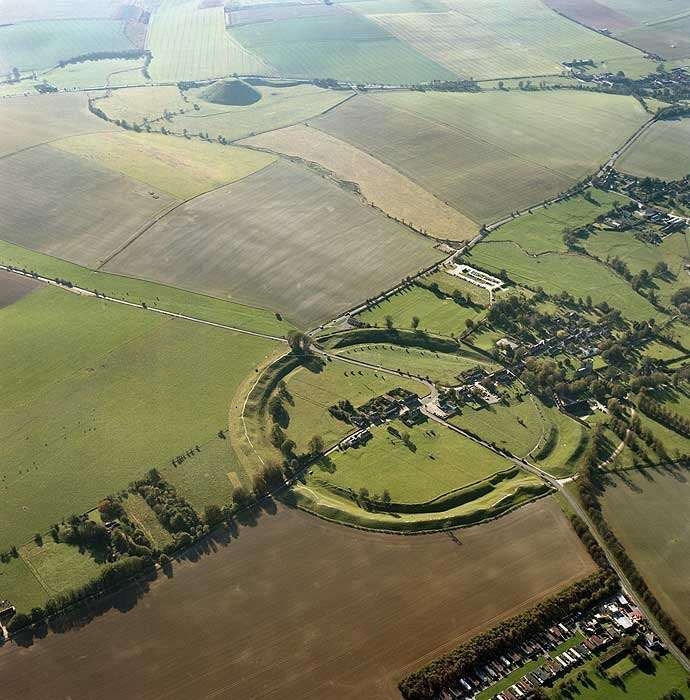
These may have been, in one case, the sperm, and in the other an equally “symbolic” phallus. Silbury Hill is, of course, the symbol of a mound — the belly of a woman. The River Kennet is a symbol of the woman’s periodic fertility, very ingeniously integrated into the entire complex, which was not built merely to stand there and be occasionally looked at by people. Every year solemn ceremonies were held there, similar in character to those that took place in ancient Egypt, Greece, and other civilizations.
What did these ceremonies consist of? Generally speaking, they were connected with the cult of the Sun. Through the fact that grain is cultivated annually on the slope of Waden Hill and that the fields of grain each year at the same time obscure the summit of Silbury Hill, and after the harvest the summit becomes visible again, one general conclusion can be drawn.
The community of Silbury and Avebury (and others like them living more than 5,000 years ago) through this “encoded” complex of structures testify to their knowledge — to things that we, so “highly educated,” are only now beginning to suspect. Is not this cyclicity of the appearance and disappearance of life (the pregnancy of the woman Silbury symbolizing the succession of generations) analogous to the “megacycle” of the cosmological theory of the Big Bang and the final collapse of the universe? In precisely this way this “cosmic perpetual motion machine” was transmitted to us — people from the time of the “Bird-Man.”
The construction of Stonehenge, the most famous structure in Great Britain, must have been an extraordinary feat. It is estimated that to drag each of the upright stones across the Marlborough hills over a distance of 39 kilometers required 1,500 people working for two months. Formerly it was believed to be a temple where Celtic priests — druids — performed human sacrifices. Only in the twentieth century did the astronomer Norman Lockyer propose the now widely accepted hypothesis about the true purpose of Stonehenge — namely, that it was a kind of calendar that allowed ancient priests to calculate the positions of the Sun, Moon, and planets at different times of the year.
Lockyer discovered that on the day of the summer solstice the Sun rises exactly along the main Avenue at Stonehenge. That is why this occasion was traditionally celebrated there each year. Around 3300 BCE the first structure at Stonehenge was built from wood. The first stone circle, consisting of a circular embankment 98 meters in diameter surrounding 56 “Aubrey holes,” was built around 2200 BCE. Stonehenge II — two horseshoes of bluestone — was created around 2000 BCE. Many of these stones were later removed during the construction of Stonehenge III — the great circle of 30 megaliths joined by horizontal slabs and surrounding five trilithons in the shape of a horseshoe, erected around 1900 BCE.
quote: C. Wilson, The Atlas of Holy Places & Sacred Sites.
Trilithon — a group consisting of three megaliths — two standing and one lying across their tops.
Megalith — a large structure built from massive stone blocks without mortar. The word comes from Greek mega lithos, meaning “great stone.”
The outer ring of stones on supports once formed a complete circle. Outside the circle four stones known as Station Stones are arranged in a rectangular pattern marking the points of sunrise and sunset. There is also a stone called the Heel Stone, which marks the point of sunrise on the day of the summer solstice, June 21. Meteorologist Terence Meaden recently noticed that the shadow of the Heel Stone penetrates into the interior of the circle during sunrise on the day of the solstice. In his opinion, this symbolizes the union of Father Sky with Mother Earth, with the circle of Stonehenge symbolizing the divine womb.
quote: Faktor X, 2000, no. 61.
Understanding the idea of Stonehenge is very simple. It is neither an astronomical observatory of ancient “scientists” nor a temple of druids, as various “experts” claim. Terence Meaden comes closest to explaining this “problem,” but not entirely.
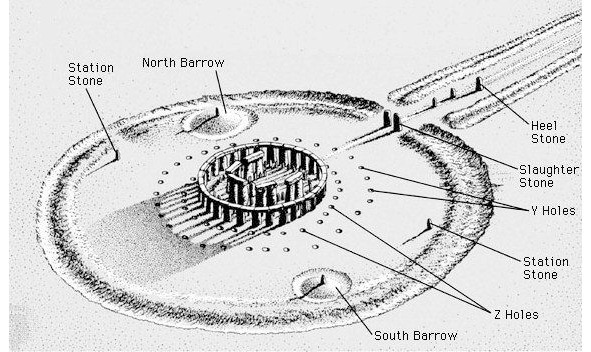
It is significant that on June 21 the Heel Stone penetrates into the stone circle. Indeed, Terence is right — the shadow cast by this stone toward the horseshoe enters its interior within the circle and perfectly, like a sperm joined with an egg cell, “implants” itself in the womb. From that moment a new organism develops — “new life.” In its structure this complex truly resembles not only the womb but also the remaining organs, namely the entire abdomen together with the ovaries — the female reproductive glands.
That this is a paired organ can be “confirmed” by carefully observing holes 18 and 46 located in the Aubrey circle. Holes 1 and 55 form a kind of labia majora, while hole 56 is a substitute for the female clitoris. There remains the question of the role of the Sun in this fertilization process of this symbolic “woman,” as Terence called her — “Mother Earth.” As I already discussed when speaking about petroglyphs — this is not any “Mother Earth” or “Father Sky,” just as the “Venus” figurines are not representations of Mother Earth.
All these Mothers are not Mothers at all, but symbols of the rebirth of life. The Sun, which appears on June 21 always in the same place, is a symbol of rebirth — after “winter death.” It symbolizes that people who have died and departed “into the streak of shadow,” just like the Sun which constantly reappears each year in the “sky of life,” will one day return from the “land of darkness.”
Avebury, Silbury Hill, and Stonehenge are therefore confirmation of the idea of the cyclicity of the universe. In this case I would not call the Sun “Father Sky” but God the Creator, and “Mother Earth” — the human being whom God the Creator forms from the beginning. Petroglyphs of Peterborough and other ground drawings, for example Nazca, rock drawings, stones such as Carnac, the great megalithic complex of Avebury and Silbury Hill, Stonehenge — all these objects built by the same symbolic “Noah,” that is the “pre-Flood adolescent,” contain various ideas.
Although they differ somewhat in message or form, they all speak with one voice and — most importantly — they speak about the same thing. They say that God is the creator of man, that everything man does results from the “intention and inspiration” of our Father. All this is “possible” thanks to three main factors: the phallus, testosterone (generally speaking), and the human brain — that is, thanks to the conclusion (the symbolic key). Confirmation of the theory of the “intervention” of God — understood here as the Sun and the conception of “new life” in the body of a symbolic woman — is provided by the example of the complex at Newgrange, perhaps the most beautiful preserved site.
The great mound at Newgrange is one of the most magnificent prehistoric structures in Europe. Traditionally considered the burial place of the kings of Tara, it was in fact built much earlier, around 3200 BCE. It is essentially a typical passage tomb: a long tunnel beneath the mound leads to a high-vaulted chamber with three niches resembling a three-leaf clover. Modern archaeologists claim that it may have been an astronomical observatory. After a careful restoration carried out in 1962 by Michael O’Kelly, it was proven beyond doubt that the mound is precisely aligned with the cardinal directions. At dawn on the day of the winter solstice, the interior of the tomb is illuminated for several minutes by a narrow beam of light. The same phenomenon can be observed in two other nearby mounds — Knowth and Dowth. When viewed from the side and from above, Newgrange reveals a wall in front of the mound faced with white quartz. At the base the wall is 97 stones wide, tightly set side by side. Around the mound stand 12 of the original 35 stones that once formed a stone circle. In the center of the mound there is a chamber with a corbelled roof. Horizontal layers of stones gradually narrow toward the top. The entrance to Newgrange is “guarded” by a massive kerbstone measuring 3 by 1 meters.
quote: C. Wilson, The Atlas of Holy Places & Sacred Sites.
Dear reader, you are now at such a point in this book that you should already be able to separate wheat from chaff. If you believe that the Newgrange mound is an “astronomical observatory” or a burial place for kings, it means you have not read the previous chapters carefully enough.
If, however, you follow my line of reasoning, then you will recognize on your own, without my help, that it is neither an observatory nor a tomb. Before your eyes appears one of the “most beautiful women in the world”! More precisely, it is the most important “subject” of human procreation — namely: those 37 stones around the mound are nothing other than the belly of a woman.
The mound itself, with its convex shape, symbolizes pregnancy, which — as is known — lasts nine months. The cause of this “greatest of gifts” is the Sun — our Father, God. Returning cyclically each year at the same time of the winter solstice, it “visits” with its “sunbeam” the interior of the mound — that is, the most important place in the woman’s body.
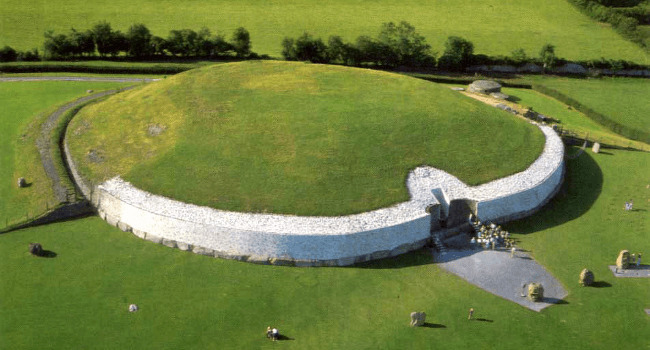
Looking at the photograph, one can immediately notice that the white quartz stones, through their reflection, emphasize this most sensitive erogenous place. The long tunnel leading to the chamber with three niches represents the internal female organs with two ovaries — the three-leaf clover.
The stone basin — the place where the “ray of the Sun looks once a year” — is the womb. It is there that the “gift” from God implants itself, where it grows and where “new life” is born. Through the cyclicity of the rebirth of this life it becomes a symbol of the perpetual motion of the universe.
At this point I would like to recall what I wrote in the introduction: myths contain more truth (than we realize) than present-day truth, which is only a myth. This sentence, used here, finally takes on its full meaning. One can become convinced of this by becoming acquainted with the beautiful myths about Dagda, the Sun god and king of Ireland, and his beloved Boand.
Myths are also part of the heritage (though until now “unknown”) of our civilization. They will be discussed again when describing other cultures, for example Egypt or Greece. Avebury and Silbury Hill constituted a complex of the “symbolic” Man and Woman.
Not far from Newgrange, on the other side of the Boyne, rises Tara, the spiritual center and legendary seat of the kings of Ireland. On the hill there is the Royal Fort with the King’s Residence and the House of Cormac, surrounded by a rampart and ditch. In the middle of the latter stands the “Stone of Destiny,” that is, an ancient fertility pillar and stone used for the inauguration of the kings of Tara.
quote: C. Wilson, The Atlas of Holy Places & Sacred Sites.
The very sight of this object from a bird’s-eye view disarms all “scientists.” The shape of this oval, and within it two smaller circles with that “ancient fertility pillar,” speaks for itself. This fertility pillar is the same symbol of male semen as the stones of Carnac or the Heel Stone at Stonehenge, while Tara Hill is a mound whose meaning is identical to Newgrange.
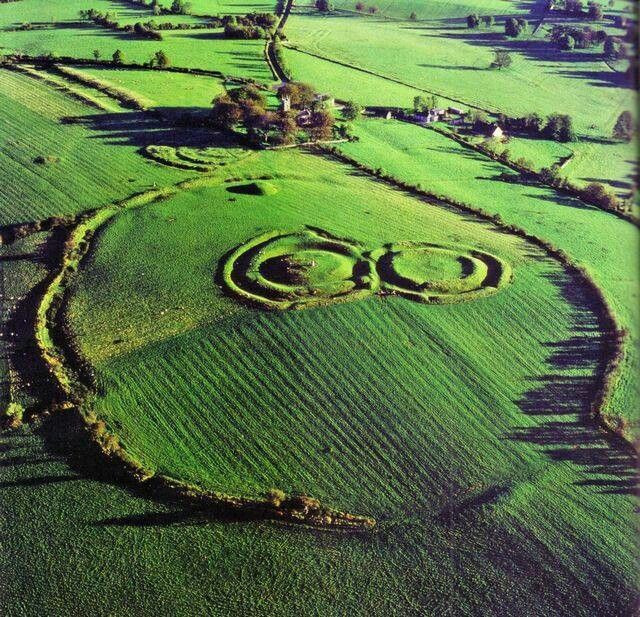
The distance between French Brittany and England or Ireland is quite large. Yet there is something that connects these lands. That “bond” is the name of this symbolic semen: Carnac and Cormac’s House.
These are my suppositions, but Carnac and Cormac have the same etymological source (this is yet another example of pre-Flood unity). That source sprang not only in these places, but that is another story.
Dolmen — a chamber tomb; in Breton etymology dol means table, men means stone. In practice, this term is applied to structures consisting of a large stone slab supported on upright stones. Together they form a characteristic round, polygonal, or square chamber, sometimes preceded by an entrance corridor.
Small groups of people inhabiting Brittany and the mouth of the Tagus River during the Mesolithic period around 10,000 BCE already knew a primitive form of megaliths. Megaliths appeared earliest in France — around 4500 BCE, later in Portugal and Spain — around 3900 BCE, and in the British Isles around 3600 BCE. A different tradition of megalithic construction developed on the Maltese islands, where rock temples and tombs appeared.
In megalithic graves, besides bones, weapons, and food remains, evidence was also found demonstrating connections between the cult of the dead and the cult of fertility. In Portugal, among goods discovered in some graves, cylindrical objects made of stone and bone were found representing schematic figures of the Mother Goddess. Her image was also created on the walls of graves in northern Europe. The oldest megalithic graves were found in Brittany — among them the passage tomb beneath the tumulus of Kercado in Carnac. Similar constructions are known from the Iberian Peninsula, Ireland, Germany, Denmark, and Sweden.
quote: C. Renfrew, Archaeology.
When describing the phenomenon of the rows of standing stones at Carnac, I claimed that they were a symbol of male ejaculation. Avebury with Silbury Hill, Newgrange, and Tara Hill with the House of Cormac are examples of female and male “cooperation.” Was Carnac a solitary manifestation of masculinity? No. Its other half was precisely the dolmens. In their structure, shape, and proportions they fit perfectly into the concept of “woman and man,” known from British constructions.
In the above quotation I highlighted one sentence that clearly and without any doubt indicates the specific purpose of those streams of sperm from Carnac. That purpose was precisely the Kercado tumulus. Moreover, there are more gallery graves in that area.
To the east of Carnac, in Gavrinis, there is an elongated mound oriented according to the summer solstice — a beautiful example of a “female interior.” The fact that there were so many such tumuli demonstrates the widespread nature of the phenomenon.
All of Europe was seized by an extraordinary and difficult-to-understand impulse to build sanctuaries symbolizing Woman and Man. Every region, every tribe considered it a point of honor that such monumental — and of course difficult-to-build — structures should exist in their area. They were not built merely out of a desire to impress others, but were likely driven by an impulse that was their imperative — an unconditional moral command.
The cause of this imperative was partly “pre-Flood madness,” but also another, perhaps even more important matter, which will be discussed in another chapter. One of the most famous dolmens in Brittany is the impressive La Roche aux Fées dolmen. The builders of all these “traces from the past” wanted to make us understand that woman and man, although they are radically different elements (characterological, anatomical, and others), nevertheless form an inseparable whole.
It is a symbol of the unity of opposites, known to us from the philosophy of Heraclitus. Woman and man are the “agents” of new life. God — the Creator of man — presented in these architectural complexes as a ray of the Sun penetrating into the depth of the “female sanctuary,” symbolizes the cyclic nature of the emergence of life on Earth — not only as the succession of generations, but above all as the cyclic nature of the emergence of the universe.
All these “traces from the past” were meant to be read at the “proper time,” namely when man would be able to rise into the air like a bird (the cult of the Bird-Man). To confirm the universality of this idée fixe, I present below examples from other regions of the world.
Great Zimbabwe — the ruins of ancient Zimbabwe undoubtedly belong to the most impressive structures in southern and central Africa. The earliest settlement at this site dates from the 4th century BCE, but the greatest flourishing occurred between the 10th and 15th centuries. The most important structure is the elliptical Great Enclosure with massive walls whose thickness exceeds 6 meters. Great Zimbabwe probably always served as a place of worship. The ruins on the hill, located 400 meters north of the Great Enclosure, come from the earliest period in the history of Great Zimbabwe and include, among other things, the Eastern Enclosure — the main sanctuary, in which monoliths once stood on round stone platforms, sometimes topped with stone bird statues. The walls of Great Zimbabwe were built from tightly fitted granite blocks without foundations and without mortar. The outer wall of the Great Enclosure has a volume of 5,154 cubic meters and is the largest historic structure in sub-Saharan Africa. One of the greater mysteries of Great Zimbabwe is the 10-meter tower that narrows toward the top.
quote: C. Wilson, The Atlas of Holy Places & Sacred Sites.
Without prolonging the matter, let us decipher this “code” from southern Africa immediately. The main complex — the Great Enclosure — is nothing other than “male jewels.” That mysterious conical tower is, unlike in previous cases, a symbolic representation of the male phallus, while the unusual corridor is an equally symbolic urinary-genital tract that delivers the “semen” to the “male cannon.” The Eastern Enclosure, standing on the Hill of Ruins, is nothing other than the “target” of that “cannon” — the female reproductive organs. In this sanctuary, I believe, annual mysteries were held in honor of the god Mwari — their Creator and the Creator of the whole world.
As in other cases, we encounter here the cult of the Bird-Man — evidenced by the statues of bird deities. They are not “ordinary” figurines, symbols of birds, but something much more — they symbolize the man of the future, that is, the human who will one day rise into the air and read their message. They believed that such a day would come — and they were not mistaken.
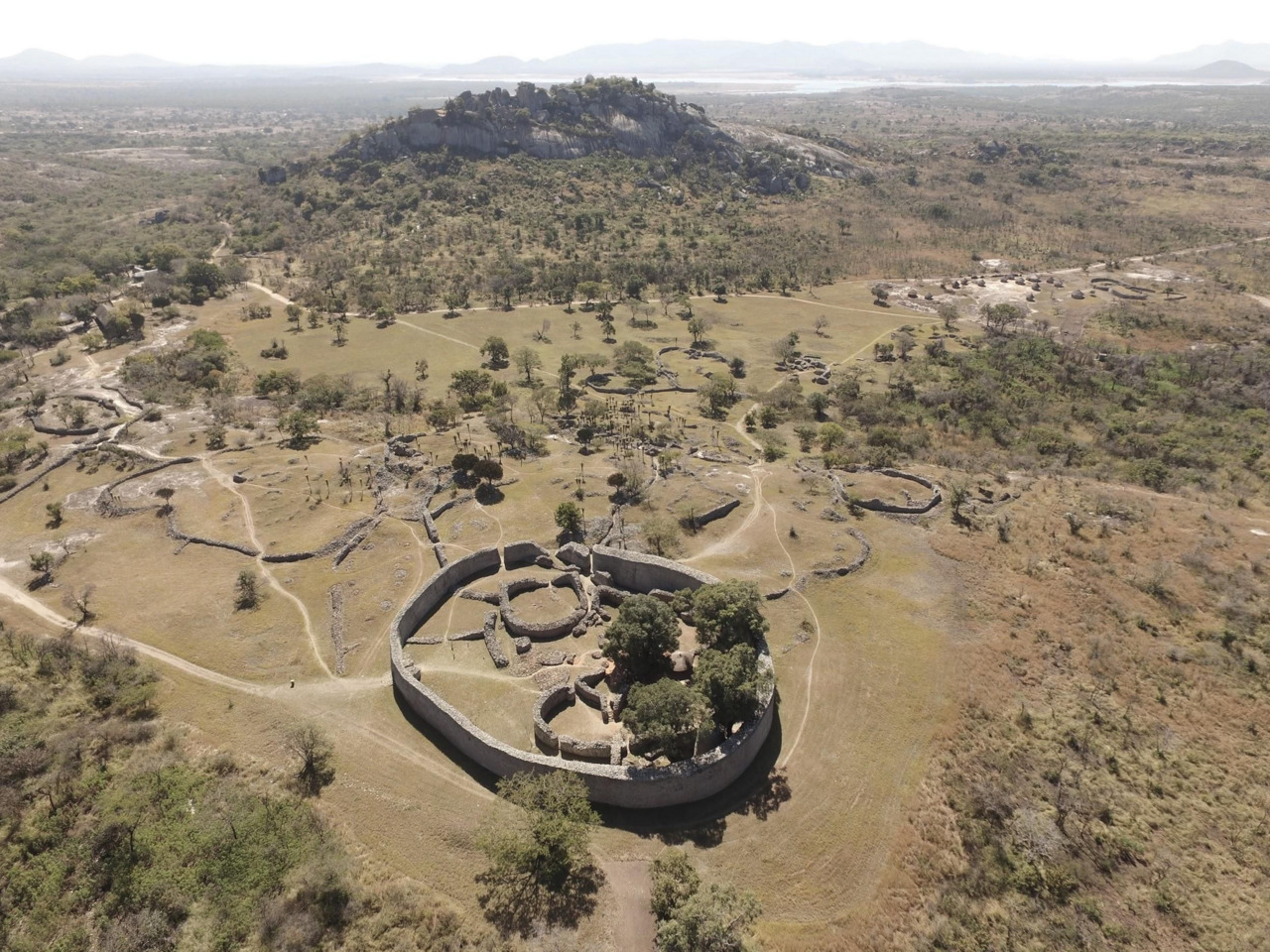
There remains the question of the figurines symbolizing chiefs or clans. Unfortunately, they do not symbolize chiefs. They are the “Venus” figurines already known to us, and as I have mentioned before, they are not symbols of Mother Earth. These figurines served other purposes — but that will be discussed elsewhere.
Almendres and Anta Grande do Zambujeiro — similarly to northern France and Great Britain, Portugal and southern Spain abound in prehistoric megalithic structures. The largest and one of the most impressive stone circles, called cromlechs, is located in Almendres, Portugal. There are as many as 95 upright stones arranged in a double oval with “petals” at both ends, the eastern one larger than the western. The circle at Almendres was built between 3500 and 1500 BCE. Anta Grande do Zambujeiro — this massive mound conceals one of the most beautiful gallery graves in Portugal. After excavating the mound, a powerful chamber nearly 6 meters high was revealed.
A stone slab found nearby has characteristic depressions in which blood may have been collected during ritual sacrifices.
quote: C. Wilson, The Atlas of Holy Places & Sacred Sites.
I think that after reading about Newgrange, the “phenomenon” of Almendres and Anta Grande do Zambujeiro no longer remains a mystery to anyone. Similar structures are also found in Germany.
Visbeck — the area around Ahlhorn, Visbeck, Dötlingen, and Wildeshausen, covering 39 hectares, forms a truly magical square containing about 500 stone circles and megaliths. The name of one of the circles — Visbecker Braut (“Bride of Visbeck”) — existed on a map from 1765, and since there is also a Glaner Bride nearby, this suggests that the circles more often served weddings than burials.
The “Dancing Stones” — the largest stone circle in Germany — Visbecker Bräutigam (“Bridegroom of Visbeck”), measuring 104 meters in length and 8–9 meters in width, consists of 130 stones.
The “Sacrificial Table” — the most frequently photographed stone in Germany — has a preserved portion of the slab weighing more than 40 tons, currently measuring 5 meters in length, 3 meters in width, and up to 1.2 meters in thickness.
quote: A. Miroński, The Mystery of the Seven Seals, Nieznany Świat, 2001, no. 5.
Perhaps someone might accuse me of some obsession, but the “sacrificial table” seems not to be what experts claim it is. That most photographed stone, as its shape suggests — especially in the previously described context — is nothing other than a gigantic phallus. All these symbols of the genius and ingenuity of our ancestors are individual yet representative examples of their cultures. They are “classics,” each in a different convention and way of presenting the subject. Carnac and all of Brittany are famous for megalithic stones; prehistoric civilizations of the British Isles specialized in building circles and mounds. Other regions also contributed something new — for example Zimbabwe with its 10-meter tower narrowing toward the top.
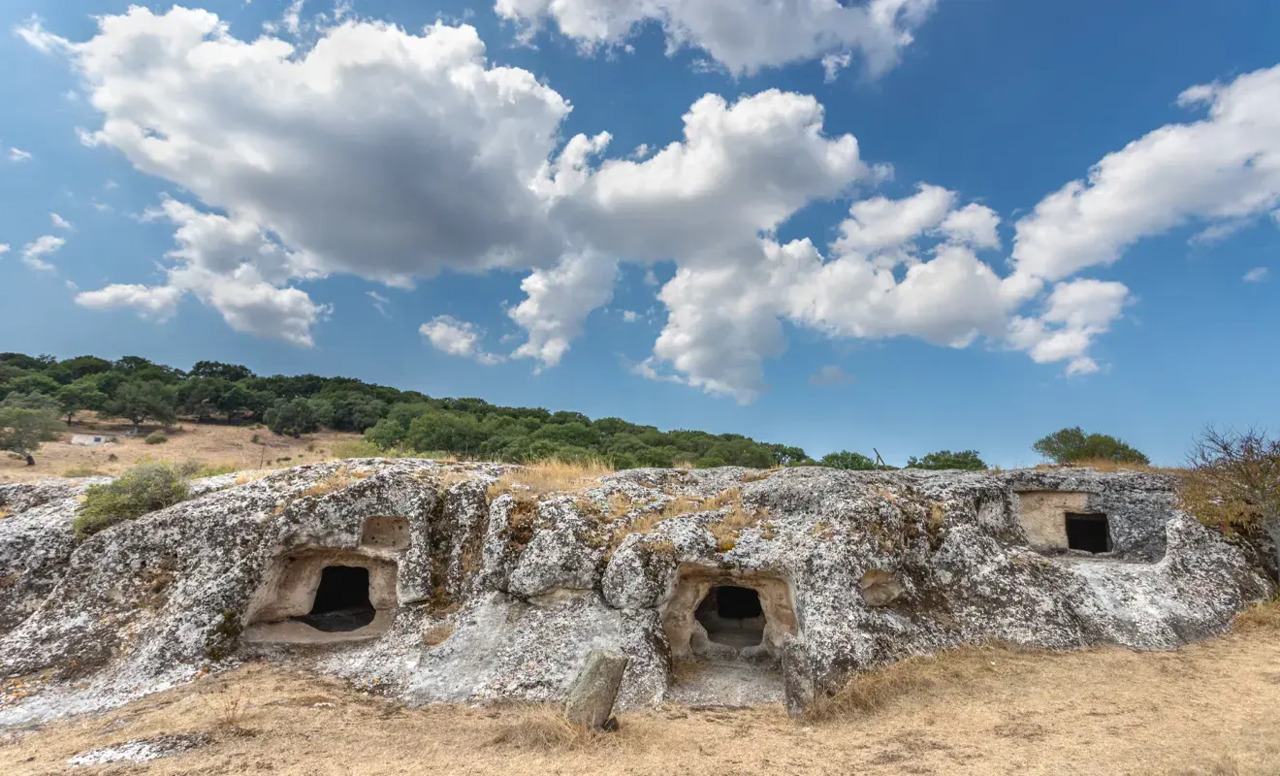
Yet there is a place in the world where almost all these tendencies were gathered together. Visiting this place, one can learn about most types and forms of structures that, like copies from a photocopier, were later reproduced in other regions of the world. In the shapes of these objects one can discern an architectural archetype that makes us recognize individual sanctuaries, leading to the conclusion — though not necessarily true — that they must have originated in that place. That place is megalithic Sardinia.
The character of the island was shaped by two important cultures: underground funerary architecture (the so-called hypogeum) from the third millennium BCE and Nuragic architecture from the second and partially the first millennium. The former, called pre-Nuragic, takes many different forms: on the island there are more than 1,000 rock-cut tombs known as domus de janas. However, the structures that prove most characteristic of the Sardinian landscape are the buildings known as nuraghe, which have been present there for 3,800 years. There are more than 7,000 of them. The religion of that period, whose main traces can still be found, was based on dualism: the male principle — female principle, earth — seed, Sun — Moon.
quote: J. Burakowska, Enigmatic Megalithic Civilization in Sardinia, “Nieznany Świat” 2001, No. 11.
Sardinia can be compared to a veritable “island of women”. All these domus de janas, nuraghi, and even well temples are, in a very “symbolic” way, representations of feminine “attributes”, identical in their idea to those described earlier. Every civilization, every culture built its own “sanctuaries of the unity of opposites” in a different way.
Domus de janas, by their shape, are supposed to resemble female sexual organs. The largest opening is the entrance to the vagina, while the two openings beside it are a symbol of the female gonads. After the turning point in the middle of the second millennium, the nuraghe also represent the above organs, but in a different way — namely, they “emerge onto the surface.” Nuraghe are already “only” towers with a single opening, yet with a meaning comparable to that of domus de janas, as evidenced by the ray of the Sun penetrating into their interior.
The fact that well temples are also symbols of womanhood is indicated by their shape (a keyhole) and by the greatest proof — the water in the well. Let us recall Avebury, where the builders used a similar device. The Moon reflected in the deep well symbolizes, of course, the difficulties that all mature women experience in every “lunar” month. Indeed, it is a very thoughtfully designed way of presenting the “theme.”
This “lunar femininity,” being a symbol of changeability, will from now on set the counterpoint for man seen as the Sun, who — just like the Sun for the symbolic Earth — is the “agent” of female pregnancy. Thus, the symbol of woman is the Moon, while the symbol of man is the Sun.
At this point I would like to emphasize one very important thing. Namely, after closer examination of the shapes of domus de janas and the structures from Goni Pranu Mutteddu in the vicinity of Cagliari, one may come to the conclusion that they are identical to those from: Bolivia (the Gate of the Sun at Tiwanaku), Mexico (the Temple of the Dolls at Dzibilchaltún), Angkor Wat, and others! Wells in the ground reflecting the light of the Moon, with their keyhole-shaped entrances, are also found, among others, in Japan, China, and the Indus Valley.
The female element has been described. And where is the male — the antagonistic half? It is present as well. It is represented by the “Giants’ Grave” at Sa Enaje Thomesfallus, menhirs, and the sacred stone omphalos, which in this “story” symbolizes a single sperm cell from which, after joining with the female element, the “human seed” is formed.
From this seed grows the entire plant — the human being. Such “grains” can also be found in other civilizations. What else are the stone heads of the Olmecs, the Platonic solids found in Scotland, or the stone Delphic omphalos, if not precisely such a “seed — human”?
Omphalos — the very name itself indicates a direct, not only etymological, connection with the phallus. The “streams of energy” known from Carnac also occur in Sardinia, just like the famous Venus figurines, whose symbolism is, of course, different from that of Mother Earth. The buildings and architectural complexes located on other continents will be discussed in the following chapters, but now I would like to present several curiosities.
Cerne Giant — on the slope of a chalk hill the figure of a naked man holding a club has been immortalized. As can be seen, the most important elements of this drawing are the club and the clearly “combat-ready” phallus. The entirety of this drawing has an undeniable connection with the conclusion — namely, that it is precisely the phallus that is the most important “modulator” of our evolution: from primitive man (hence the club) up to the present day.
Long Man — the “Long Man” of Wilmington was created from rectangular stone slabs that reflect light at dusk. It is an obvious symbol of the “agreement of opposites.” The “perfect” human stands on two staffs — on opposing forces. If on one side there is man — the Sun, then on the other there is woman — the Moon. Neither side should, indeed cannot, be greater or stronger than the other. If one side gains dominance over the other — there will be no perfect human, there will be no harmony between these two forces. In the further part of the book I will repeat this many times, even to the point of weariness.
Burning Eagle — near Eatonton in the state of Georgia, an image of an eagle was arranged from white quartz. The bird was probably created 5,000 years ago. From head to tail it measures 30 meters. This eagle certainly symbolizes the Cult of the Bird-Man. What this cult means — I have already mentioned; only one thing astonishes — the scale of the undertaking and the incredible beauty of the bird, which finally arrived at the “time” of its destiny. Those who “encoded” this drawing unfortunately did not have the pleasure of admiring it in its full splendor.
Menantol — a stone with a hole accompanied by two other vertically placed boulders may be the remains of a Bronze Age tomb. The “stone with the hole” was attributed healing properties. Today we already know what it means and for what purposes it served. Explaining this “phenomenon” is certainly unnecessary.
Zbruch Idol — found in the Zbruch River — dates from the first millennium BCE. In the territory of Poland there are also enigmatic monuments about which little is known: animal statues on Mount Ślęża near Wrocław and two mounds (of Krakus and Wanda) near Kraków. The most significant, however, is precisely this Svetovid. It is a four-sided limestone pillar covered with bas-reliefs. At the top are four male figures and four faces covered with a common hat. It shares certain stylistic features with representations in Scandinavia and Celtic sculptures.
quote: K. Estreicher, History of Art in Outline, Warsaw 1998.
The beliefs of peoples living in the territory of Poland also no longer constitute any mystery. They were identical to all those previously presented. What significance “sacred mountains” or other mounds have — we already know. “Svetovid,” by its form and manner of presenting the subject, is decidedly the most interesting (although that is not the main point here).
As can be seen, at the very top appears the figure of God — the Creator — and below His work — the human being. This child is not yet “mature” and is not yet “aware” of its existence, but there is someone who watches over it and takes care of it. The statue itself, by its shape, symbolizes, of course, what is one of the main themes of the conclusion — namely the phallus.
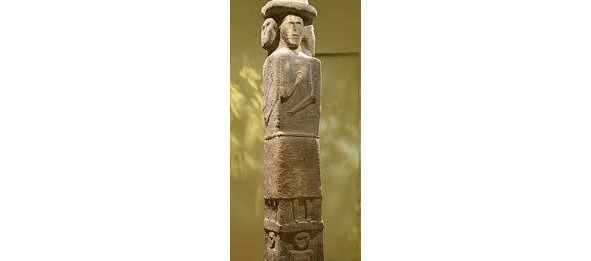
Similar in meaning are Native American totem poles, for example the one from the village of Gitanyow in Hazelton (British Columbia). Obelisks also held no less significance for the beliefs of other peoples. The word derives from the Greek obeliskos, meaning “spear,” “pyramid,” or “spit.” Arab writers used the expression misallat fir’aun, meaning “the great needle of the pharaoh,” or ayn ash-shams — that is, the source of the Sun.
In conclusion, I will once again remind you of what every reader should remember from this chapter. The cult of the Sun is a symbolic representation of God the Creator. Woman and man, thanks to their sexual dimorphism, constitute a perfect example of dualism — that is, the opposition of two principles: male and female, Sun and Moon. Through this dualism, prehistoric man communicates to us that the foundation of our existence is the unity of opposites, which in a broader sense refers to the cyclic nature of the universe.
The Serpent Mound and the Long Man clearly testify to this. Dualism: good and evil — the beginning and the end of the world, which is a “megacycle,” is the life and death of the entire universe. If these “pebbles” have not convinced someone, then I hope that the next chapters will turn into an enormous stone avalanche that will bury the “ravine of skepticism.”
Chapter IX
Woman — The Moon
The process of the formation of history, from the beginnings of life on Earth up to the present day, constitutes a certain logical sequence. One epoch or era follows another, yet in this process it constantly presses forward. Nothing in our history happens anew. Thus, what was the subject of the previous chapter — the buildings and stone complexes of Western Europe — are an integral part of other structures in other times. In the “pre-civilizational” era these were rather “primitive temples,” yet they constituted a “model” for other, more advanced and more impressive constructions in their scale.
It should be emphasized that the main “bond” of the idea behind building these objects were the myths and beliefs of those great civilizations. Thanks to them one can perceive that their faith in God the Creator, in the beginning of the creation of the world, was the same as the faith of those stone “pre-civilizations.” This testifies to the continuity of beliefs and to the fact that the faith and mythology of those tribes and peoples were the inspiration for those peoples from before the era of the first ancient civilizations.
Mesopotamia, that is the land between two great rivers — the Tigris and the Euphrates — is often called the “cradle of history.” Around 10,000 BCE people began to cultivate the land there, mastered the art of weaving cloth, and domesticated the first animals. […] Rulers were also counted among the gods, including Ur-Nammu, who erected most of the temples and created a powerful empire. His successors proved far less talented, and in 2006 BCE Ur was conquered by the Elamites, who allowed the city to fall into ruin.
According to the Bible, Abraham was born in Ur of the Chaldeans. The greatest flourishing of the city, located on the eastern bank of the Euphrates, occurred around 2100 BCE during the reign of Ur-Nammu. The center of the city was a walled sacred area with a powerful ziggurat and temples mostly dedicated to the moon god Nanna and his wife Ningal. In the 1920s the British archaeologist Leonard Woolley uncovered here a vast royal cemetery (ca. 2600–2300 BCE) with nearly 1,500 tombs filled with valuable objects that testified to the wealth of the Sumerian civilization.
quote: C. Wilson, The Atlas of Holy Places & Sacred Sites.
The Old Testament, which is the basic source of knowledge about the faith and religion of our ancestors, was written between 1200 and 150 BCE. The matters and themes contained in this book did not originate solely from the knowledge of people living in that period. They were drawn from the faith of “pre-civilizational” peoples. Between “pre-civilizational” beliefs and the faith contained in the Bible there is a certain gap. However, it cannot be an empty space. This gap is indisputably filled by the myths and beliefs of prehistoric civilizations. A convincing proof of this are the myths of ancient Sumer.
Enuma Elish (“When on high”) — in the primordial vastness there existed three deities: Apsu (identified with the fresh waters of rivers), his wife Tiamat (the salt sea), and Mummu, the womb of chaos. From them a number of other deities emerged through emanation. New gods emerged one from another, in pairs, and as divine evolution progressed each gained greater distinctness. First appeared Lahmu and Lahamu (their names mean “silt” — water and earth still not separated). Then came Anshar and Kishar, identified respectively with the horizon of heaven and the sea. Later arrived Anu (the heavens) and Ea (the earth), and with them this process ended. The divine world now had heaven, rivers, and earth clearly separated from one another. But the act of creation had only just begun: the forces of chaos and disintegration can be restrained only through painful and constant struggle. The young, vigorous gods rose up against their parents, yet although Ea managed to defeat Apsu and Mummu, he failed to conquer Tiamat, who gave birth to a tribe of deformed monsters to fight on her behalf. Fortunately Ea had his own miraculous child, Marduk, the sun god, the most perfect creation of the divine lineage. When the great assembly of gods gathered, Marduk promised to fight
Tiamat on the condition that he be made their ruler. After a long and dangerous battle he succeeded in killing Tiamat. Finally Marduk stood over the enormous body of Tiamat and decided to build a new world. Marduk created humanity. He seized Kingu (the foolish husband of Tiamat, whom she had created after the defeat of Apsu), killed him, and by mixing divine blood with clay fashioned the first human being. The myth of Marduk and Tiamat influenced the people of Canaan, among whom circulated a very similar story about Baal-Hadad, the god of heaven, war, and storms, and indirectly — fertility.
quote: K. Armstrong, A History of God.
While writing all these chapters — and you as well, dear reader, while reading them — we could have saved all this time by becoming acquainted only with these several sentences. It is astonishing, but within these myths lies the entire wisdom of this book. I will repeat once again that myths contain more truth than we realize, compared with present-day truth, which is only a myth. Nevertheless, this time has not been wasted.
Thanks to learning about the “pre-Flood” times, one can state with full responsibility that, just like all traces, myths are in an encoded form a transmission of the entire truth about the past and the future of the universe. By carefully reading the “stories” of the Sumerians and Canaanites, one can observe as if under a microscope that these “myths” are not myths or fairy tales at all, but a trace leading to the discovery of truth — just like the Serpent Mound or the Long Man. The same, of course, applies to all other “traces from the past.”
Let us therefore recall which architectural element of Sumer is identical to the “museum” located in Sardinia. The Ziggurat of Nanna located in Mesopotamia corresponds to the Great Altar at Monte d’Accoddi. The Sumerian ziggurat — just like the Sardinian Great Altar — towers above the entire city of Ur. The most characteristic element of the ziggurat are the monumental stairs leading to the holiest place in the city — the House of Nanna.
Just as in Sardinia, so in Ur similar ceremonies in honor of the Moon God were held at the tops of these structures, the god who was a symbol of women (as changeable as the Moon).
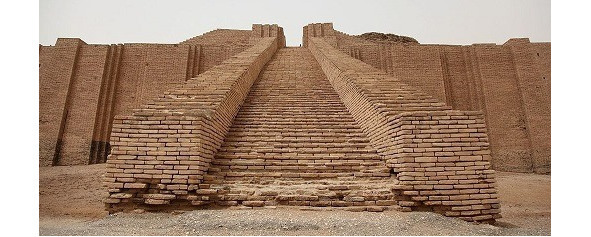
Thus this mighty ziggurat, in its meaning, is yet another highly symbolic representation of woman. These stairs, viewed from the base of the pyramid, seem to represent the path leading to the most intimate parts of the female body. How similar this is in meaning to Stonehenge, Newgrange, the Cahokia Mound, Chichén Itzá, and others. Everywhere the same cult prevailed, the same beliefs. What, however, besides monumentality, distinguishes this sacred city of the Sumerians?
The pyramid itself is not yet the greatest representation of the Moon God; not even the entire city of Ur with its beliefs holds that role. The idea that arose in the minds of those “pre-Flood” people was indeed very simple, yet at the same time difficult to decipher. They knew about the Cult of the Bird-Man — that a day would come when human beings would not only be able to rise into the air, and what they saw would not appear to them as a mere coincidence, but thanks to this they would understand the genius of those who created these civilizations.
They created them not merely in order to build them, but so that traces would remain after them — clues in the form of these very “stone monuments.”
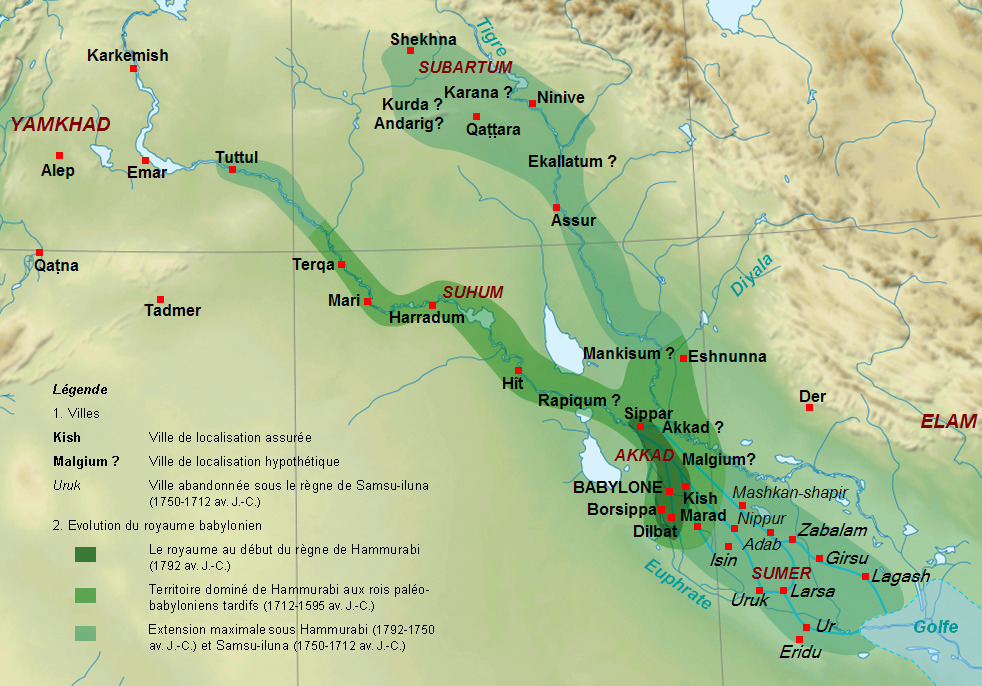
Looking at a map marked with the locations of the greatest ancient civilizations, one can immediately notice that they arose along the banks of some of the largest rivers on Earth. What could have been the reason for this? It is obvious — the most favorable living conditions existed there.
What, then, distinguishes Sumer with its cult of the Moon? The very geographical name of this place — Mesopotamia, meaning “the land between rivers” — points us toward a clue leading to the discovery of truth. Namely, those “pre-Flood” thinkers decided to make Mesopotamia into the greatest possible “sanctuary” of woman — on an almost cosmic scale.
This is most clearly demonstrated by the shape of that land between the rivers. These are the two rivers, the Tigris and the Euphrates, which, narrowing toward the south, form very distinctly the most important part of the female anatomy.
There is yet another very interesting matter from a historical point of view. Before the Cult of the Woman-Moon spread widely in Ur, another cult had ruled in that region — the Cult of the Sun, which, as is known, was a widely recognized symbol of the Creator of Life. Let us recall Stonehenge, Newgrange, and the role of the Sun in the beliefs of those peoples. There is no need to fear — there was no “coup d’état.” This “change” of cults in Ur was entirely “bloodless.”
As I have already mentioned, the shape of Mesopotamia is almost ideal for forming on its “branches” the symbol of the Woman-Moon. The explanation of how this process of changing cults looked is suggested precisely by Leonard Woolley — the discoverer of the royal cemetery.
As we know, that cemetery was created around 2600–2300 BCE, that is before the greatest flourishing of the city of Ur and its ziggurat (2100 BCE). In those graves Woolley found very many objects, both practical and decorative, including figurines of goats standing on their hind legs and a magnificent helmet made of electrum (an alloy of gold and silver). Most of these discoveries were made in the tomb called the Great Death Pit. Almost all these objects were made of gold. The golden color, as is known, belongs to the Sun, not to the Moon, to which the color silver is more appropriate.
Thus, in the “pre-lunar” era the Cult of the Sun — the Creator of Man — prevailed. The remnants of that cult are myths and beliefs that do not disappear quickly. The “goat in the thicket” is, of course, a symbolic representation of the Sun God.
The sight of the goat’s spread golden wings indeed constituted a beautiful symbol of the Sun. The golden helmet of Meskalamdug was the headgear of Sumerian kings, who certainly symbolized the Sun God on Earth, just as was the case with other, more widely known rulers, for example Louis XIV — called the Sun King.
As I have already mentioned, this “change” of cults was carried out “without bloodshed”; moreover, it was the greatest and most magnificent ceremony in the entire history of the ancient world. It was by no means a funeral — neither of a man nor of a king — but a symbolic farewell to the Sun God, the Creator of Man, who departed into the afterlife, yet just as the Sun returns every day, so he too would one day return to revive life on Earth with his light.
Confirmation that this truly was a great and unique ceremony is provided by the Great Death Pit, which is a place of only “temporary” rest for the God (gold objects, as well as servants who accompany the God on his journey through the world of darkness).
The fact that in “pre-lunar” Sumer the same faith prevailed as in other parts of the world is demonstrated by a bas-relief from around 2700 BCE carved on a stone bowl. It is an excellent example of dualism. In its form and arrangement of symbols it is identical to the idea of the Serpent Mound, the Long Man, and others. This principle of dualism is the “hallmark” of all civilizations and cultures throughout the world, created at different times.
Thus Mesopotamia was, is, and will forever remain a symbol of woman — known for her “lunar” changeability. She is the first of the two sides of the dualistic concept that from the beginning of our history has permeated, and still permeates, all ancient and modern civilizations. Where, then, is the second — the “uglier” half of the unity? That will be discussed in the next chapters.
Chapter X
Venus — The Conclusion — Part Two
Paraphrasing the ancient philosopher Heraclitus of Ephesus, who claimed “panta rhei” — everything flows — one may conclude that everything is relative. Depending on the level of knowledge, each observer of a given phenomenon or issue may draw conclusions that differ as greatly as the distance between the Milky Way and the road to a dairy.
Remaining within the convention of relativity, every reader, after becoming acquainted with photographs depicting “Venus” figurines, must answer a very important question. Do they, in accordance with the commonly held opinion, symbolize the idea of Mother Earth, or — as I believe — do they constitute a substitute for a woman? Art historians see in these figurines nothing but the Mother, yet these symbols were not created or “used” by art historians, but by people — most certainly most often men — for whom the erotic context of Woman had primary significance.
If the same photographs were placed in some erotic magazine alongside more daring nudes, their message would certainly acquire a different meaning. Therefore, one may venture the conclusion that in the case of Venus figurines, the effect they produced — that is, the conclusion — is more important than the abstract concept of Mother Earth.
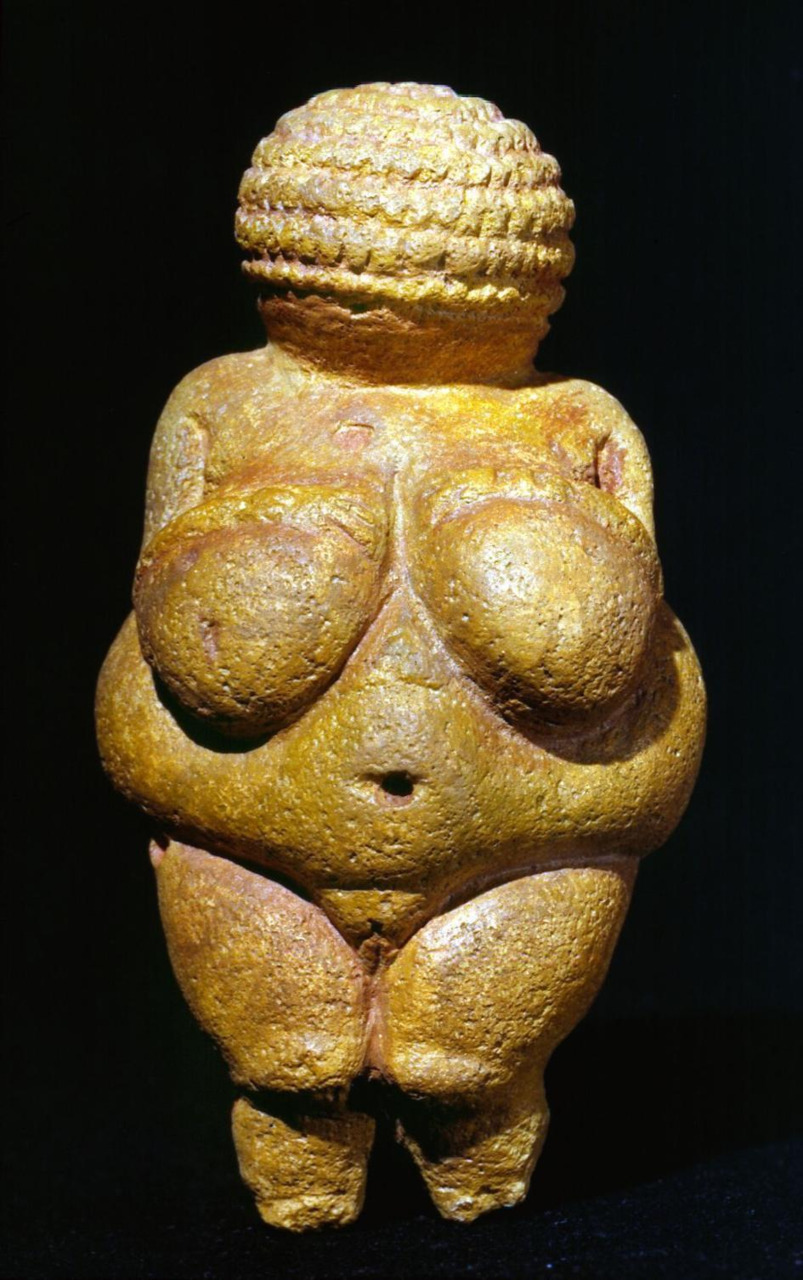
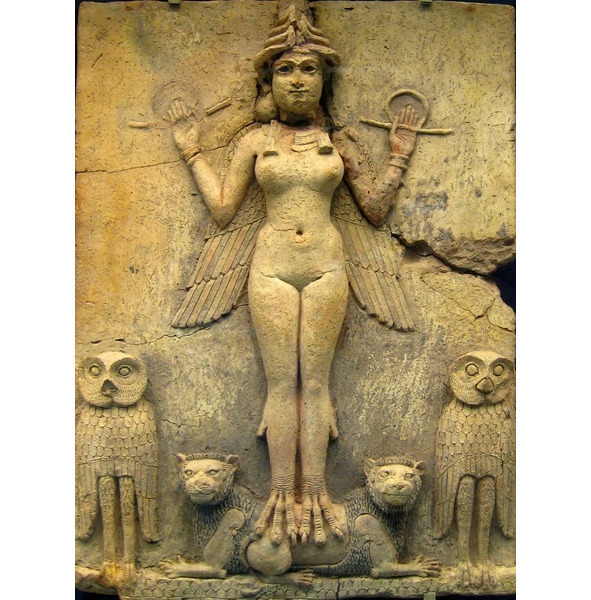
Chapter XI
Man — The Sun — Part One — The Head
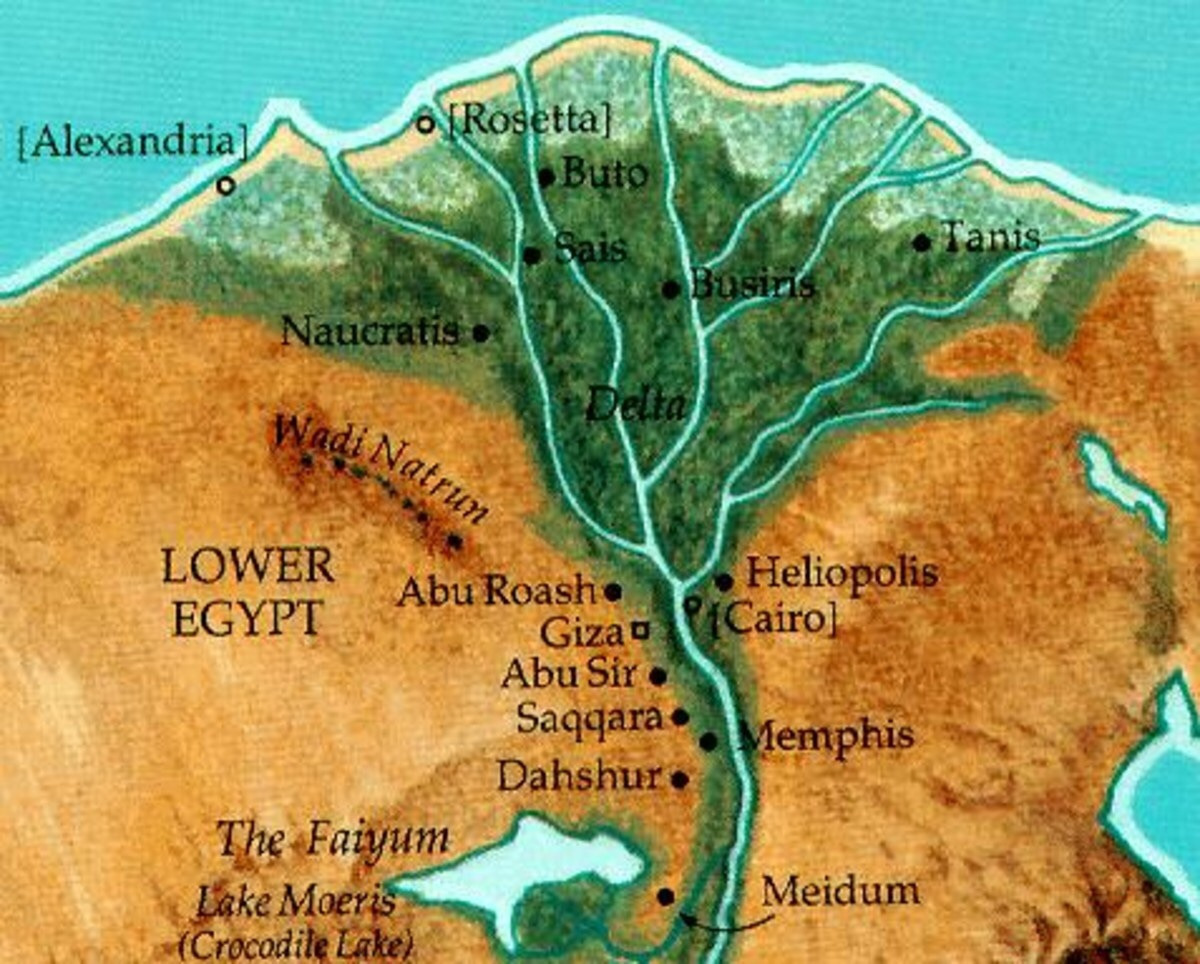
Yes, it is precisely the civilization of ancient Egypt that constitutes the sought-after second half of the dualistic unity. In the previous chapter, in order to confirm that Mesopotamia resembles a woman, only a single glance at the map was needed to be convinced of it. Now as well, I ask every reader to take the same careful look at the Nile River.
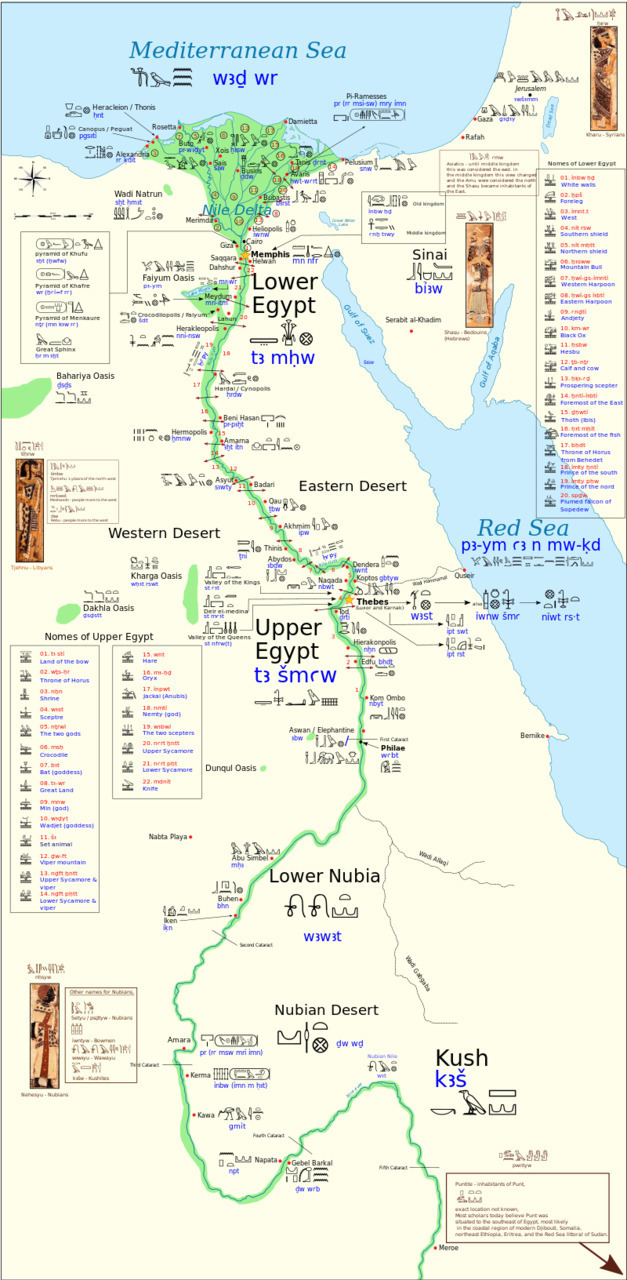
As can be seen, the course of the river fits almost perfectly to be recognized as a symbolic representation of the image of a man. The shape of Mesopotamia depicted a woman in a frontal position. In the case of the Nile this is impossible; therefore, the representation of a man on the map is an outline of a figure shown in profile. Whether this was caused by the forces of nature or is the design of the Supreme Being is not for us to judge. What is important, however, is that the peoples and tribes living in this area used the course of the river to turn it into the greatest possible “sanctuary” of the male body.
That this was a conscious choice is evidenced by the entire body of painting and sculpture. It is not accidental that the silhouettes of almost all figures are depicted — like the Nile — in profile. This profile is programmatically, and in a certain sense subconsciously, an introduced code, a canon for creating the image of a human being on the walls of temples and tombs throughout Egypt.
Using the example of Mesopotamia, I tried to demonstrate that the most valuable “inheritance” of that civilization is the Cult of the Woman-Moon, with its most important “personification” — the Ziggurat — at its head. An equally epoch-making “work” was meant to be the creation of a civilization based on the Nile River. Assuming hypothetically that there had been no previously conceived plan to build a “sanctuary” of the male image, one might suppose that today there would be only a few rather insignificant “monuments” — ciphers from the past — in this area, which, as can be seen, is not the case.
As I have already mentioned, the people living in the region of the Fertile Crescent came up with the brilliant idea of building a “megasymbol” of woman and man on a scale exceeding human imagination. What had been in the plans of those “pre-civilizational” peoples was carried out. No one and nothing could prevent them from doing so.
The first step in realizing this goal was the burial of the Cult of the Sun God in the Death Pit and replacing it with the Cult of the Woman-Moon. To complete these changes, it was now necessary “only” to build a civilization in the lands through which the Nile River flows — there occurred an incorporation of this territory by envoys from Mesopotamia. It was not a bloody confrontation with the natives, but a gradual “civilizing” of these lands (the potter’s wheel, writing, metallurgy, brick walls).
The process of creating these gigantic “traces” lasted not hundreds but thousands of years. Throughout all these years, the main task — bordering almost on obsession — was the creation “on the map” of Egypt of objects whose “characteristics” would correspond to the most important parts of the male body.
The Nile Delta is therefore the equivalent of the head. The branching of the rivers in this delta perfectly “imitates” the cerebral cortex and the connections between nerve cells. Below are located all the other parts of the head: the eyes, mouth, nose, and teeth.
The most important part of the head is the brain, and within it a small gland — the pineal gland — and it is from this that I will begin the “story” of Egypt and the creators of the symbol of the Man-Sun. Yet one thing is puzzling. The construction of this “sanctuary,” as I have mentioned, lasted several thousand years. What force, then, sustained these people in this millennia-long process of creating this symbol?
I believe that such a force, providing energy for such a mad undertaking in its scale, could only have been faith and hope. Faith in God the Creator, who, just as God commanded Noah to build the Ark, commanded them as well. They, like their predecessors from the “pre-civilizational” era, had to (guided by an inner command) leave behind this symbol of dualism.
Thanks to this “stone Ark,” they hoped that a time would come — a turning point — when humanity would read their message. The process of creating the individual elements of this message proceeded in stages. Only a very wealthy society, moreover at the peak moment of its development, could afford such a great undertaking.
Each time the power and significance of Egypt grew, the concept encoded in the minds of successive generations — the construction or expansion of the greatest gift of the Egyptians for God, for us, and also for themselves — would resurface. No one needed to be forced to build these structures. At all the pyramids, even the greatest ones, built in sweat and toil often over dozens of years, the workers were not “slaves,” but people fully aware of what they were doing, why, and for whom.
The pineal gland is a small organ, not much larger than a pea, shaped like a pine cone. It may be striking that the pineal gland is an organ sensitive to light, especially to the times of day and night. This property is attributed to its direct neural connection with the retina of the eye. Such a connection is closely related to the presence in the human body of melatonin, the only hormone known to be secreted by the pineal gland, which regulates the state of sleep and wakefulness as well as processes occurring in the body in 24-hour cycles. The level of melatonin secretion into the bloodstream depends solely on the amount of light in the environment.
Melatonin is produced only at night. Strong light stops its production, and after darkness falls, this hormone prepares all the body’s systems for sleep. There is also an as yet unconfirmed connection between melatonin and extended biological rhythms with a monthly period (such as menstruation) or longer, even annual cycles. Because melatonin is clearly linked to our perception of the passage of time, it is not difficult to observe how changes in its level in the brain’s blood supply may influence our perception of the world. Disturbances in the sense of time and states of “timeless” ecstasy described by people practicing meditation or using psychotropic substances are probably, on the physical level, conditioned by the level of melatonin, and therefore by the functioning of the pineal gland.
quote: “Factor X,” 2001, no. 63.
Why this gland is so important for the human organism will be discussed in another chapter; however, the question arises: what meaning and significance does the pineal gland have for the subject considered here?
It is no longer a “pebble,” but a huge “megalithic boulder.” Let us recall which structure was the first to be built in ancient Egypt and what it looked like — particularly its shape and the place where it is situated. Anyone even slightly familiar with the history and art of ancient Egypt certainly already knows what the subject of this chapter will be.
Yes, that first monumental and rather unusual structure in its architectural form was — and still is — the Step Pyramid located at Saqqara. Does the shape of this pyramid not resemble the “pine-cone-like” shape of the pineal gland? That it is a symbolic pineal gland within our symbolic Man is demonstrated not only by the shape of this pyramid, but also by its location on the plan of the Nile River — in the place corresponding, how could it be otherwise, to the head, and more precisely — to the brain.
Archaeologists and various, more or less serious “scholars” or enthusiasts have tried and continue to try to decipher the phenomenon of this pyramid. Numerous theories have been created about the purpose of building such a unique structure, as well as about its architect, Imhotep, who designed it for Pharaoh Djoser around 2630 BCE.
The ancient cemetery at Saqqara, located on a desert plateau about 30 kilometers from Cairo, is one of the most famous and most frequently visited places in Egypt. It forms part of a vast necropolis stretching over more than 30 kilometers of ancient Memphis. The founding of Memphis coincides with the beginnings of Egyptian history and took place around 3100 BCE, when it was decided to establish a common capital for the newly unified Lower and Upper Egypt. The site chosen was where the narrow Nile valley begins to widen at the apex of the Nile Delta.
Herodotus attributed the founding of Memphis to the mythical creator of the Egyptian dynasties, Menes — who, according to more recent research, is identified with Aha, a king buried in the cemetery of Abydos in Upper Egypt. On the plateau of Saqqara, around the middle of the third millennium BCE, the greatly talented architect Imhotep built the extraordinary complex of the Step Pyramid of Djoser, king of the Third Dynasty, thereby making his name immortal.
quote: C. Renfrew, Archaeology
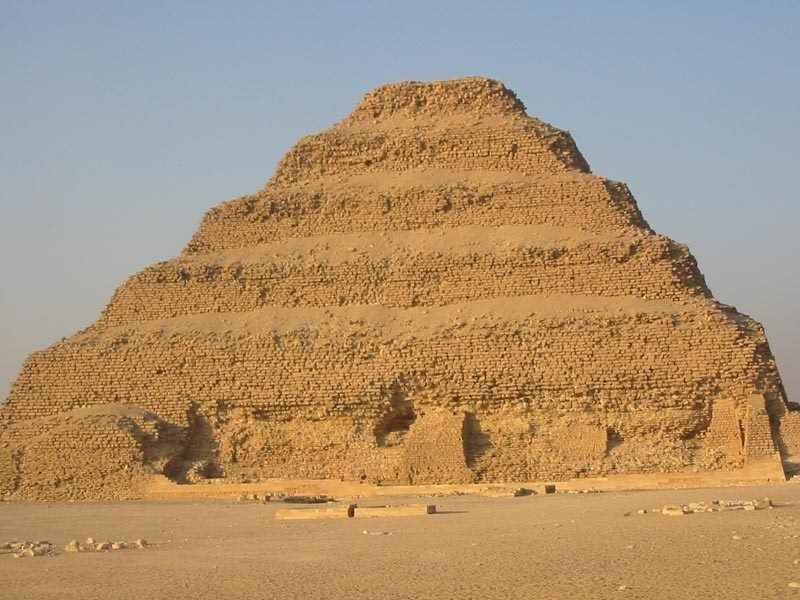
Pyramid of Djoser, through its stepped shape, imitates the organ most important to people of ancient Egypt — the pineal gland, which, as is known, is one of the most essential glands in the human body. All other glands, such as the pancreas, pituitary gland, and thyroid gland, are equally important, but the pineal gland has a significance that can be understood only in terms of magic or mysticism.
The opening of the so-called third eye is in the East widely recognized as a symbol of enlightenment and paranormal abilities. In mystical and religious traditions it is usually located in the center of the forehead, just above the eyebrows. […] Mystics use the third eye to observe things existing beyond the material world, inaccessible to the sense of sight — events occurring in another place and another time, or in the minds of other people.
The opening of the third eye is therefore associated with possessing paranormal abilities such as clairvoyance, astral travel, bilocation (being in two places at the same time), and telepathy. It is also associated with all kinds of mystical experiences. Belief in the third eye is closely linked with another concept of Eastern philosophy: the concept of life energy — in the yogic tradition called prana, and in the Chinese tradition — chi. People practicing yoga claim that the third eye can be opened through meditation, work on imagination, breathing exercises, and adopting specific asanas, that is, physical postures (for example the lotus position), belonging to yogic exercises. In tantric yoga or kundalini yoga, the opening of the third eye is achieved by raising sexual energy originating in the first chakra up to the top of the head. The most commonly used method leading to this goal is adopting sexual positions that allow orgasm to be postponed indefinitely.
quote: “Factor X,” 2001, no. 63
In the previous chapter I claimed that in all regions of the world, on all continents, the same beliefs and rituals of ceremonial rites connected with the cult of the Sun God — the inspirer of life on Earth — prevailed. The knowledge of those civilizations became covered with the “patina” of new religions. For example, ancient India in the third millennium BCE was inhabited by dark-skinned Dravidian peoples. Only around 1500 BCE did the Aryans conquer the local population. The Dravidians inhabited the Indus Valley and were worshippers of the phallus. With the Aryans “arrived” new great religious systems: Hinduism and Buddhism. In China, before Confucianism, people worshipped the Earth — the mother of life, understood as the dwelling place of deceased ancestors. Confucius combined Chinese beliefs (ancestor worship) with an ethical-religious system.
Thus, by learning about the seemingly primitive beliefs, myths, and rituals hidden deep in our past, we can today understand what served as the “prototype” for “new” religions and beliefs. Therefore, remnants of our ancestors’ knowledge preserved in the form of a caricatured belief in the third eye may also be a clue leading to the discovery of truth. Contrary to appearances, this is not a false clue.
What Hindus did with this knowledge we already know — it was incorporated into the system of yogic meditation practices. But just as in every fairy tale there is a grain of truth, so too the Hindu religion indicates that the ancient Egyptians also saw in the pineal gland a mystical organ that symbolized spiritual enlightenment.
Taking all the above into consideration, one may state with certainty that: the Step Pyramid of Djoser is a symbolic representation of the pineal gland. Although for mystical reasons it was the most important for the Egyptians, in order to complete the plan of building a man based on the course of the river, other structures were also necessary. Saqqara, with its pyramid, symbolizes the centrally located pineal gland, but the human brain also consists of other parts: the pituitary gland, hypothalamus, cerebellum, and the largest and most visible — the cerebral cortex.
Now once again a map will be needed. As is known from archaeological excavations, almost all the most important ancient necropolises have already been “brought back to life.” To organize these sites on the map, it will be best to examine this symbolic figure from top to bottom.
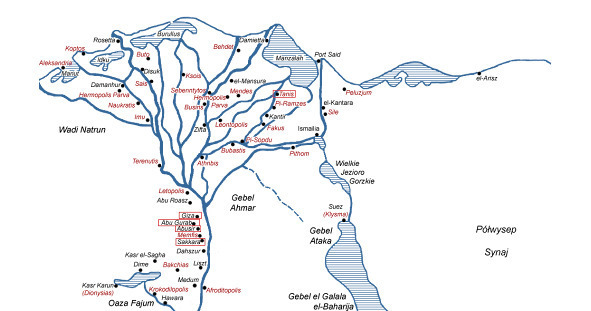
Thus, the highest-situated and most “impressive” necropolis of ancient Egypt is the Giza plateau; below it lie Abusir, then Saqqara, Dahshur, Meidum, and Lake Qarun.
Abusir — 2494–2345 BCE
Magnificent funeral ceremonies were held in this place. Four royal pyramids were erected here. The anatomical knowledge of the ancient Egyptians was not perfect. The pyramids in Abusir, as well as in Abu Rawash (which lies above Giza), undoubtedly symbolize all the “less important” details of brain structure, but the very fact that they were commemorated in the form of pyramids constitutes evidence of a not insignificant knowledge of medicine. This is supported by documented cases of skull trepanation performed using surgical instruments. We possess rather limited comparative material, so my claim that the pyramids in Abusir symbolize the component parts of the midbrain is probably insufficiently credible; however, the next pyramids, in Dahshur and Meidum, I hope will prove it.
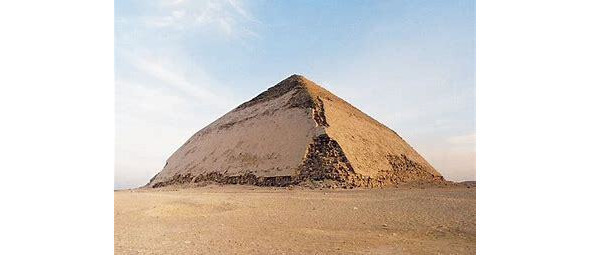
Dahshur — 2500 BCE The Bent Pyramid and the Red Pyramid of Sneferu. This pharaoh probably ruled for more than forty years, during which Egypt achieved stability and prosperity enabling the ruler to build three great pyramids (successively: in Meidum, Northern Dahshur, and Southern Dahshur). Sneferu was the greatest builder of the Old Kingdom: the amount of material used to build his pyramids exceeds by nearly half the volume of the Great Pyramid of his son Khufu, while the quality of workmanship is comparable.
quote: “Archeologia Żywa,” 2002, no. 1
Among some researchers of antiquity there exists the belief that the angle at which the edge of the Bent Pyramid runs had to be changed during construction due to the risk of catastrophe. This is not true. This pyramid was designed from beginning to end precisely so that roughly halfway up it would change its angle of inclination.
This was an intentional act, because the pyramid in its shape was meant to represent the Nose of the “Mega-Human.” As is known, in Egypt there is only one such structure, and just as a human nose must have a slightly crooked shape, and since we see it exactly in this place on the map, it perfectly fulfills its role.
There remains the question of the Red Pyramid. It lies north of the “nose,” so it can be nothing other than a symbolic Eye. The fact that it is red in color is not of great importance; what matters is that it is located in the appropriate place on the “face” of the Nile. Incidentally, do we not sometimes have red, bloodshot eyes when we are tired or sleep-deprived?
Meidum — 2550 BCE Just as in the case of Dahshur the shape of the Bent Pyramid was misinterpreted, so too the pyramid in Meidum is constantly haunted by ignorance and misunderstanding. The pyramid in Meidum has various names. It has been called, for example, the Unfinished Pyramid or a pyramid that collapsed in the final phase of construction, causing the deaths of hundreds of workers. Nothing of the sort. The location of this pyramid, as well as its deliberately designed shape, is meant to symbolize the Teeth of the Human.
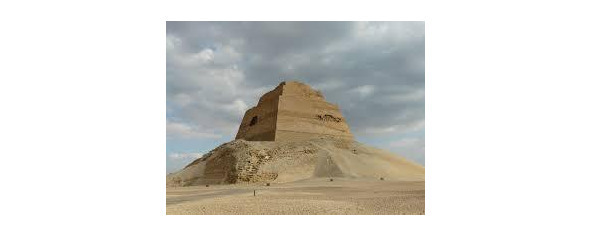
Through its form — protruding angular irregularities — it is meant to resemble teeth of different shapes and sometimes with cavities. There has been an eye, a nose, teeth — now it is time for another very important and characteristic element of the “human head” on the map of Egypt — Lake Qarun.
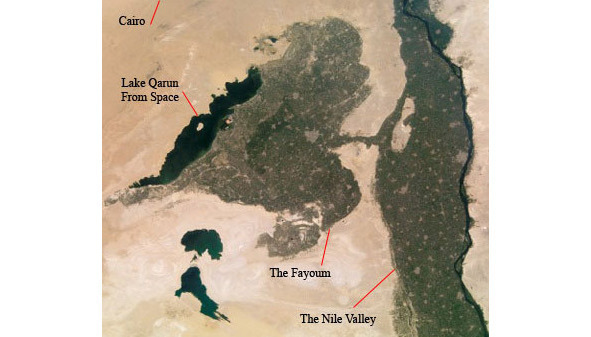
It is simply astonishing how closely the outline of this lake, together with the canal connecting it with the Nile, resembles the beginning of the respiratory and digestive system — the oral cavity, the throat, and so on. The ancient Egyptians, by digging the canal of Lake Moeris, caused the Nile, flowing into fertile lands located below sea level in El-Lahun, to irrigate the surrounding areas. This was the primary purpose of the canal, but thanks to its favorable location, its builders thereby further emphasized the symbolic significance of Lake Qarun.
At this point I can only emphasize that all these distinctive “facial features” did not arise purely by chance as a result of probability — they were very carefully planned in advance and even more carefully executed. One may ask why, for example, the “nose” was not built below the “mouth,” and so on. Logic indicates that it could not have been otherwise. In the plan of the ancient builders, however, the above components were not the most important. For preserving the memory of the past, the mind is the most essential — and what it preserves in its gray cells for descendants.
Memory is fleeting, but stones arranged into pyramids, as we can see with our own eyes, are the most perfect “transformer” of that memory. Let us therefore make use of this treasury of knowledge passed down to us by those anonymous, until now misunderstood and greatly underestimated geniuses of the “hammer and stone,” who with very primitive tools built for us this encrypted message.
There still remains to discuss the most “impressive” part of this chapter — the most precious “jewels” in the collection of human ingenuity, equal in their greatness even to the finest achievements of modern science and technology. To contain such complex knowledge in such a simple form was not easy.
Moreover, this information had to survive several thousand years in an unaltered state — unread by accidental “onlookers,” yet at the same time simple enough to decode so that everyone, after deciphering it, would recognize it as true.
All this “conspiratorially hidden” knowledge is now available. One must remember, however, that our ancestors already possessed it 5,000 years ago, and even earlier. The fact that these supposedly “primitive” people, in comparison to us “educated” ones, knew the same things — and perhaps even more — must certainly be quite a surprise, yet this was intentional. The moment of decoding this “hibernated” knowledge was meant to be — and should be — a turning point in understanding both the past and the future of humanity. The time has come to reflect on this.
The Pyramids of Giza. They stand on a flat rocky elevation about 40 meters high, on the northeastern outlier of the Libyan escarpment — from which the distant Nile Delta, 77 kilometers away, can be seen. It was probably this commanding position that influenced the choice of this site for the construction of the oldest monument there — the Great Pyramid of Pharaoh Khufu (Cheops) of the Fourth Dynasty, who ruled Egypt from about 2551 to about 2528 BCE. Another important factor was the availability of limestone.
Stones from the nearest vicinity were used to build the core of the Great Pyramid, while beautiful limestone, almost resembling marble, was brought from Tura and used for the external finishing works. Before the Great Pyramid was erected, the uneven surface of the plateau was partially leveled — mounds were removed and natural depressions filled in. Only one rock outcrop in the center of the construction area was left intact. […]
Each side of the Great Pyramid measured 440 ancient Egyptian cubits (about 230 meters), and its faces are inclined at an angle of 51 degrees, 50 minutes, and 40 seconds. The pyramid originally reached a height of 280 cubits (146.6 meters). Today it measures 138.75 meters. The entrance to the pyramid of Cheops was placed at a height of 17 meters, near the center of the northern wall. It leads to the system of burial chambers inside, forming an extraordinary architectural reflection of beliefs concerning the afterlife. It was there that the ritual journey of the deceased pharaoh to another world was believed to begin.
quote: C. Renfrew, Archaeology
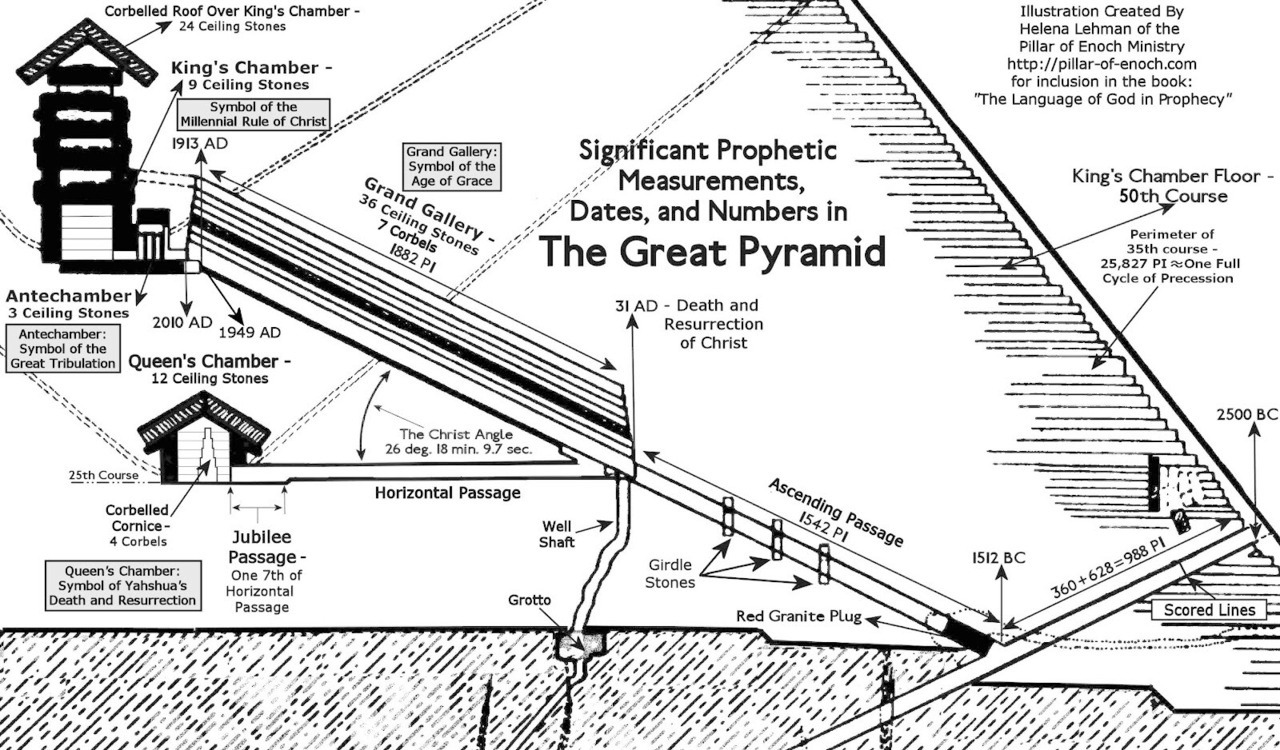
At this point I am forced to interrupt this very interesting story about “corridors,” “burial chambers,” and “air shafts,” because these are merely conjectures and imaginings of archaeologists, resulting from their lack of fundamental knowledge — knowledge that only now we are able to learn. Let us therefore try to decipher all these characteristic elements of the Pyramid of Cheops.
Generally speaking, each of these components is a symbolic metaphor intended to characterize successive stages in the evolution of life on Earth — from the very beginning to its final result: the human being. The Pyramid of Cheops also contains within it the entire knowledge concerning God the Creator and the spiritual sphere of the human being.
The shape of the pyramid — a pyramid with a square base, with its four sides converging at a single point, as well as the apex of this pyramid — contains within itself the true, not symbolic, quintessence of all knowledge to date.
This knowledge was “hibernated” both in the shape and in the interior of the pyramid. What the inhabitants of prehistoric Europe tried to convey in a fragmented way, the Egyptians gathered into one — yet extraordinarily impressive — “diary.” Let us begin from the very bottom of this pyramid.
The burial chamber — located 30 meters below sea level. This chamber was never completed. From it, an unfinished corridor 16 meters long leads south. In the center of the eastern part of this chamber there is a deep well. The “subterranean chamber,” through its location, “tells” us that life on Earth originated and developed in water (the “well”), and shortly afterward emerged onto land. Plants and animals, after leaving the water, spread throughout the world — the symbol of this process is the 16-meter corridor.
The 120-meter ascending corridor signifies the long path that this “primitive” life still had to travel to develop into a more perfect form (hence the constantly rising direction).
About 28 meters from the entrance there is an upward passage. After covering another 39 meters, a horizontal passage 38 meters and 70 centimeters long leads to an intermediate chamber, also called the Queen’s Chamber. The corridors symbolize successive stages in development — not only of life on Earth in general, but also of the beginnings of human evolution.
The Queen’s Chamber is a symbol of evolution from an anthropoid ape to the Neanderthal. This direct ancestor of ours — the symbolic Abel known from Genesis — was not yet the human who could take upon his shoulders (with an incompletely developed brain) what God the Creator still intended.
The Grand Gallery — this chamber is 47.85 meters long, and its corbelled vault rises to a height of 8.48 meters — is one of the architectural masterpieces of ancient Egypt. This corridor, through its height and form, produces an impressive effect on those who see it from inside. No photographs can convey this vastness — the sudden appearance of space after so many meters of a “narrow passage.” This enormous corridor symbolizes the rapid expansion of modern human society — from a population of a few million to more than six billion.
The King’s Chamber — measures 5.24 by 10.49 meters and 5.48 meters in height. Its ceiling consists of nine enormous granite slabs. This chamber symbolizes the society and the time in which we live. It is a turning point in the entire history of humanity. But in order for humanity to move forward — toward the inevitably approaching and unknown future — there must be a breakthrough both in understanding the role of human beings in the surrounding world and the role of God in the entire process of bringing “His son” to full awareness. The relieving chambers — above the ceiling of the burial chamber there are five so-called relieving chambers, made of large granite slabs and an inclined “roof” of enormous limestone blocks.
From an architectural point of view, these rooms do not in fact reduce the pressure of the weight of the upper blocks of the pyramid nor protect the burial chamber itself. To better understand the true purpose of this strange construction — practically useless, difficult, and labor-intensive to build — I will refer to another symbol identical in its idea. That symbol is ANKH — the ancient Egyptian symbol. To understand its message, one must examine not these “chambers,” but — as in the case of the Ankh — the four protruding transverse slabs “piercing” the empty space. These constitute another very important piece of information.
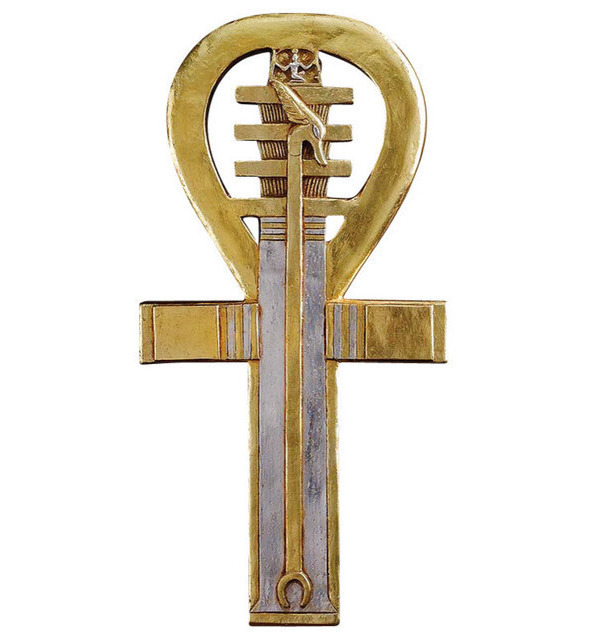
In the Ankh, above these four slabs, there is a symbol of everything that has been the content of this book so far — namely, the symbol of dualism. The four slabs correspond to four steps that the symbolic human — that is, all of us — must take in order to reach the goal of destiny. What this destiny is will be discussed elsewhere. To explain precisely what these steps mean, I must use another example from another civilization that is just as important as the Egyptian one.
This clue will be the philosophy of ancient Greece, which, at the appropriate time, will also speak to us with its true voice. For now, let us take only one of its elements. It is the very well-known knowledge of ancient philosophers — known, for example, from the theory of the quintessence — that the components of the universe are: earth, air, fire, and water. All these elements, in the order consistent with truth — that is: air, fire, water, and earth — tell us about the entire process of the creation of the universe and life on Earth.
There is also the most important — the fifth element — and this is precisely that strangely shaped sloping roof at the outer top of the so-called “relieving chambers.” I wrote about this in more detail in the chapters devoted to Greek philosophy and Judaism.
There still remains the question of the pyramid as a solid figure. As we know, the pyramid has the shape of a polyhedron with a square base. The four faces symbolize — just as in the case of the relieving chambers — four stages of the human path toward perfection. At the very top, they converge into a single point. The meaning of this summit is similar to that of the “sloping roof.” The top of the pyramid, called the pyramidion, is the fifth and final stage of our “journey.” Everything that has been discussed in this book from the very beginning has ultimately been gathered in this single pyramid, about which we have known so little until now.
While admiring the Pyramid of Cheops during tourist excursions, let us pay tribute to all the anonymous builders of this ingenious symbol. Let us appreciate their effort and finally step out of the shadow of ignorance.
One of the most fascinating mysteries in Giza are the two shafts in the northern and southern walls of the King’s Chamber in the Great Pyramid, as well as two shafts in the lower Queen’s Chamber. These are very narrow rectangular tunnels with a cross-section of barely 20 centimeters.
Researchers suggest that their purpose was ventilation or that they had astronomical significance — because they are directed toward the constellation of Orion. None of this is true — these narrow tunnels were not ventilators. The ancient Egyptians considered the constellation of Orion sacred, and in its hourglass shape they saw the likeness of a god. To understand the true purpose of these channels, one must follow the astronomical trail of the ancient Egyptians.
The first person to recognize their symbolic meaning in this way was the Belgian engineer Robert Bauval, who calculated that in 2500 BCE the southern “ventilation shaft” in the King’s Chamber pointed exactly at the constellation of Orion. The southern shaft in the Queen’s Chamber pointed at Sirius — the sacred star of the wife of Osiris, Isis.
That in Egypt one mystery hides another, and behind it yet another, so that all of them form a true thicket of mysteries, impenetrable to the uninitiated — anyone who has reached this point can see for themselves. To pass this next turn, one must use a small hint, and it is the synthesis of all the sciences of the ancient world carved in precious stone — the Tabula Smaragdina.
“As above, so below, and the depth, just like the height, was created only to shape the wonders of the One Thing.”
This is the essence of the knowledge that all the clues, traces, and symbols presented in this book have been speaking about from the very beginning. Let us compare the meaning of this sentence carved in stone with the words from Genesis (1:26): “Let us make man in our image.”
The meaning and idea of these two sentences are cosmically identical. Which of these statements was articulated first? The sentence from the Emerald Tablet was created about two thousand years earlier. From this it follows that all the knowledge contained in the Bible was already known to the ancients much earlier.
This has enormous significance for the later chapters. But let us return to the Emerald Tablet. It is not only a synthesis but even an “apotheosis of secret knowledge.” The shape of the constellation Orion looks like this: three points of light form Orion’s belt. Above and below them are two other points of light. All together, their shape resembles an hourglass — two at the top, three in the middle, and again two at the bottom.
In the constellation of Orion there are other stars forming the arm of the figure, but for the symbol under discussion they have no significance. Let us now compare the meaning of the Emerald Tablet and Genesis with the shape of Orion. Indeed, this is one of the greatest and most deeply hidden secrets in the entire history of humanity.
Namely, the two stars at the top, together with the third located in the middle of Orion’s belt, form a triangle pointing downward, while the two stars at the bottom, together with the third from the middle of that belt, form a triangle pointing upward.
Is this not exactly what the Emerald Tablet and Genesis speak about? As I have already mentioned, this is only an introduction to another chapter of this book. These mysterious tunnels from the King’s Chamber are another clue deciphered at this moment, which should make us realize that the code sent into space-time more than four and a half thousand years ago has finally reached its destination. What we do with this knowledge depends solely on ourselves.
The southern shaft from the Queen’s Chamber, in 2500 BCE, pointed at Sirius — the brightest star in our sky. Its appearance in the morning sky announced the imminent arrival of the Nile floods. In ancient Egypt, it was worshipped as divine. The significance of Sirius can be found in Egyptian mythology. Like the beliefs of the Sumerians or Greeks, Egyptian myths constitute encoded information whose meaning and significance are more serious than we have previously thought.
The appearance of Sirius in the sky symbolizes the rebirth of life on Earth. The floods fertilize the soil, preparing it for sowing. The entire life of the Egyptians was connected with this annual ritual. In addition to this “mini-meaning,” there was also a “mega-meaning.” Sirius, through its appearance, symbolizes the return of life to Earth. This life dies and is reborn in an endless vortex of life and death, like a symbolic perpetual motion machine. It is the symbolic beginning of a great cosmic megacycle. And this is precisely what Egyptian mythology tells us about.
The goddess Nut, her husband — the earth god Geb, their children Osiris and Isis, the jealous brother of Osiris — Set, who kills him, and the triumphant return of Osiris to the world of the living — these seemingly simple myths are encoded information mentioned earlier. They are nothing other than the megacycle known from the System of Doctor Tarr and Professor Fether.
These myths testify that the cyclical nature of the universe was perfectly known already to the ancients. This message, reaching us from a history more than five thousand years old in the form of the symbol of the pyramid, should be for us a guiding thread, just like Ariadne’s thread for Theseus, which led him out of the labyrinth of ignorance. At this point, the words of the 12th-century Spanish scholar and mystic of Jewish origin — Abraham Abulafia — are meaningful:
“The pyramid is the essence of secret knowledge. In it you will find the laws of proportion and moderation. The proud pyramid stands, swollen with meaning in silence. Within it lies an entire labyrinth of meanings. In it you have the world written down. Stand at the top of the pyramid, and you will find yourself at the center of the Whole. Six pyramids form a cube. When you grasp each of them with reason and drink knowledge from them, it is a sign that you have understood everything.”
As for the meaning of the first part of these words, dear reader, you have already learned it, and the meaning of the second part you will learn at the appropriate time. The remaining two pyramids of the Giza plateau — those of Khafre and Menkaure — also contain chambers whose meaning has not yet been deciphered.
The successor of Cheops, his son Djedefre (2528–2520 BCE), began the construction of a pyramid north of Giza. After his premature death, the throne was taken by his brother Khafre (2520–2494 BCE), who erected his funerary monument south of the pyramid of his father, Cheops. The pyramid of Khafre has sides measuring 215.25 meters and is therefore smaller at the base than the pyramid of Cheops; however, its steeper angle of inclination (53 degrees 10 minutes) made it possible to achieve an impressive height of 143.5 meters — only 3 meters less than the pyramid of his father.
The two lower layers were clad in dark red granite, the remaining ones in limestone. This outer layer has survived well in the upper sections to our times; only the cone (Greek: pyramidion), probably made of pink granite, is missing. The arrangement of chambers in the pyramid of Khafre is strikingly uncomplicated.
To this day we do not know why two entrances and two corridors lead to the Burial Chamber. According to the original plans, there was to be an underground rock chamber, an intermediate chamber (above ground level), and a burial chamber, just as in the pyramid of Cheops. The last of these was never completed, while the intermediate one was extended westward. This extension was paved with a granite floor. Most likely the entire chamber was lined with granite. Its dimensions are: 4.99 meters in width, 14.15 meters in length, and 6.86 meters in height.
quote: C. Renfrew, Archaeology.
Keeping in mind the influence of the arrangement of individual chambers and corridors on their symbolic meaning, let us attempt to decipher the riddle of Khafre. To do this, we must return for a moment to the pyramid of Cheops. Its casing was made of limestone, therefore it had a white color. This color symbolizes the human being and his evolution — from his primordial beginnings up to the present day.
From this symbolism of “colors” one should exclude the pyramidion, whose symbolism is entirely different. The colors of the remaining pyramids also possess their own gnosis. The pyramid of Khafre has two dark red layers at the base, while the remaining ones are white. What could these colors symbolize?
The pyramid of Cheops describes the history of humanity and mammals in general. The pyramid of Khafre, on the other hand, is a symbolic description of the period preceding the age of man — namely, the era of the domination of reptiles on Earth. The red color at the base of the pyramid — the two largest levels — symbolizes precisely the enormous, terrifying dinosaurs. Suddenly the red color disappears and white appears. Is this not a symbolic representation of the great extinction of reptiles — 65 million years ago? Undoubtedly.
Now let us consider the arrangement of chambers in the pyramid of Khafre. The beginning we already know. The underground chamber — the emergence of life in the seas and oceans of the Earth. The middle chamber is already more imposing than the Queen’s Chamber in the Pyramid of Cheops. This chamber symbolizes more than 150 million years of the rule of gigantic reptiles on Earth. Two shafts and two entrances to this chamber symbolize the rivalry of two species — mammals and reptiles — for domination of the Earth.
Mammal-like reptiles and reptiles, as we remember, coexisted for some time on the prehistoric Earth. Who emerged victorious from this rivalry? The decision on this matter was made 65 million years ago. Was there a pink pyramidion at the top of the pyramid of Khafre? There is no evidence for this. Personally, however, I believe that for obvious reasons it was still too early.
The solution to the riddle of the pyramid of Menkaure should now be childishly simple.
The son of Khafre, Menkaure (2490–2472 BCE), placed his monument in the last free spot in the southern part of the Giza plateau. The base and sixteen lower layers of the pyramid of Menkaure were clad with blocks of dark red granite, while the higher sections were covered with beautiful light-yellow limestone. Its dimensions — approximately 104.6 meters at the base and 65 meters in height — are more than twice as modest as those of the pyramids of Cheops and Khafre.
Unlike the Great Pyramid of Cheops, the builders concentrated on underground works and — which at that time was a pioneering achievement — introduced granite slabs through a long passage into the interior to cover the burial chamber from above, in order to create the impression of a “false vault.”
quote: C. Renfrew, Archaeology.
Besides the arrangement of chambers and the colors of the pyramids, their size also has a hidden meaning. Their gradual decrease in size symbolizes moving backward in our story about the evolution of life on Earth.
First there was the story of man; later (moving backward) the breakthrough moment of evolution — the reign of reptiles; and later the slow emergence of mammals; and finally the pyramid of Menkaure, which — as its size indicates — symbolizes the initial stage of the formation of life. In its “quality” this life is still very primitive, yet most importantly, without it we humans — the last link in the chain of the evolution of life on Earth — would not exist at all.
Looking chronologically, the pyramid of Menkaure is the first (initial) stage in the development of life on Earth; the pyramid of Khafre, with its two chambers, is the intermediate stage; and the pyramid of Cheops, with three chambers — the final stage in this development. Very characteristic of the pyramid of Menkaure is the construction of rooms underground. This symbolizes that the “theme” of this pyramid is life before emerging from the seas and oceans.
Let us look at its colors. Their placement is entirely consistent with the state of our current knowledge. The base and sixteen lower granite layers symbolize the still unformed Earth’s crust, shaken by constant volcanic eruptions and streams of red-hot lava. The light-yellow limestone symbolizes everything that followed: the formation of oceans, the atmosphere, the first living organisms, and so on.
The three small pyramids near the pyramid of Menkaure, one near the pyramid of Khafre, and three more near the pyramid of Cheops symbolize the individual sub-periods in the history of these great epochs. There still remains the matter of the Sphinx — a huge sculpture created around 2500 BCE during the reign of Pharaoh Khafre, standing by the road leading to his pyramid.
In solving the riddle of this mysterious sculpture a lion with a human head, help comes from a computer reconstruction carried out by Mark Lehner. Between its paws, at the level of the heart, there is a figurine of a human being. Lion with a human head is nothing other than a symbolic representation of God himself. The human figurine is probably the pharaoh — king and ruler, and at the same time the symbolic representative of the entire human race. God the Father watches over him and leads him toward the future. Fact that this figure emerges directly from His heart signifies the great and boundless love of God for His creation — humanity.
Kup książkę, aby przeczytać do końca.