
Part One: The Anatomy of the River Nile
Introduction
Mesopotamia — that is, Woman
The process of creating history — from the beginnings of Life on Earth up to the present day — constitutes a certain logical sequence. One epoch or era follows another, yet in this process always presses forward. Nothing in our history happens anew. The buildings and stone complexes of Western Europe constitute an integral part of other structures, created in different times. In the “pre-civilizational” era these were rather “primitive temples,” yet they served as a “model” for other, more advanced and more impressive in their scale constructions.
It should be emphasized that the main “binding agent” of the idea of constructing these objects were the myths and beliefs of great civilizations. Thanks to them, one can perceive that their faith in God–the Creator, in the beginning of the creation of the world, was the same as the faith of those stone “pre-civilizations.” This testifies to the continuity of beliefs and to the fact that the faith and mythology of those tribes and peoples were the inspiration for peoples from before the era of the first ancient civilizations.
The Old Testament, which constitutes the basic source for understanding the faith and religion of our ancestors, was written between 1200 and 150 BCE. The matters and themes contained in this book did not originate solely from the knowledge of people living in that period. The knowledge was drawn from the faith of “pre-civilizational” peoples.
Between “pre-civilizational” beliefs and the faith contained in the Bible there exists a certain gap. It cannot, however, be an unoccupied space. This gap is indisputably filled by the myths and beliefs of prehistoric civilizations. Convincing proof of this are the myths of ancient Sumer.
Thanks to the understanding of “pre-Flood” times, one can state with full responsibility that — like all traces — myths are, in a coded manner, a transmission of the entire truth about the past and the future of the universe. By reading carefully the stories of the Sumerians and Canaanites, one sees as if under a microscope that these “myths” are not myths or fairy tales at all, but — like the Serpent Mound or the Long Man — a trace leading toward the discovery of truth. The same applies to all other “traces of the past.” Let us therefore recall which element of Sumerian architecture is identical with the “museum” located in Sardinia. The Ziggurat of Nanna in Mesopotamia corresponds to the Great Altar of Monte d’Accoddi. The Sumerian ziggurat — just like the Sardinian Great Altar — towers above the entire city of Ur.
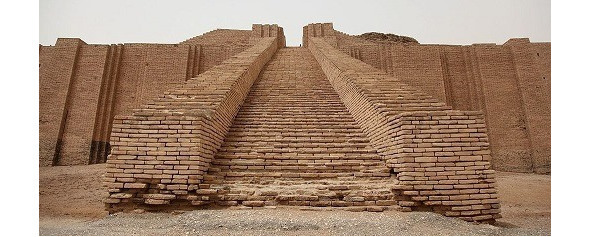
The most characteristic element of the ziggurat is the monumental staircase leading to the holiest place in the city — the House of Nanna. Just as in Sardinia, so too in Ur, ceremonies were held on the tops of these structures in honor of the Moon–God, who was a symbol of woman — just as changeable as the Moon.
Thus this mighty ziggurat, in its meaning, constitutes yet another highly symbolic representation of woman. The stairs, viewed from the base of the pyramid, appear to be an image of the path leading to the most intimate parts of the female body. How similar this is in meaning to Stonehenge, Newgrange, Cahokia Mound, Chichen Itza, and other places. Everywhere the same cult and the same beliefs prevailed.
What, however, apart from monumentality, distinguishes this holy city of the Sumerians? The pyramid itself is not yet the greatest representation of the Moon–God, nor is even the entire city of Ur with its beliefs. The design that arose in the minds of those “pre-Flood” people was indeed very simple, and at the same time difficult to decipher.
They knew from the Cult of the Bird that the day would come when man would be able to rise into the air, and what he would see would not appear to him as mere coincidence, but thanks to it he would understand the genius of those who created those civilizations. They created them not merely in order to build them, but so that traces would remain after them — clues in the form of stone monuments.
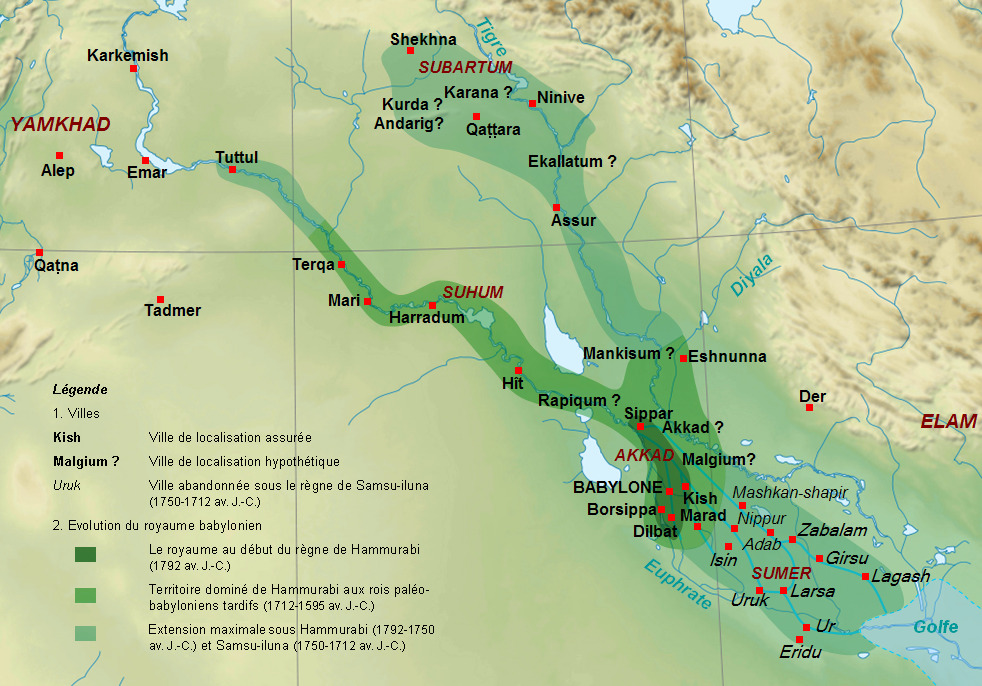
Looking at a map marked with the locations of the greatest ancient civilizations, one can immediately notice that they arose on the banks of some of the largest rivers in the world. What could have been the reason for this? It is obvious — the most favorable conditions for life prevailed there. What, then, distinguishes Sumer with its cult of the Moon? The very geographical name of this place — Mesopotamia, that is, the Land Between the Rivers — indicates a clue leading toward the discovery of truth.
These “pre-Flood” thinkers decided to make of Mesopotamia the greatest possible, almost cosmic-scale “Sanctuary of Woman.” This is most clearly testified to by the very shape of Mesopotamia — the two rivers, the Tigris and the Euphrates, which, narrowing toward the south, very distinctly form the most important part of female physiognomy.
There is yet another very interesting issue from a historical point of view. Before the cult of the Woman–Moon developed in Ur, another one prevailed in that area — the cult of the Sun, which, as is known, was a commonly recognized symbol of the Creator of Life. Let us recall Stonehenge, Newgrange, and the role of the Sun in the beliefs of those peoples. There was no “coup d’état” — this “exchange” of cults in Ur took place entirely without bloodshed.
As already mentioned, the shape of Mesopotamia is almost ideal for creating on its “extensions” the symbol of the Woman–Moon. An explanation of how the process of the “exchange” of cults looked is suggested to us by Leonard Woolley — the discoverer of the royal cemetery.
As we know, this cemetery was established around 2600–2300 BCE, thus before the greatest flourishing of the city of Ur and its ziggurat (around 2100 BCE). Woolley found in the graves numerous objects — both utilitarian and decorative — among them figurines of goats standing on their hind legs and a magnificent helmet made of electrum (an alloy of gold and silver). Most of these discoveries were made in the tomb called the Great Death Pit.
Almost all the objects were made of gold — a metal belonging to the Sun, not to the Moon, to which the color silver corresponds more appropriately. Thus in the “pre-Moon” era the cult of the Sun — the Creator of Man — prevailed. The remnants of this cult are myths and beliefs, which do not disappear so quickly.
“The Goat in the Thicket” is, of course, a symbolic representation of the Sun–God. The sight of the goat’s spread golden wings constituted a beautiful symbol of the Sun. The golden helmet of Meskalamdug was the headgear of Sumerian kings, who certainly symbolized the Sun–God on earth, just as other well-known rulers did, for example Louis XIV — the Sun King.
As already mentioned, the “exchange” of cults was carried out without bloodshed; moreover, it was the greatest and most magnificent ceremony in the entire history of the ancient world. It was by no means the burial of either a man or a king, but a symbolic farewell to the Sun–God, the Creator of Man, who departed to the afterlife. Just as the Sun “returns” each day, so He too will one day return to revive life on Earth with His light.
Confirmation that it was indeed a great and exceptional ceremony is the Great Death Pit — the place of the “temporary” rest of God, full of golden objects and servants accompanying Him on His journey through the world of darkness.
As confirmation that in “pre-Moon” Sumer the same faith prevailed as in other parts of the world, there is a bas-relief from around 2700 BCE, made on a stone bowl. It is an excellent example of dualism — in its form and arrangement of symbols identical with the idea of the Serpent Mound, the Long Man, and others. The principle of Dualism is the “hallmark” of all civilizations and cultures throughout the world, created in different historical periods.
Thus Mesopotamia was, is, and forever will be a symbol of Woman — known for her “lunar” changeability. She is the first of the two sides of the dualistic concept which, from the beginnings of our history, has permeated and will continue to permeate all ancient and modern civilizations.
Egypt — that is, Man
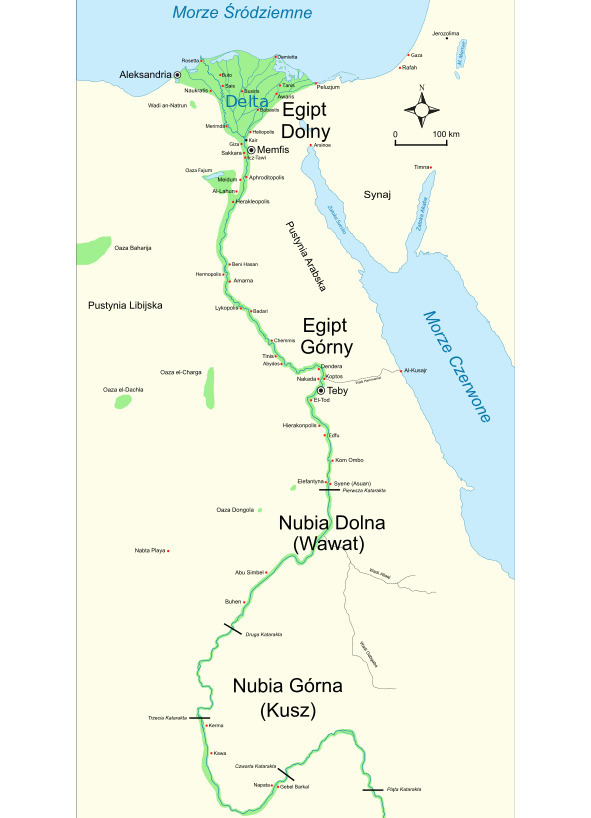
The civilization of ancient Egypt is our sought-after second half of the dualistic unity. In the previous chapter, in order to confirm that Mesopotamia resembles a Woman, only a single glance at the map was needed to be convinced of it. Now I ask for the same attentive look at the River Nile. As can be seen, the course of the Nile fits almost perfectly to regard its shape as a symbolic representation of the image of a Man.
The shape of Mesopotamia depicted a Woman in a frontal position. In the case of the Nile, this is impossible; therefore, the image of the Man on the map is an outline of a silhouette presented in profile. Whether the forces of nature caused this — it is not for us to judge. What is important, however, is that the peoples and tribes living in this area used the course of the river in order to make of it the greatest possible “sanctuary” of the male body.
That this was a conscious choice is evidenced by the entirety of painting and sculpture. Not by chance are the silhouettes of nearly all figures depicted — like the Nile — in profile. This profile is a deliberately, and also in a certain sense subconsciously, introduced code, a canon for creating the human image on the walls of temples and tombs throughout Egypt.
Using the example of Mesopotamia, I attempted to prove that the most valuable “legacy” of that civilization is the Cult of Woman — the Moon — with its most important “personification” at the forefront: the ziggurat. An equally monumental “work” was intended to be the creation of a civilization based on the River Nile.
Hypothetically assuming that there had been no previously conceived plan to build a “sanctuary” of the male image, one might suppose that in this area today there would be only a few, not very significant “monuments” — ciphers from the past — which, as can be seen, is not true. As I have already mentioned, the people living in the area of the Fertile Crescent came upon the brilliant idea of building a “mega symbol” of Woman and Man on a scale surpassing human imagination. What was in the plans of those “pre-civilizational” peoples — was accomplished. No one and nothing could prevent them from doing so.
The first step in achieving this goal was the “burial” of the Cult of the Sun–God in the Death Pit and replacing it with the Cult of Woman — the Moon. To complete these changes, it was now “only” necessary to build a civilization in the territories through which the Nile flowed. The incorporation of this area by envoys from Mesopotamia then followed.
This was not a bloody confrontation with the natives, but a gradual “civilizing” of these lands (the potter’s wheel, writing, metallurgy, brick walls). The process of creating these gigantic “traces” lasted not hundreds, but thousands of years. Throughout all these years, the main task — bordering almost on obsession — was the creation “on the map” of Egypt of objects whose characteristics would correspond to the most important parts of the male body.
The Nile Delta is therefore the equivalent of the head. The branching of the rivers in this delta perfectly “imitates” the cerebral cortex and the connections between nerve cells. Below are situated all the other parts of the head: eyes, mouth, nose, teeth.
The most important part of the head is the brain, and within it a small gland — the pineal gland. Yet one thing is striking. The construction of this “sanctuary,” as I have already mentioned, lasted several thousand years. What force, then, sustained these people in this millennia-spanning process of creating this symbol?
I think that such a force, giving energy to an undertaking so immense in its scale, could only have been faith and hope. Faith in God — the Creator, who, just as God commanded “Noah” to build the “Ark,” so they, as well as their predecessors from the “pre-civilizational” era, must have (guided by an inner command) left behind a symbol of dualism. Thanks to this “stone Ark,” they hoped that a time would come — a time of breakthrough — when Man would “open his eyes” and read their “message.”
The process of creating the individual elements of this “message” proceeded in stages. Only a very wealthy society, moreover at the peak of its development, could afford such a great undertaking as the one that awaited them. Each time the power and significance of Egypt grew, the concept encoded in the minds of subsequent generations — to build or expand the greatest gift of the Egyptians to God, to us, and also to themselves — reawakened.
To build all these structures, no one had to be forced. At all, even the largest pyramids, built in the sweat of the brow often over several decades, it was not “slaves” who worked, but people fully aware of what they were doing, why, and for whom.
Methodology of Reading the Sacrum of Ancient Egypt
Before beginning a detailed analysis of the symbolism of ancient Egypt, it is necessary to present the method according to which I identify and describe individual temples, cities, and places of worship. This approach differs from traditional historical interpretations, as it is based on the assumption that the whole of Egypt constitutes an integrated, monumental ideogram of Man, carefully constructed over millennia.
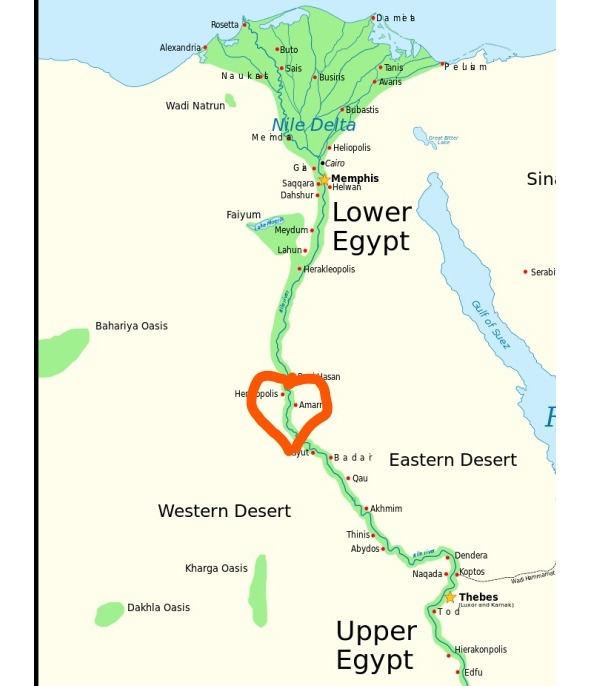
In order for the reader to fully understand the structure of this symbolic body, I adopt one fundamental research principle: all sacred places of Egypt are analyzed according to their position in relation to the course of the Nile, which constitutes the compositional axis of the entire symbol. The starting point is always Tel el-Amarna — a place unique both historically and symbolically, fulfilling the function of the Heart.
Stage One — Journey Up the River (to the South)
The first part of the pilgrimage leads from Tel el-Amarna along the Nile toward the south, that is, “up the river.” In the symbolic representation, this corresponds to the lower parts of the male body, gradually revealed through successive cities, temples, and necropolises. The culmination of this path is Meroe — a place of exceptional significance, which closes the Nile Valley from the south and at the same time fulfills the role of the final, yet one of the most important elements of the symbolic anatomy.
Stage Two — Journey Down the River (to the North)
For the sake of coherence and structural logic, after reaching Meroe the narrative returns to Tel el-Amarna, from which the second stage begins — following the course of the river downstream, toward the north and toward the Nile Delta. This part of Egypt is the symbolic equivalent of the head, and its complex system of branches resembles the cerebral cortex and the network of neuronal connections. It is here that the elements of the “higher” part of the body are located, and at the same time the highest, in a symbolic sense, levels of Egyptian spirituality.
The Aim of the Method — Reconstructing the Intention of the Ancients
The journey along the Nile in both directions — first to the south, then to the north — is not merely a geographical device. It is a way of unveiling a deliberately designed structure, being the greatest symbolic work of the Egyptians, uniting the sacred, topography, and cosmology into one thoughtfully conceived whole.
Each temple, each city, and each cult center fulfills its function here, exactly like elements in the human organism. Adopting such a perspective allows one to read ancient Egypt as a complete, comprehensive representation of Man, constituting the second half of the ancient dualism, whose first part was Woman — Mesopotamia.
1. Tel el-Amarna — Heart
Before proceeding to discuss the symbolic role of Tel el-Amarna as the heart of the Man, one must recall the event which, like a violent shock, tore apart the existing order of the pharaohs’ world and forever changed the spiritual history of Egypt.
Up to that moment, the entire religious, political, and cosmological system of Egypt had been extraordinarily stable — virtually inviolable. Changes occurred, but they were cosmetic, such as the temple of Hatshepsut, which in comparison with what was to follow appears merely as an innocent “whim,” a minor innovation within a centuries-old tradition.
Meanwhile, Pharaoh Amenhotep IV committed something unprecedented. What he did was a revolutionary upheaval, a bold strike at the very foundation of priestly authority. The priests — guardians of the “mission” of Egypt’s civilization, depositaries of knowledge and of the order of Ma’at — could not allow such a thing. For Amenhotep IV had laid hands on the greatest sanctity, on the very summit of the Egyptian divine hierarchy.
He introduced the cult of one — I emphasize: the only — god Aton, replacing with him the age-old cult of the god Amun, who for centuries had been the heart of Theban religion, politics, and cosmology. It was an act that for Egyptians must have sounded like blasphemy, and for the priests of Amun it meant an attempt to overthrow their power and role in the state. To understand the extraordinariness and unprecedented nature of this “coup,” we must first examine the motives that may have guided Amenhotep IV.
Who was he? What did he desire? How did he understand God and his royal destiny? Why did he make a choice that shook great Egypt for generations?
Before we attempt to answer these questions, let us begin with the basics — with a characterization of the two deities that stood at the center of this dramatic conflict.
Amun — one of the most important deities of ancient Egypt. Husband of Mut, father of Khonsu. After identification with Re, he became the supreme god of the state. From the 14th century BCE he possessed features of a universal deity, depicted with the head of a ram or wearing a crown with two feathers; oracle in the oasis of Siwa (4th century BCE).
Aten — the solar disk, the visible manifestation of the god Re. The only deity in the religion of Amenhotep IV — Akhenaten. Depicted as a solar disk with rays ending in hands.
Both of these deities are the “personification” of the same God — Re, who in ancient Egypt was regarded as the creator of the universe. Why then did the identical meaning of these deities so greatly enrage the priests that after the pharaoh’s death they moved the capital from Tel el-Amarna back to Thebes?
If the cult of Amun had not possessed its hidden meaning, perhaps the capital and the cult of Aton would have remained in Tel el-Amarna. The temples of Amun in Luxor and Karnak, as well as the Opet festival, are unequivocal proof that the cult of Amun was not merely an ordinary faith in the Creator — Re.
This dualistic cult of Woman and Man was the “heir” of other dualistic cults known from “prehistory.” Dualism in its symbolism was meant to be encoded information intended for the human of the time of the Bird–Man.
If the cult of Amenhotep IV had erased from the surface of the earth all those “individual traces,” how would that “voice from the past” have reached us? The priests did not oppose merely the change of religion — their “intervention” was a rescue from the destruction of the entire previous effort of dozens of generations.
Amenhotep IV adopted the name Akhenaten and in an exceptionally spectacular manner severed ties with Thebes. Looking at the location of this temple on the map, there is no doubt that it is the heart of the symbolic Man.
Yet the question arises: what would have happened if Akhenaten had not moved the capital to Tel el-Amarna? On the map of the Nile there would be no heart. And what is a — even symbolic — man worth without the organ most essential for blood circulation? It seems to me that this entire “affair” was a very well-directed maneuver in order to place that heart where it ought to be.
It seems to me that Akhenaten’s love for God–Re would not have allowed him, without His consent, to distort and thereby nullify the plan so carefully executed for centuries. If, therefore, Akhenaten was “carrying out” the design of a Higher Power, the priests did not necessarily have to know of these intentions. From this it follows that the transfer of the capital was intentional and executed with the same precision as all other buildings and temples up to that time.
And further, if it was intentional, then Akhenaten must have had a special, direct, and personal contact with the “Creator” Himself — God–Re. In what way this might have taken place — one can only conjecture. Akhenaten was not an “iconoclast and violator” of the cult of Amun, but merely an “intermediary” in carrying out a serious task — building a temple that would be a symbol of the heart of Man.
Did the priests know of this — not necessarily. It was a very atypical and exceptional, yet necessary task. Great love for God compelled him to be an apostate from the faith of his ancestors, yet Akhenaten is not an apostate at all. For this reason, Amenhotep IV deserves from historians and archaeologists full and well-earned rehabilitation.
Finally, one more matter. Taking all of the above into account, one may conclude that the Cult of Aten was not a “false start” in introducing a monotheistic Religion, because Religion in Egypt was not “needed” at all, but rather a deliberate action of the “apostate” Amenhotep IV.
The Cult of Aten of Pharaoh Amenhotep IV constituted — even before Judaism, Christianity, and Islam — the first official monotheistic Religion, which Religions would only in the following centuries come to dominate the majority of polytheistic religions throughout the world.
2. Asyut — Lungs
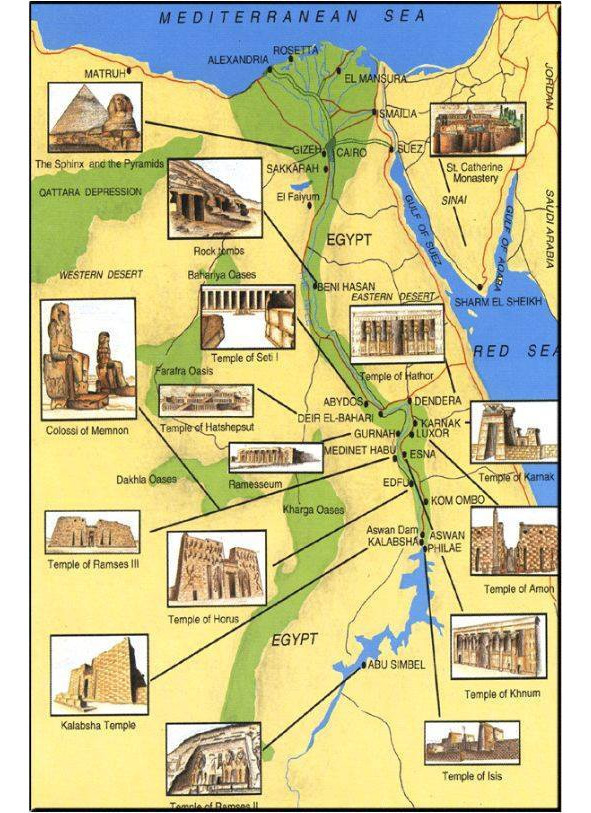
In specifying the most important constituent elements of our symbolic Man, it is necessary to use a precise map of ancient Egypt, which will allow for the accurate localization and description of both the most spectacular and easily recognizable elements of his anatomy, as well as other, less obvious yet equally essential organs.
Taking all components of the organism into account is indispensable, because its proper functioning requires the harmonious cooperation of both the most characteristic parts and those hidden or smaller. A detailed map will therefore make it possible not only to reproduce the structure and hierarchy of the organs, but also to understand their mutual relationships and significance in the context of the entire system, which will allow for the creation of a complete and coherent specification of the symbolic organism.
Proof of this will be all subsequent entries, whose gnosis will certainly surprise more than one enthusiast of “journeys” through ancient Egypt, not to mention seasoned experts or scientific authorities, for whom — I presume — this will be a reason to reassess their entire body of previous knowledge.
The direction of this symbolic inventory — up the River Nile, that is, down the male body — will suggest the subject of all subsequent entries, and its starting point will be the Great Temple of Akhenaten in Tel el-Amarna, which — as I have previously mentioned — by virtue of its location and all its attributes perfectly personifies the Heart.
As the title of this chapter indicates, its main subject will be the Lungs (a paired respiratory organ) — one of the largest organs of the human being. Spread out flat, together with all the alveoli, they have the surface area of a tennis court.
This is a very important piece of information, which finds its confirmation in the manner in which this organ is presented in the plan of the River Nile. In order to understand the genius of the method of encoding knowledge available to the ancient Egyptian creators of these temples, an equally brilliant method is required to reach their hidden message. Below I present my concept of an exit from this labyrinth of common ignorance.
Ancient Asyut was the capital of the Thirteenth Nome of Upper Egypt (the Lycopolite Nome) around 3100 BCE. It lay on the western bank of the Nile. The two most important gods of ancient Egyptian Asyut were Anubis and Wepwawet, both funerary deities. […] Other monuments of ancient Egypt discovered in Asyut include the Asyut necropolis (to the west of the modern city), tombs dating from the Ninth, Tenth, and Twelfth Dynasties, and the tombs of the Ramesside Siese and Amenhotep.
link: https://en.wikipedia.org/wiki/Asyut
Taking into account the anatomical size of this organ, it becomes easier to understand that the compilers of this symbol had to represent it not as one, or — more understandably — two temples, but as an entire network of various smaller or larger spatial structures, which I shall attempt to demonstrate. Before doing so — one more important clue to consider.
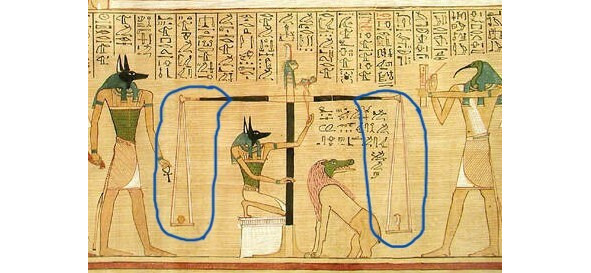
Anubis (…) is the god of funerary rites, protector of graves, and guide to the underworld, usually depicted as a dog or a man with a canine head. (…) One of his most important roles was that of the god who ushered souls into the afterlife. He attended the scales during the Weighing of the Heart, in which it was determined whether the soul would be allowed to enter the realm of the dead.
link: https://en.wikipedia.org/wiki/Anubis
The information that Anubis, together with other gods, took part in weighing the heart of the soul in the Hall of Two Truths is that proverbial “Ariadne’s Thread,” thanks to which it becomes possible to exit the labyrinth of ignorance. On the basis of many ancient Egyptian illustrations, one can see for oneself that the shape of the two pans of the scales perfectly imitates the paired organ that the lungs are. Meanwhile, the fact that the weighing ceremony took place in the Hall of Two Truths constitutes indisputable confirmation of my claim.
Now nothing remains but to present the places where those “pulmonary alveoli” were incorporated into the spatial plan: Asyut, El Hammamiya, Meir.
The tombs of the Western Mountain in Asyut were known as the cemetery of ‘Najafta and the tombs of Khent’ (…) they extend from the Mir area located in the north to the Washtab area located in the south […] they are rock-cut and constitute one of the most important archaeological complexes in this part of Egypt.
link: https://hurghadalovers.com/the-western-mountain-tombs-in-asyut-egypt/
The monumental tombs of El Hammamiya in Asyut (…) belong to the oldest pharaonic cemeteries, about 5,000 years old, and were built by rulers inhabiting the tenth region of Upper Egypt during the Old Kingdom.
link: https://hurghadalovers.com/el-hammamiya-monumental-tombs-egypt/
The necropolis of Meir (…) is an archaeological site in Middle Egypt, on the west bank of the Nile. It contains the tombs of the nomarchs, mayors, and priests of Cusae from the Old and Middle Kingdom. (…) About 75 tombs have preserved their interiors; the rest have been destroyed or looted.
link: https://en.wikipedia.org/wiki/Meir,_Egypt
In the symbolism of ancient Egypt, air and breath played a special role. It was through breath that the gods endowed man with life, and the loss of breath was the first sign of passage into the world of the dead. In this light, the placement of the “lungs” in Asyut takes on a deeper meaning — it is the space where symbolically the “breath of life” entered the body of Egypt.
The Asyut region is characterized by a specific topography — the valley there suddenly narrows and widens, resembling the mechanics of breathing, that is, the rhythmic contraction and expansion of the chest. This geographical “breath of the Nile” is an additional argument for interpreting this area as the lungs of the symbolic Man. In ancient Egyptian thought, breath was associated with truth and purity — a person who spoke the truth “breathed lightly,” whereas falsehood “suffocated the heart.” This harmonizes remarkably with the ritual of the Weighing of the Heart, in which the soul had to be “light,” like a free breath.
The three main locations — Asyut, El Hammamiya, and Meir — form an arrangement resembling the anatomical structure of the lungs: the communication center (Asyut), the upper sections (El Hammamiya), and the extensive southern lobes (Meir). Together they form a whole just as alveoli create the full respiratory surface. After the Heart, the natural step would be the Lungs, because without them the body cannot function or sustain the rhythm of life. From a symbolic point of view, the Heart represents love, will, and consciousness, and the Lungs — breath, balance, and the connection between the body and the world. That is why Asyut appears on the map as the second organ of this “stone anatomy.”
3. Qau el-Kebir — Liver
My previous entry concerned Asyut, which in my personal nomenclature constitutes encoded information about the lungs of the symbolic Man. This time I address an equally mysterious place on the map of the River Nile — Qau el-Kebir. As the logic of human anatomy suggests, the main subject will be the liver.
To fully understand the method of encoding knowledge by the ancient Egyptian creators of temples and necropolises, a precise method of entering the “labyrinth” of this hidden knowledge is required. Below I present my idea of an exit from this labyrinth of common ignorance.
Qaw el-Kebir (…) is a village in the Asyut Governorate of Egypt, known in ancient Egypt as Tjebu or Tkow. In Greek and Roman Egypt the name was Antaeopolis, after the protective war god Antaeus. In the vicinity there are terraced tombs from the Twelfth and Thirteenth Dynasties and the tomb of the governor May from the New Kingdom.
link: https://en.wikipedia.org/wiki/Qaw_el-Kebir
Taking the above quotation as the basis for further reflection, one should focus attention on the name of the war god who protected Qaw el-Kebir — Antaeus. This is a very important clue, thanks to which it will be possible to decipher which anatomical organ is encoded in this particular ancient Egyptian location on the map of the River Nile.
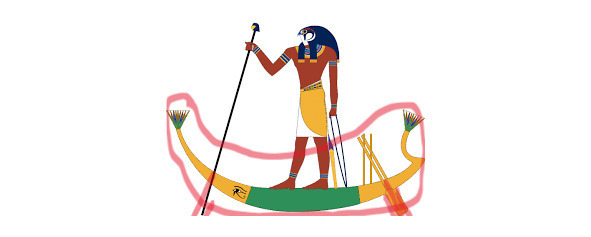
In Egyptian mythology, Nemty (Greek Antaeus) was a falcon god worshipped at Antaeopolis. His cult dates back at least to the Second Dynasty, and originally Nemty was the patron of the area around Badari, the cult center of Horus.
link: https://en.wikipedia.org/wiki/Nemty
Thanks to this information — that the protective deity of Qaw el-Kebir was Nemty — we can “exit the labyrinth of ignorance” and understand why the Egyptians encoded the symbol of the liver in this place.
The key here is the comparison of the shape of the liver with the boat upon which the deity Nemty sails. The boat, as depicted in iconography, has a characteristic curved silhouette corresponding to the curvature of the human liver. Observing both its proportions and the relationship of its elements — for example, the front prow and the rear part — one can perceive an analogy to the upper and lower surfaces of the liver, as well as its asymmetrical arrangement of lobes.
This comparison is not accidental — the ancient Egyptians used such visual analogies to preserve anatomical knowledge in a way hidden from the uninitiated. The symbolism of Nemty’s boat thus becomes simultaneously an anatomical scheme of the liver, and its presence in Qaw el-Kebir reflects the integrity of the bodily system and its connections with cosmology and mythology.
The conclusion is as follows: the liver — an organ of fundamental importance for human life and energy transformation — was consciously “encrypted” in the topography of ancient Egypt.
Its recognition requires the integration of geographical, mythological, and anatomical knowledge, because only the integration of these three perspectives reveals the hidden intention of the ancient creators and allows one to perceive the fullness of the symbolic message.
4. Akhmim — Pancreas
My previous two entries concerned Asyut and Qau el-Kebir, which in my personal nomenclature constitute encoded information about the lungs and the liver of the symbolic Man. This time I address an equally mysterious place on the map of the River Nile — Akhmim. As the logic of human anatomy indicates, it will not be surprising to state that the main subject will be another organ lying in the vicinity of the two previously discussed — namely, the pancreas.
To understand the genius of the method of encoding knowledge available to the ancient Egyptian creators of these temples, an ingenious method is required to reach this labyrinth. Below I present my concept of an exit from the labyrinth of common ignorance.
Akhmim was known in ancient Egypt as Ipu or Apu (…) or Khent-min. It was the capital of the ninth (Chemmite) nome of Upper Egypt. The city is suggested to be the hometown of Yuya, an official of Thutmose IV and Amenhotep III. The ithyphallic Min (whom the Greeks identified with Pan) was worshipped here as ‘the strong Horus.’
link: https://en.wikipedia.org/wiki/Akhmim
Taking the above information as the basis for further reflection, one should focus attention on the name of the god worshipped in the capital of the ninth nome of Upper Egypt — that is, in Akhmim. He was the ithyphallic Min.
This is a very important clue, thanks to which it becomes possible to decipher which anatomical organ was encoded in this specific place of ancient Egypt. It is worth recalling that in a similar way — through the analysis of symbolism associated with the god Nemty — it was possible to arrive at the truth about another body part inscribed in the sacred topography of Egypt.
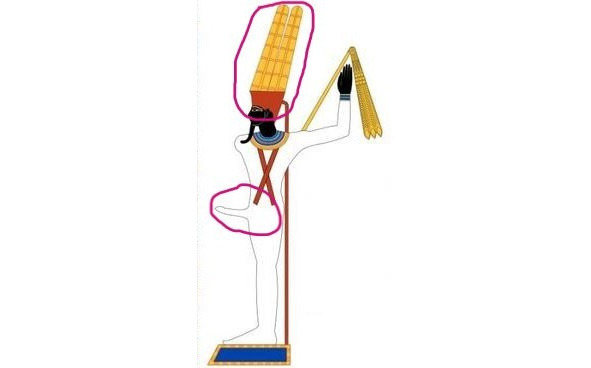
Min (…) is an ancient Egyptian god whose cult originated in the Predynastic Period (4th millennium BCE). He was depicted in many forms, most often as a male human figure, with an erect penis in his right hand and a flail in his left. The cult of Min began and was centered around Coptos and Akhmim in Upper Egypt.
link: https://pl.wikipedia.org/wiki/Min_(b%C3%B3g_egipski)
Only thanks to this information — that in Egyptian mythology the deity protecting the area in which Akhmim was located was Min — can one exit the labyrinth of ignorance. To be convinced that the ancient Egyptian encoders found it appropriate to place the symbol of the pancreas here, one must compare the shape of this anatomical organ with the illustration depicting the god Min.
One should carefully examine the shape of this god’s headdress and compare it with the structure of the pancreas. The pancreas consists of two types of tissue: the exocrine pancreas, functioning as a digestive gland, and the endocrine (islet) pancreas, performing an internal secretory function.
Additionally, if anyone were to doubt the validity of such a deduction, it is worth noting the non-accidental coincidence between the erect penis of the god Min and the shape of the pancreas. And this constitutes the entire hidden gnosis of this place on the map of the River Nile.
5. Thinis — Small Intestine
The previous three chapters concerned Asyut, Qaw el-Kebir and Akhmim, which in my personal nomenclature constitute encoded information about the lungs, liver, and pancreas of the symbolic Man. This time I address an equally mysterious place on the map of the River Nile — Thinis.
As the logic of human anatomy suggests, it will not be surprising to state that the main subject will be another organ lying below those previously discussed — namely, the small intestine.
At this point, I remind the reader of the still-binding principle that in this specification of the most important organs of the male body we are constantly moving upstream along the Nile.
To understand the genius of the method of encoding knowledge available to the ancient Egyptian creators of these temples, an equally ingenious way of reaching this labyrinth is required. Below I present my concept of an exit from this labyrinth of common ignorance.
Thinis (Greek: Θίνις Thinis, Θίς This; Egyptian: Tjenu; Coptic: Ⲧⲓⲛ; Arabic: طين) was the capital before the unification of Upper Egypt. […] As in every nome there was a tomb and mummy of the deceased nome-god, so in Thinis there was a temple and final resting place of Anhur, whose epithets included ‘Bull of Thinis,’ worshipped after his death as Khenti-Amentiu, and who as nome-god was placed at the head of the local ennead.
link: https://simple.wikipedia.org/wiki/Thinis
Taking the above information as the basis for further reflection, one should focus on the name of the god of this city — Anhur. This is a very important clue, thanks to which it is possible to decipher which anatomical organ was encoded in this place of ancient Egypt — on the map of the River Nile. In a similar way — through knowledge of the gods Nemty and Min — one could arrive at the truth about other parts of the body.
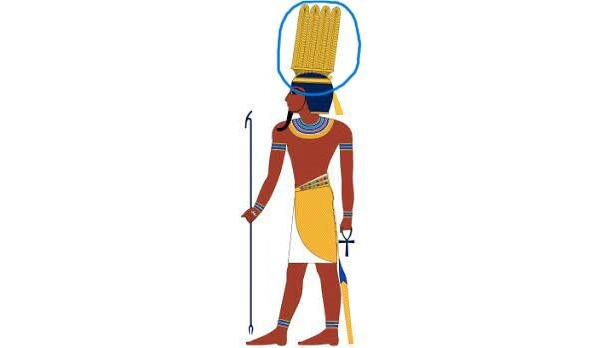
In early Egyptian mythology Anhur (also written: Onuris, Onouris, An-Her, Anhuret, Han-Her, Inhert) was a god of war worshipped in the Egyptian area of Abydos, and especially in Thinis. Myths say that he brought back his wife Mehit from Nubia, she being his female counterpart. His name means ‘(He who) leads back the distant one.’ One of his titles was Slayer of Enemies. Anhur was depicted as a bearded man wearing a robe and a headdress with four feathers, holding a spear or lance, and sometimes as a lion-headed god (representing strength and power). In some depictions the robe resembled more a kilt.
link: https://en.wikipedia.org/wiki/Onuris
Only thanks to this information — that the deity protecting the city of Thinis was Anhur — can one exit the labyrinth of ignorance. To be convinced that the ancient Egyptian encoders found it fitting to place the symbol of the small intestine here, one must compare the shape of the god’s headdress with the anatomical structure of the small intestine.
Without entering into overly detailed deliberations, the most important fact is that the small intestine is about 5.5 meters long and is repeatedly folded to fit within the abdominal cavity. Although it is longer than the large intestine, it is called “small” because it has a narrower diameter.
The small intestine consists of three distinct regions: the duodenum, the jejunum, and the ileum. In the duodenum, the shortest part, preparation for absorption begins through tiny projections called villi. And this constitutes the entire hidden gnosis of this place on the map of the River Nile.
6. Abydos — Large Intestine
The previous four entries concerning Asyut, Qau el-Kebir, Akhmim, and Thinis constitute in my personal nomenclature encoded information about the lungs, liver, pancreas, and small intestine of the symbolic Man. It is time to continue deciphering the symbolism of these exceptional places on the map of ancient Egypt, which — beyond doubt — were situated at these precise points along the Nile with full awareness of their significance. Moreover, my “detective-style” method of confirming earlier theses finds reflection in the way the patron deities of these cities are depicted — namely Anubis, Nemty, Min, and Anhur.
This time the equally mysterious place on the map of the River Nile is Abydos. The main subject will be another organ lying below those previously discussed — namely, the large intestine.
Below I present my concept of an exit from this labyrinth of common ignorance.
Abydos (…) is one of the oldest cities of ancient Egypt and also the eighth nome in Upper Egypt. From the earliest times, Abydos was a cult center, first of the local deity Khenti-Amentiu, and from the end of the Old Kingdom of the rising cult of Osiris.
link: https://pl.wikipedia.org/wiki/Abydos
Taking the above information as the basis for further reflection, one should focus on the name of the deity of this city — Khenti-Amentiu. A very important piece of information that will allow us to understand the genius of the ancient Egyptian creators of this cipher is to recall everything previously established regarding Anhur, who according to my interpretation symbolizes the small intestine. This analogy decisively influences the correctness of assigning the large intestine to Abydos.
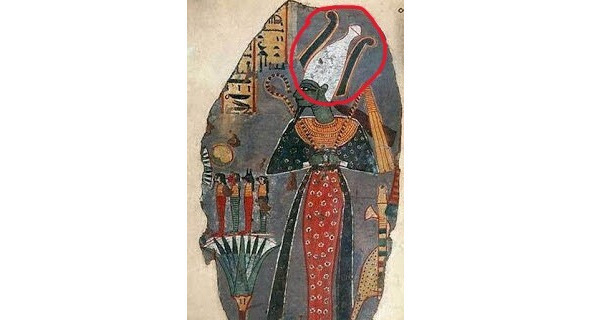
Khenti-Amentiu (…) is an ancient Egyptian deity whose name was also used as a title of Osiris and Anubis. The name means ‘Foremost of the Westerners’ or ‘Chief of the Westerners,’ where ‘Westerners’ refers to the dead. Khenti-Amentiu was depicted as a jackal-headed deity in Abydos in Upper Egypt who guarded the city of the dead.
link: https://en.wikipedia.org/wiki/Khenti-Amentiu
And here is a very important clue which, like the proverbial Ariadne’s thread, will lead us out of the labyrinth of ignorance. One must take into account the nearly shared nomenclature and the similar functions of both organs.
The small intestine serves to digest food, further process it, and separate useful components from insignificant residues. The large intestine, by contrast, extracts water and nutrients from food previously digested in the stomach and small intestine, forming the remains into fecal mass, which is later excreted. Only thanks to the above information — that the deity protecting the city of Abydos was Khenti-Amentiu — can one exit the labyrinth of ignorance.
To be convinced that the ancient Egyptian encoders found it fitting to place the symbol of the large intestine here, one must compare the shape of Khenti-Amentiu’s headdress with the anatomical structure of the large intestine.
One can hardly imagine a more precise structural scheme of this organ — and therein lies the entire hidden gnosis of this place on the map of the River Nile.
7. Dendera — Prostate
Continuing my research into the symbolism of ancient Egyptian places on the map of the River Nile, after analyzing Asyut, Qau el-Kebir, Akhmim, Thinis, and Abydos, the time has come for another remarkable city — Dendera. In my personal nomenclature these locations constitute encoded information about successive organs of the symbolic Man: lungs, liver, pancreas, small intestine, and large intestine. Dendera naturally continues this system, this time indicating an organ located higher in the hierarchy of male organs — the prostate.
Moreover, my detective method of confirming earlier theses is reflected in the manner in which all the patron deities of these cities are depicted — Anubis, Nemty, Min, Anhur, and Khenti-Amentiu. In the case of Dendera, a special role is played by the goddess Hathor, whose symbolism allows us to enter deeper into the hidden structure of the ancient Egyptian cipher.
Dendera (…) is a small town and former bishopric in Egypt, located on the west bank of the Nile. The Dendera Temple complex, which contains the Temple of Hathor, is one of the best-preserved temple complexes in all of Upper Egypt. The entire complex covers about 40,000 square meters and is surrounded by a substantial mudbrick enclosure wall.
link: https://en.wikipedia.org/wiki/Dendera
Taking the above information as a basis for further reflection, one should focus on how the goddess Hathor was depicted in reliefs. This is a very important clue, thanks to which it is possible to decipher which anatomical organ is encoded in this ancient Egyptian place — on the map of the River Nile.
Hathor (…) was a major goddess in ancient Egyptian religion, playing a wide variety of roles. As a sky deity she was the mother or consort of the sky god Horus and the sun god Ra, both associated with kingship, and thus she was the symbolic mother of their earthly representatives, the pharaohs.
link: https://en.wikipedia.org/wiki/Hathor
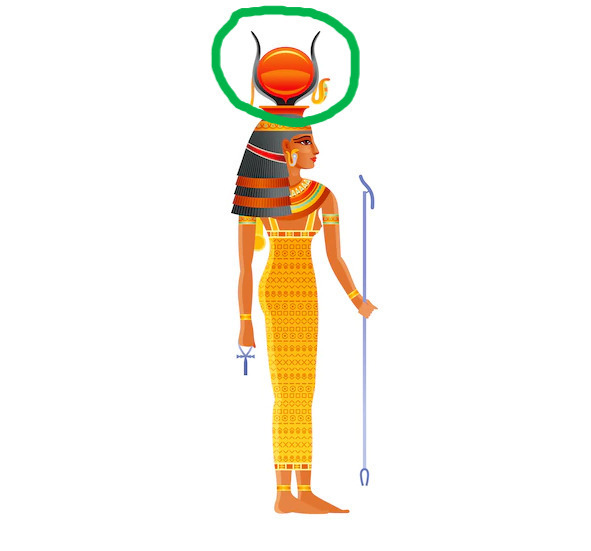
Only thanks to this information — that the deity protecting the temple complex at Dendera was Hathor — can one exit the labyrinth of ignorance. To be convinced that the ancient Egyptian encoders found it fitting to place the symbol of the prostate here, one must apply the same simple yet effective method: an analysis of the deity’s headdress.
One must carefully observe the shape of Hathor’s headdress — the cow horns between which a solar disk is placed remarkably imitate the shape of another important organ within the male body — the prostate. And this constitutes the entire hidden gnosis of this place on the map of the River Nile.
8. Naqada — Pubic Hair
I remind the reader that the direction of our symbolic inventory is southward — upstream along the Nile, that is, downward along the male body. The starting point is the Great Temple of Akhenaten at Tel el-Amarna, which by its location and attributes perfectly personifies the Heart.
In successive entries I assigned various organs of the male body to particular regions and localities. Confirmation of the correctness of my interpretation lies in the illustrations of the gods patronizing these ancient Egyptian cities. Usually, the headdresses of these gods corresponded with striking precision to the anatomical structure of particular organs.
This time we are dealing with such a specific part of the male body that the deliberate act of the creators of this code becomes fully understandable. As the title of this entry already indicates, this time it will be a very specific and rather non-concrete part of the body — namely, pubic hair.
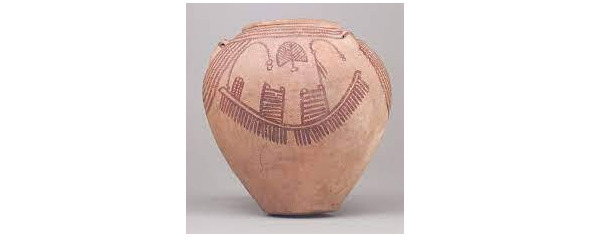
Particular attention should be paid to the information contained in the quotation below concerning the Naqada region — namely: the various designs on the pottery include waves and are sometimes accompanied by floral motifs or drawings of people.
The Naqada culture is an archaeological culture of Chalcolithic Predynastic Egypt (c. 4000–3000 BCE), named after the town of Naqada in Qena Governorate. […] The types of pottery found at Naqada sites include bowls, small jars, bottles, medium-necked jars, wine jars, and jars with wavy handles. Various designs on the pottery include waves and sometimes floral motifs or drawings of people, suggesting that art was strongly expressed in Naqada cultures.
link: https://en.wikipedia.org/wiki/Naqada_culture
The fact that in this case not a specific city but an entire region is involved has significant meaning. As can be seen on the map — the outline of the Naqada region excellently personifies hair in the lower parts of the male body.
An additional argument confirming my thesis is the wavy motifs of Naqada pottery — instead of pointing to a specific deity. And therein lies the entire genius of the ancient Egyptian creators of this cipher — the use of regional symbolism and artistic patterns to encode a very specific part of the body.
9. El-Tod — Scrotum
As I have already adopted as a principle — the direction of our symbolic inventory is southward — upstream along the River Nile, that is, downward along the male body. The starting point is the Great Temple of Akhenaten at Tel el-Amarna, which by its location and all its attributes perfectly personifies the Heart.
This time the equally mysterious place on the map of the River Nile is El-Tod. The main subject of this entry will be another organ lying below those previously discussed — namely, the scrotum. Below I present my concept of an exit from this labyrinth of common ignorance.
El-Tod (…) was the site of an ancient Egyptian city and temple of the god Montu. It is located 20 km southwest of Luxor in Egypt, near the settlement of Hermonthis.
link: https://en.wikipedia.org/wiki/El-Tod
Taking the above quotation as a basis for further reflection, one should focus on the name of the deity of this city — Montu. This is a very important clue, thanks to which it becomes possible to decipher which anatomical organ is encoded in this specific place — on the map of the River Nile.
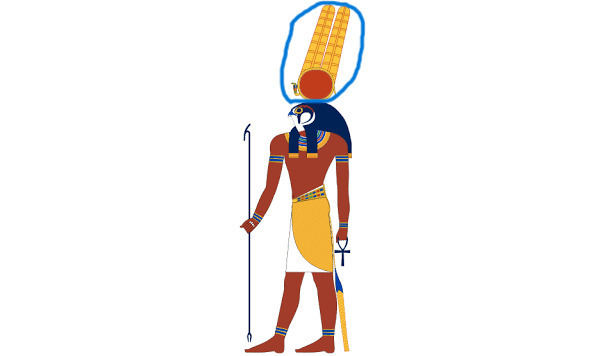
Montu was a falcon-god of war in ancient Egyptian religion, an embodiment of the victorious vitality of the pharaoh. A very ancient god, Montu was originally a manifestation of the burning action of Ra, the sun — and as such often appeared under the epithet Montu-Ra.
link: https://en.wikipedia.org/wiki/Montu
In successive entries I assigned various organs of the male body to particular regions and localities. Confirmation of the correctness of my interpretation lies in the illustrations of the gods patronizing these ancient Egyptian cities. Usually, the headdresses of these gods corresponded with striking precision to the anatomical structure of particular organs.
Thanks to the above information stating that in Egyptian mythology the deity of the city of El-Tod was Montu, one can exit the labyrinth of ignorance. To be convinced that the ancient Egyptian encoders found it fitting to place the symbol of the scrotum at this point along the Nile, it is enough to compare the shape of Montu’s headdress with the anatomical structure of this organ.
An additional argument confirming my interpretation is the plan of the temple at El-Tod, which — as in the case of previous organs — reflects the form and position of the scrotum in the lower part of the male body.
10. Hierakonpolis — Penis
For anyone who has read my earlier entries, it should come as no surprise that the place currently being discussed on the map of ancient Egypt constitutes the natural complement to the most important marker of masculinity — the genitals. As the title of this chapter announces, the complementary part to the scrotum is the penis.
This time the equally mysterious place on the map of the River Nile is Hierakonpolis, that is, the ancient Egyptian Nekhen. Below I present my way out of this labyrinth of common ignorance.
Nekhen (/ˈnɛkən/, ancient Egyptian: nḫn), also known as Hierakonpolis (Greek: Ἱεράκων πόλις, City of the Hawk or City of the Falcon), was the cult center of the falcon deity, Horus of Nekhen, who raised one of the oldest Egyptian temples in this city.
It retained its importance as a center of worship of this divine patron of kings long after the site itself had declined.
link: https://en.wikipedia.org/wiki/Hierakonpolis
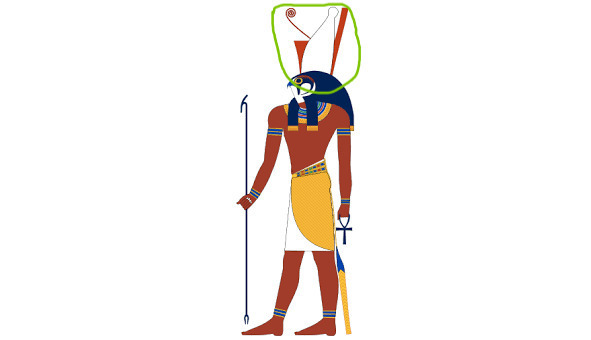
Taking the above quotation as the basis for further reflection, one must focus on the name of the god worshipped in Nekhen — Horus. This is the key clue that makes it possible to decipher which anatomical organ is encoded in this place — on the map of the River Nile.
Horus (also known as Heru, Har, Her) is one of the most important deities of ancient Egypt, fulfilling many functions, including: god of kingship, healing, protection, the sun, and the sky. He was worshipped from the late prehistoric period through the Ptolemaic and Roman periods of Egypt. He was most often depicted as a falcon or as a man with a falcon’s head.
link: https://en.wikipedia.org/wiki/Horus
One must carefully examine the shape of Horus’s headdress and compare it with the shape and structure of the penis. It is astonishing how the creators of this ancient Egyptian cipher managed to present the entire knowledge of this male organ through a single symbol.
The most characteristic element — the protruding and coiled feature of Horus’s headdress — fully corresponds with the anatomy of the penis. One can see here a deliberate combination of religious symbolism with anatomy, and at the same time the full logic of knowledge encoding by the ancient Egyptians.
If one accepts as true everything I have asserted since the beginning of this book, then besides temple structures, pyramids, architectural complexes, artifacts, and even the shaping of the terrain, one of the most important clues in deciphering the mystery of Nile-based Egypt is precisely the headdresses of the gods.
Confirmation that the ancient Egyptian encoders created their codes in various ways is found in ivory artifacts, as well as limestone vessels and cylindrical jars discovered in Nekhen, whose phallic shapes constitute further proof of the correctness of my assumptions. I recall that in a similar way the inhabitants of the Naqada region, through wavy pottery motifs, personified male pubic hair.
And in this lies the entire hidden gnosis of Hierakonpolis on the map of the River Nile.
11. Kom Ombo — Skin
As I have already adopted as a principle, the direction of this symbolic inventory is southward — upstream along the River Nile, that is, downward along the male body. The starting point is the Great Temple of Akhenaten at Tel el-Amarna, which by its location and all its attributes perfectly personifies the Heart.
In successive entries I assigned various organs of the male body to particular regions and localities.
Confirmation of the correctness of my interpretation lies in the illustrations of the gods who patronized these ancient Egyptian cities. Usually, the headdresses of these gods corresponded with striking precision to the anatomical structure of particular organs.
This time we are dealing with such a specific part of the male body that it is easy to perceive the deliberate act of the creators of this cipher. As the title of this entry indicates, the organ discussed is the outer covering of the body — the skin.
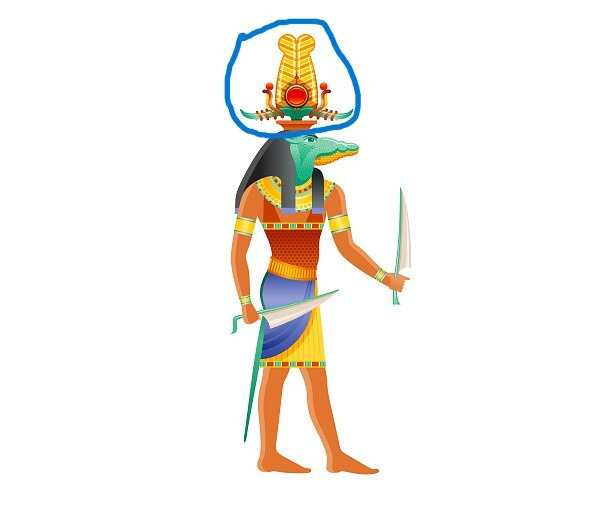
The Temple of Kom Ombo is an unusual double temple in the town of Kom Ombo in Aswan Governorate in Upper Egypt. It was built during the Ptolemaic dynasty (180–47 BCE). Some additions were later made during the Roman period. The building is unique because its ‘double’ design meant that there were courtyards, halls, sanctuaries, and rooms duplicated for two sets of gods. The southern part of the temple was dedicated to the crocodile god Sobek…
link: https://en.wikipedia.org/wiki/Temple_of_Kom_Ombo
Taking the above quotation as the basis for further reflection, one must focus on the name of the god of the southern part of the temple — Sobek. This is the key clue that makes it possible to decipher which anatomical organ is encoded in this place — on the map of the River Nile.
Kup książkę, aby przeczytać do końca.